
TL;DR:
- Most forklift accidents are preventable through proper safety protocols and continuous training.
- Daily inspections and technological aids like proximity sensors significantly reduce accident risks.
- Building a strong safety culture focusing on behavior is vital for sustained accident prevention.
Forklift accidents remain one of the most serious hazards in warehouse and logistics operations. Every year, tip-overs, struck-by incidents, and equipment failures injure thousands of workers and trigger costly OSHA investigations. The good news is that most of these incidents are entirely preventable. With structured prevention methods, the right equipment, and a genuine commitment to safety culture, you can protect your team and stay compliant. This guide walks you through the most common accident types, the tools and steps you need, and how to build a system that keeps improving over time.
Table of Contents
- Understanding common forklift accidents
- Essentials for effective accident prevention
- Step-by-step prevention strategies
- Verification and ongoing improvement
- A practical perspective on forklift accident prevention
- Take your forklift accident prevention to the next level
- Frequently asked questions
Key Takeaways
| Point | Details |
|---|---|
| Tip-overs are preventable | Slow turns, proper load management, and seatbelt use eliminate the main fatal risk. |
| Technology boosts safety | Proximity sensors and daily inspections cut accident rates by over 70%. |
| Training must go beyond compliance | VR and simulation training help address real-world risks for new operators. |
| Continuous improvement matters | Regular audits and operator feedback are crucial for maintaining low accident rates. |
| Culture drives results | A safety-first mindset is more effective than just checking boxes for OSHA compliance. |
Understanding common forklift accidents
Before you can prevent accidents, you need to know exactly what you’re up against. Forklift incidents fall into a handful of recurring categories, and each one has clear, identifiable causes.
Tip-overs are the deadliest. Tip-overs cause 42% of fatalities, and they happen when operators take turns too fast, carry loads too high, or drive on uneven surfaces without adjusting their speed. The physics are unforgiving. A loaded forklift has a narrow stability triangle, and exceeding its limits even briefly can flip the machine in seconds.
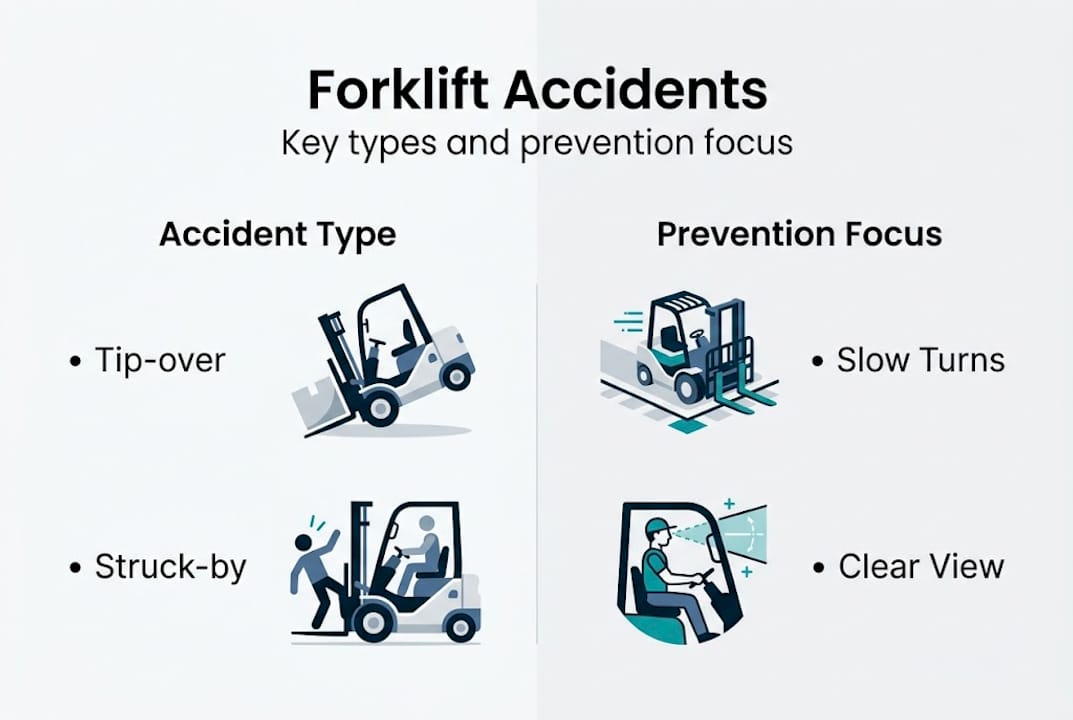
Struck-by incidents are the second major category. Poor visibility is the most common trigger, especially in busy receiving areas or narrow aisles where pedestrians and forklifts share space. Rushed, high-volume environments see significantly more pedestrian collisions, and new or inexperienced operators carry a measurably higher accident risk than seasoned drivers.
| Accident type | Common cause | Prevention focus |
|---|---|---|
| Tip-over | Speed, high loads, uneven surfaces | Slow turns, low forks, seatbelts |
| Struck-by pedestrian | Poor visibility, rushed environment | Spotters, mirrors, pedestrian lanes |
| Falling loads | Improper stacking, overloading | Load limits, inspection routines |
| Collision with racking | Narrow aisles, distraction | Aisle markings, speed limits |
| Runover | Blind spots, reversing without signals | Horns, backup alarms, spotter use |
Some patterns are easy to miss until you look at the data. Distracted operators, skipped pre-shift inspections, and missing pedestrian barriers all show up repeatedly in incident reports. Reviewing your forklift incident prevention records is often the fastest way to spot where your operation is most vulnerable.
Building real forklift hazard awareness across your team means going beyond a poster on the wall. It means operators understand why these accidents happen, not just that they happen.
- Speed is the single most controllable risk factor in tip-overs and pedestrian strikes
- Visibility gaps during high-volume shifts create the most dangerous windows for collisions
- Inexperienced operators need more frequent check-ins, not just initial certification
- Load management errors often stem from unclear policies, not operator carelessness
Now that we know the dangers, let’s clarify what’s required for prevention.
Essentials for effective accident prevention
Prevention is not a single action. It’s a system. And like any system, it only works when every component is in place and functioning.
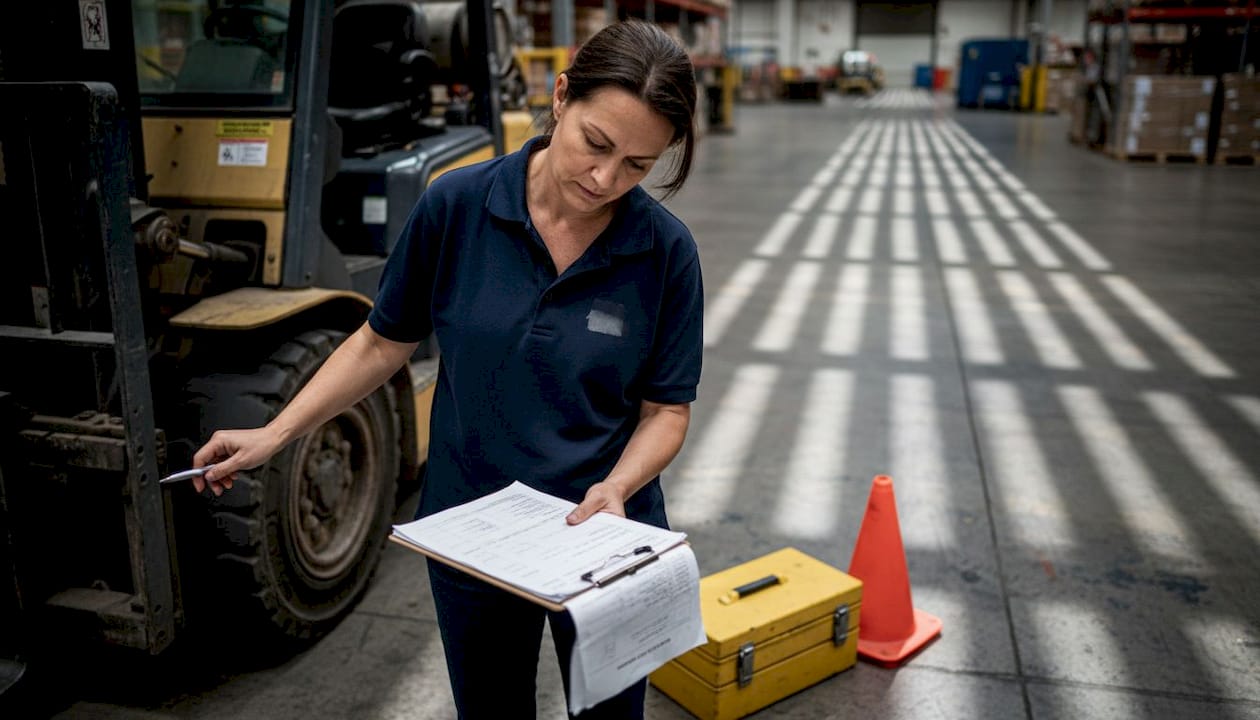
The foundation is daily inspection. Daily inspections prevent 82% of accidents, and comprehensive safety programs cut incidents by up to 75%. That’s not a small margin. That’s the difference between a safe operation and a recurring injury problem.
| Prevention component | What it covers | Why it matters |
|---|---|---|
| Pre-shift inspection checklist | Brakes, forks, tires, lights, horn | Catches mechanical failures before operation |
| Proximity sensors | Pedestrian detection zones | Reduces collision risk in blind spots |
| Personal protective equipment | Hard hats, high-vis vests, steel-toed boots | Reduces injury severity in incidents |
| Operator certification records | Training dates, evaluations, renewals | Ensures OSHA compliance and accountability |
| Pedestrian lane markings | Floor paint, barriers, signage | Physically separates workers from forklift paths |
A solid forklift safety checklist is not optional. It’s the first line of defense. When operators complete a structured pre-shift check every single day, they catch problems before those problems become accidents.
Most overlooked prevention essentials include:
- Refresher training schedules: Many operations certify operators and never revisit training until an incident occurs
- Near-miss reporting systems: If workers don’t report close calls, you lose your best early warning data
- Shift-specific safety briefings: High-volume shifts need a quick safety reset, not just standard procedures
- Equipment age tracking: Older forklifts have more sensor and brake failures; tracking service history prevents surprises
Reviewing your forklift safety rules regularly keeps your policies current with your actual operating conditions.
Pro Tip: VR simulators are one of the most effective tools for training new hires on edge cases like tip-over recovery and pedestrian avoidance. They let operators experience high-risk scenarios without real-world consequences, and the retention rate is significantly higher than classroom-only instruction.
With these essentials in place, managers can take systematic action.
Step-by-step prevention strategies
Having the right tools matters, but the order in which you implement them matters just as much. A structured approach prevents gaps.
- Conduct a risk assessment: Walk every forklift travel path and identify blind spots, pedestrian crossings, and high-traffic zones. Document what you find.
- Update your safety policies: Make sure your written policies reflect current operations, shift volumes, and equipment. Outdated policies create compliance gaps.
- Schedule and complete operator training: Every operator needs current, OSHA-compliant certification. Prioritize new hires and anyone returning from extended leave.
- Install proximity sensors and visibility aids: Proximity sensors reduce accidents by 74% when properly installed. Add mirrors at blind corners and audible backup alarms on all machines.
- Establish pedestrian management zones: Mark pedestrian lanes clearly, install physical barriers where possible, and brief all workers on the zones before every high-volume shift.
- Implement a near-miss reporting system: Create a simple, non-punitive process for reporting close calls. This data is your most valuable prevention tool.
- Set a review schedule: Prevention is not a one-time project. Schedule monthly audits and quarterly policy reviews.
Safety warning: Never skip pedestrian management protocols during high-volume shifts. The combination of increased traffic, time pressure, and operator fatigue creates the highest-risk window in any warehouse operation. Cutting corners during these periods is when serious injuries happen.
OSHA prevention solutions give you a regulatory framework to build from. Pair that with the forklift accident prevention basics your team needs to execute daily.
The basics still matter most. Seatbelts, slow turns, and low loads are the core of tip-over prevention. Using horns and spotters at intersections reduces struck-by incidents. Simple. Proven. Often skipped.
Pro Tip: In busy warehouses, customize your prevention steps by shift type. A receiving shift with heavy inbound volume needs different pedestrian controls than a picking shift. Map your risks by shift, not just by location.
Completing these steps brings you closer to ongoing accident-free operations.
Verification and ongoing improvement
Implementing a prevention program is step one. Keeping it effective is the real work.
Comprehensive safety programs cut incidents by 60 to 75%, but only when they include regular audits and active feedback loops. A program that sits in a binder and never gets reviewed will drift out of alignment with your actual operations within months.
Set up a monitoring routine that includes:
- Weekly incident and near-miss reviews: Look for patterns, not just individual events
- Monthly equipment inspection audits: Verify that pre-shift checklists are being completed correctly, not just signed off
- Quarterly operator evaluations: Observe operators in real conditions, not just during formal assessments
- Annual policy reviews: Update your written procedures to reflect any changes in layout, equipment, or staffing
Common mistakes that undermine ongoing prevention:
- Treating certification as a one-time event rather than an ongoing process
- Ignoring near-miss reports or failing to act on them
- Assuming experienced operators don’t need refresher training
- Letting busy periods override safety protocols without a documented exception process
Understanding the warehouse safety impact of a strong prevention culture helps you make the case internally for sustained investment. Safety is not a cost center. It’s what keeps your operation running.
Pro Tip: Build a feedback channel directly with your operators. They see risks that managers miss. A monthly five-minute safety debrief with your forklift team, where they can flag issues without fear of blame, will surface more actionable intelligence than any audit. Use a training setup guide to formalize how you capture and act on that feedback.
As prevention efforts become habitual, consider how your team can lead safety improvements.
A practical perspective on forklift accident prevention
Here’s something most safety guides won’t tell you: OSHA compliance does not equal accident prevention. We’ve seen operations with spotless paperwork and current certifications still running up injury rates. The difference between compliant and safe is culture.
Real prevention happens in the moments that aren’t documented. It’s the operator who slows down even when they’re behind schedule. It’s the manager who stops a rushed shift to address a near-miss instead of letting it slide. It’s the team that actually uses the feedback system instead of treating it as a formality.
The most dangerous blind spots in any warehouse are not physical. They’re behavioral. Rushed shifts create pressure to skip steps. New operators feel reluctant to ask questions. Feedback gets ignored when production targets are tight.
Building on forklift safety program basics gives you the structure, but leadership gives it life. Safety is built daily, not checked off once. The operations that sustain the best records are the ones where managers treat every near-miss as a gift, every operator concern as data, and every shift as a chance to reinforce what safe looks like in practice.
Take your forklift accident prevention to the next level
You now have a clear picture of what effective forklift accident prevention looks like, from daily inspections to operator culture. The next step is making sure your entire team has the formal training and certification to back it up.
At Forklift Academy, we’ve spent over 20 years helping warehouse and logistics teams build OSHA-compliant safety programs that actually work. Whether you need to certify a single operator or roll out training across a full fleet, our forklift training programs are built for real warehouse conditions. Our train the trainer online option lets you build in-house training capacity so safety stays consistent at every shift. Use our OSHA compliance guide to make sure your operation meets every current standard.
Frequently asked questions
What are the most common forklift accidents and their main causes?
Tip-overs cause 42% of fatalities and are driven by speed, high loads, and uneven surfaces. Struck-by incidents follow closely, most often caused by poor visibility and rushed operating conditions.
How effective are proximity sensors in reducing forklift accidents?
Proximity sensors reduce accidents by 74% when properly installed and used consistently. They are one of the highest-impact technology investments a warehouse can make.
Why is daily inspection important for forklift accident prevention?
Daily inspections prevent 82% of accidents by catching mechanical issues before they become operational hazards. Skipping even one pre-shift check creates unnecessary risk.
How can training be improved for new or inexperienced forklift operators?
VR simulators and hands-on practice target the specific gaps that new operators face at higher risk compared to experienced drivers. Pairing simulation with real-world supervised operation builds both skill and confidence faster.
What should managers do if accidents keep happening despite compliance?
Shift your focus from paperwork to behavior. Culture and daily safety leadership are what separate compliant operations from truly safe ones. Review rushed-shift protocols, act on near-miss data, and invest in operator feedback channels.
Recommended
- Forklift safety trends 2026: reduce accidents, ensure OSHA compliance – Top Osha Forklift Certification
- Forklift training: boost safety and efficiency in 2026 – Top Osha Forklift Certification
- Forklift incident prevention: reduce warehouse risks – Top Osha Forklift Certification
- Forklift safety checklist 2026: ensure OSHA compliance – Top Osha Forklift Certification