
TL;DR:
- Forklift accidents cause a high number of fatalities and serious injuries annually in the United States. Tip-overs, pedestrian strikes, environmental hazards, mechanical failures, and training gaps are the primary risks that facilities must address. Systematic hazard recognition, comprehensive training, and effective safety measures are crucial for preventing these preventable incidents.
Forklifts move material efficiently, but they also kill people at an alarming rate. Forklift accidents cause roughly 85 to 100 fatalities and 35,000 serious injuries every year in the United States alone. If you work in warehousing, logistics, or manufacturing, understanding real examples of forklift safety hazards is not an abstract exercise. It is the difference between a compliant operation and a fatality investigation. This article breaks down the most common and consequential hazards by category so you can recognize them before they cause harm.
Table of Contents
- Key takeaways
- 1. Tip-over hazards from improper load handling
- 2. Operator visibility hazards and blind spots
- 3. Pedestrian collision hazards
- 4. Environmental and workplace condition hazards
- 5. Mechanical and maintenance-related hazards
- 6. Human factors: fatigue, distraction, and training gaps
- My honest take on forklift hazard recognition
- How Forkliftacademy helps you address these hazards directly
- FAQ
Key takeaways
| Point | Details |
|---|---|
| Tip-overs are the top killer | Tip-overs account for up to 42% of forklift fatalities, driven by speed and improper load height. |
| Pedestrians face serious risk | Pedestrian strikes cause up to 36% of forklift deaths, often due to blind spots and poor traffic separation. |
| Environment creates hidden danger | Slippery floors and poor lighting directly increase collision and tip-over risk throughout a facility. |
| Maintenance neglect is costly | Brake and steering failures cause accidents that proper pre-shift inspections would prevent. |
| Training gaps drive most accidents | Roughly 70% of forklift accidents trace back to inadequate operator training. |
1. Tip-over hazards from improper load handling
Tip-overs are the single deadliest category of forklift accident. Tip-overs account for 25% to 42% of all forklift fatalities, and the physics behind them are unforgiving. A forklift operates on a three-point stability triangle. When the center of gravity shifts outside that triangle, the machine goes over. It happens fast, often faster than an operator can react.
The most common triggers include carrying a load too high during travel, taking corners at speed, driving across an uneven surface with a raised load, and turning on a ramp. OSHA requires loads to be carried 4 to 6 inches off the ground during travel to maintain stability. Many operators raise their forks higher to see the path ahead, which shifts the center of gravity upward and makes the machine far less stable.
One counterintuitive fact that trips up experienced operators: jumping from a tipping forklift dramatically increases fatality risk. The overhead guard is specifically designed to protect the operator who stays inside the cab, holds the steering wheel tightly, and braces against the fall. Operators who jump are frequently crushed by the machine they just abandoned.
- Always travel with the load as low as safely possible
- Reduce speed well before any turn, ramp, or intersection
- Never raise a loaded mast in a travel lane or narrow aisle
Pro Tip: Mark speed limit signs at every corner and ramp in your facility. Posted limits are not just for compliance. They are a daily reminder that tip-overs are a function of speed and load position.
2. Operator visibility hazards and blind spots
Poor visibility is a forklift-related workplace hazard that gets normalized quickly in busy facilities. When operators carry large or irregularly shaped loads, their forward sightline is blocked entirely. The standard solution, traveling in reverse, creates its own blind spot behind the machine.
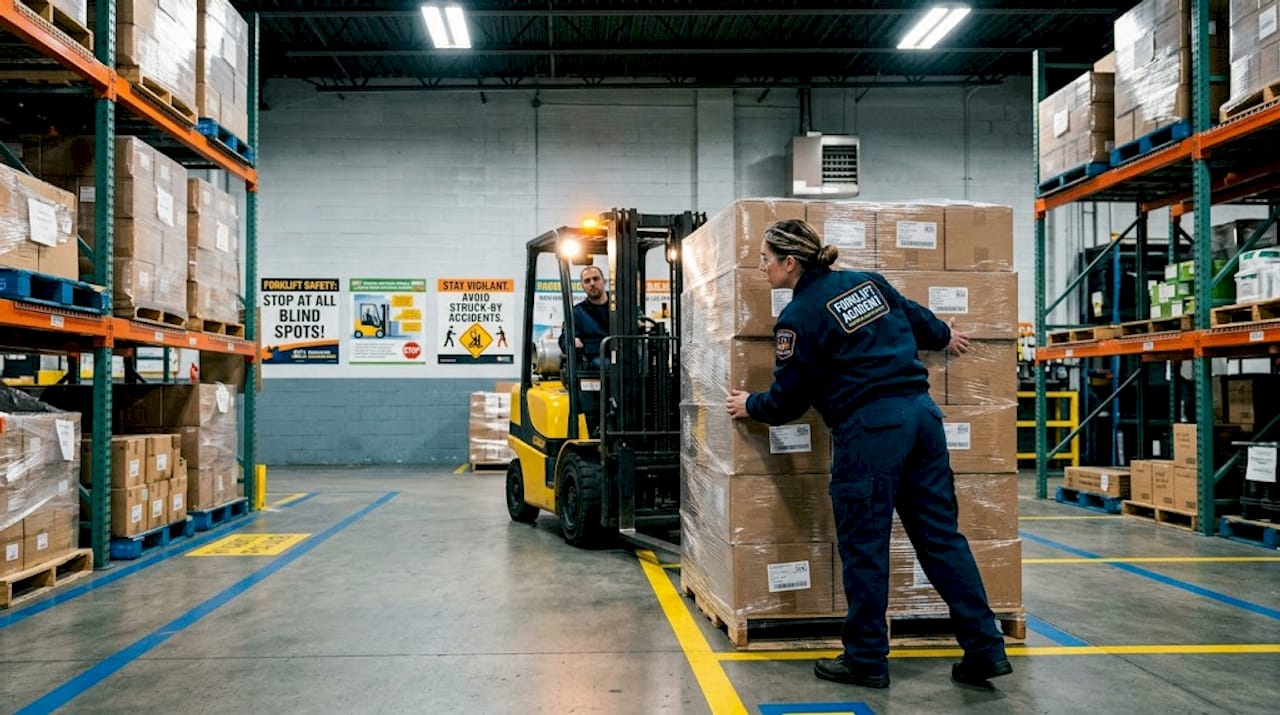
Operators carrying loads that obstruct the view require auxiliary warning devices such as backup alarms, spotters, or convex mirrors at intersections to compensate. Many facilities use these tools inconsistently. A warehouse might install mirrors at one blind corner but leave three others unaddressed. That inconsistency is exactly where accidents cluster.
Visibility hazards also include:
- Obstructed warehouse columns or racking that blocks sightlines at cross-aisles
- Seasonal issues like sun glare through dock doors affecting operator vision
- Attachments like slip sheets or clamps that reduce forward visibility below load level
- Dim aisle lighting that prevents operators from seeing pedestrians at adequate stopping distance
Pro Tip: Walk your facility from a pedestrian’s perspective, not an operator’s. You will identify blind corners that are invisible from the seat but perfectly obvious at floor level.
3. Pedestrian collision hazards
Pedestrian strikes account for roughly 20% to 36% of forklift-related fatalities, making this one of the most lethal common forklift dangers in any shared workspace. The scenarios are predictable once you know what to look for.
Workers crossing forklift travel lanes at unmarked intersections. Visitors unfamiliar with traffic patterns walking through active loading areas. Employees stepping out from behind racking directly into a forklift’s path. Forklift accidents follow predictable patterns at high-traffic intersections and blind corners where operators simply cannot see pedestrians at approach speed.
Physical segregation using guardrails, bollards, and dedicated pedestrian corridors reduces pedestrian accidents more effectively than administrative controls alone. Signs, vests, and verbal warnings fail under the pressure of a busy shift. Engineered barriers provide consistent protection that does not depend on human compliance.
The best facilities treat pedestrian and forklift traffic the same way a city treats vehicles and sidewalks: separate them physically wherever possible. Where separation is not possible, proximity detection systems with fixed sensors at blind spots provide a reliable second layer of protection. Vehicle-mounted sensors alone are not sufficient.
4. Environmental and workplace condition hazards
The floor your forklift travels on is either an asset or a liability. Uneven, slippery, or cluttered floors significantly increase the risk of tip-overs and lateral collisions, particularly when operators are moving at normal travel speed and encounter the condition without warning.
Here are the most common environmental hazards explained with their specific consequences:
- Wet or contaminated floors. Oil, water, or spilled product reduces tire traction and extends stopping distance. A forklift that cannot stop predictably is a collision waiting to happen.
- Cracked or damaged concrete. A small floor crack can catch a tire and destabilize a loaded forklift in a fraction of a second. Repair schedules should treat floor damage as a safety issue, not a cosmetic one.
- Loading dock edges and ramps. Falls from docks are one of the more severe environmental hazards. Without dock locks, wheel chocks, and edge guards, a forklift can drive off an unsecured trailer edge.
- Inadequate lighting. Poor lighting accounts for 26% of forklift accidents. Cross-aisles, dock areas, and outdoor staging zones frequently fall below the minimum foot-candles required for safe forklift operation.
- Cluttered travel lanes. Pallets, packaging material, or equipment left in aisles forces operators to make unplanned maneuvers, often at speed. Clear aisle policies need enforcement, not just documentation.
Pro Tip: Add lighting audits to your quarterly OSHA compliance checklist. Lighting levels change with seasons, facility modifications, and burned-out fixtures. A single dark cross-aisle creates months of elevated risk.
5. Mechanical and maintenance-related hazards
Mechanical failures account for a smaller but significant portion of forklift accidents. Brake and steering malfunctions cause around 5% to 6% of incidents, and these failures share a common cause: maintenance that was skipped, delayed, or incomplete.
The table below outlines the most common mechanical hazards, their failure points, and what proper maintenance prevents.
| Mechanical component | Common failure mode | Preventive action |
|---|---|---|
| Brakes | Worn pads cause extended stopping distance | Inspect brake response during pre-shift check |
| Steering system | Hydraulic leak causes loss of directional control | Check for fluid levels and leaks daily |
| Lift mechanism | Hydraulic failure causes uncontrolled load drop | Test lift and tilt function before each shift |
| Tires | Wear or chunking reduces traction and stability | Inspect tread, pressure, and surface condition |
| Mast and chains | Chain stretch or damage causes load instability | Lubricate and inspect per manufacturer schedule |
OSHA requires operators to perform a documented pre-shift inspection before every use. This is not a suggestion. It is a regulatory requirement, and it exists because it works. An operator who checks brake response before a shift will catch a degraded system before it fails in a travel lane. One who skips the check will find out the hard way at a loading dock edge.
Maintenance neglect compounds over time. A small hydraulic leak ignored for two weeks becomes a lift mechanism failure on week three. Forklift workplace hazards tied to mechanical systems are almost entirely preventable with consistent inspection protocols.
6. Human factors: fatigue, distraction, and training gaps
The single most consequential fact about forklift accidents is this: 70% of forklift accidents are attributed to inadequate operator training. That number reframes how you should think about every other hazard on this list. Tip-overs, pedestrian strikes, and dock falls are not random. They are predictable outcomes of operators who were never taught to recognize the conditions that cause them.
Human factors that directly create forklift safety hazards include:
- Fatigue. A fatigued operator has slower reaction time, reduced hazard recognition, and poorer judgment about speed and clearance. Night shifts and long warehouse seasons elevate this risk substantially.
- Distraction. Using a phone, talking to coworkers, or monitoring radio communications while operating a forklift creates gaps in situational awareness that last just long enough for a collision.
- Outdated training. An operator certified five years ago on a sit-down counterbalance may now be operating a reach truck in a narrow-aisle configuration without updated instruction. The equipment changed. The training did not.
- Complacency. Experienced operators statistically have more accidents than newer operators in some categories. Familiarity breeds inattention. A worker who has driven the same aisle 10,000 times stops actively scanning it.
- Untrained temporary workers. Seasonal and temp workers are frequently placed in forklift-adjacent roles without proper orientation, increasing pedestrian risk even when the operator is trained.
Forklift training programs that include scenario-based hazard recognition, not just equipment operation, produce operators who can identify danger before it materializes. Refresher training is not a bureaucratic requirement. It is the mechanism that prevents complacency from becoming a fatality.
My honest take on forklift hazard recognition
I have spent years reviewing how facilities approach forklift safety, and the pattern I keep seeing is the same. Operators know the big hazards in theory. They have seen the OSHA posters. They passed the certification. But hazard recognition in a real facility, on a Friday afternoon in the fourth hour of a busy shift, is a completely different skill.
The facilities that genuinely reduce accidents do one thing differently: they treat hazard identification as a daily operational activity, not an annual training event. They do walkdowns. They ask operators what made them uncomfortable that week. They update traffic patterns when racking layouts change instead of waiting for an incident report to trigger a review.
What I find genuinely underappreciated is the tip-over survival protocol. Almost every operator I have spoken with says their instinct is to jump. That instinct is wrong and it is deadly. The overhead guard on a modern forklift is engineered specifically to protect the operator who stays in the seat. Training that teaches the physics of why staying inside works is far more likely to override instinct under pressure than a checklist item that says “do not jump.”
The other thing I would push back on: proximity sensors and mirrors are tools, not solutions. I have seen facilities install sensors at every intersection and still have near-misses because the sensors were not calibrated correctly or the alerts were so frequent that operators tuned them out. Technology supports good safety culture. It does not substitute for it.
— Juiced
How Forkliftacademy helps you address these hazards directly
Knowing the hazards is the starting point. Systematically training every operator in your facility to recognize and respond to them is where safety programs succeed or fail. Forkliftacademy delivers OSHA-compliant forklift certification through online and onsite formats designed for exactly the audience reading this article: safety managers who need compliance, operators who need practical skills, and logistics teams who need both.
For organizations managing multiple operators or locations, the train-the-trainer program lets you build internal safety leadership that sustains hazard awareness beyond a single training event. With over 20 years of experience and OSHA-aligned curriculum, Forkliftacademy gives your team the tools to turn hazard recognition from a concept into a daily habit.
FAQ
What are the most common examples of forklift safety hazards?
The most common examples include tip-overs from improper load height or speed, pedestrian strikes in shared work areas, poor visibility from obstructed loads, and mechanical failures from skipped inspections. Environmental hazards like wet floors and poor lighting are also frequently cited.
How often do forklift tip-overs occur?
Tip-overs account for 25% to 42% of all forklift fatalities, making them the leading cause of forklift-related deaths. Improper load height during travel and excessive cornering speed are the primary contributing factors.
What should an operator do if a forklift starts to tip over?
The operator should stay in the seat, hold the steering wheel firmly, brace both feet on the floor, and lean away from the direction of fall. Jumping out of a tipping forklift significantly increases the risk of fatal injury, as the overhead guard is designed to protect those who remain onboard.
How much do training gaps contribute to forklift accidents?
Inadequate operator training is linked to approximately 70% of all forklift accidents. Regular certification, scenario-based hazard recognition training, and refresher courses reduce this risk significantly.
Are pedestrian hazards preventable in forklift environments?
Yes. Physical segregation using guardrails, marked pedestrian corridors, and bollards reduces pedestrian accidents more reliably than signs or vests alone. Facilities that combine engineered barriers with proximity detection systems at blind spots achieve the most consistent results.
Recommended
- Top 5 Forklift Hazards You Can’t Afford To Ignore On The Job Site – Top Osha Forklift Certification
- 7 Essential Forklift Safety Best Practices for Operators – Top Osha Forklift Certification
- Forklift Hazards Explained: Reducing Warehouse Risks – Top Osha Forklift Certification
- Forklift Operator Safety Rules: Essential Guide – Top Osha Forklift Certification