
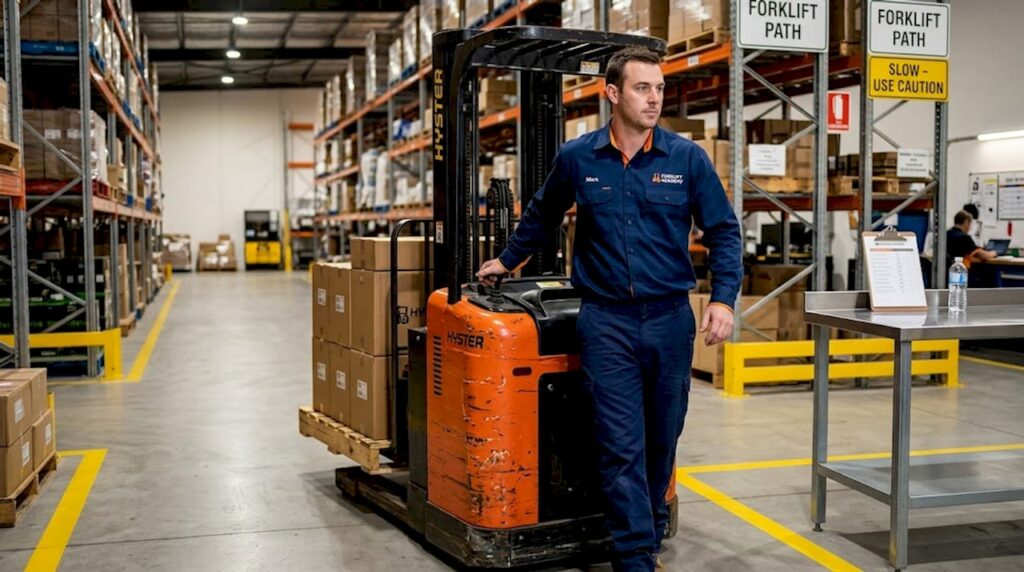

TL;DR:
- Most forklift accidents stem from training gaps, ignored procedures, and unsafe habits rather than faulty equipment.
- Consistently practicing proper load height, inspection routines, safe driving habits, and ongoing training enhances safety and operational efficiency.
Most forklift accidents aren’t caused by faulty equipment. They’re caused by gaps in training, ignored procedures, and habits that seem harmless until they aren’t. If you work in a warehouse or operate a lift truck daily, following solid lift truck best practices is what separates a productive shift from a preventable incident. This guide covers the operational standards, driving habits, maintenance routines, and training requirements that actually move the needle on safety and efficiency. These aren’t generic reminders. They’re specific, research-backed practices that professionals use to protect people and protect equipment.
| Point | Details |
|---|---|
| Load height matters | Carry loads 4 to 6 inches off the ground with the mast tilted back to keep the center of gravity stable. |
| Inspect every shift | Treat pre-shift inspections as mandatory safety checks, not paperwork, and tag out any defective truck immediately. |
| Smooth driving saves money | Abrupt stops, sharp turns, and wheel spinning accelerate wear on brakes, tires, and hydraulics. |
| Training is ongoing | OSHA requires refresher training when unsafe behavior is observed, not just at initial certification. |
| Operator behavior is the variable | Equipment quality matters, but operator habits are the biggest factor in accident prevention and equipment longevity. |
Before you get into specific situations, there are non-negotiable standards that apply to every lift truck operation on every shift. These form the baseline of any serious forklift safety best practices program.
Load height is the place to start. Carrying loads 4 to 6 inches off the ground with the mast slightly tilted back keeps the combined center of gravity low and reduces the risk of tip-overs during travel. It also improves ground clearance awareness. Operators who travel with loads raised are creating an unstable condition that can go wrong fast.
Rated capacity is another hard line. Never exceed the forklift’s rated capacity, and understand that the load center distance changes your effective capacity. A 2,000-pound load with a 30-inch load center behaves very differently than the same weight at 48 inches from the forks. Always check the data plate and factor in attachments, which reduce rated capacity.
Here are the additional foundational standards every operator should treat as non-negotiable:
Pro Tip: If your facility doesn’t have clearly marked pedestrian zones, push for them. Separating foot traffic from lift truck travel paths is one of the highest-impact safety changes a warehouse can make.
The way an operator drives a lift truck affects far more than just safety in the moment. Abrupt stops, harsh turns, and wheel spinning accelerate wear on brakes, tires, hydraulics, and the drivetrain. In high-cycle environments, poor driving habits can cut component lifespan significantly and drive up repair costs before anyone realizes the connection.
Smooth acceleration and controlled braking are the foundation of good lift truck driving technique. When you decelerate gradually, you put less stress on the brake pads and reduce the momentum shift that can destabilize a load. Sharp turns at speed are one of the leading contributors to tip-over incidents, especially when carrying a load that raises the center of gravity.
Speed management is another area where habits matter more than rules posted on a wall. Set and enforce posted speed limits in your facility. Operators who routinely push past those limits aren’t just creating personal risk. They’re also creating struck-by hazards for pedestrians and co-workers at cross-aisles and dock areas.
A few driving habits worth building into your daily routine:
Pro Tip: Where telematics or operator scoring systems are available, use the data for coaching conversations rather than discipline. Operators who understand the “why” behind smooth driving habits change behavior much more reliably than those who are just told to slow down.
Most facilities have operators fill out an inspection checklist at the start of each day. That’s a good start, but it’s not enough. Inspection should be a per-shift habit, not a once-daily box to check. If a truck does two or three shifts, it needs a pre-shift check before each one. Problems that develop mid-shift on the previous operator’s watch don’t disappear because paperwork was filed.
Empower operators to tag out defective trucks. This is a critical piece of the puzzle that often gets overlooked. When an operator spots a cracked fork, a leaking hydraulic line, or a tire with visible chunking, they should have the authority and the obligation to remove that truck from service. A culture that pressures operators to keep running equipment they know is unsafe is a culture building toward a serious incident.
Here’s a practical inspection sequence to follow before every shift:
| Inspection area | What to look for | Action if defective |
|---|---|---|
| Forks | Cracks, bends, heel wear | Tag out, do not operate |
| Tires | Chunking, flat spots, low pressure | Replace before shift |
| Hydraulics | Leaks, slow response, unusual sounds | Report to maintenance |
| Brakes | Soft pedal, grinding, delayed stop | Tag out immediately |
| Lights and horn | Non-functional, dim, or missing | Repair before operating |
Inspections catch problems. Preventive maintenance stops them from developing in the first place. Implementing structured maintenance programs alongside daily inspections reduces both repair costs and unplanned downtime. The two practices reinforce each other when they’re connected, meaning inspection findings feed directly into work orders.
Computerized maintenance management systems, or CMMS platforms, make it much easier to track service intervals, log inspection findings, and schedule preventive work before components fail. Even for smaller fleets, a basic digital log is more reliable than paper records scattered across binders.
Operator behavior and maintenance are more connected than most people realize. Operator coaching on smoothness metrics, including braking force, turning speed, and load handling aggression, directly reduces the rate at which those same components need service. The maintenance team and the training program are working on the same problem from different angles.
Always use licensed technicians for repairs that involve safety-critical systems: brakes, steering, mast components, and hydraulics. This isn’t just about quality. It’s about liability and code compliance. A repair done incorrectly on a lift truck creates a hidden hazard that won’t show up until the worst possible moment.
How you pick up, carry, and set down a load is where most forklift accidents originate. The mechanics are straightforward in theory but demand consistent attention during every lift.
Start with proper fork insertion. Forks should be fully inserted under the load, centered on the pallet, and set to the widest spacing the pallet allows for stability. Partially inserted forks create a lever effect that can cause loads to shift or fall unexpectedly during travel or elevation.
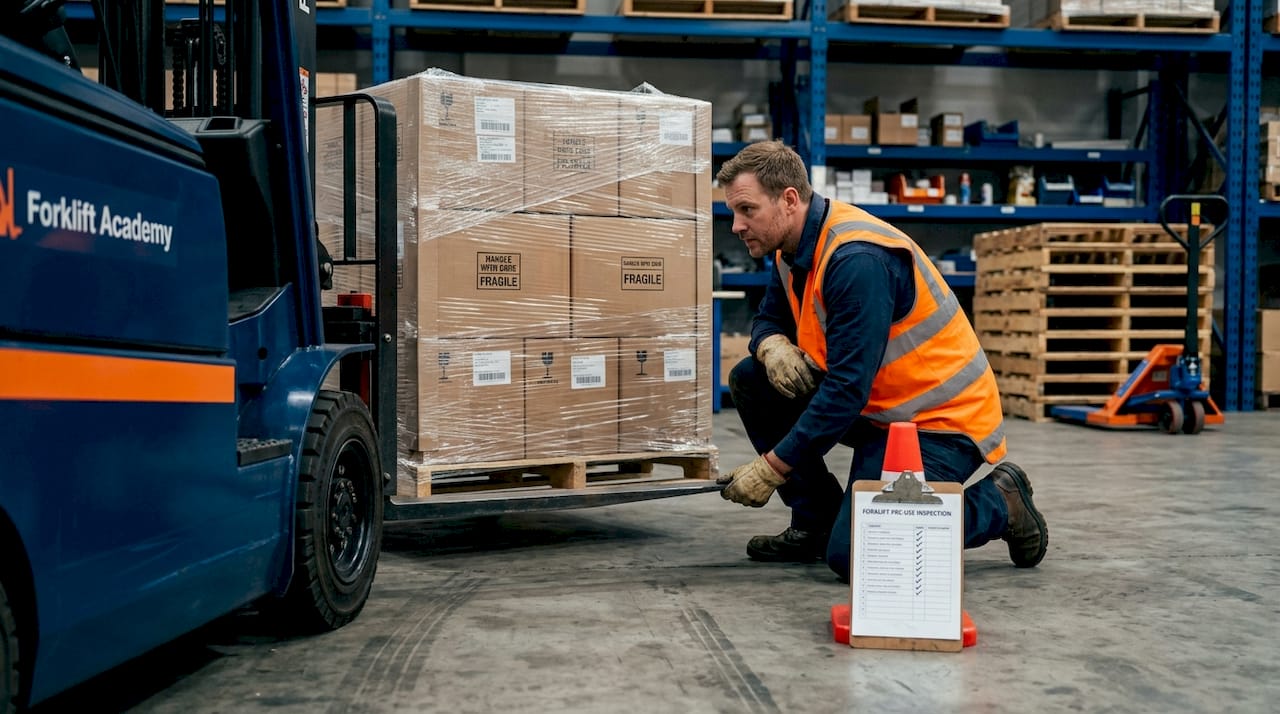
On ramps, travel with the load facing uphill regardless of your direction of travel. This keeps the heavy end toward the slope and reduces the risk of the load sliding forward off the forks. Forks should remain low and tilted back during all travel, whether you’re on flat ground or a grade.
A few more load handling standards that directly reduce incident rates:
Certification gets operators legally authorized. Ongoing training is what keeps them safe two years later when habits have drifted and shortcuts have crept in. Forklift training best practices require treating training as a continuous process, not a one-time event.
OSHA requires refresher training when an operator is observed operating unsafely, when an accident or near-miss occurs, when an operator receives a poor evaluation, or when conditions change. That’s a broad mandate, and it’s the right one. Effective training targets specific high-risk scenarios with behavioral sequences, not just rules memorization. The difference between an operator who knows the rules and one who applies them under pressure comes down to that kind of practice.
Documentation matters too. Keep records of initial certification, refresher training, and evaluations for every operator. These records protect your facility in the event of an OSHA inspection or incident investigation. For guidance on staying current, the OSHA compliance requirements that apply to your operation are worth reviewing in detail.
On-board operator guidance systems that display task prompts and reinforce safe workflows are increasingly practical for facilities with high operator turnover or complex shift schedules. They won’t replace training, but they do standardize behavior across shifts in a way that posted signs never will.
I’ve worked alongside forklift operators and warehouse managers for years, and the pattern in serious incidents is almost always the same. The truck was fine. The operator had been certified. Something in the habits, the culture, or the training had quietly eroded.
The facilities with the best safety records I’ve observed share one thing: they treat operator behavior as the primary variable to manage, not equipment specs or floor markings. They have supervisors who recognize the difference between a rushed operator and a dangerous one. They run skill-specific refresher sessions after near-misses rather than just filing reports. And they’ve built a culture where tagging out a defective truck is seen as doing your job, not slowing production.
What I’ve found genuinely works is connecting forklift safety training to real scenarios operators recognize from their own shifts. Generic compliance training gets forgotten. A session built around what actually goes wrong in your specific facility gets remembered.
The technology helps too. Telematics data and on-board assist systems give managers visibility they never had before. But technology surfaces the problem. It doesn’t solve it. Coaching conversations, consistent reinforcement, and a management team that takes near-misses seriously. Those are what actually change behavior over time.
— Juiced
Following lift truck best practices only works when every operator on your floor has the training to back it up. Forkliftacademy delivers OSHA-compliant forklift certification through flexible online and onsite formats designed for real warehouse environments. Whether you’re certifying a single new hire or building an in-house training program, the resources are there. For facilities that want to keep training in-house long-term, the train-the-trainer program equips your own staff to run OSHA-compliant evaluations and refresher sessions on your schedule. With over 20 years of experience behind every course, Forkliftacademy makes compliance straightforward.
Loads should be carried 4 to 6 inches off the ground with the mast tilted slightly back. This keeps the center of gravity low and reduces tip-over risk during travel.
Inspections should be completed before every shift, not just once per day. If a truck operates across multiple shifts, each operator should complete a pre-shift check before using it.
OSHA requires refresher training after observed unsafe operation, a near-miss or accident, a poor evaluation, or a change in equipment or workplace conditions. It is not limited to a fixed time interval.
Tip-overs most often result from traveling with an elevated load, taking turns too fast, exceeding the rated capacity, or operating on uneven surfaces without adjusting speed and load position.
OSHA does not set a fixed expiration date, but operators must be re-evaluated at least every three years and retrained whenever unsafe behavior, an incident, or a change in conditions occurs.