
TL;DR:
- A scissor lift inspection checklist is essential for ensuring safety and compliance, preventing costly failures and fines. Operators must conduct daily visual and control tests, while quarterly and annual inspections require qualified personnel to assess systems and structural integrity, with proper documentation retained for years. Effective safety management relies on trained inspectors, digital tools, and strict adherence to inspection schedules to maintain operational safety and mitigate risks.
A scissor lift inspection checklist is not a formality. It is the difference between a safe workday and a catastrophic equipment failure that injures workers and costs your organization six figures in OSHA fines. Many operators treat the pre-use walkthrough as a box-checking exercise, but willful violations can exceed $150,000 per citation when defective equipment is operated without tagging out. This guide gives forklift operators and safety managers a structured, regulation-aligned inspection process covering daily, monthly, and annual requirements so you stay compliant and keep your team safe.
Table of Contents
- Key takeaways
- 1. Understanding OSHA and ANSI scissor lift inspection requirements
- 2. Daily pre-use inspection checklist: ground-level visual checks
- 3. Daily pre-use inspection checklist: functional control tests
- 4. Monthly and quarterly scissor lift maintenance checklist
- 5. Annual comprehensive inspection checklist essentials
- 6. Inspection management tips for safety managers
- What I have learned from watching inspections go wrong
- Strengthen your inspection program with certified training
- FAQ
Key takeaways
| Point | Details |
|---|---|
| Daily inspections are non-negotiable | Every operator must complete a pre-use check before each shift, not just once per day. |
| OSHA and ANSI set tiered inspection intervals | Inspections are required daily, quarterly (every 150 hours), and annually by a qualified mechanic. |
| Tagging out defective equipment is required | Any lift with a known defect must be removed from service immediately until repaired. |
| Documentation protects you in audits | Retain inspection records for 3 to 5 years to satisfy compliance and insurance requirements. |
| Qualified personnel matter for annual checks | Annual inspections must be performed by a certified mechanic, not a general operator or supervisor. |
1. Understanding OSHA and ANSI scissor lift inspection requirements
Before you run through any checklist, you need to know who is required to inspect what, and when. OSHA and ANSI do not leave this open to interpretation.
OSHA and ANSI standards require three distinct inspection tiers for scissor lifts:
- Daily pre-use inspections performed by the operator before each shift
- Frequent inspections conducted every three months or every 150 operating hours, whichever comes first
- Annual inspections completed by a qualified mechanic, not to exceed 13 months between cycles
The daily inspection is the operator’s responsibility. The frequent and annual inspections require a more experienced person, typically someone with manufacturer certification or equivalent technical training. For OSHA inspection requirements to be satisfied, each level must be documented separately.
One rule operators frequently miss: any scissor lift involved in a tip-over, impact, or overload event must be inspected before returning to service by a competent person, regardless of where it falls in the inspection schedule. Inspection records should be retained for 3 to 5 years to cover audits and insurance claims.
Pro Tip: Post the inspection interval schedule on the equipment or inside the cage. When operators see the next inspection due date, they are less likely to skip the documentation step.
Non-compliance is not just a fine risk. Delaying the annual inspection beyond 13 months renders the equipment non-compliant and requires you to pull it from service until the inspection is completed. That downtime costs more than the inspection ever would.
2. Daily pre-use inspection checklist: ground-level visual checks
The daily scissor lift checklist starts before you ever power the machine on. Ground-level visual checks catch the most common and most dangerous issues.
Walk completely around the machine and check:
- Structural frame and platform: Look for cracks, bent components, or any visible weld damage
- Guardrails and toe boards: Confirm all rails are present, locked in position, and undamaged
- Tires and wheels: Check for proper inflation on pneumatic tires, and look for cuts, flat spots, or excessive wear on solid tires
- Decals and placards: All load capacity, safety, and operational decals must be legible and in place
- Hydraulic system: Scan underneath and around the lift for oil puddles, stains, or wet hose connections
- Battery or fuel connections: Check for corrosion on terminals, loose cables, and adequate charge level
Daily inspections include visual checks of guardrails, tires, hydraulic leaks, and control functions as foundational safety steps before operation begins.
Pro Tip: Take your ground-level inspection seriously on shared equipment. When multiple shifts use the same lift, damage from the previous operator often goes unreported. You are the last line of defense before the next person goes up.
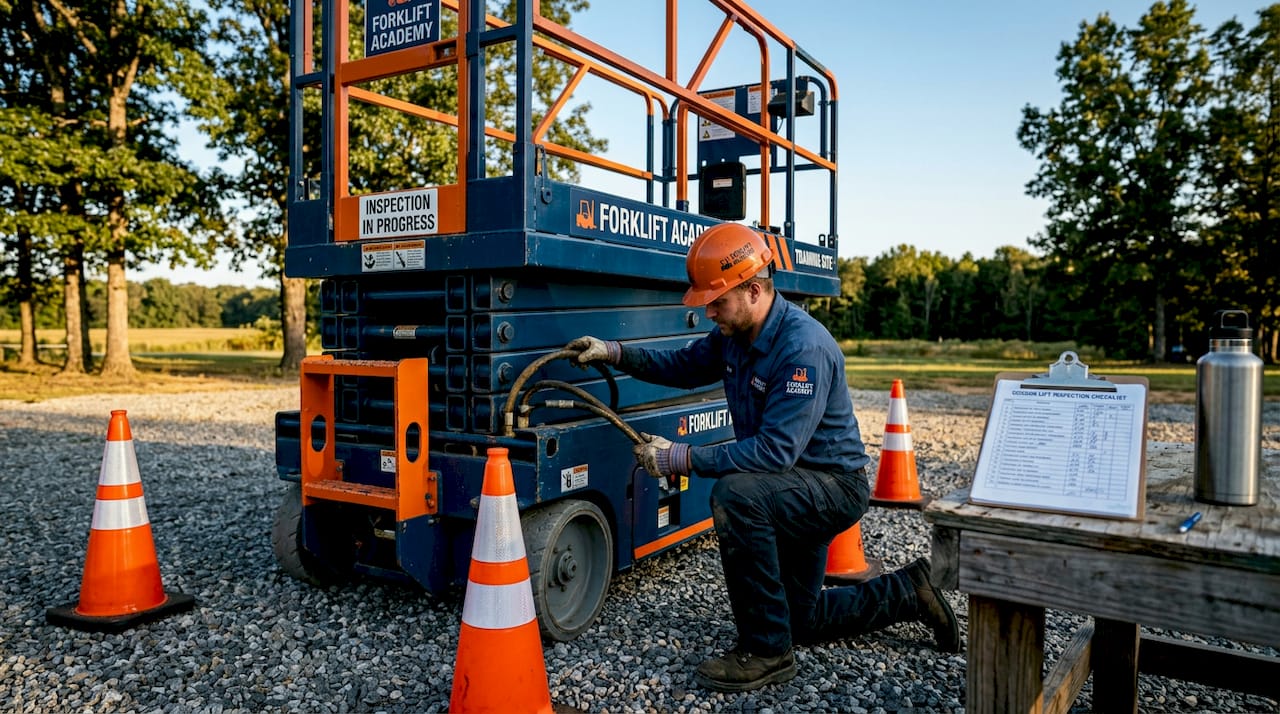
If you find anything during the ground inspection that compromises safety, tag out the machine immediately. Do not assume a supervisor will handle it later.
3. Daily pre-use inspection checklist: functional control tests
Once your visual check is complete, the functional test portion of the scissor lift safety checklist confirms that every control system works under actual operating conditions.
From the ground panel, test the following:
- Lift and lower functions: The platform should raise and lower smoothly without jerking or unusual noise
- Emergency lowering system: Verify the manual lowering valve operates correctly if power is lost
- Emergency stop buttons: Test both the platform and ground-level e-stops to confirm they cut power immediately
- Alarms and horns: Activate the tilt alarm, motion alarms, and audible horn to verify they respond
- Steering and drive controls: Test forward, reverse, and steering response at low speed before operating in congested areas
Then move to the platform controls and repeat the lift, lower, and drive tests from the elevated position. You are confirming that platform-level controls override ground controls correctly and that the machine responds consistently.
Scissor lifts are classified as mobile scaffolds under OSHA 1926.452(w), which means fall protection requirements center on guardrail integrity rather than personal harnesses in most scenarios. Before going up, verify that every guardrail latch is secured and that the entry gate closes and locks properly.
Any functional test that fails means the equipment goes out of service. No exceptions.
4. Monthly and quarterly scissor lift maintenance checklist
The quarterly inspection is where operators hand off responsibility to a qualified technician. This level of the scissor lift maintenance checklist digs into systems that daily checks cannot fully evaluate.
Here is what quarterly inspections must cover:
- Hydraulic fluid level and condition: Check the reservoir level and look for discoloration or contamination. Milky fluid signals water intrusion. Dark fluid signals oxidation.
- Hydraulic hose and fitting condition: Inspect hoses for bulging, abrasion, cracking, and loose fittings. A bulging hose is a blowout waiting to happen.
- Battery maintenance: Test electrolyte levels in flooded lead-acid batteries, clean terminals, and verify charging cycle performance.
- Scissor arm pivot points: Lubricate pivot pins and check for excessive wear or play in the joints. Worn pivot points create platform instability under load.
- Wiring and electrical components: Inspect wiring harnesses for chafing, bare spots, or corroded connectors.
- Oil and fluid leak confirmation: Cross-reference with the maintenance log to confirm any daily-reported leaks were actually repaired and not just wiped down.
| Inspection interval | Who performs it | Primary focus areas |
|---|---|---|
| Daily | Operator | Visual, structural, controls, fall protection |
| Quarterly (150 hrs) | Qualified technician | Hydraulics, battery, pivot points, wiring |
| Annual (13 months) | Certified mechanic | Load testing, structural integrity, sensors, full calibration |
Pro Tip: At the 150-hour mark, pull the maintenance log and compare it against the manufacturer’s service manual. If recurring issues appear in the same system across multiple cycles, that is a pattern worth escalating before the annual inspection.
5. Annual comprehensive inspection checklist essentials
The annual inspection is the most rigorous layer of the scissor lift inspection process, and it must be performed by a qualified mechanic with recognized certification. Sending an untrained supervisor to sign off on this inspection is not just a compliance failure. It can invalidate your insurance coverage in the event of an incident.
The annual scissor lift inspection form must document:
- Weld crack detection: Inspectors use visual checks and sometimes dye penetrant testing to identify cracks at high-stress weld points on the frame and scissor arms
- Overload protection calibration: The load-sensing system must be tested and calibrated against the machine’s rated capacity
- Load testing procedures: The machine is tested at its rated load to verify stability, platform levelness, and structural response
- Safety sensor verification: Tilt sensors, overload sensors, and platform position sensors are tested individually and documented
- Return-to-service authorization: The inspector must sign off that the machine is compliant before it re-enters operation
Documentation must include detailed checklists, load test results, safety device calibrations, photos of damage found, and the return-to-service authorization signature. These records are what protect you when OSHA audits your facility.
One fact worth knowing: annual inspections must not exceed 13 months between cycles. If your calendar slips and you hit month 14, the machine is non-compliant and must be grounded immediately.
6. Inspection management tips for safety managers
Running a compliant inspection program across multiple machines and multiple operators takes more than a good checklist. Here is where most safety managers fall short, and how to fix it.
The most common inspection oversights include failing to check pivot points, ignoring hydraulic hose abrasion, and dismissing tilt alarm activations as false positives. These are not minor gaps. Each one is a documented precursor to platform instability or sudden failure.
For effective inspection management:
- Use a digital inspection form that timestamps submissions and flags incomplete entries. A blank field is impossible to miss when the system requires it.
- Require operators to sign and date every entry. Accountability changes behavior. Anonymous checklists get rushed.
- Assign inspection responsibility by equipment serial number, not just by shift. When a specific machine is tied to a specific operator, problems get reported faster.
- Review inspection logs weekly, not just when something breaks. Patterns in minor defects predict major failures.
Effective inspection programs integrate documentation, operator training, digital tools, and consistent corrective actions as a system rather than individual steps.
Pro Tip: For facilities running two or three shifts on the same lift, require the outgoing operator to physically hand off the inspection form to the incoming operator. That transfer of responsibility catches defects that would otherwise stay buried in a logbook.
Digital tools improve compliance tracking significantly, but they rely on well-trained operators who can actually recognize what a bulging hose or a stressed weld looks like. Technology does not replace trained eyes.
What I have learned from watching inspections go wrong
I have watched operators walk around a scissor lift in under 45 seconds and sign off on a full inspection form. That is not an inspection. That is paperwork with liability attached to it.
The hardest truth about scissor lift safety is that the people most likely to rush an inspection are also the people most likely to operate the lift immediately after. When you are the one going up 20 feet on a machine you just skimmed over, the incentive to be thorough should be obvious. But production pressure is real, and it warps judgment.
What I have seen work is treating the inspection as a non-negotiable start time. You do not start the machine until the form is complete. The inspection is not extra time before work. It is the beginning of work.
I am also skeptical of inspection programs that lean too hard on apps and digital forms without pairing them with real training. An app can prompt you to check the hydraulic hoses. It cannot tell you what a hose with internal delamination feels like versus one that just looks dirty. That tactile knowledge comes from structured operator training, and there is no substitute for it.
The scissor lift inspection checklist steps you follow are only as good as the inspector performing them. Invest in that.
— Juiced
Strengthen your inspection program with certified training
Inspection checklists only work when the people using them know what they are looking for.
Forkliftacademy’s OSHA-compliant scissor lift training programs teach operators exactly how to identify hydraulic wear, structural damage, and control system failures during pre-use and periodic inspections. If you are responsible for multiple operators or multiple sites, the train-the-trainer online program gives your in-house safety leads the credentials and curriculum to train your entire team to the same standard. With over 20 years of experience and OSHA-aligned content built for real warehouse and logistics environments, Forkliftacademy makes it straightforward to get your team certified and your inspection program compliant. Do not wait for an incident to find the gaps.
FAQ
What must be on a daily scissor lift inspection checklist?
A daily scissor lift checklist must cover structural integrity, guardrails, tires, hydraulic leaks, battery connections, and functional tests of all controls including the emergency stop and tilt alarm.
How often does a scissor lift need a formal inspection?
Scissor lifts require daily pre-use checks by the operator, quarterly inspections every three months or 150 hours by a qualified technician, and annual inspections every 13 months by a certified mechanic.
Who can perform the annual scissor lift inspection?
Annual inspections must be performed by a qualified mechanic with manufacturer certification or equivalent credentials. An untrained supervisor or operator does not meet OSHA and ANSI compliance standards.
What happens if a scissor lift fails an inspection?
Any lift with a safety defect must be tagged out and removed from service immediately. It cannot return to operation until a competent person inspects and authorizes it, regardless of schedule.
Do inspection records need to be kept on file?
Yes. Inspection records including checklists, load test results, and calibration data should be retained for 3 to 5 years to satisfy OSHA audit requirements and protect the organization in insurance claims.
Recommended
- Scissor lift inspection procedure: A safety manager’s guide – Top Osha Forklift Certification
- Scissor Lift Operator Workflow for Safety Compliance – Top Osha Forklift Certification
- 7 Key Scissor Lift Safety Tips Every Manager Must Know – Top Osha Forklift Certification
- Essential Scissor Lift Training Steps for Safe Operations – Top Osha Forklift Certification