
TL;DR:
- Having a certification alone does not ensure a forklift operator’s safety or legal compliance. The effectiveness of training depends on qualified trainers who possess equipment knowledge, teaching skills, and practical experience, which the employer must verify and document. Ongoing observation, structured development, and proper record-keeping are essential for building a safe, compliant forklift training program.
Getting a piece of paper that says “certified” does not make a forklift operator safe. The role of trainers in certification is where real competence gets built, and where OSHA compliance either holds up or falls apart under scrutiny. Most organizations focus on the certificate itself, treating it like a finish line. The trainers who deliver that certification, their qualifications, their teaching ability, and their hands-on experience, are the actual variables that determine whether your workforce operates safely or puts people at risk. This article breaks down what trainers actually do, what employers are legally responsible for, and how to build a training program that stands behind every certificate it issues.
Table of Contents
- Key takeaways
- The role of trainers in certification: what it actually means
- Employer responsibility: who really owns trainer qualifications
- Building train-the-trainer programs that actually work
- Certification vs. experience: what actually predicts trainer effectiveness
- How organizations should select and support qualified trainers
- My take on where trainer roles are heading
- Build your forklift trainer program the right way
- FAQ
Key takeaways
| Point | Details |
|---|---|
| Trainers do more than instruct | Trainers evaluate, document, and take legal accountability for every operator they certify. |
| OSHA places liability on employers | Employers designate and are responsible for trainer qualifications, not third-party certificate providers. |
| Certification alone is not enough | A certificate without a qualified trainer behind it offers no real protection against liability or accidents. |
| Train-the-trainer programs need follow-through | Effective programs include observed practice after initial certification, not just a one-time training event. |
| Documentation is non-negotiable | Detailed records of trainer qualifications and experience are required for OSHA compliance audits. |
The role of trainers in certification: what it actually means
There is a significant difference between signing off on a certification and genuinely qualifying someone to operate a forklift. The forklift trainer responsibilities required under OSHA cover three distinct functions: classroom instruction, hands-on training, and practical evaluation. Not every person who can drive a forklift is qualified to do all three.
OSHA requires that trainers possess knowledge, training, and operating experience. Critically, OSHA does not certify trainers itself. The employer designates who qualifies as a trainer and takes on full responsibility for that decision. This is a point many organizations miss entirely.
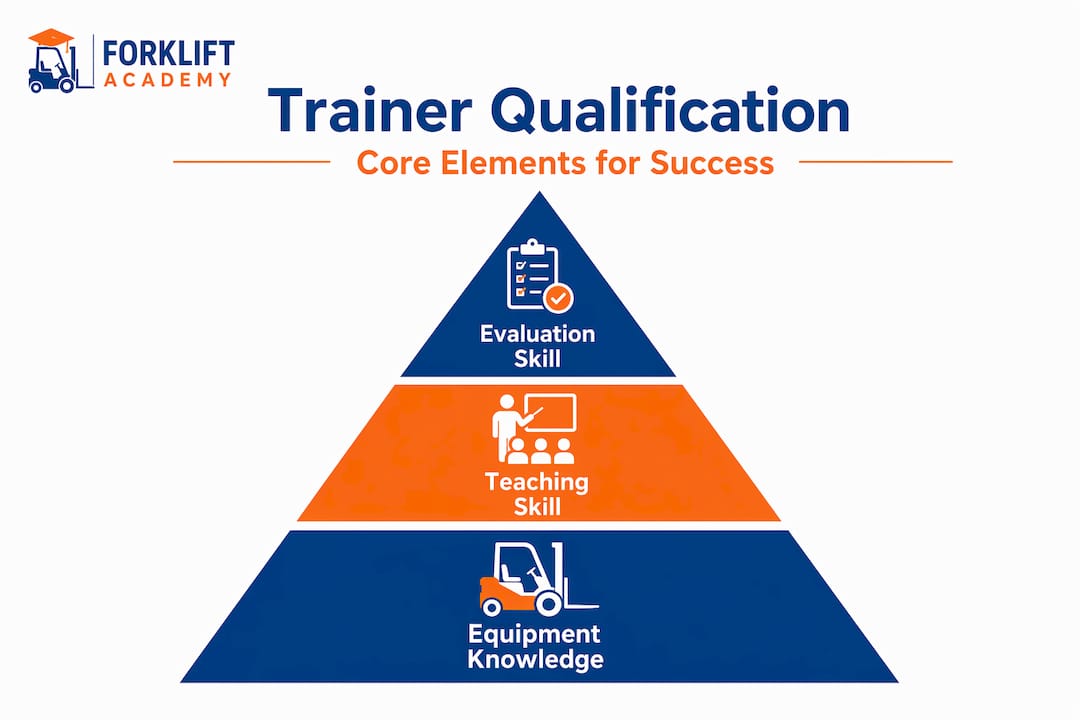
A qualified forklift trainer must bring together all of the following:
- Equipment knowledge: A thorough understanding of the specific forklift types being operated at the worksite, including load capacity, stability, and mechanical risks.
- Teaching skills: The ability to structure instruction, explain procedures clearly, and adjust for different learning styles.
- Practical experience: Real operational history with powered industrial trucks, not just theoretical familiarity.
- Evaluation ability: The skill to assess operator performance objectively, identify unsafe habits, and determine whether someone is genuinely ready to work independently.
None of these competencies alone is sufficient. Employers must ensure trainers carry a combination of all three: operating experience, instructional training, and evaluation skills. A veteran operator who cannot teach is not a qualified trainer. A skilled communicator with no forklift experience is equally disqualified.
Pro Tip: Before designating anyone as a trainer, ask one straightforward question: Can this person recognize and correct unsafe operator behavior in real time? If the answer is uncertain, they are not ready to certify others.
Employer responsibility: who really owns trainer qualifications
Many organizations believe that purchasing a third-party certification program transfers their compliance obligations. It does not. The impact of trainers on certification validity runs directly through the employer, not through whatever vendor issued the training materials.
Here is how employer responsibility actually breaks down:
- Designate qualified trainers in writing. OSHA requires employers to formally identify who is authorized to train and evaluate forklift operators at each site.
- Verify trainer competencies before designation. Collect documentation of the trainer’s operating experience, any instructional training they have received, and their familiarity with the specific equipment at your facility.
- Maintain complete qualification records. Monitoring and maintaining documentation of trainer qualifications alongside operator certifications is an operational challenge but a legal requirement for audits and liability defense.
- Reassess trainers periodically. Trainer designations should not be permanent and unconditional. Any changes in equipment, worksite layout, or operating procedures require re-evaluation of whether the trainer’s qualifications still apply.
- Do not outsource accountability. Third-party certificates do not transfer compliance risk. If your designated trainer was underqualified and an accident occurs, the liability rests with the employer, period.
This is a harder truth than most safety managers want to hear. The certification training process cannot be reduced to sending someone to a course and filing the paperwork. The employer is the final authority on trainer qualification, and that designation carries legal weight.
Pro Tip: Build a simple trainer qualification file for each designated trainer that includes their operating experience log, any instructional certifications, a list of equipment types they are approved to train on, and the date of their last performance review. This file is your first line of defense in an OSHA inspection.

Building train-the-trainer programs that actually work
The best train-the-trainer programs are not built around a single training day. They are built around a feedback cycle that continues long after the initial certification event. Successful programs require observation beyond certification, including supervised initial training and observed shifts to confirm practical application of skills.
What separates a strong program from a weak one comes down to structure and follow-through:
- Pre-qualification assessment: Candidates should demonstrate operational competency before entering trainer development. You cannot train someone to teach a skill they have not mastered themselves.
- Instructional methodology training: New trainers need explicit coaching on how to deliver content, manage a training session, and conduct practical evaluations fairly and consistently.
- Observed training sessions: After initial certification, the new trainer should deliver at least two to three full training sessions under direct observation by an experienced trainer or safety officer.
- Structured feedback: Every observed session should conclude with a debrief covering what went well, what needs correction, and any compliance gaps identified.
- Ongoing refresher cycles: Training methodologies for certification need to stay current with OSHA updates and any changes to your equipment or operating environment.
“Well-designed train-the-trainer programs maintain certification as an ongoing standard through observed practice after initial certification, not as a one-off event.” — Forklift trainer program best practice
Training providers with recognized certification paths report enrollment increases of up to 30%, which reflects something important: organizations increasingly recognize that structured certification paths signal quality and attract serious participants. The same logic applies internally. When your own trainers go through a rigorous, documented development process, your entire safety culture gets stronger.
Certification vs. experience: what actually predicts trainer effectiveness
This is where the certification training process gets complicated. A certificate does not automatically produce an effective trainer, and a highly experienced operator without formal instructional training can be equally problematic. Certification success with trainers depends on the right combination of both.
| Criterion | Certificate Only | Experience Only | Balanced Qualification |
|---|---|---|---|
| Equipment knowledge | Limited to course scope | Strong | Strong, continuously updated |
| Teaching ability | Depends on course quality | Often untested | Formally developed |
| Evaluation consistency | Varies widely | Subjective | Structured and documented |
| OSHA compliance defense | Partial | Weak | Strong |
| Operator safety outcomes | Unpredictable | Variable | Consistently higher |
Treating certification as a box to tick leads to poor outcomes and increased liability. Organizations that approach trainer certification as a genuine quality standard see real returns: stronger risk management, greater staff confidence, and a more defensible position when incidents are investigated.
92% of business leaders require or prioritize professional certifications, with 88% expecting their importance to grow. That trend means your trainers in professional certification roles carry more organizational weight than ever. The question is whether the certification behind them actually reflects the competency it claims to.
Professionalism and ethical conduct are also non-negotiable trainer qualities. A trainer who cuts corners on evaluations, passes operators who are not ready, or fails to document properly is not just a compliance risk. They are a safety hazard. How trainers influence certification outcomes at your facility comes down to whether those trainers hold themselves to a professional standard every single time.
How organizations should select and support qualified trainers
Getting the right person into a trainer role is a decision that deserves real process. Here is a practical framework for organizations that want to get this right:
- Vet candidates on operating experience first. Verify how long they have operated the specific equipment types at your facility. Generic forklift experience is not enough if your site uses multiple truck classes.
- Assess communication and teaching instinct. Ask candidates to explain a safety procedure to you as if you had never seen a forklift before. Their answer reveals more than their resume does.
- Review any prior instructional training. Have they completed a recognized train-the-trainer program? Have they ever formally taught or evaluated anyone before? Prior experience in a coaching or mentoring capacity matters.
- Set up a mentored onboarding period. New trainers should not go solo immediately. Pair them with an experienced trainer for their first certification cycle.
- Use technology to stay organized. Digital platforms for tracking trainer certifications and operator records reduce administrative burden and keep your documentation audit-ready without manual scrambling.
Pro Tip: Do not rely on memory or spreadsheets to track trainer qualification renewal dates. Set calendar-based reminders tied to each trainer’s file so no expiration slips through unnoticed during a busy operational period.
Aligning your trainer selection process with your safety goals also means setting clear performance expectations from day one. Trainers who know they will be observed, evaluated, and given feedback are more likely to stay sharp than those who are certified once and left to operate without accountability.
My take on where trainer roles are heading
I have spent years watching organizations treat trainer qualification as a back-office task, something to check before the real work starts. What I have learned is that the trainer is the real work. Effective educators are shifting from knowledge transmitters to human development facilitators, and that shift matters enormously in a high-stakes environment like forklift operation.
The trainers I have seen produce the best certification outcomes are not the ones who know the most rules. They are the ones who genuinely pay attention to how each operator learns, where they hesitate, and what they need before they go solo on the floor. That takes more than a certificate. It takes judgment, patience, and a sense of professional responsibility that no online course alone can install.
Where I see organizations failing is in treating initial trainer certification as the end of the story. It is the beginning. The trainers who keep workplaces safe are the ones whose skills are regularly observed, whose knowledge is kept current, and whose role is treated as a position of ongoing trust rather than a title earned once and forgotten.
The future of this work will involve more technology, better record systems, and more structured program frameworks. But the human judgment at the center of it will not be replaced. Your trainers are the standard your certification means anything against.
— Juiced
Build your forklift trainer program the right way
If your organization is ready to move from checkbox certification to a training program that actually holds up, Forkliftacademy has the tools to make that happen.
Forkliftacademy offers both an online train-the-trainer certification and hands-on trainer programs across key U.S. cities, all built around OSHA compliance and real operational readiness. With over 20 years of experience and a full suite of forklift training programs, the platform gives employers exactly what they need: documented trainer qualification pathways, flexible delivery formats, and a curriculum that reflects the demands of working warehouse and logistics environments. Whether you are qualifying your first in-house trainer or standardizing trainer development across multiple facilities, Forkliftacademy is built for that work.
FAQ
What does OSHA require from forklift trainers?
OSHA requires that forklift trainers have knowledge, training, and operating experience with the equipment they teach. Employers are responsible for designating qualified trainers and maintaining documentation of those qualifications.
Can a third-party certificate make someone a qualified forklift trainer?
Not on its own. A certificate supports a trainer’s qualification but does not replace the employer’s obligation to verify actual operating experience and instructional ability before designation.
How does trainer quality affect certification success?
Trainers who combine equipment knowledge, teaching skill, and evaluation ability produce operators who are genuinely competent and safe, not just technically certified. Weak trainer qualifications lead directly to increased liability and accident risk.
What records should employers keep for forklift trainers?
Employers should document each trainer’s operating experience, any instructional certifications, the equipment types they are approved to train on, and a log of performance reviews and observed training sessions.
How often should forklift trainer qualifications be reviewed?
Trainer designations should be reassessed whenever equipment, worksite conditions, or operating procedures change. Regular periodic reviews, at minimum annually, help confirm trainers remain qualified for the roles they hold.