

TL;DR:
- Many misconceptions about forklift training persist, risking injuries, fines, and OSHA violations. Proper certification involves ongoing, site-specific training, practical evaluation, and adherence to OSHA standards, not just online courses or outdated certificates. Employers must invest in comprehensive, documented programs to ensure safety, compliance, and legal protection.
Forklift training myths debunked articles exist because the gap between what people believe about forklift certification and what OSHA actually requires is wider than most employers realize. Operators and managers routinely make compliance decisions based on assumptions that are flat-out wrong, and those assumptions lead to injuries, failed audits, and five-figure fines. Whether you’re an operator trying to understand your certification status or a safety manager building a training program, the misconceptions covered here will change how you approach forklift compliance.
| Point | Details |
|---|---|
| Online training alone is insufficient | OSHA requires formal instruction, practical training, and hands-on evaluation. Online covers only the first element. |
| Certifications are not lifetime | Refresher training is mandatory every three years or after any qualifying incident. |
| One certification does not cover all forklifts | Each forklift class requires its own documented training and evaluation. |
| No government forklift license exists | Certification is an employer-issued training record, not a government-issued credential. |
| Ignoring myths carries real financial risk | OSHA violations related to forklift training start at $16,131 per incident in 2026. |
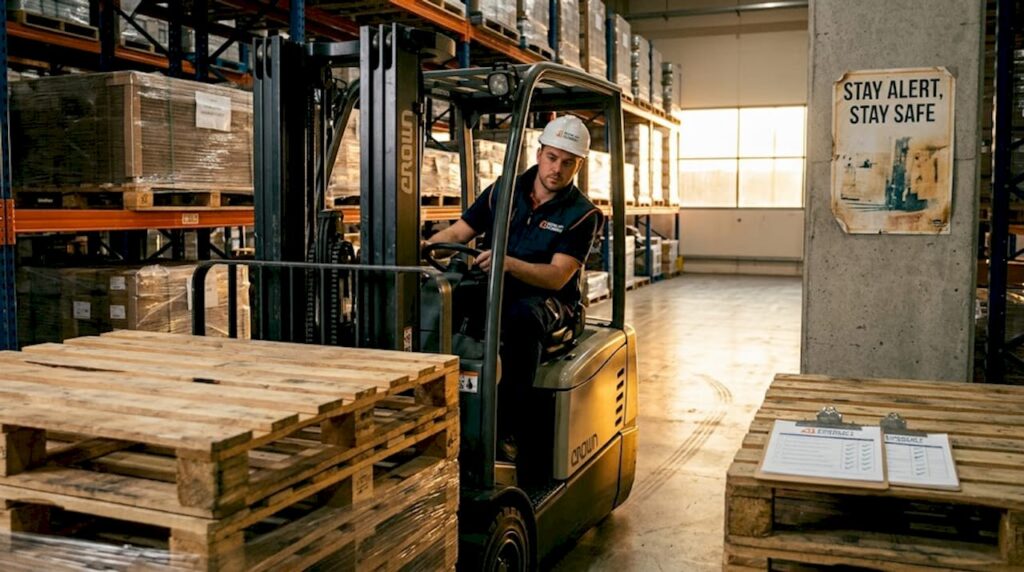
The most persistent myth in forklift operation is that anyone who can drive a car can operate a forklift with minimal preparation. This assumption gets people hurt. Forklifts behave in ways that feel completely counterintuitive to anyone with only road driving experience: they steer from the rear axle, meaning the back of the machine swings wide on turns. They carry loads that raise the center of gravity dramatically, making a fully loaded mast at height genuinely unstable. Understanding load dynamics, tipping angles, and hydraulic controls requires actual instruction, not guesswork.
OSHA’s Powered Industrial Trucks standard (29 CFR 1910.178) mandates formal instruction, practical training, and a hands-on workplace evaluation before any operator is authorized. This is not optional, and it’s not satisfied by watching a colleague for a shift. The regulation exists because forklift accidents kill approximately 85 workers and seriously injure around 34,900 more in the United States every year.
The risks of skipping or cutting corners on training are not abstract:
Pro Tip: If a new hire tells you they were “trained at their last job,” that’s a starting point for evaluation, not a reason to skip your own site-specific orientation. Their previous experience is useful context, nothing more.
A surprisingly common forklift certification myth is that once a person gets certified, they stay certified for life. This is incorrect and creates real liability for employers who operate under this assumption.
OSHA and Canadian standard CSA B335-15 both specify that refresher training is required every three years at minimum, and sooner when any of the following conditions occur:
That three-year cycle exists because equipment changes, regulations update, and operator habits drift over time. An operator who was thoroughly trained in 2020 and has had no refresher since may be using techniques that are outdated or that have calcified into unsafe habits without anyone noticing.
There’s also an important distinction that many employers blur: the difference between formal certification and site-specific competency. Even if an operator holds a valid certificate from a previous employer, that prior certificate does not verify competency on your equipment, in your facility, with your specific hazards. Site-specific evaluation is mandatory. It’s not a courtesy or a formality.
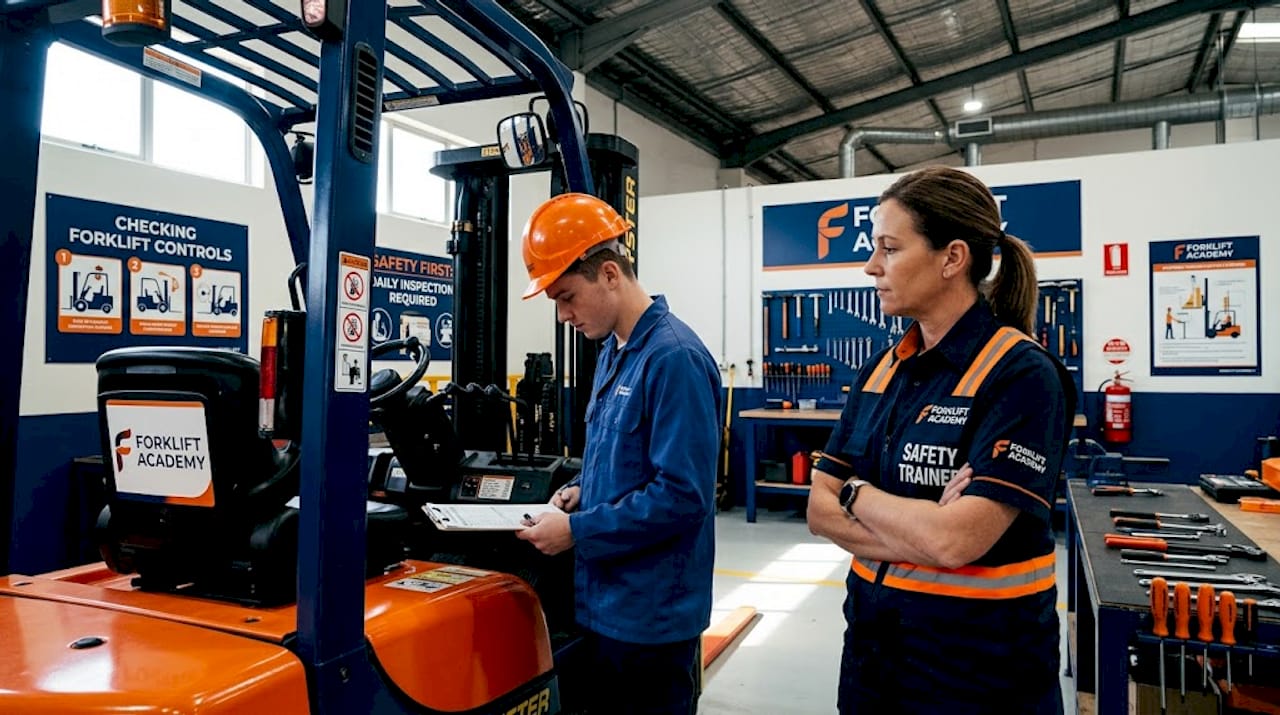
The buddy system, where a current employee informally shows a new hire the ropes, does not satisfy this requirement. It produces operators who inherit existing bad habits and have no documented competency record, which leaves the employer fully exposed during an OSHA inspection.
This is one of the most misunderstood realities of forklift training, and it catches employers off guard during audits. If an operator is certified on a counterbalance sit-down forklift, that certification means nothing when they climb onto a reach truck, a rough terrain vehicle, or an order picker. These are fundamentally different machines with different controls, stability profiles, and operating requirements.
Here’s a direct comparison of what changes between forklift classes:
| Forklift class | Key operational differences | Separate certification required? |
|---|---|---|
| Class I (electric counterbalance) | Rear-wheel steering, smooth surfaces | Yes |
| Class IV/V (cushion/pneumatic tire) | Fuel type, outdoor vs. indoor use | Yes |
| Class II (narrow aisle, reach truck) | Elevated operator cab, different mast mechanics | Yes |
| Class VI (tow tractors) | No forks, pulling mechanics | Yes |
Each forklift class requires its own documented training and hands-on evaluation. There is no umbrella certification that covers all types. This is a regulatory requirement, not a best practice suggestion.
The second part of this myth involves the belief that a “forklift license” is a government-issued document comparable to a driver’s license. It is not. Forklift certifications are employer-issued training records that document what instruction and evaluation an operator has completed. No federal or state agency in the U.S., and no provincial authority in Canada, issues a universal forklift license. The accountability sits with the employer.
Pro Tip: When hiring an operator with previous experience, ask for their specific training documentation, including which forklift classes they were evaluated on and when. A general “I’m certified” tells you very little about actual compliance status. Review your forklift operator requirements to know exactly what documentation you need.
Online forklift certification has made training more accessible, and that’s genuinely valuable. But it has also created a category of common forklift training misconceptions that put both operators and employers at risk. The core misunderstanding: completing an online course does not make someone OSHA-certified to operate a forklift.
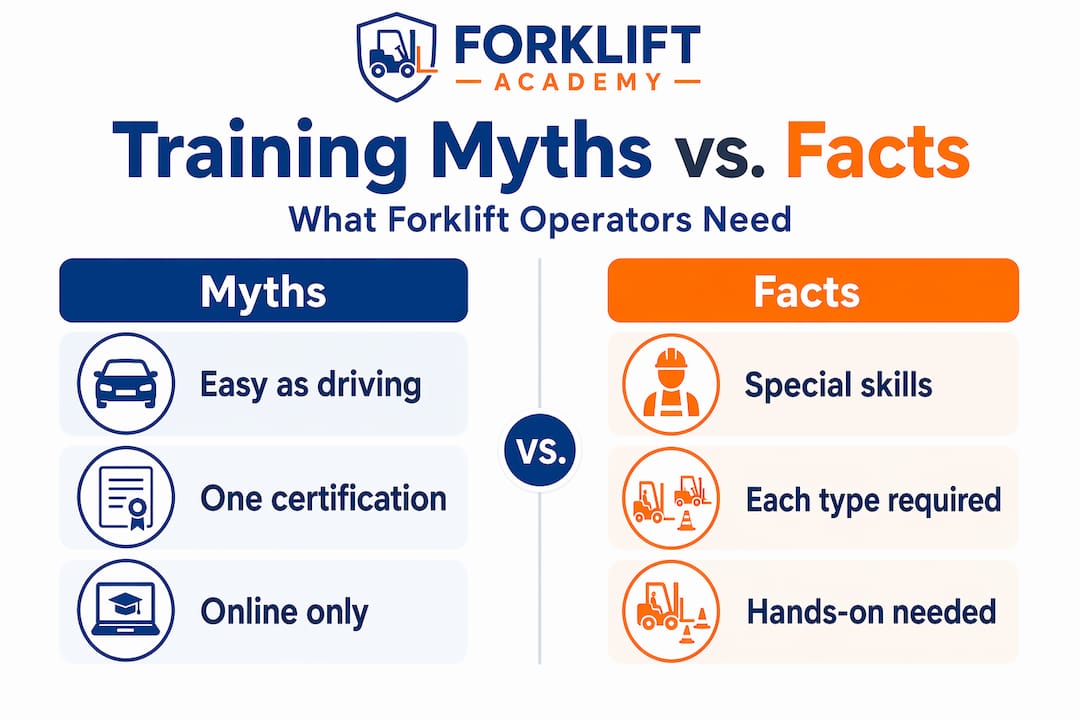
OSHA’s training standard requires three elements: formal instruction, practical training, and a hands-on workplace evaluation. Online courses cover formal instruction only. They do not and cannot satisfy the practical training or evaluation components. That requires a qualified evaluator watching the operator perform tasks on actual equipment in the actual workplace.
The risks go further:
The solution is not to abandon online training. It’s to use it correctly: as the formal instruction component of a complete training program, followed by site-specific practical training and a documented hands-on evaluation. Forkliftacademy’s approach to site-specific forklift training makes clear what that complete process looks like and why shortcuts in any phase create compliance gaps.
Dismissing forklift training myths as minor technicalities is a mistake with measurable consequences. The financial and legal exposure is not theoretical.
“Employers who believe informal training is sufficient often discover otherwise during OSHA inspections. By then, the cost of non-compliance is always higher than the cost of proper training would have been.”
The numbers support this directly:
The value of investing in a thorough, compliant training program is not just safety, although that should be reason enough. It’s protection from a category of legal and financial risk that most employers significantly underestimate until they experience it firsthand.
I’ve spent years watching the same forklift training misconceptions show up again and again, even in organizations that genuinely care about safety. The core issue is not negligence. Most employers who cut corners on certification genuinely believe they’re doing enough.
What I’ve found is that the myths persist because the consequences are invisible until they aren’t. An operator runs an improperly maintained forklift for two years without incident, and that becomes “proof” the training process worked. When something finally goes wrong, the training records are the first thing an OSHA inspector asks for.
The operators I’ve seen handle forklifts most safely are the ones who received thorough site-specific training, not just generic certification. They know the quirks of their exact equipment. They know which floor areas in their facility require extra caution. That knowledge comes from structured, documented, hands-on evaluation. Not from watching someone else do it for a week.
My honest advice: stop treating forklift certification as a box to check and start treating it as an ongoing process. Refresh it on schedule. Document everything. And if your current training program relies on online courses alone without a practical evaluation component, fix that before the next audit finds it for you.
— Juiced
If anything in this article made you question whether your current training process holds up to scrutiny, that instinct is worth acting on.
Forkliftacademy has over 20 years of experience delivering OSHA-compliant forklift certification programs for both individuals and employers across the United States and Canada. The platform offers online formal instruction, onsite practical training coordination, and complete Train the Trainer packages that let employers build an internal certification capability. All programs are built around what OSHA actually requires, including documentation, qualified evaluation, and the ability to demonstrate compliance during an audit. Whether you need to certify one operator or a full warehouse team, Forkliftacademy gives you a clear, compliant path forward. Start with their OSHA forklift certification programs and know exactly where you stand.
No. OSHA requires formal instruction, practical training, and a hands-on workplace evaluation. Online courses cover only the formal instruction component and must be paired with a practical evaluation conducted by a qualified assessor.
Forklift certification is not permanent. OSHA and CSA B335-15 both require refresher training at least every three years, and sooner if an operator is involved in an accident, observed operating unsafely, or assigned to a new type of equipment.
No. Each forklift class requires separate documented training and a hands-on evaluation. A certification on a counterbalance forklift does not authorize operation of a reach truck, rough terrain vehicle, or any other class.
No. Forklift certifications are employer-issued training records, not government licenses. Neither the U.S. nor Canada issues a universal forklift license. The employer is responsible for ensuring operators are trained, evaluated, and documented per OSHA standards.
OSHA fines for forklift training violations start at $16,131 per violation in 2026. Willful or repeat violations can result in significantly higher penalties, and a single incident can trigger a full inspection of all training records.