
Forklifts cause 85 fatalities and 35,000 injuries every year in the U.S., and 70% of those incidents are preventable with proper training. Yet many warehouse operations still rely on informal “watch-and-learn” methods or online-only courses, assuming that experience or theory alone is enough to keep operators safe. It isn’t. OSHA and CSA regulations are explicit: hands-on, evaluated practice is not optional. This article breaks down exactly what the law requires, why practical training outperforms classroom instruction, and how investing in real skill-building pays off in safety, compliance, and bottom-line results.
Table of Contents
- The regulatory case: OSHA and CSA standards demand hands-on training
- Why theory isn’t enough: The real impact of hands-on experience
- Preventing accidents: How hands-on training transforms safety outcomes
- Operational and financial benefits: Why hands-on is good for business
- The hidden edge: What most managers miss about hands-on training
- Elevate your training standards with proven solutions
- Frequently asked questions
Key Takeaways
| Point | Details |
|---|---|
| Hands-on is required | Both OSHA and CSA standards make hands-on training and evaluation mandatory for compliance. |
| Reduces accidents dramatically | Hands-on, compliant training reduces forklift incidents by up to 70% and saves lives. |
| Theory alone falls short | Online or classroom-only instruction cannot substitute for supervised practical experience. |
| Major financial ROI | Each dollar spent on training yields up to six in savings from safety and efficiency. |
The regulatory case: OSHA and CSA standards demand hands-on training
Before you design any training program, you need to know what regulators actually require. Both U.S. and Canadian authorities are clear on this point, and the rules leave no room for shortcuts.
In the U.S., OSHA requires hands-on practical training and a formal evaluation for every forklift operator. The standard, 29 CFR 1910.178(l), mandates that a qualified trainer observe each operator performing real tasks on the actual equipment they will use. No evaluation, no compliance. Period.
In Canada, the CSA standard B335 takes a similar position, requiring both theory instruction and hands-on practical training. Provinces may add their own requirements on top of this baseline, so managers operating in multiple regions need to check local rules carefully.
“The operator must be evaluated while performing the tasks and operations specific to the types of powered industrial trucks in use in the workplace.” — OSHA 29 CFR 1910.178(l)(3)
Here is a side-by-side look at what each standard demands:
| Requirement | OSHA (U.S.) | CSA B335 (Canada) |
|---|---|---|
| Theory/classroom component | Required | Required |
| Hands-on practical training | Required | Required |
| Observed operator evaluation | Required | Required |
| Equipment-specific training | Required | Required |
| Refresher training triggers | Every 3 years or after incident | As needed, after incidents |
| Qualified trainer oversight | Required | Required |
The consequences of skipping the hands-on component are serious. OSHA fines for serious violations can reach $16,550 per incident, and willful violations can exceed $165,514. Beyond fines, a single forklift accident can trigger OSHA investigations, lawsuits, and reputational damage that takes years to recover from.
Common infractions include using online-only certificates as proof of compliance, failing to document the practical evaluation, and not retraining operators after an observed unsafe behavior or near-miss. A solid forklift training compliance guide will help you track all required documentation and avoid these pitfalls. If you want a step-by-step breakdown of the process, reviewing the OSHA forklift training steps is a smart starting point for any manager building or auditing a program.
Why theory isn’t enough: The real impact of hands-on experience
Knowing the rules is one thing. Understanding why they exist is what separates managers who build genuinely safe operations from those who just check boxes.
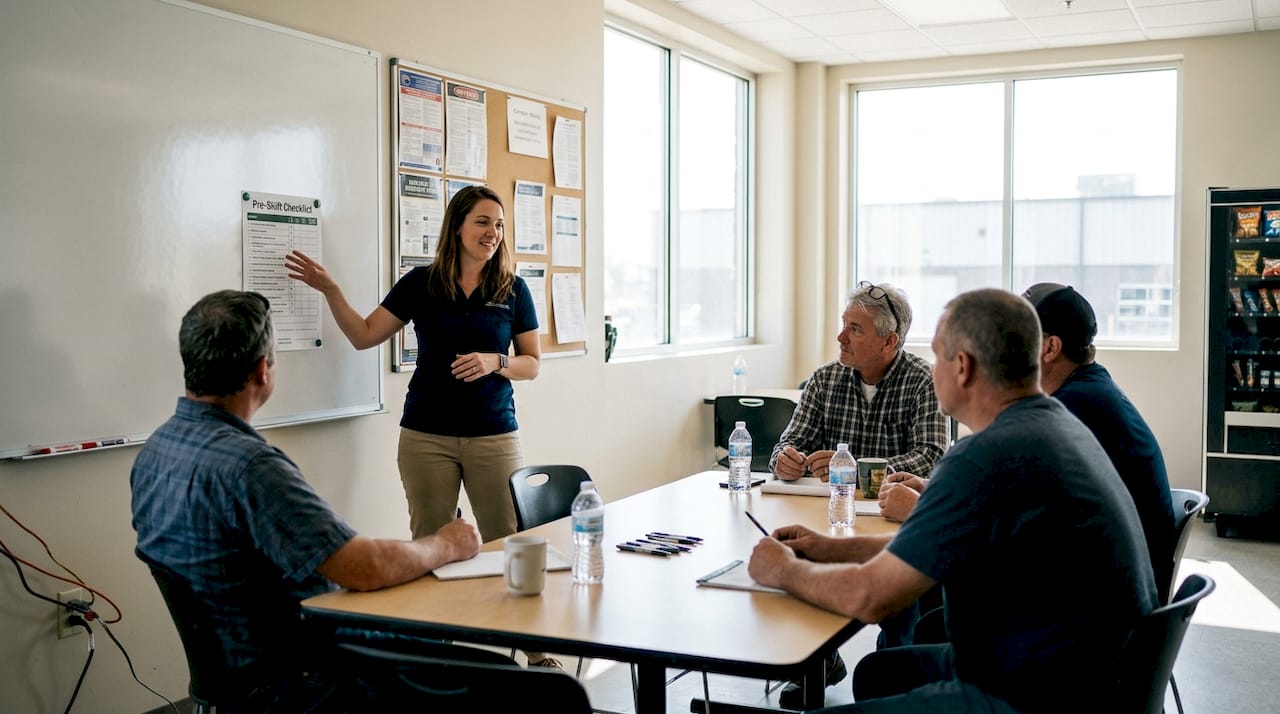
Classroom and online training are valuable for covering regulations, load capacity charts, and pre-shift inspection checklists. But reading about counterbalance physics does not prepare an operator for the moment a load shifts unexpectedly at the top of a racking system. That reaction comes from muscle memory and spatial awareness, which only develop through repeated, supervised practice on real equipment.
Think of it like learning to drive. You can memorize the entire driver’s manual, but you are not ready for rush-hour traffic until you have logged real hours behind the wheel with a qualified instructor watching your blind-spot checks.
Here is how incident rates compare by training type:
| Training type | Estimated incidents per 100 operators | OSHA/CSA compliant? |
|---|---|---|
| Online theory only | ~12 | No |
| Classroom theory only | ~10 | No |
| Hybrid (theory + hands-on) | ~3.6 | Yes |
The numbers make the case clearly. Online theory alone does not meet OSHA or CSA compliance standards, and it leaves operators underprepared for real-world conditions.
Here is how hands-on training builds competence in a way no classroom can replicate:
- Equipment familiarization. Operators learn the feel of the specific truck they will use, including sensitivity of controls and turning radius.
- Load handling practice. Picking up, transporting, and placing loads under supervision builds judgment that theory cannot teach.
- Hazard recognition drills. Trainers introduce realistic scenarios, pedestrian crossings, blind corners, uneven surfaces, so operators develop instinctive responses.
- Evaluated performance. A qualified observer identifies bad habits before they become accidents, providing corrective feedback in real time.
Pro Tip: Use online modules to deliver theory efficiently, then schedule a structured hands-on session for each operator. This hybrid approach keeps training time manageable while meeting full compliance requirements. For more on building this kind of program, see our guide on implementing forklift safety training and review practical advice on onsite forklift training tips.
Preventing accidents: How hands-on training transforms safety outcomes
Let’s put real numbers to the safety argument, because the data is striking.
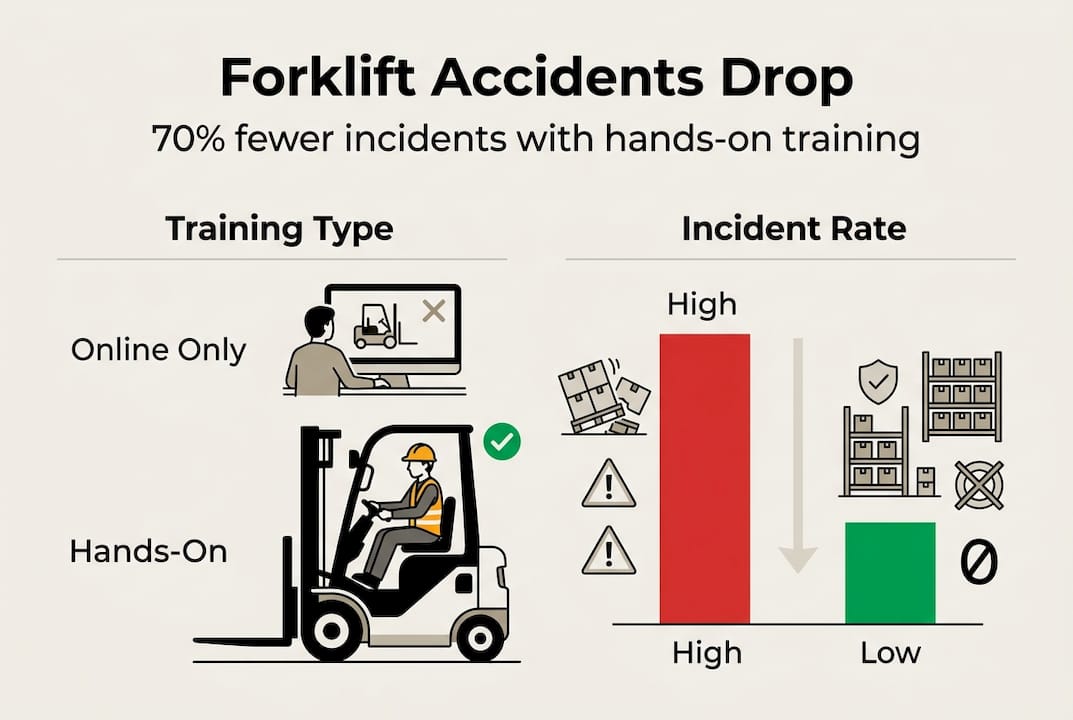
OSHA-compliant training reduces forklift incidents by up to 70%, dropping incident rates from roughly 12 per 100 operators to just 3.6. Human error drives 87% of all forklift accidents. That means the vast majority of incidents are not mechanical failures or bad luck. They are the result of gaps in operator skill and judgment that hands-on training directly addresses.
The most common accident types, and the ones hands-on training is specifically designed to prevent, include:
- Tip-overs. Caused by turning too fast, carrying an unbalanced load, or operating on an incline. Hands-on training builds the spatial awareness to avoid these situations.
- Pedestrian strikes. Operators learn to scan intersections and communicate with foot traffic through real-scenario practice.
- Falling loads. Improper fork positioning and overloading are habits that a qualified trainer can identify and correct during supervised sessions.
- Dock and edge incidents. Depth perception on loading docks is a skill that must be practiced, not read about.
- Collisions with racking. Tight aisle maneuvering requires hands-on repetition to master.
Pro Tip: Even experienced operators develop blind spots over time. Schedule hands-on refresher training every three years at minimum, or immediately after any incident or near-miss. Complacency is one of the leading contributors to accidents among long-tenured operators.
The 35,000 annual injuries in the U.S. represent real people, real downtime, and real costs. The 70% reduction achievable through compliant training is not a marketing claim. It is a documented outcome that your safety program can replicate. Review the full compliance safety guide to understand how to build a program that consistently delivers these results.
Operational and financial benefits: Why hands-on is good for business
Safety is priceless, but for your business, training investments must make financial sense too. Fortunately, the return on investment for hands-on forklift training is one of the strongest in workplace safety.
“Every $1 invested in quality forklift training returns $4 to $6 in reduced injuries, lower insurance premiums, and improved operational efficiency.”
That ratio reflects a combination of direct and indirect savings. Direct savings come from fewer workers’ compensation claims, lower insurance premiums, and reduced legal exposure. Indirect savings come from less equipment damage, fewer production disruptions, and lower employee turnover.
Here are four concrete operational improvements that hands-on training enables:
- Higher productivity. Operators who are genuinely confident and competent move loads faster and with fewer errors, directly improving throughput.
- Reduced equipment damage. Proper technique means fewer collisions with racking, walls, and other equipment, cutting repair and replacement costs.
- Stronger employee retention. Workers who receive structured training feel valued and are less likely to leave. Turnover in warehouse roles is expensive, and training investment signals commitment to staff development.
- Fewer operational disruptions. Every incident, even a minor one, triggers investigations, paperwork, and downtime. Fewer incidents mean smoother daily operations.
Beyond the numbers, there is a reputational dimension. Clients, insurers, and regulators notice when a facility has a strong safety record. A well-documented business forklift training guide helps you build and demonstrate that record. Understanding your team’s operator compliance responsibilities is equally important for maintaining consistent standards across shifts and locations.
The hidden edge: What most managers miss about hands-on training
Here is the uncomfortable truth most training conversations avoid: even if OSHA and CSA did not require hands-on evaluation, you would still need it. Regulations set the floor, not the ceiling.
The real problem with informal on-the-job training is not just that it skips a compliance checkbox. It actively builds bad habits. An operator who learned by watching a coworker will replicate that coworker’s shortcuts, including the ones that have not caused an accident yet. On-the-job training alone fosters complacency and embeds unsafe behaviors that are extremely difficult to correct later.
We have seen this pattern repeatedly: a facility with zero recorded incidents for years, where operators have “always done it this way,” suddenly experiences a serious accident. The investigation almost always reveals that informal habits had drifted far from safe practice. No one noticed because no one was watching with a trained eye.
Evaluated, structured hands-on practice is the only method that consistently catches these gaps before they become tragedies. It forces operators to perform under observation, which surfaces the habits they do not even know they have. A strong safety culture is not built on good intentions. It is built on regular, evaluated practice. Start by reviewing how to approach preparing onsite training with the rigor your team deserves.
Elevate your training standards with proven solutions
Ready to turn these insights into action? Here is how industry leaders make it happen efficiently and at scale.
At Forklift Academy, we have spent over 20 years helping warehouse and logistics operations across the U.S. and Canada build training programs that actually work. Our OSHA forklift certification programs combine online theory with structured hands-on evaluation, meeting every OSHA and CSA requirement. For managers who want to build internal capacity, our Forklift Train the Trainer program equips your own staff to deliver compliant, evaluated training at your facility. Explore the full range of forklift OSHA compliance resources and take the next step toward a safer, more efficient operation today.
Frequently asked questions
What is the difference between classroom and hands-on forklift training?
Classroom training covers theory, regulations, and safety rules, while hands-on training develops real operating skills through supervised practice on actual equipment. Online theory alone does not satisfy OSHA or CSA compliance requirements.
Is online-only forklift certification valid for OSHA/CSA compliance?
No. Both OSHA and CSA require a hands-on practical evaluation in addition to theory instruction. Online training covers theory but cannot substitute for the in-person evaluation component.
How much can proper forklift training reduce workplace accidents?
OSHA-compliant training reduces forklift incidents by up to 70%, dropping rates from approximately 12 incidents per 100 operators to just 3.6.
What business benefits come from investing in hands-on forklift training?
Every dollar invested in quality training returns $4 to $6 through reduced injuries, lower insurance costs, less equipment damage, and fewer operational disruptions.
Recommended
- Forklift training: boost safety and efficiency in 2026 – Top Osha Forklift Certification
- Forklift safety trends 2026: reduce accidents, ensure OSHA compliance – Top Osha Forklift Certification
- Ensure forklift operator OSHA training compliance in 2026 – Top Osha Forklift Certification
- Step by step forklift training for OSHA compliance 2026 – Top Osha Forklift Certification