
Forklift accidents send roughly 34,900 workers to the hospital every year in the U.S., and up to 70% of those incidents are preventable with proper refresher training. Yet many warehouse and logistics managers still operate under the assumption that a one-time certification is enough. It isn’t. OSHA regulations require ongoing evaluation, and the cost of ignoring that requirement goes well beyond fines. This article breaks down exactly what OSHA expects, what updated training actually costs versus what it saves, and how to build a training program that holds up under scrutiny.
Table of Contents
- OSHA requirements for forklift training: What’s changed and what hasn’t
- The compliance and cost equation: Fines, recordkeeping, and legal drivers
- Safety and performance: Accident prevention and workforce ROI
- What up-to-date forklift training should include (and common pitfalls)
- Our take: Why proactive updates beat last-minute compliance every time
- How Forklift Academy can help you level up training and compliance
- Frequently asked questions
Key Takeaways
| Point | Details |
|---|---|
| OSHA compliance is ongoing | Regulations require regular evaluations and timely updates to forklift training. |
| Accident risk is preventable | Up-to-date training and refreshers can prevent up to 70% of forklift accidents. |
| Documentation protects your business | Proper training records and documentation are your defense against fines and audits. |
| ROI extends beyond safety | Fewer incidents and injuries mean reduced costs and smooth operations for your warehouse. |
OSHA requirements for forklift training: What’s changed and what hasn’t
The foundation of forklift training compliance is 29 CFR 1910.178(l), which requires that every forklift operator receive training and a formal performance evaluation at least once every three years. That three-year cycle is not optional, and it applies regardless of how experienced your operators are.
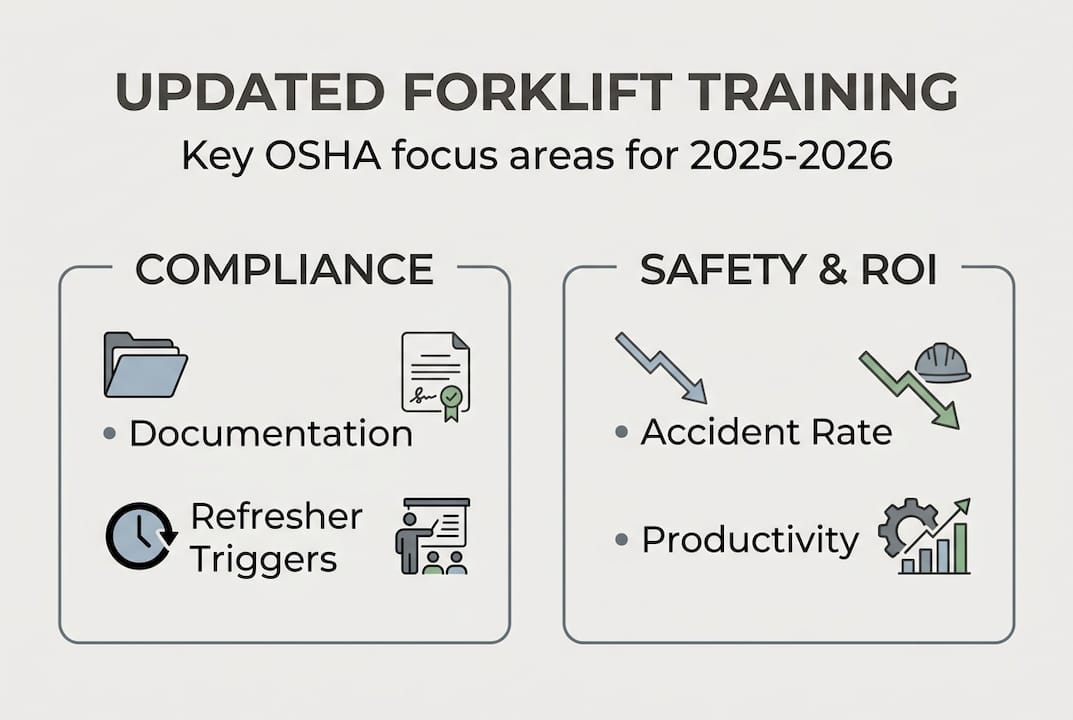
But the three-year mark is just the floor. OSHA also mandates refresher training whenever specific triggers occur:
- An operator is observed operating the forklift unsafely
- An operator is involved in an accident or near-miss
- An operator receives an unsatisfactory evaluation
- The operator is assigned to a different type of forklift
- Workplace conditions change in a way that affects safe operation
These triggers are where many managers fall short. They track the three-year calendar but miss the event-based requirements entirely.
For 2025 and 2026, OSHA has sharpened its focus on documentation quality, equipment-specific training records, and alignment with the latest ANSI/ITSDF B56.1 standards. The proposed updates emphasize enhanced inspection records, stricter rules around equipment modifications, and clearer accountability for who authorized training and when.
| Requirement | Core OSHA rule | 2025/2026 focus area |
|---|---|---|
| Initial training | Required before operation | Equipment-specific documentation |
| Performance evaluation | Every 3 years minimum | Qualified evaluator records |
| Refresher training | After triggers (accident, unsafe act) | Post-incident retraining timelines |
| Record retention | Operator name, date, trainer | Enhanced inspection and modification logs |
| Training format | Formal instruction plus hands-on | Hybrid accepted with evaluation component |
One persistent myth is that OSHA recently introduced a new mandatory annual retraining requirement. It hasn’t. The three-year evaluation cycle remains the standard. What has changed is the level of scrutiny applied to documentation and the expectation that employers proactively address training triggers rather than waiting for an audit.
For a full breakdown of what your operators need to cover, the employee forklift training guide at Forklift Academy walks through every compliance checkpoint. You can also review the step by step forklift training process to see how each phase maps to OSHA’s requirements.
The compliance and cost equation: Fines, recordkeeping, and legal drivers
Let’s talk numbers. A serious OSHA violation related to forklift training can cost your business up to $15,625 per violation. Willful or repeated violations can reach $156,259 per incident. Those figures add up fast when an inspector finds multiple gaps in a single audit.
OSHA enforcement is typically triggered by one of three events: a worker complaint, a workplace accident, or a programmed inspection of high-hazard industries. Warehousing and logistics fall squarely in the high-hazard category, which means your facility is not waiting in a long line before an inspector shows up.
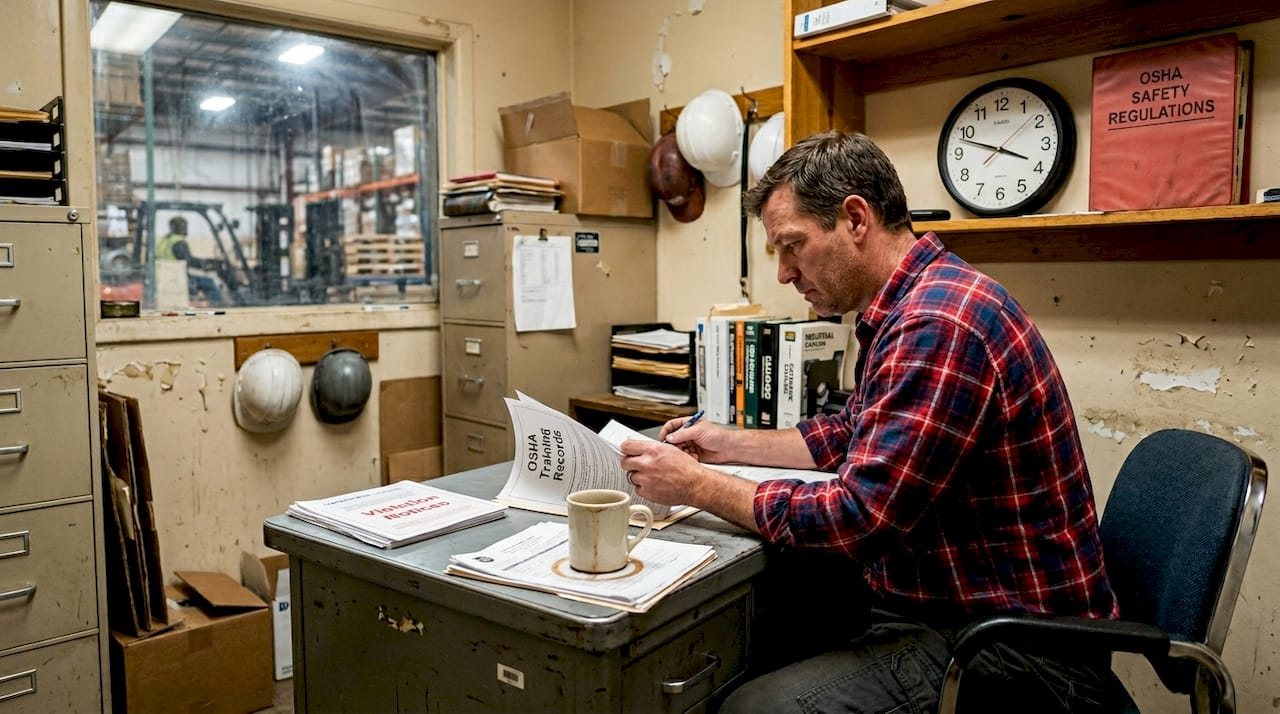
Solid recordkeeping is your first line of defense. OSHA requires that training records include:
- The operator’s full name
- The date of training and evaluation
- The name of the person who conducted the training
- The type of forklift covered
- The outcome of the evaluation (pass/fail, notes)
Records must be retained for at least three years and be available for inspection on request. Digital records are acceptable, but they need to be organized and retrievable quickly.
| Violation type | Potential fine | Common trigger |
|---|---|---|
| No initial training | Up to $15,625 | New hire operating without certification |
| Missing refresher after incident | Up to $15,625 | Accident with no retraining documented |
| Incomplete records | Up to $13,653 | Missing trainer name or evaluation date |
| Willful/repeated violation | Up to $156,259 | Pattern of non-compliance found at audit |
The anatomy of a bulletproof training record is simple: who was trained, on what equipment, by whom, on what date, and what the result was. If you cannot answer all five questions for every operator on your floor, you have a gap.
Review the OSHA compliance guide for a practical checklist you can use to audit your current records before an inspector does it for you.
Safety and performance: Accident prevention and workforce ROI
Beyond fines, the real argument for updating forklift training is what it does to your accident rate and your bottom line. Refresher training reduces accidents by 30 to 35% and improves measurable safety skills by 25%. Those are not small gains.
Complacency is a bigger problem than most managers realize. Experienced operators are often the most at risk because they stop consciously thinking through each step. Roughly 20% of forklift accidents are directly tied to complacency, not inexperience. Refresher training breaks that pattern by forcing operators to re-engage with procedures they have started to run on autopilot.
The financial case is just as strong:
- A single lost-time forklift injury costs an average of $38,000 in direct costs (workers’ comp, medical, investigation)
- Indirect costs, including lost productivity, retraining, and morale impact, can multiply that figure by three to five times
- Facilities with consistent refresher training programs report measurably lower workers’ comp premiums over time
“Up to 70% of forklift accidents are preventable with proper training. That means the majority of injuries on your floor are not inevitable. They are a choice.”
The ROI math is straightforward. If refresher training for your team costs $2,000 and it prevents even one lost-time injury, you have already saved more than 15 times that investment.
Pro Tip: Don’t wait for the three-year mark to schedule retraining after you bring in new equipment. Operators who learned on older forklifts often transfer bad habits to newer models with different stability systems. Early retraining after any equipment swap is one of the highest-value moves you can make.
For a deeper look at the numbers, the boost safety and efficiency resource breaks down the productivity gains alongside the safety data. You can also explore how to implement forklift safety training across a multi-shift operation.
What up-to-date forklift training should include (and common pitfalls)
Best-in-class forklift training in 2026 is not just a refresher quiz and a signature on a form. OSHA requires that training cover both truck-related topics and workplace-specific hazards, and it must include formal instruction, practical hands-on training, and evaluation by a qualified trainer.
The core elements every program should include:
- Truck operation: controls, capacity, load handling, stability triangle
- Pre-shift inspection procedures
- Workplace hazard recognition: pedestrian zones, racking systems, floor conditions
- Refueling and battery charging safety
- Practical evaluation on the specific equipment the operator will use
Skills degrade over time, and modern training needs to account for that. New technology like telematics, stability controls, and proximity warning systems requires operators to learn new habits, not just apply old ones. If your training program hasn’t been updated to reflect the equipment on your floor, it’s already out of date.
Hybrid training, which combines online theory with in-person hands-on evaluation, is not just allowed by OSHA. It is increasingly the preferred format because it gives operators flexibility on the theory side while maintaining the non-negotiable hands-on component.
Pro Tip: Build a retraining trigger log into your safety management system. Every near-miss, every equipment swap, and every operator reassignment should automatically generate a retraining task. Most compliance gaps aren’t from managers who don’t care. They’re from managers who simply lost track.
Common pitfalls to avoid:
- Skipping hands-on evaluation because an operator “has years of experience”
- Using a generic training program that doesn’t reflect your specific equipment and facility layout
- Failing to document who conducted the evaluation and what the result was
- Treating the three-year cycle as the only trigger instead of one of many
The OSHA forklift training steps resource gives you a clear sequence to follow, and the OSHA training requirements list helps you verify nothing is missing from your current program.
Our take: Why proactive updates beat last-minute compliance every time
After working with warehouses and logistics operations across the country, we’ve seen the same pattern repeat itself. A manager waits until training is technically overdue, schedules a rushed refresher, files the paperwork, and considers the box checked. Then six months later, an incident happens that the refresher would have prevented if it had been done thoughtfully instead of reactively.
The uncomfortable truth is that most OSHA fines don’t come from managers who ignored training entirely. They come from managers who did the minimum and missed a trigger they didn’t know to watch for. An operator gets reassigned to a different forklift model. No one schedules the equipment-specific retraining. An inspector shows up three weeks later.
Proactive training culture means treating every near-miss as a retraining signal, not just a close call. It means reviewing your business forklift training guide annually, not just when an audit is on the horizon. The facilities with the best safety records aren’t the ones with the most paperwork. They’re the ones where operators genuinely believe training makes them better at their jobs, not just compliant on paper.
How Forklift Academy can help you level up training and compliance
If you’re ready to move from reactive compliance to a proactive training strategy, Forklift Academy has the tools to get you there.
With over 20 years of experience delivering OSHA-compliant programs across the U.S. and Canada, Forklift Academy offers everything from individual OSHA forklift certification courses to full business solutions including onsite training, train-the-trainer kits, and hybrid programs that satisfy both the theory and hands-on evaluation requirements. Whether you need to understand forklift certification requirements for a new hire or manage forklift certification renewal for an entire fleet, the platform makes it straightforward to stay current, documented, and audit-ready.
Frequently asked questions
How often does forklift training need to be updated to stay OSHA-compliant?
OSHA requires a formal performance evaluation at least every three years, but additional refresher training is mandatory after accidents, observed unsafe operation, equipment changes, or unsatisfactory evaluations. The three-year cycle is the minimum, not the only requirement.
What are the consequences of not updating forklift training?
Failure to update training can result in serious OSHA fines of up to $15,625 per violation, plus significantly higher exposure to workplace accidents and workers’ compensation claims. Willful violations can exceed $156,000.
Does online forklift theory training meet OSHA requirements?
Yes. Online theory training is acceptable under OSHA rules as long as it is paired with a hands-on practical evaluation conducted by a qualified trainer on the actual equipment the operator will use.
How does refresher training impact accident rates?
Refresher training reduces accidents by 30 to 35% and directly counters the complacency that drives roughly one in five forklift incidents. The safety improvement is measurable and consistent across facility types.
Recommended
- Forklift training: boost safety and efficiency in 2026 – Top Osha Forklift Certification
- Cost Vs. Benefit: The ROI Of Forklift Training For Businesses – Top Osha Forklift Certification
- Ensure forklift operator OSHA training compliance in 2026 – Top Osha Forklift Certification
- Why renew forklift certification for safety in 2026 – Top Osha Forklift Certification