
TL;DR:
- Forklift accidents cost U.S. businesses significantly, and OSHA enforces strict training protocols without exceptions. Proper onsite training requires equipment inventory, qualified trainers, site-specific content, and scheduled re-evaluations to ensure compliance. Effective programs focus on documented outcomes, continuous observation, and swift retraining to maintain workplace safety and avoid costly penalties.
Forklift accidents cost U.S. businesses far more than most managers expect, and OSHA (the Occupational Safety and Health Administration) doesn’t accept “we were busy” as a defense. OSHA requires every operator to complete formal instruction, practical training, and a workplace evaluation before operating unsupervised — and if your onsite forklift training steps don’t follow that structure, you’re exposed to citations, lawsuits, and operational shutdowns. This guide walks you through every stage of building, running, and maintaining a compliant program, from pre-training prep to documentation cycles that hold up under inspection.
Table of Contents
- Preparing for onsite forklift training: prerequisites and planning
- Step-by-step execution of onsite forklift training
- Maintaining compliance: documentation and re-evaluation cycles
- Common onsite forklift training challenges and how to overcome them
- Why focusing on outcomes, not just procedures, makes onsite forklift training truly effective
- Get OSHA-compliant forklift training and certification with Forklift Academy
- Frequently asked questions
Key Takeaways
| Point | Details |
|---|---|
| Three-part training | OSHA mandates formal instruction, practical training, and workplace evaluation before unsupervised forklift operation. |
| Re-evaluation cadence | Operators must be evaluated at least every three years and retrained after incidents or changes. |
| Documentation essential | Employers must maintain detailed training records including dates, trainers, and truck types. |
| Qualified trainers needed | Trainers must have proper knowledge and experience to ensure effective and compliant training. |
| Outcome-based approach | Effective programs focus on demonstrated safe operation and continuous improvement, not just completion. |
Preparing for onsite forklift training: prerequisites and planning
Getting your warehouse ready for onsite forklift training isn’t about printing a sign-in sheet and calling a meeting. It requires deliberate preparation across four areas: equipment inventory, trainer qualification, content alignment, and scheduling.
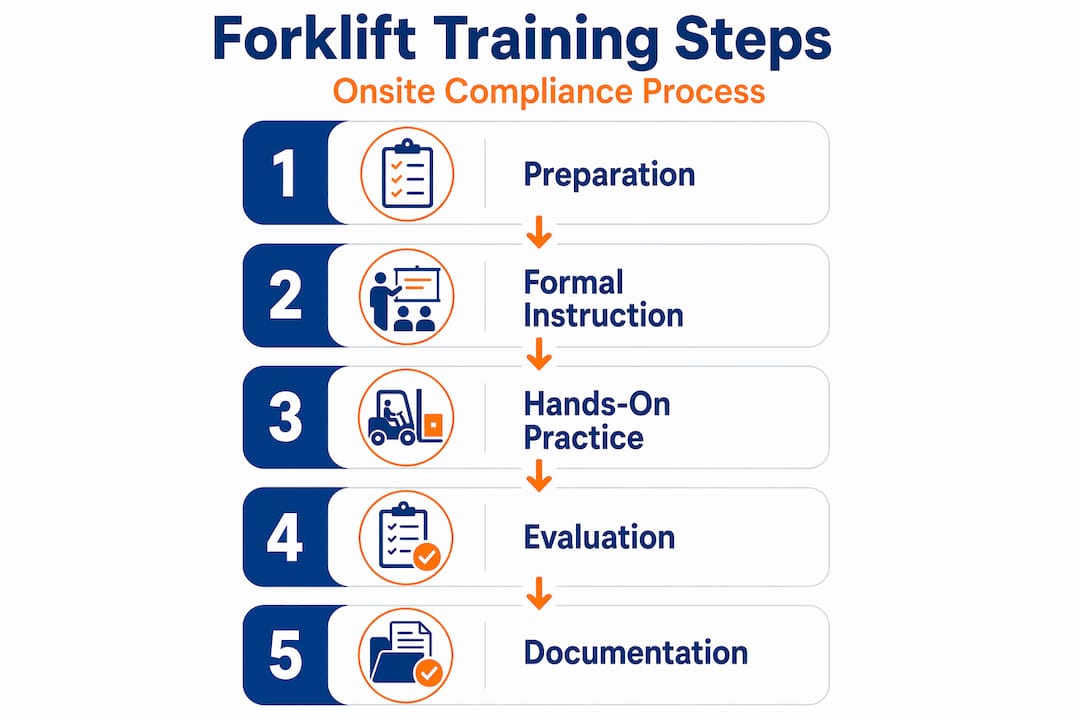
Start with your equipment inventory. Employers must catalog every powered industrial truck on site, because OSHA treats each truck class as a separate training requirement. A counterbalanced rider truck (Class 4) and a reach truck (Class 2) are not interchangeable for training purposes. If your warehouse runs both, your operators need documented training on both. Many compliance officers discover mid-inspection that they’ve been running a single generic program for three different truck types — that’s a citation waiting to happen.
Qualifying your trainer matters more than most managers realize. Your trainer must have verifiable knowledge, experience, and understanding of OSHA’s forklift standard (29 CFR 1910.178). That means they don’t just know how to drive a forklift. They must understand load capacities, pre-shift inspection protocols, and how to evaluate another operator’s performance objectively. Consider whether organizing onsite forklift training with a structured trainer program is more reliable than relying on informal experience.
Your training content must cover OSHA-required topics AND site-specific conditions. Generic forklift training doesn’t cut it. Topics must include truck-related hazards, load stability, pedestrian safety, and the specific floor surfaces, ramps, and dock areas your operators actually encounter. Review forklift training prerequisites to confirm you’re covering every required module before your program goes live.
Build a realistic training schedule, including initial training for new hires, type-specific training when equipment changes, and calendar reminders for three-year re-evaluations. Don’t leave scheduling to memory.
Key items to include in your pre-training setup:
- Complete inventory of all powered industrial truck types on site
- Verified trainer qualifications and documented credentials
- Topic checklist aligned to OSHA 29 CFR 1910.178(l)(3)
- Site-specific hazard identification for training content
- Scheduling system for initial training and re-evaluation cycles
| Preparation task | Responsible party | Completion trigger |
|---|---|---|
| Equipment type inventory | Safety compliance officer | Before program launch |
| Trainer qualification review | Warehouse manager | Before first training session |
| OSHA topic checklist review | Trainer | Before each training cycle |
| Site hazard documentation | Safety officer + trainer | After any facility change |
| Training schedule creation | Warehouse manager | Before onboarding new hires |
Pro Tip: Use your equipment list as the backbone of your training matrix. Each truck type gets its own column, and each operator gets a row. At a glance, you can see who is certified on what, and where gaps exist.
Step-by-step execution of onsite forklift training
With preparation in place, it’s time to execute the critical OSHA-mandated training steps onsite. These aren’t interchangeable phases you can condense or reorder — each one serves a distinct compliance function.
OSHA mandates formal instruction, practical training, and workplace evaluation as separate, required components of step-by-step forklift training. Skipping or blending these steps is the most common reason employers fail compliance audits.
The three mandatory onsite forklift training steps:
- Formal instruction: Deliver classroom or online training covering every OSHA-required topic. This includes forklift controls and instrumentation, stability and load handling, pre-operation inspection procedures, fueling and charging safely, and hazard recognition. Online delivery counts here, but the content must match the specific truck types and site conditions your operators will face.
- Practical hands-on training: Operators move from content to equipment. Under direct trainer supervision, they practice the actual tasks they’ll perform on the job: picking, transporting, lowering loads, navigating turns, and operating in the real environment of your facility. This must be done on the same class of truck the operator will use. Practicing on a sit-down counterbalanced forklift and then certifying someone on a stand-up reach truck is a compliance failure.
- Workplace performance evaluation: The trainer directly observes the operator performing job functions in real working conditions. This is not a written test. It’s a live assessment of whether the operator can do the job safely without supervision. Reviewing the full OSHA forklift training steps process helps ensure you don’t accidentally combine this step with practical training, which is the most common compliance mistake.
What to document during each step:
- Operator’s full name and employee ID
- Date of each training component
- Trainer’s name and qualifications
- Truck type(s) covered during training
- Evaluation outcome and any observed deficiencies
| Training step | Format | Who conducts it | OSHA requirement |
|---|---|---|---|
| Formal instruction | Classroom or online | Qualified trainer | Mandatory per truck type |
| Practical training | Hands-on, supervised | Qualified trainer | Mandatory per truck type |
| Workplace evaluation | Live observation | Qualified trainer | Mandatory before unsupervised operation |
An employee forklift training guide can help you structure this delivery sequence for multiple operators across multiple shifts without letting any step fall through the cracks.
Pro Tip: Run your workplace evaluation during actual shift conditions, not in a cleared-out warehouse at 6 a.m. OSHA’s standard requires evaluation in the conditions where the operator will actually work. If your operator runs a busy receiving dock, evaluate them there.
Maintaining compliance: documentation and re-evaluation cycles
After delivering training, proper documentation and ongoing evaluations ensure lasting safety and compliance. This is where many warehouses do well at first and then drift — and where OSHA inspectors focus heavily.
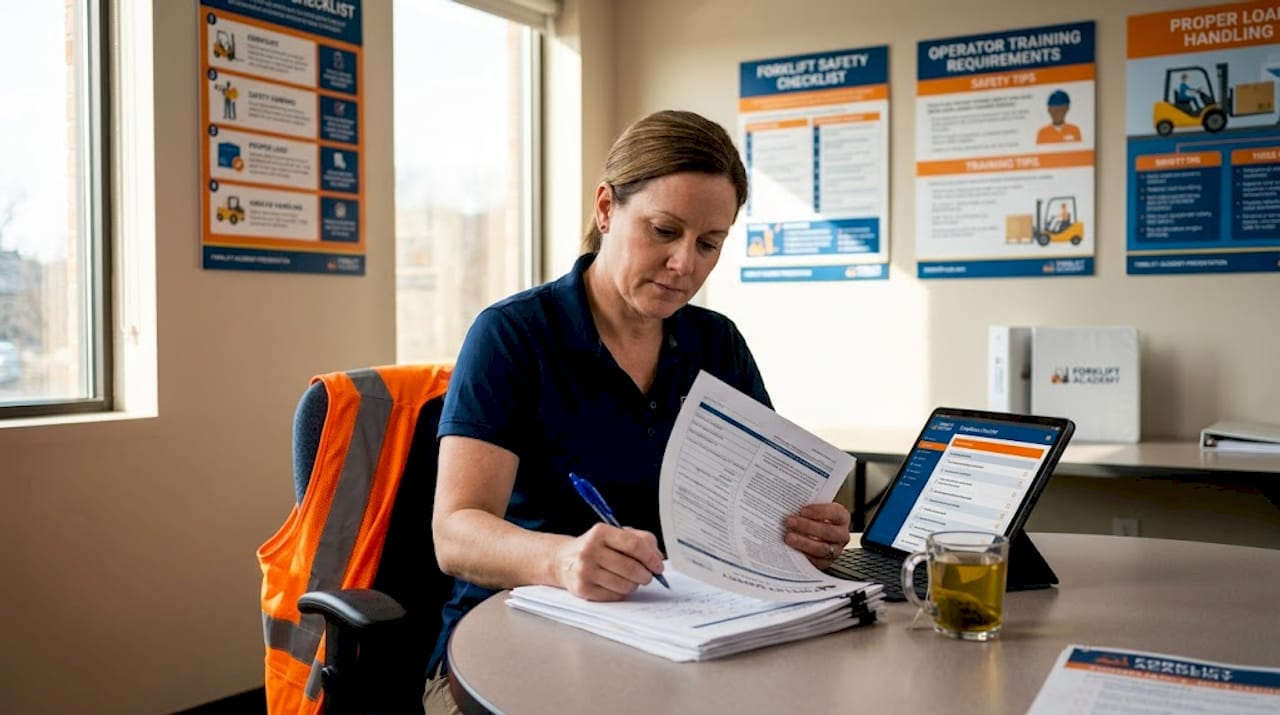
OSHA requires documented training records that include operator identity, dates of training, trainer credentials, and the specific truck types covered. These records must be accessible, not buried in a filing cabinet. If an inspector walks in and your records are disorganized or incomplete, the training itself doesn’t matter — you’re still exposed.
What every training record must contain:
- Operator name and identifying information
- Date of each training component (formal, practical, evaluation)
- Name and qualifications of the trainer
- Equipment type(s) covered
- Evaluation outcome, including any corrective actions taken
- Scheduled date of next re-evaluation
Set your three-year re-evaluation reminders now, not when the date arrives. Your forklift compliance checklist should include a column for evaluation expiration dates per operator and per truck type.
Beyond the calendar, recognize the triggers that require immediate retraining before three years pass:
- Observed unsafe operation, even once
- Any forklift accident or near miss
- Operator assigned to a new or different truck type
- Changes to the physical layout or hazards of the work area
- Supervisor observation revealing knowledge gaps
Build a “stop and fix” protocol into your program. When a trainer or floor supervisor observes unsafe behavior, there must be a defined process: pull the operator from unsupervised operation, conduct targeted retraining, document it, and re-evaluate before they return. Without this system, you’re reactive to OSHA rather than ahead of it. The OSHA training tips for managers section of your compliance framework should address this loop explicitly.
| Documentation method | Best for | Limitation |
|---|---|---|
| Spreadsheet tracker | Small to mid-size warehouses | Manual updates required |
| Training management software | Multi-site, large teams | Initial setup time |
| Paper records | Backup only | Difficult to audit at scale |
Pro Tip: Add a calendar invite or automated reminder to your training management system the day every evaluation is completed. Set it to fire 30 days before the three-year window closes. Waiting until expiration guarantees you’ll miss it.
Common onsite forklift training challenges and how to overcome them
Knowing how to sidestep common pitfalls will help your onsite training program succeed smoothly. The most damaging mistakes are rarely about intent. They’re about structure.
Many employers mistakenly combine practical training with workplace evaluation, which puts them out of compliance even when they believe they’ve done everything right. These are legally distinct steps. Practical training is instruction and guided practice. Evaluation is independent performance assessment. One cannot substitute for the other.
The most common onsite training challenges and how to address them:
- Blending training steps: Treat each phase as a separate, documented event with its own date and sign-off. A combined “training and eval” session doesn’t satisfy OSHA.
- Undertrained trainers: Verify that whoever is conducting training can articulate OSHA’s standard, not just operate the equipment. Trainer qualification is not optional.
- Scheduling conflicts: Run training during low-traffic hours when possible. High-activity periods create distractions that compromise both learning and safety during evaluations.
- Operator resistance: Frame training as protection, not surveillance. Operators who understand that proper training limits their personal liability are more engaged.
- Expired certifications: Assign a compliance officer as the sole owner of the training calendar. Shared responsibility usually means no one does it.
“The operators most resistant to retraining are usually the ones with the most ingrained bad habits. That’s exactly who needs the evaluation most.”
Staying current on OSHA inspection requirements for forklifts and scissor lifts gives you a preview of what inspectors actually look for, which shapes how you structure your own program.
Pro Tip: After every training cycle, conduct a 10-minute debrief with your trainer. Ask what operators struggled with and whether any evaluation outcomes were borderline. That conversation, documented informally, helps you refine the next cycle and catch systemic issues before they become incidents.
Why focusing on outcomes, not just procedures, makes onsite forklift training truly effective
Here’s the part most training guides skip: following the steps correctly and running an effective training program are not the same thing.
Plenty of warehouses have perfectly formatted documentation and still experience forklift incidents. Why? Because they treated certification as the finish line instead of the starting point.
OSHA’s forklift standard is outcome-based, meaning it cares about demonstrated safe operation and documented competence, not which vendor you used or how many slides your presentation had. That’s actually a significant freedom if you use it correctly. You can design your training around your real equipment, your real hazards, and your actual operators’ current skill levels. Most companies don’t take that flexibility seriously.
The warehouses with the best safety records we’ve seen don’t just run training programs. They run business forklift training systems that include continuous floor observation, a genuine stop-and-fix loop, and managers who treat a near miss as a training event rather than an embarrassment.
Onsite forklift training should function as a continuous system triggered by evidence, not just calendar events. A trainer who certifies an operator and then never observes them again hasn’t completed a training program. They’ve completed a paperwork exercise.
The documentation piece shifts when you adopt this mindset. Instead of recording that someone attended a session, you’re capturing what they can and cannot do, what corrective action was taken, and whether the behavior changed. That’s the difference between records that satisfy an inspector and records that actually reflect a safer workplace.
Investing in a feedback-driven, continuously monitored program also carries a direct business case. OSHA penalties for serious violations can reach $16,550 per incident as of 2026. A single forklift accident with injury easily costs six figures in workers’ compensation, lost productivity, and legal exposure. The three-year re-evaluation isn’t a bureaucratic formality. It’s a floor, not a ceiling.
Get OSHA-compliant forklift training and certification with Forklift Academy
If you’re serious about running a compliant, documented forklift training program without reinventing the wheel, Forklift Academy has the infrastructure to support you. With over 20 years of experience delivering OSHA-compliant certification programs across the U.S. and Canada, we build solutions for warehouse managers who need results, not more paperwork.
Whether you need to certify a single operator or train an in-house trainer to run your ongoing program, we have the tools. Our train the trainer online course gives your designated trainer the knowledge and materials to conduct and document all three OSHA-required training steps on your floor. For managers who want to understand exactly what top OSHA forklift certification looks like and how to achieve it, our resources walk you through every requirement. And if you’re clarifying your own OSHA certification process obligations, we make compliance straightforward.
Frequently asked questions
What are the mandatory components of OSHA-compliant onsite forklift training?
OSHA requires three components for every operator: formal instruction, practical hands-on training, and a workplace performance evaluation conducted by a qualified trainer, all completed before the operator works unsupervised.
How often must forklift operators be re-evaluated according to OSHA?
OSHA mandates re-evaluation at least every three years, plus additional retraining whenever an operator is involved in an accident, observed operating unsafely, assigned to new equipment, or faces changed workplace conditions.
Can online training alone satisfy OSHA forklift training requirements?
No. Online courses can deliver the formal instruction portion, but OSHA requires practical training and evaluation to be completed in person before an operator can be considered compliant.
Who qualifies as a “qualified trainer” for onsite forklift training?
A qualified trainer must have knowledge, training, and experience in forklift operation and OSHA’s applicable standard to deliver instruction and objectively evaluate operator performance.
What triggers forklift operator retraining besides the three-year evaluation?
Retraining is required after any near miss or accident, observed unsafe operation, assignment to a different truck type, or a significant change to the work environment that affects safe operation.
Recommended
- Guide to Onsite Forklift Training: Master Safety Skills – Top Osha Forklift Certification
- Onsite Forklift Training: Safeguarding Warehouse Operations – Top Osha Forklift Certification
- Forklift Training Program Setup: Step-by-Step Guide – Top Osha Forklift Certification
- Onsite forklift training for OSHA-compliant safety – Top Osha Forklift Certification