
TL;DR:
- Choosing a forklift training program is a legal safety obligation for employers, with inadequate training causing numerous accidents annually. It requires compliance with specific OSHA or Canadian provincial standards, including formal instruction, practical evaluation, and thorough documentation. Tailored, site-specific training delivered by qualified evaluators ensures operators are competent and your business remains compliant and safe.
Knowing how to choose a forklift course isn’t just a training question. It’s a legal and safety obligation that lands squarely on your desk as an employer. Forklifts are involved in roughly 85 fatal accidents and nearly 35,000 serious injuries each year in the U.S. alone, and the majority trace back to inadequate operator training. OSHA holds employers directly accountable, meaning a wrong choice here doesn’t just put workers at risk. It exposes your business to citations, fines, and potential litigation. This guide cuts through the noise and gives you a clear framework for finding the right program.
Table of Contents
- Understanding OSHA and Canadian forklift training regulations
- Preparing to choose the right forklift course: requirements and prerequisites
- Evaluating forklift training programs: options and quality factors
- Executing forklift training and verifying operator competence
- Common mistakes when choosing forklift training and how to avoid them
- Why custom-tailored forklift training beats one-size-fits-all courses
- Top OSHA-compliant forklift training solutions for your business
- Frequently asked questions
Understanding OSHA and Canadian forklift training regulations
Before you can choose the right course, you need to know exactly what the law requires. The regulatory picture looks different depending on which side of the border you operate on, and mixing up the rules is one of the most common compliance mistakes employers make.
In the United States, OSHA 1910.178(l) mandates formal instruction, practical training, and evaluation before any operator can work unsupervised. The standard is federal, which means it applies from a warehouse in Atlanta to a distribution center in Seattle. There is no state-level opt-out. Forklift training certification is entirely employer-driven. No government agency issues a license. Your documentation is your proof of compliance.
Canada operates differently. There is no federal forklift standard equivalent to OSHA. Instead, Canadian provinces enforce their own occupational health and safety regulations, most of which reference CSA B335-15, the national industrial truck safety standard. The practical result is that training requirements vary by province, and a certified operator in Ontario cannot simply walk into a British Columbia facility and be considered compliant without a site-specific orientation and re-evaluation.
Here is what both U.S. and Canadian frameworks share in common:
- Training must be specific to the forklift class and type the operator will use
- Programs must include formal instruction, practical training, and evaluation
- Employers must maintain written records of all training and evaluations
- Refresher training is required after incidents, observed unsafe behavior, or changes in conditions
Understanding this forklift training guide for OSHA compliance before you start comparing programs is essential. If a provider cannot explain how their curriculum maps to these requirements, that alone should disqualify them.
Preparing to choose the right forklift course: requirements and prerequisites
With the legal landscape clear, let’s look at what you need to prepare internally before you evaluate a single provider.
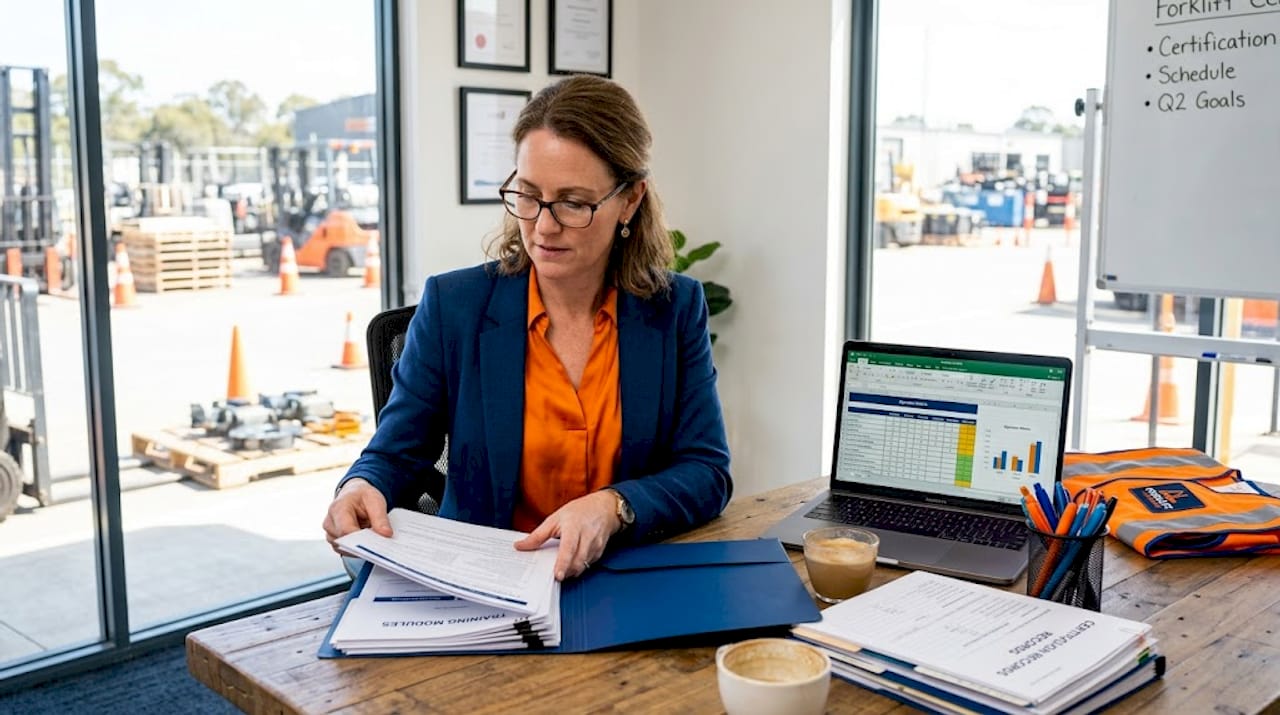
The first step is an inventory of your equipment. Training must be specific to the forklift class and workplace hazards, covering both theory and practical evaluation. Forklifts are divided into seven classes under OSHA, from electric motor rider trucks (Class I) to rough terrain forklifts (Class VII). An operator trained on a Class IV internal combustion engine sit-down rider truck is not authorized to operate a Class II narrow-aisle reach truck. These are not interchangeable.
Here is a quick reference for common forklift classes:
| Class | Type | Common use |
|---|---|---|
| I | Electric motor rider truck | Indoor warehouses |
| II | Electric motor narrow-aisle truck | High-density racking |
| III | Electric motor hand or hand-rider truck | Order picking |
| IV | Internal combustion engine truck (cushion tires) | Indoor/smooth surfaces |
| V | Internal combustion engine truck (pneumatic tires) | Outdoor/mixed surfaces |
| VI | Electric and IC engine tractor | Towing applications |
| VII | Rough terrain forklift | Construction, outdoor uneven ground |
Beyond equipment class, review your site-specific hazards. Narrow aisles, high-traffic pedestrian zones, dock areas, cold storage environments, and racking density all affect what your training program needs to address. A thorough prereview of training prerequisites will save you from buying a generic course that misses half of what your operators actually need.
Pro Tip: Create a simple operator matrix before purchasing any training. List each operator’s name, the forklift classes they currently use, their last training date, and their next recertification due date. This one document will expose every gap in your current compliance status before you even talk to a training provider.
Evaluating forklift training programs: options and quality factors
Not all programs are created equal. Price, delivery method, and curriculum depth vary widely, and the lowest-cost option is almost never the smartest one.
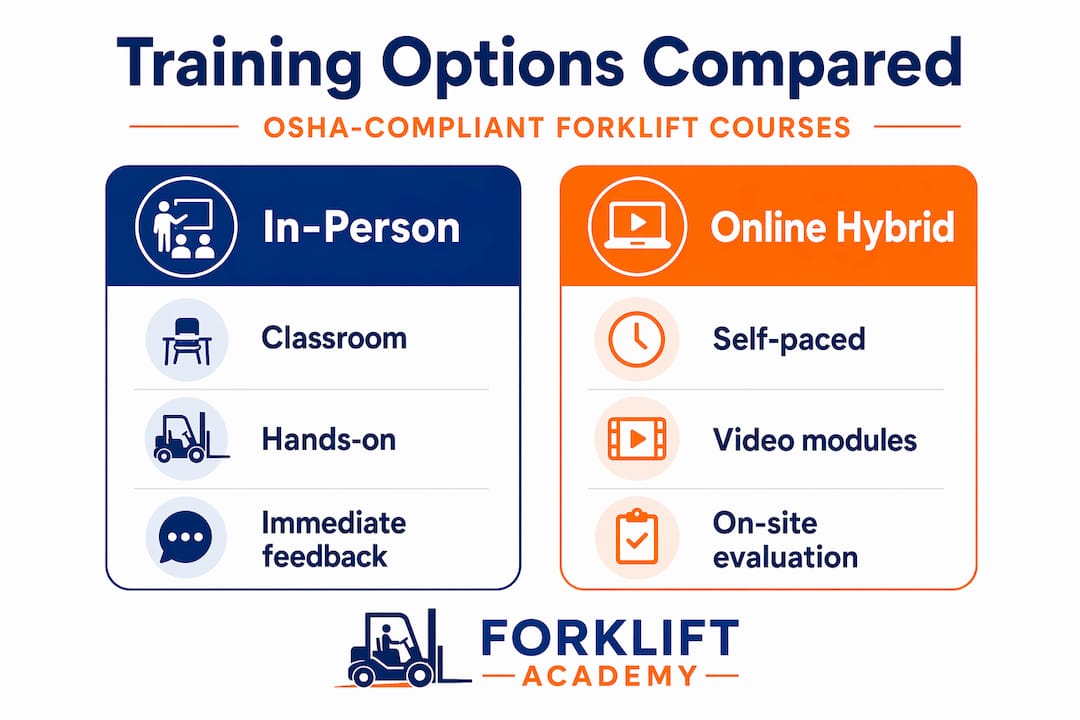
Here is a side-by-side comparison of the three main delivery formats:
| Format | Theory delivery | Practical evaluation | Best for |
|---|---|---|---|
| Fully in-person | Classroom | On-site with trainer | Small teams, single location |
| Online theory + in-person practical | Web-based modules | On-site with trainer | Multi-location employers |
| Train-the-trainer | External initial training | Internal qualified trainer | Large operations, ongoing needs |
Online theory can reduce costs significantly without sacrificing compliance, but hands-on practical evaluation is non-negotiable and must be conducted in person by a qualified trainer. Any provider advertising a “fully online certification” that skips the practical component is not offering OSHA-compliant training. Full stop.
When evaluating any fork lift certification training program, ask these questions:
- Does the curriculum explicitly reference OSHA 1910.178(l) or the applicable CSA B335-15 standard?
- Is the practical evaluation conducted by a qualified evaluator (someone with documented knowledge, training, and experience)?
- Does the program cover your specific forklift classes, not just generic forklift operation?
- Does it include a site-specific hazard component, or does it only cover equipment operation?
- What documentation do you receive after training, and is it audit-ready?
Choosing the cheapest provider without verifying adherence to OSHA standards or CSA B335-15 leads to certificates that look legitimate but collapse under regulatory scrutiny. OSHA inspectors do not check for a card. They check for documented evidence that a qualified trainer evaluated the operator on the actual equipment in the actual workplace.
Pro Tip: Look for providers that offer a train-the-trainer option alongside individual certifications. The upfront cost is higher, but if you have 20 or more operators and ongoing hiring, building an internal qualified trainer pays for itself within the first year. Review the forklift training delivery options available to understand which format fits your workforce size and schedule.
Executing forklift training and verifying operator competence
Once you have chosen a program, execution matters just as much as selection. A well-designed course delivered poorly will not protect you or your workers.
Follow this sequence for every operator you put through training:
- Complete formal instruction covering operating principles, safety rules, load handling, and refueling or recharging procedures
- Conduct hands-on training on the specific forklift class the operator will use, in conditions that resemble actual work
- Administer a written test to confirm theory comprehension
- Perform a practical evaluation with a qualified trainer observing the operator on the actual equipment in the actual workplace
- Document everything: training date, topics covered, trainer name and qualifications, test scores, and evaluation results
- Issue authorization to operate only the classes and equipment types covered in training
Employers must conduct practical evaluations and document operator competency. This is non-negotiable, and no government-issued license replaces this process.
On the topic of forklift re-certification, the rule is clear:
Re-evaluation is required at minimum every three years, and immediately after any observed unsafe operation, near-miss, accident, or when an operator is assigned to a new type of equipment or work environment.
Track these forklift training steps carefully and build reminders into your HR or safety management system. Three years passes faster than you think, especially in high-turnover warehousing environments.
Common mistakes when choosing forklift training and how to avoid them
Even well-intentioned employers stumble in predictable ways. Recognizing these patterns early can save you from a costly OSHA citation or, worse, a preventable injury.
The most frequent mistakes include:
- Buying a cheap online certificate without verifying that practical evaluation is included or completed
- Assuming one certification covers all equipment: certification on one forklift class does not authorize an operator to use other classes without class-specific training
- Skipping site-specific hazard orientation, which is required even when an operator transfers from another facility with valid training
- Letting certifications lapse by not tracking re-evaluation dates, especially in high-turnover environments
- Using unqualified evaluators: the person conducting the practical evaluation must have documented knowledge and experience with the equipment being evaluated
OSHA does not require a specific number of training hours. What they require is demonstrated competence. That means your evaluation must be thorough enough to prove the operator can do the job safely, not just pass a checklist.
Pro Tip: Audit your current training records once a year. Pull the files for five random operators and verify that each one has a documented practical evaluation, a trainer signature, and a training date within the required window. If any of those three elements are missing, you have a compliance gap right now. Use the OSHA training requirements checklist as a reference when doing this audit.
Why custom-tailored forklift training beats one-size-fits-all courses
Here is the uncomfortable truth most training vendors will not tell you: a generic forklift course teaches operators how to drive a forklift. It does not teach them how to drive your forklift in your facility with your specific hazards. Those are two very different things.
Effective training programs match the specific forklift class and workplace hazards. That is not a nice-to-have. It is what separates compliant training from box-checking. A course that covers counterbalance forklift operation generically will not prepare an operator for a narrow-aisle facility with 30-foot racking, high pedestrian traffic, and dock plates they have never encountered.
We have worked with employers who assumed their workers were covered because they had a certification card on file. When those employers faced OSHA audits, the cards were present. The documented practical evaluations were not. The site-specific hazard training was nowhere in the records. That is not a training failure. That is a selection failure, where the employer chose a provider based on price and speed rather than compliance depth.
Investing in a train-the-trainer approach builds something no off-the-shelf course can: institutional knowledge. An internal qualified trainer knows your equipment, your layout, your seasonal traffic patterns, and your new-hire onboarding process. They can deliver customized forklift training that reflects real conditions, not a stock video shot in a distribution center that looks nothing like yours. Over time, that investment lowers per-operator training costs, accelerates onboarding, and makes your compliance documentation airtight.
Top OSHA-compliant forklift training solutions for your business
Choosing the right training partner is as important as choosing the right format. At Forklift Academy, we have spent over 20 years helping warehouse managers and employers across the U.S. and Canada build training programs that hold up under regulatory scrutiny.
Our forklift training programs cover all major forklift classes and are built to meet OSHA 1910.178(l) and Canadian provincial requirements. Whether you need online theory modules with practical evaluation, full onsite training for your team, or a train-the-trainer program to build lasting in-house capacity, we have a format designed to fit your operation. We also provide audit-ready documentation tools and OSHA compliance guidance so you are never left guessing whether your records will pass inspection. If you are ready to close compliance gaps and protect your workforce, this is where you start.
Frequently asked questions
Is there an official forklift license issued by the government?
No. In both the U.S. and Canada, there is no government-issued forklift license. Certification is issued by employers after training and practical evaluation, and your internal documentation is the proof of compliance.
How often should forklift operators receive refresher training?
Refresher training is required at least every three years, and immediately after any incident, observed unsafe behavior, or change in equipment or work conditions. Some Canadian provinces, including British Columbia, have this codified explicitly.
Can online forklift training alone fulfill OSHA requirements?
No. While theory instruction can be completed through online certification modules, practical hands-on evaluation must be conducted in person by a qualified trainer. A fully online certificate without a practical component does not meet OSHA or Canadian provincial standards.
Do forklift training certifications transfer between Canadian provinces?
No. Training accepted in one province may not satisfy requirements in another without a site-specific orientation and re-evaluation. Employers must verify training validity and conduct their own documentation process when operators move between provinces.
Who is legally responsible for ensuring forklift operators are properly trained?
Employers hold full legal responsibility. Employers are legally required to ensure training is complete, documented, and current before any operator works unsupervised, under both OSHA and Canadian occupational health and safety laws.
Recommended
- OSHA Training Guide 2025 for Forklift Certification Success – Top Osha Forklift Certification
- Business forklift training guide: OSHA compliance 2026 – Top Osha Forklift Certification
- How to Implement Forklift Safety Training for OSHA Compliance – Top Osha Forklift Certification
- Forklift Training Program Guide for OSHA Certification Success – Top Osha Forklift Certification