
Forklift accidents kill roughly 85 workers and seriously injure nearly 35,000 more every year in the United States. Yet most warehouse managers still treat safety as a checklist rather than a system. Warehouse safety encompasses policies, procedures, training, and equipment to protect workers from hazards in warehouse environments. Miss any one of those pillars and you expose your team, your budget, and your license to operate. This article breaks down the real definition of warehouse safety, the OSHA standards that govern it, the hazards most likely to hurt someone on your floor, and the practical steps you can take starting today.
Table of Contents
- What does warehouse safety really mean?
- Key OSHA standards for forklift safety
- Common warehouse hazards and how to prevent them
- Critical forklift operating practices for safety
- Building and sustaining a culture of warehouse safety
- Achieve warehouse safety and compliance with expert certification
- Frequently asked questions
Key Takeaways
| Point | Details |
|---|---|
| OSHA compliance is essential | Following 29 CFR 1910.178 safeguards your workers and avoids costly fines. |
| Tip-overs are preventable | Proper training and strict protocols can prevent most serious forklift accidents. |
| Safety is a culture | Embedding safety practices and regular audits reduces incidents and builds long-term results. |
| Training makes the difference | Nearly 70% of forklift injuries can be avoided by ongoing education and skill verification. |
What does warehouse safety really mean?
Warehouse safety is not a poster on the break room wall. It is a living system made up of written policies, daily procedures, physical equipment, and ongoing operator training. When one of those elements breaks down, the others cannot fully compensate. That is why a single untrained operator can undo months of careful planning.
The hazards in a warehouse environment are wide-ranging. Vehicle operation, pedestrian collisions, elevated falls, poor sightlines, and hazardous material handling all appear on OSHA’s radar. Forklifts sit at the center of most serious incidents because they combine heavy loads, speed, and limited visibility in tight spaces.
OSHA forklift standards set the legal baseline through 29 CFR 1910.178, which governs powered industrial truck (forklift) operations across general industry. Compliance with this standard is not optional. Violations carry financial penalties, increased injury rates, and potential criminal liability for supervisors.
Effective warehouse safety programs deliver a double benefit. They protect your workers from harm and they protect your operation from costly shutdowns, absenteeism, and regulatory fines. A safe warehouse is also a more productive one because fewer incidents mean fewer interruptions.
“Warehouse safety encompasses policies, procedures, training, and equipment to protect workers from hazards in warehouse environments.” — 29 CFR 1910.178
Key components of a complete warehouse safety program include:
- Written safety policies reviewed and updated at least annually
- Pre-shift equipment inspections documented and signed off by operators
- Certified operator training aligned with OSHA requirements
- Hazard identification procedures covering both routine and non-routine tasks
- Incident reporting systems that capture near-misses before they become fatalities
Key OSHA standards for forklift safety
OSHA’s 29 CFR 1910.178 is the primary federal standard for forklifts in warehouse settings. It covers truck type selection, maintenance schedules, daily inspections, operator training and certification, and worksite-specific operating rules. If your facility uses a powered industrial truck of any kind, this regulation applies to you.
The financial stakes are significant. OSHA fines up to $16,000 per violation for non-compliance with 29 CFR 1910.178, and willful violations can reach far higher. More importantly, facilities with full safety programs see 60% fewer tip-overs compared to those without structured programs.
Here is a quick reference for the core requirements under 29 CFR 1910.178:
| Requirement | What it means for your facility |
|---|---|
| Operator certification | Every forklift operator must complete formal training and evaluation |
| Pre-shift inspection | Equipment must be inspected before each shift and defects reported |
| Truck type matching | The right forklift must be selected for the specific environment |
| Maintenance records | All repairs and service must be documented |
| Worksite rules | Speed limits, load limits, and pedestrian zones must be enforced |
Review your OSHA compliance checklist regularly to confirm your program covers every requirement. Pay special attention to forklift inspection requirements, which are one of the most commonly cited deficiencies during OSHA audits.
For current OSHA benchmarks and penalties, check the latest published guidance to make sure your fine exposure calculations are up to date.
Pro Tip: Schedule quarterly safety audits and require supervisors to log near-miss incidents in a shared tracking system. Near-miss data is one of the most powerful leading indicators you have. It tells you where the next serious accident is likely to happen before it does.
Common warehouse hazards and how to prevent them
Knowing the regulations is step one. Knowing where your people are most likely to get hurt is step two. The top hazards in warehouse forklift operations are tip-overs, pedestrian collisions, falls from elevated platforms, improper load handling, and equipment failures caused by deferred maintenance.
The numbers are stark. Forklift tip-overs cause approximately 42% of fatalities, making them the single deadliest forklift event in warehouses. Most of these deaths are preventable with proper training and consistent operating habits.
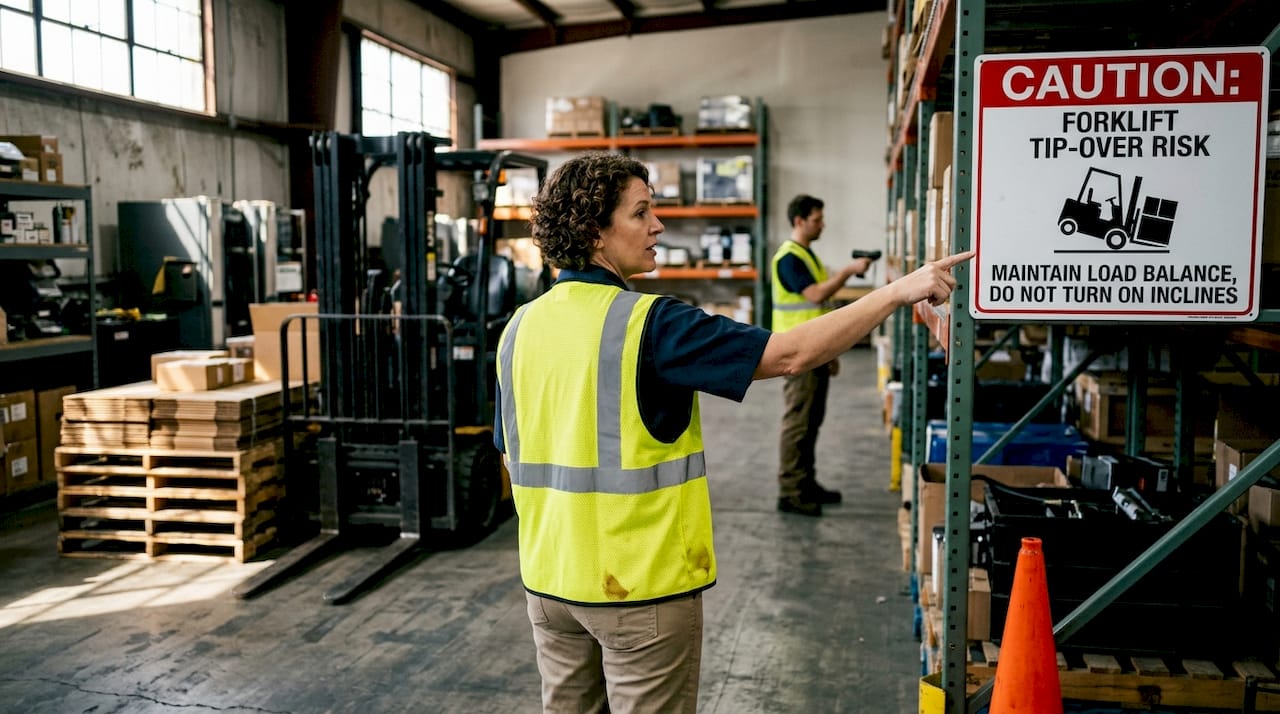
Here is a side-by-side look at the most common hazards, their severity, and how likely they are to occur without a structured prevention program:
| Hazard | Severity | Likelihood without controls | Primary cause |
|---|---|---|---|
| Tip-over | Fatal | High | Sharp turns, overloading, uneven floors |
| Pedestrian collision | Severe | High | Poor visibility, no pedestrian zones |
| Elevated fall | Severe | Moderate | Unsecured platforms, no fall protection |
| Load drop | Moderate to severe | Moderate | Improper stacking, exceeding capacity |
| Equipment failure | Variable | Low to moderate | Skipped inspections, deferred repairs |
Use these incident prevention strategies to address each hazard systematically. The role of training in accident prevention cannot be overstated. Studies consistently show that 70% of forklift accidents are preventable through proper operator training.
Here is a step-by-step prevention plan for the highest-risk hazards:
- Tip-overs: Train operators never to exceed the load capacity plate. Require slow, wide turns. Mark uneven floor areas clearly and repair them promptly.
- Pedestrian collisions: Install physical barriers between forklift lanes and foot traffic. Use mirrors at blind corners. Require horn use at every intersection.
- Elevated falls: Never allow workers to stand on forks or unsecured platforms. Use only approved work platforms with guardrails.
- Load drops: Train operators to keep loads low and stable during travel. Inspect pallets before picking them up.
- Equipment failures: Enforce pre-shift inspections without exception. Tag and remove any equipment with defects from service immediately.
Critical forklift operating practices for safety
Regulations and hazard maps are only useful if operators actually apply them on every shift. These are the non-negotiable daily practices that separate safe warehouses from dangerous ones.
Safe operating practices require operators to carry loads 4 to 6 inches off the ground during travel, never exceed the rated capacity, stay below 5 mph in pedestrian areas, sound the horn at every intersection, and never carry riders on the forks or truck body. These rules exist because each one addresses a specific, documented cause of injury.
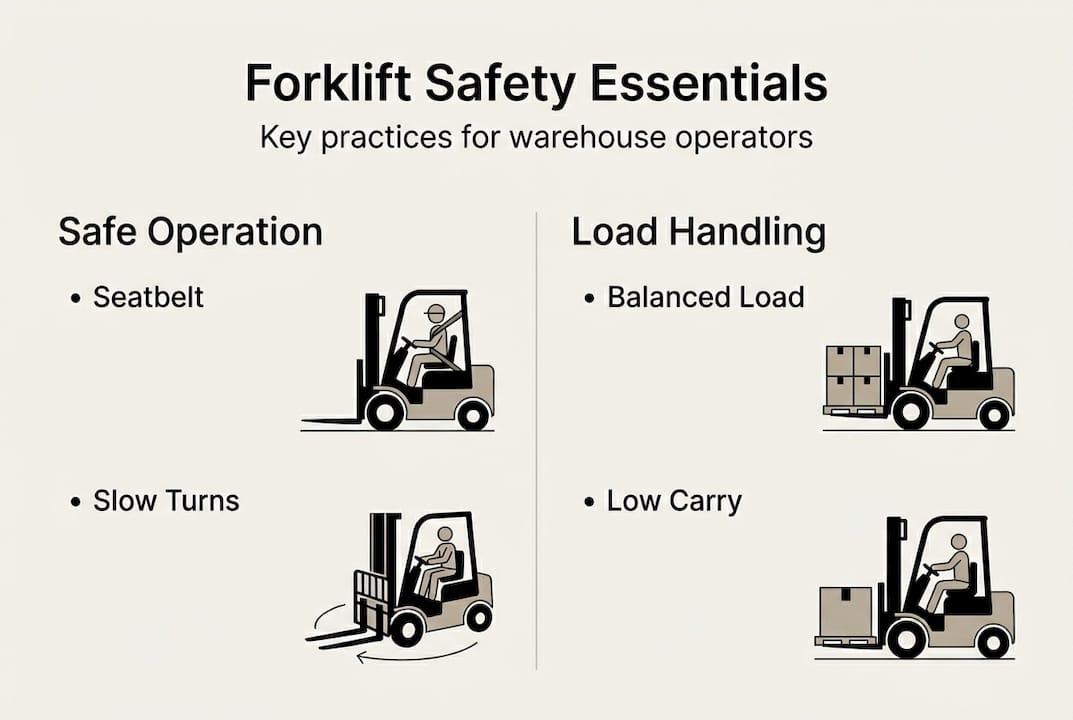
Understanding the stability triangle is essential for every operator. A forklift’s stability depends on three contact points: the two front wheels and the rear axle pivot point. As you raise a load higher or extend it further from the mast, the center of gravity shifts forward and the effective capacity drops. Operators who do not understand this relationship routinely overload their machines without realizing it.
Here is a practical safety checklist for every shift:
- Inspect the forklift before starting (brakes, tires, forks, lights, horn, fluid levels)
- Confirm the load weight before picking up
- Tilt the mast back slightly to stabilize the load during travel
- Slow down before turns, never during them
- Keep a clear sightline; travel in reverse if the load blocks forward view
- Wear the seatbelt on every trip, no exceptions
Pro Tip: If a tip-over begins, do not jump. Grip the steering wheel, brace your feet, and lean away from the direction of the fall. Jumping is the leading cause of operator fatalities during tip-overs because operators land under the falling mast. Reinforce this in every forklift training session so it becomes muscle memory.
Operators who understand why training matters are also more likely to follow these rules consistently, not just when a supervisor is watching.
Building and sustaining a culture of warehouse safety
A safety culture is what happens when your team follows the rules even when no one is watching. It does not emerge from a single training session or a new policy memo. It is built through consistent leadership behavior, open reporting systems, and regular reinforcement.
Here is a numbered action plan for managers who want to move from compliance to culture:
- Lead visibly. Walk the floor. Acknowledge safe behavior publicly. Correct unsafe behavior immediately and respectfully.
- Empower reporting. Make it easy and consequence-free to report near-misses and hazards. Punishing reporters destroys your best early-warning system.
- Invest in regular training. Do not treat certification as a one-time event. Refresh training annually and whenever new equipment or hazards are introduced.
- Track near-misses. Every near-miss is a free lesson. Log them, analyze them, and act on the patterns you find.
- Review hazards quarterly. Warehouses change. New products, new layouts, and seasonal volume spikes all create new risks. Your hazard review schedule must keep pace.
“Facilities with full safety programs see 60% fewer tip-overs; ongoing training and audits are essential to sustaining those results.”
Track your progress using both leading indicators (training completion rates, near-miss reports filed, inspection compliance) and lagging indicators (injury rates, lost workdays, OSHA citations). Leading indicators tell you where you are headed. Lagging indicators tell you where you have been.
The role of training in building this culture is foundational. Managers who invest in structured, recurring training programs see measurable reductions in incidents within the first year.
Achieve warehouse safety and compliance with expert certification
Building a strong safety culture is the goal. Getting there requires formal, structured training that meets OSHA’s exact requirements and holds up under audit scrutiny. That is where Forklift Academy comes in.
With over 20 years of experience delivering OSHA forklift certification programs across the United States and Canada, Forklift Academy offers online and onsite training options built for busy warehouse operations. Whether you need to certify a single operator or train an entire team, the platform gives you flexible, audit-ready solutions. Safety officers who want to build internal capacity can explore the train the trainer course to develop in-house instructors. For a full overview of what certification requires and how to stay compliant, start with navigating certification requirements to map out your next steps.
Frequently asked questions
What is OSHA’s key standard for warehouse forklift safety?
OSHA standard 29 CFR 1910.178 is the primary regulation governing safe forklift operation in warehouses, covering everything from operator training to equipment maintenance.
What causes most forklift accidents in warehouses?
Tip-overs are the leading cause of forklift fatalities, typically triggered by overloading, sharp turns, or uneven surfaces, and most are preventable with proper training.
How often should warehouse safety training be conducted?
Conduct training at least annually, and immediately whenever new equipment, new hazards, or observed unsafe behavior is identified. Ongoing training and audits are what sustain low incident rates over time.
Which forklift safety rules do most operators miss?
Proper load positioning, seatbelt use, and the correct response during a tip-over (stay in the seat, grip the wheel, lean away) are the rules operators most commonly overlook or forget under pressure.
What is the penalty for failing to comply with warehouse safety standards?
OSHA fines up to $16,000 per violation for non-compliance, with willful or repeat violations subject to significantly higher penalties.
Recommended
- Forklift incident prevention: reduce warehouse risks – Top Osha Forklift Certification
- OSHA Training Cuts Forklift Incidents 70%: Safety Guide – Top Osha Forklift Certification
- OSHA Forklift Standards: Reducing Warehouse Risks – Top Osha Forklift Certification
- Forklift Hazard Awareness Explained: Reducing Warehouse Risks – Top Osha Forklift Certification