
TL;DR:
- Forklifts move vast quantities of products daily but pose significant safety risks due to operator errors and hazards. Implementing ongoing training, hazard identification, and management involvement reduces incidents and ensures compliance with OSHA and CSA B335 standards. Building a strong safety culture with accurate documentation, operator feedback, and systematic inspections prevents accidents and safeguards warehouse operations.
Forklifts move millions of tons of product every day across U.S. and Canadian warehouses, but they are also one of the most dangerous pieces of equipment on the floor. Powered industrial truck (PIT) incidents cause serious injuries and fatalities, and many of those outcomes trace directly back to operator competence and safe operating practices. If you manage a warehouse, forklift safety is not a box to check once a year. It is an ongoing responsibility that protects your workers, keeps your facility compliant with OSHA and Canadian standards, and prevents the kind of incident that shuts operations down.
Table of Contents
- The real risks: Consequences of poor forklift safety
- What makes forklift safety a legal and operational must
- Key elements of an effective forklift safety program
- Special considerations for Canada: Certification, programs, and language
- What most guides get wrong about forklift safety
- Get OSHA-compliant: Your next steps with Forklift Academy
- Frequently asked questions
Key Takeaways
| Point | Details |
|---|---|
| Injury rates are high | Forklift accidents cause severe injuries and fatalities—making safety programs essential for every warehouse. |
| Legal compliance matters | Both OSHA and Canadian regulations mandate effective forklift safety training and certification. |
| Systemic approach needed | True safety goes beyond operators—programs must address hazards, policies, and culture. |
| Jurisdictional differences | Canada uses varied terms for operator qualification but always demands formal safety programs and records. |
| Actionable improvement | Managers should go beyond compliance with ongoing training, audits, and open communication. |
The real risks: Consequences of poor forklift safety
Many warehouse managers underestimate forklift danger because the equipment looks familiar and the tasks look routine. That familiarity is the problem. A forklift carrying a 3,000-pound load moving at just five miles per hour has stopping distance comparable to a car at highway speeds, yet operators work within feet of pedestrians, racking systems, and blind corners every shift.
Understanding forklift safety hazards starts with understanding how incidents happen. They rarely involve a single catastrophic mistake. More often, they result from a chain of smaller failures: an operator who was never properly certified, a pedestrian lane that was poorly marked, a load stacked higher than the rated capacity. Severe outcomes include fatalities where workers are struck or crushed by forklifts or loads and crushed during tip-overs, and both nonfatal and fatal incidents are tracked as significant workplace events by safety regulators.
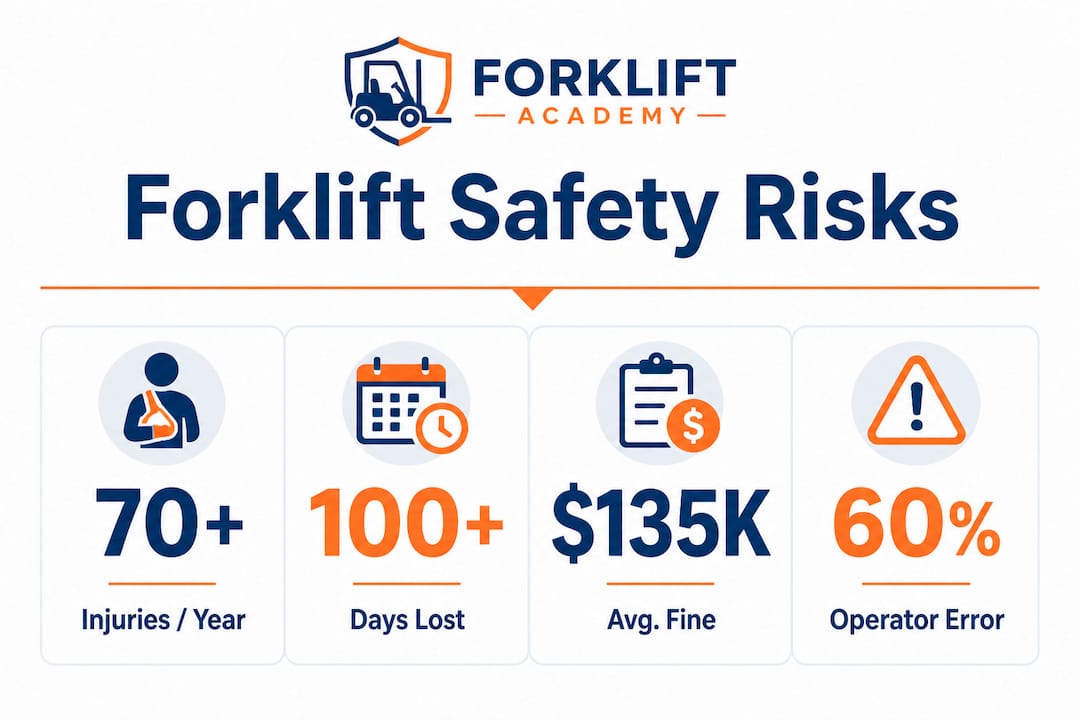
Here is a breakdown of the most common incident types, their typical frequency, and outcomes:
| Incident type | Relative frequency | Typical outcome |
|---|---|---|
| Tip-overs | Very high | Fatal/serious crush injuries |
| Struck by forklift or load | High | Fatal/serious trauma |
| Falling loads | High | Crush injuries, fatalities |
| Collisions with racking | Moderate | Property damage, injury |
| Runaway/roll-away events | Moderate | Fatal/serious crush injuries |
| Pedestrian caught in travel path | High | Serious injury, fatality |
“Forklift incidents are not random events. They follow recognizable patterns and are preventable when managers treat safety as a system rather than a set of individual behaviors.”
Preventable scenarios your team faces every week include:
- Tip-overs on uneven surfaces or during sharp turns with elevated loads
- Struck-by incidents when pedestrians enter forklift travel lanes
- Falling loads caused by improper stacking or exceeding rated capacity
- Roll-away events when a forklift is left running or on an incline without the parking brake set
- Blind corner collisions where mirrors, lights, or spotters are absent
The impact on your operation goes beyond the immediate injury. An OSHA investigation can halt production for days. Workers’ compensation claims drive up insurance costs. Reputation damage affects recruiting. And in serious cases, criminal liability for managers and owners becomes a real possibility. Building effective incident prevention strategies from the start is far less costly than recovering from a critical event.
What makes forklift safety a legal and operational must
OSHA’s powered industrial truck standard (29 CFR 1910.178) sets clear requirements for U.S. employers, and Canadian provinces have parallel rules backed by national guidance from CCOHS and the CSA B335 standard. Operator safety programs must include training, certification or licensing requirements that vary by jurisdiction, and structured safety program elements. Ignoring these requirements is not a calculated risk. It is a guaranteed liability.
Here is a side-by-side comparison of what U.S. and Canadian frameworks require:
| Requirement | U.S. (OSHA 29 CFR 1910.178) | Canada (CSA B335 / Provincial) |
|---|---|---|
| Operator training | Required before independent operation | Required; trainer must be competent |
| Certification/licensing | Employer-issued certification | Varies by province; some require formal licensing |
| Refresher training | Every 3 years or when unsafe behavior observed | Employer-determined; aligned to CSA B335 |
| Equipment inspection | Pre-shift checklist required | Required; maintenance records must be kept |
| Written program | Strongly recommended | Required under most provincial OH&S acts |
| Minimum operator age | 18 years in most U.S. states | Varies; most provinces set 16 to 18 years |
One important nuance worth understanding is the vocabulary difference between jurisdictions. In the U.S., OSHA uses the term “certified” to describe an operator who has completed employer-issued training and evaluation. Canada uses “competent,” “trained,” “licensed,” or “authorized” depending on the province. The minimum operator age and scope of required documentation also shift depending on where your facility operates. The core expectation everywhere is the same: operators must be qualified, authorized for their specific equipment type, and retrained when circumstances change.
Steps to build a compliant program from scratch:
- Audit your current state. Identify which operators are certified, which equipment types are in use, and where documentation gaps exist.
- Assign a qualified trainer. Under OSHA and CSA B335, trainers must have the knowledge, training, and experience to instruct operators and evaluate their performance.
- Conduct formal training. Combine classroom or online instruction with hands-on evaluation on the specific forklift types operators will use.
- Issue and document certification. Every certified operator should have a record on file with training date, equipment type, trainer name, and evaluation results.
- Schedule refresher cycles. Mark calendar reminders for three-year renewals and set triggers for early retraining after incidents or observed unsafe behavior.
- Review and update your written safety program annually. Regulations and workplace conditions both change.
Following OSHA compliance steps carefully from the start prevents the scramble that happens when an inspector arrives or an incident occurs. Understanding why certification matters goes beyond avoiding fines. It reduces incident rates and builds a stronger safety culture over time.
Pro Tip: Document everything. Keep training records, pre-shift inspection logs, incident reports, and refresher training dates in a centralized system. If OSHA investigates or a workers’ compensation claim is filed, organized documentation is your first and strongest line of defense.
Key elements of an effective forklift safety program
Knowing what the law requires is different from building a program that actually works on the warehouse floor. Setting up safety training effectively means addressing the human, physical, and procedural elements of your operation together.
The strongest forklift safety programs share these success factors:
- Visible management involvement. When supervisors do regular walk-throughs and enforce safety rules consistently, operators follow suit. When management ignores violations, operators learn that rules are optional.
- Formal hazard identification. Walk every forklift travel route. Identify blind corners, low-clearance areas, uneven flooring, and high-traffic pedestrian crossings. Mark them clearly.
- Structured operator training. Not just initial certification but ongoing skill reinforcement tied to the actual equipment and site conditions in your facility.
- Physical separation of forklifts and pedestrians. Painted lanes, physical barriers, convex mirrors, and warning lights are not optional extras. They are the difference between a near-miss and a fatality.
- Clear load handling procedures. Define maximum load heights, required pallet conditions, and prohibited stacking practices in writing, and post them where operators can see them.
Stacked pallet incidents demonstrate that safety failures are systemic across training, traffic and pedestrian separation, load handling, and site-specific hazard recognition. They are not the result of one careless operator. They are the result of a program that failed to address root causes.
Steps for ongoing inspections and incident review:
- Daily pre-shift inspections. Operators complete a checklist covering brakes, steering, forks, hydraulics, lights, and horn before every shift starts.
- Weekly supervisor walk-throughs. A manager or safety lead walks the full operation looking for new hazards, blocked exits, damaged racking, or behavioral patterns worth addressing.
- Immediate incident documentation. Any collision, near-miss, or unsafe behavior gets recorded within 24 hours, with root cause analysis to follow.
- Monthly review of incident data. Look for patterns. If three incidents happen in the same aisle, the aisle is the problem.
- Annual full program audit. Compare your practices against OSHA and CSA B335 standards to close any gaps before they become violations.
Learning how to implement training for OSHA compliance is a strong starting point, but your program needs to go further than compliance minimums to actually change behavior. Review your essential safety rules at regular team meetings, not just during certification cycles.
Pro Tip: Create clearly marked exclusion zones around charging stations, loading docks, and high-traffic corners. Use floor tape, physical barriers, and posted signage. Then enforce the zones every single day, because a rule that is sometimes enforced is not a safety rule. It is a suggestion.
Special considerations for Canada: Certification, programs, and language
If you operate warehouses in Canada or manage cross-border operations, the regulatory landscape adds a layer of complexity that many U.S.-focused safety programs miss entirely. Canadian provinces each administer their own occupational health and safety legislation, and the language used to describe operator qualifications differs meaningfully between them.
CCOHS guidance clarifies that jurisdictions may use “competent,” “trained,” “certified,” or “licensed” differently, but the core expectation is consistent: operators must be authorized and qualified for their specific task, and employers must implement a lift truck safety program aligned to CSA B335 requirements including training and maintenance.
Action items to align your Canadian facilities with CSA B335:
- Confirm the terminology used in your province. Ontario, British Columbia, Alberta, and Quebec each have specific language in their OH&S regulations. Match your written program to that language to avoid compliance gaps.
- Verify trainer qualifications. CSA B335 requires that trainers have demonstrated competency. An online video watched without evaluation does not satisfy the standard.
- Maintain written training records for every operator, including the date, equipment type, trainer name, and evaluation result. Keep records for the duration of employment plus a defined retention period per provincial rules.
- Document equipment maintenance and inspection schedules. CSA B335 places explicit requirements on pre-use inspections and scheduled maintenance records.
- Review the operator responsibilities in Canada page for jurisdiction-specific guidance your operators need to understand before they start operating.
One detail Canadian managers often overlook is that some provinces require operators to be formally licensed through a provincial body, not just employer-certified. That distinction matters when an inspector reviews your records or when an incident triggers a formal investigation.
What most guides get wrong about forklift safety
Here is an uncomfortable truth: most forklift safety programs are designed to satisfy auditors, not to prevent injuries. They produce paperwork. They do not produce behavior change. And when an incident happens, the instinct is to blame the operator. Rarely does anyone look at the system that put that operator in a situation where a mistake was likely.
After more than 20 years working with warehouse operations, the pattern is consistent. The facilities with the fewest incidents are not the ones with the thickest binders. They are the ones where managers walk the floor, talk to operators regularly, and treat near-misses as learning opportunities instead of embarrassments to suppress.
Real improvement happens when you use incident data as diagnostic information rather than documentation. If your incident prevention strategies are working, incident rates drop over time and the types of incidents shift from serious collisions to minor near-misses that get caught early. That shift is evidence of a functioning safety culture.
The most overlooked tool in any safety program is honest feedback from operators. Operators know where the blind corners are. They know which aisles have uneven flooring. They know which shifts are understaffed. When managers create space for that feedback without blame, they get access to hazard information that no inspection checklist ever captures.
True safety leadership means investing in ongoing training and open communication, not just running certification cycles to reset the OSHA clock. The checklist mindset creates compliance. The culture mindset prevents injuries.
Get OSHA-compliant: Your next steps with Forklift Academy
Building a forklift safety program that actually protects your team requires the right training resources behind you. Whether you manage a single warehouse or a network of facilities across the U.S. and Canada, getting certified and staying compliant does not need to be complicated.
Forklift Academy offers flexible OSHA forklift certification options that fit your operation, including online courses for fast individual certification and on-site training programs for teams that need hands-on evaluation at your facility. For managers who want to build internal capacity, the train the trainer online certification program equips your designated instructors to run compliant training sessions in-house. With over 20 years of experience supporting U.S. and Canadian warehouses, Forklift Academy makes it straightforward to get your operators certified, your documentation organized, and your program aligned with OSHA and CSA B335 standards.
Frequently asked questions
What are the most common forklift accidents in warehouses?
The most common forklift accidents include tip-overs, pedestrian struck-by incidents, and falling loads. Severe outcomes include fatalities where workers are struck or crushed by forklifts or loads, and these incidents are tracked as significant workplace events.
Is forklift operator certification required in both the U.S. and Canada?
Yes. OSHA requires employer-issued certification in the U.S., and Canadian provinces require operators to be trained and qualified under jurisdiction-specific rules tied to CSA B335 standards. The terminology differs, but the requirement to have authorized, qualified operators is consistent.
What does the CSA B335 standard require for forklift safety?
CSA B335 requires employers to develop and implement a lift truck safety program, provide operator training, verify trainer qualifications including medical fitness assessments, and maintain detailed maintenance and repair records for all lift trucks.
Who is responsible for forklift safety in a warehouse?
Warehouse managers carry primary responsibility for safety policies, training, hazard controls, and regulatory compliance. Safety failures are systemic, meaning they trace back to program decisions made at the management level, not just to individual operator mistakes.
How often should forklift operators receive safety refresher training?
OSHA requires refresher training at least every three years, and sooner if an operator is observed performing unsafe acts, is involved in an incident, or if new equipment or workplace conditions are introduced. Making refresher training a routine part of your safety calendar prevents gaps from forming.
Recommended
- Why workplace safety is critical for forklift ops – Top Osha Forklift Certification
- Essential Forklift Skills for Safe, Compliant Operations – Top Osha Forklift Certification
- Why update forklift training: compliance, safety, ROI – Top Osha Forklift Certification
- Why Forklift Certification Matters: Safety & Compliance – Top Osha Forklift Certification