

TL;DR:
- OSHA requires site-specific, hands-on forklift evaluation to ensure safety and compliance.
- Onsite training reduces incidents and fosters safety culture more effectively than online courses.
- Regular onsite evaluation and documentation are essential for OSHA compliance and workplace safety.
Most warehouse and logistics managers assume that completing an online forklift course checks the OSHA compliance box. It does not. Under 29 CFR 1910.178(l), OSHA requires site-specific, hands-on evaluation of every forklift operator on your actual equipment in your actual facility. Skipping that step exposes your operation to fines, increased liability, and preventable injuries. This article breaks down exactly what onsite forklift training involves, why the regulation demands it, and how to build a program that protects your team and your bottom line.
| Point | Details |
|---|---|
| OSHA requires onsite training | Site-specific, hands-on forklift training is necessary to comply with OSHA and ensure safe operations. |
| Improves real-world safety | Onsite programs address facility-specific hazards, leading to fewer incidents and more confident operators. |
| Boosts efficiency | Training tailored to your setup reduces downtime, increases productivity, and supports regulatory readiness. |
| Continuous improvement matters | Treating onsite training as ongoing, not one-time, creates a stronger safety culture and higher morale. |
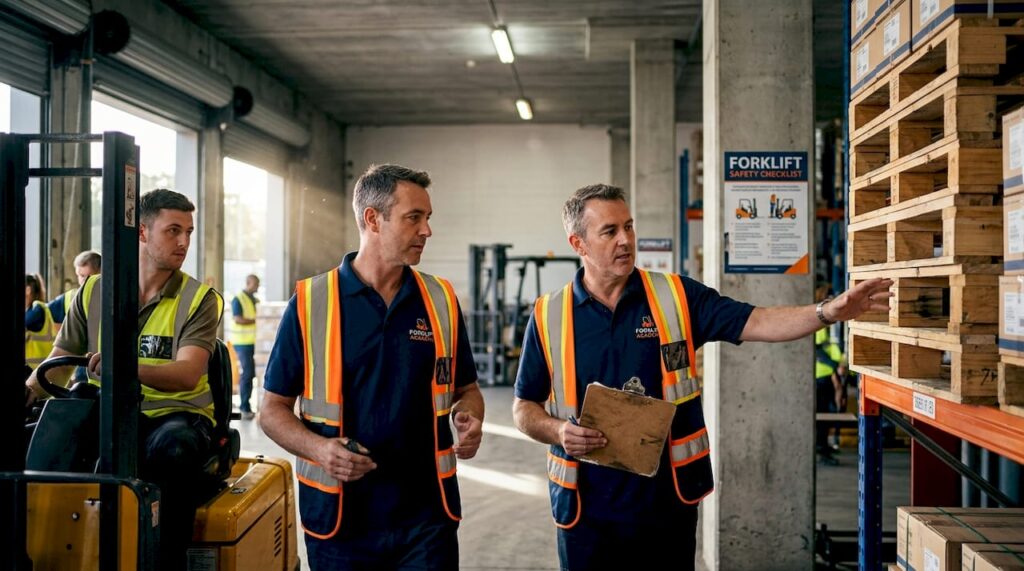
Onsite forklift training is formal operator instruction and evaluation conducted at your facility, using your equipment, your layout, and the real hazards your workers face every shift. That distinction matters more than most people realize. A generic course at an offsite location teaches universal concepts, but it cannot account for the narrow aisle configuration in your receiving area or the blind corner near your loading dock.
The structure of a proper onsite program typically includes several key elements:
The onsite forklift training importance cannot be overstated, especially when you consider that OSHA’s standard requires direct observation of operator performance on site-specific equipment and actual workplace hazards.
Pro Tip: Schedule your onsite training session right after an internal safety audit. Trainers can immediately address layout hazards that the audit flags, turning two processes into one coordinated improvement effort.
The practical observation requirement is what most online-only programs cannot fulfill. An instructor watching a video of someone on a forklift is not equivalent to a qualified evaluator watching your operator navigate a loaded pallet through a congested warehouse aisle. These are fundamentally different experiences, and OSHA draws a clear line between them.
Understanding the regulation itself removes any ambiguity about what is required. OSHA’s forklift standard is not vague on this point. Here is the core language that drives the onsite requirement:
“The employer shall ensure that each powered industrial truck operator is competent to operate a powered industrial truck safely, as demonstrated by the successful completion of the training and evaluation specified in this paragraph.”
That phrase “training and evaluation” is the key. Evaluation, by definition, requires a qualified person to watch an operator work. It cannot happen through a multiple-choice test alone. Organizing onsite training for OSHA means structuring your program to satisfy three distinct compliance elements:
The third element is where many operations fall short. They complete the instruction portion but either skip or poorly document the evaluation component. OSHA inspectors look for this gap directly, and it is one of the most cited forklift training violations year after year.
The OSHA compliance forklift guide reinforces that workplace evaluation on actual equipment is non-negotiable under 29 CFR 1910.178(l). Warehouses that implement structured onsite programs also see measurable safety outcomes. Research consistently shows that facilities with robust, site-specific training programs experience significantly fewer forklift-related incidents, with some studies reporting up to 70% fewer incidents compared to operations relying solely on generic training methods.
The regulation also requires retraining whenever there is a reason to believe an operator is not operating the equipment safely, after an accident or near-miss, and at a minimum of every three years regardless of incident history. This recurring requirement means onsite training is not a one-time event but a scheduled operational responsibility.
The legal case for onsite training is solid. The business case is equally strong. Warehouses that invest in thorough, site-specific training see returns across multiple operational dimensions.
Safety outcomes that directly affect your insurance and liability
Forklift accidents are not just tragic on a human level; they are expensive. OSHA estimates that a serious forklift injury costs an employer an average of $38,000 in direct costs, and indirect costs often multiply that figure by four or more. Onsite training that enables site-specific practical training dramatically reduces the frequency of those events because operators learn to navigate your hazards, not hypothetical ones.
Productivity gains from customized instruction
When a trainer works inside your facility, the instruction is immediately relevant to your operators’ daily tasks. There is no translation gap between “what I learned in the course” and “what I actually do at work.” Operators retain more, apply it faster, and make fewer procedural errors. That directly reduces product damage, racking damage, and time lost to incident investigations.
Explore the full range of onsite training safety efficiency improvements that logistics operations report after implementing structured programs. The data consistently shows reduced damage claims, lower turnover among safety-conscious workers, and faster onboarding for new operators.
Here is a direct comparison of training formats to help you evaluate your current approach:
| Training format | OSHA compliant | Site-specific hazard coverage | Hands-on evaluation | Practical for large teams |
|---|---|---|---|---|
| Online only | No | No | No | Yes |
| Offsite classroom | Partial | No | Limited | Moderate |
| Onsite instructor-led | Yes | Yes | Yes | Yes |
| Train-the-trainer onsite | Yes | Yes | Yes | Very high |
The onsite certification benefits extend well beyond a piece of paper. Operators who complete thorough, observed training demonstrate measurably better judgment in high-pressure situations because their training happened in a real environment with real stakes.
Pro Tip: Pull your facility’s incident log for the past 12 to 24 months before scheduling your onsite training session. Share that data with your trainer ahead of time. A good instructor will weave those specific scenarios into the evaluation, turning historical near-misses into prevention lessons.
Hazard reduction that generalized training cannot replicate
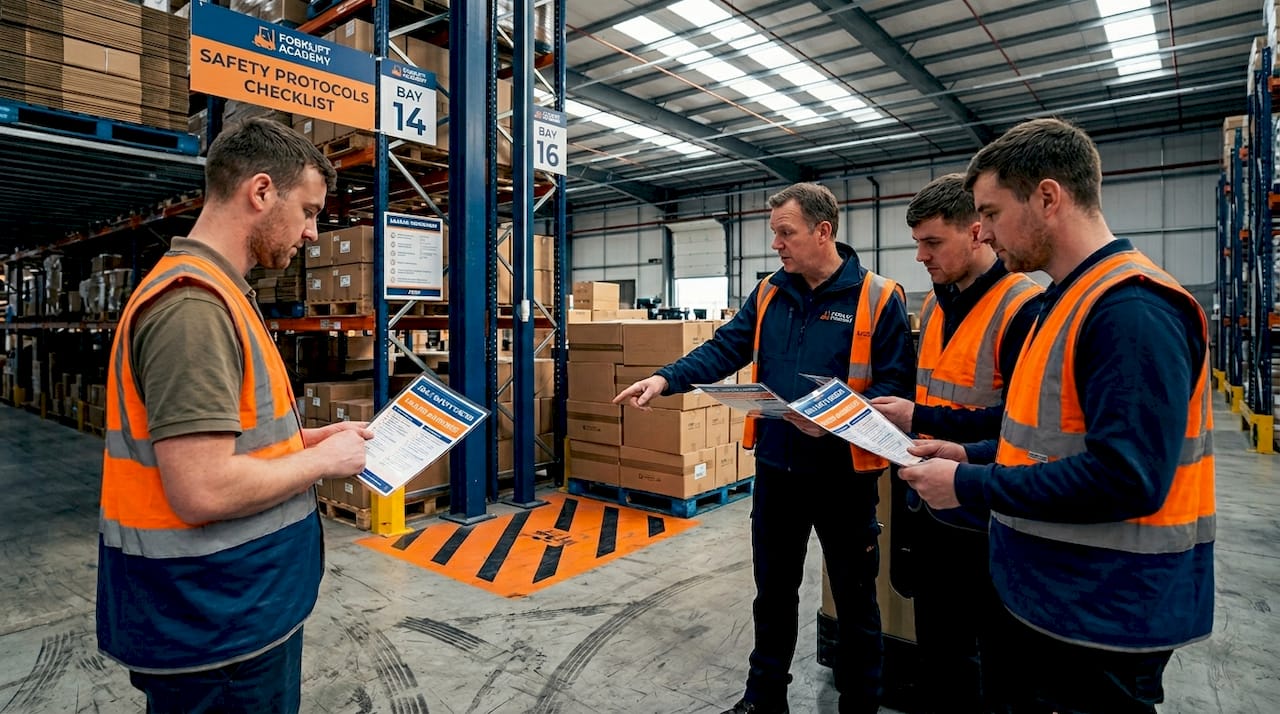
Every warehouse is different. Your specific combination of narrow aisles, pedestrian crossings, dock doors, column placements, and racking height creates a unique risk environment. Onsite trainers walk that environment, spot the friction points, and train operators to respond appropriately. No offsite course replicates that.
Knowing you need onsite training and actually running a compliant, effective program are two different things. Here is how to build one that holds up under OSHA scrutiny and actually works for your team.
Step-by-step setup process
The following table outlines the core documents and checkpoints your program needs to stay compliant:
| Document or checkpoint | Purpose | Frequency |
|---|---|---|
| Site hazard assessment | Identifies location-specific training focus areas | Before initial training, after facility changes |
| Operator training record | Proof of completed instruction and evaluation | Per operator, per equipment type |
| Evaluator qualification record | Confirms trainer competency | On file, updated after any trainer change |
| Equipment-specific training log | Documents truck types covered per operator | Per operator, per new equipment type |
| Retraining documentation | Records reason for and completion of retraining | After incident, near-miss, or observed unsafe act |
| Three-year recertification record | Meets OSHA’s recurring evaluation requirement | Every 36 months minimum |
You can master onsite training safety more efficiently when you treat documentation as an ongoing system rather than a post-training scramble. Build your forms before the first session, and make sure supervisors understand their role in triggering retraining when unsafe behavior is observed.
If building an internal program from scratch feels overwhelming, implementing forklift training through an accredited external provider can compress your setup time significantly. Experienced providers bring ready-made materials, qualified evaluators, and documentation templates that are already aligned with current OSHA language. The site-specific practical training requirement remains your responsibility, but a good partner makes executing it much simpler.
Here is something that most compliance guides will not tell you: the warehouses that get the most value from onsite forklift training are not the ones that treat it as a regulatory requirement. They are the ones that treat it as a cultural signal.
When operators see a trainer walk their floor, point out their specific hazards, and take the time to evaluate them individually on their equipment, the message they receive is not “the company is checking a box.” The message is “the company takes our safety seriously enough to invest real time and resources in it.” That perception shift is worth more than any compliance certificate.
We have seen this pattern repeatedly across facilities of all sizes. Warehouses that run annual or semi-annual onsite training sessions rather than waiting for the mandatory three-year cycle report something unexpected: operators start self-reporting near-misses more frequently. That is a sign of psychological safety, and it is a leading indicator that serious accidents are actually declining. People who feel safe enough to report close calls are people who trust their employer to respond constructively rather than punitively.
The onsite training explained at its deepest level is not about certifications. It is about building a team of operators who understand the risks of their environment so thoroughly that they make better decisions when no trainer is watching. That is when the safety culture becomes self-sustaining. Compliance follows naturally, but the real return is a floor where accidents simply do not happen as often because the people on it are genuinely skilled and genuinely engaged.
Managers who resist frequent onsite training because of scheduling friction often overlook the math. One avoided forklift accident covering medical costs, incident investigation time, OSHA recordable reporting, and potential fines pays for multiple years of proactive onsite training. The question is not whether you can afford it. The question is whether you can afford not to.
Forklift Academy has spent over 20 years helping warehouse and logistics operations across the United States and Canada build training programs that actually work. Our OSHA-compliant, instructor-led onsite sessions are designed around your facility, your equipment, and your specific workforce.
Whether you manage a single distribution center or a multi-site enterprise operation, our certified onsite forklift training programs are built to fit your scheduling needs and your team’s size. We bring qualified instructors to your location, handle the evaluation documentation, and make sure every operator leaves certified and genuinely prepared. Browse our full range of forklift training programs to find the right fit for your operation, and take the first step toward a safer, fully compliant floor today.
Yes. OSHA mandates practical, workplace-specific forklift training and direct evaluation of each operator under standard 29 CFR 1910.178(l). Online instruction alone does not satisfy this requirement.
Operators must be evaluated at minimum every three years, and retraining is required immediately after any observed unsafe operation, near-miss, or workplace incident involving a forklift.
No. OSHA requires hands-on, site-specific evaluation by a qualified trainer in addition to any classroom or online instruction. Online components can satisfy the formal instruction portion but never replace the required practical evaluation.
Failure to comply with 29 CFR 1910.178(l) can result in OSHA citations carrying fines up to $16,550 per serious violation, and willful violations can reach $165,514 per instance, plus the direct costs of any injuries that result.