
TL;DR:
- Onsite forklift training significantly reduces incidents and costs by adapting to specific work environments.
- It offers practical, site-specific instruction that boosts safety, compliance, and operational efficiency.
- Regular refresher training and tailored assessments ensure ongoing safety and regulatory adherence.
Proper onsite forklift training reduces forklift incidents by up to 70%, yet many companies still rely on generic offsite programs that miss site-specific hazards entirely. The difference between training that happens at your facility versus training that happens somewhere else is not just logistical. It is the difference between operators who know how to handle your equipment in your environment and operators who passed a course in a room they will never see again. This article breaks down what onsite forklift training actually involves, why it outperforms alternatives on safety and cost, and how companies across the U.S. and Canada can use it to stay fully OSHA and CSA compliant.
Table of Contents
- What is onsite forklift training?
- Core benefits: Safety, compliance, and productivity
- Operational advantages: Cost and efficiency
- Addressing edge cases: Refresher training and compliance pitfalls
- Our take: Why onsite remains the gold standard
- Connect with OSHA-certified onsite training solutions
- Frequently asked questions
Key Takeaways
| Point | Details |
|---|---|
| Custom hazard training | Onsite training adapts instruction to your actual workplace hazards, reducing risks and improving operator readiness. |
| Compliance and certification | Meeting OSHA and CSA standards onsite ensures legal compliance and faster, more effective certification. |
| Operational efficiency | Training multiple employees onsite minimizes downtime and operational disruptions for your business. |
| ROI and cost savings | Investing in onsite training yields significant savings through reduced incidents, insurance costs, and regulatory fines. |
| Avoid common pitfalls | Refresher training and site-specific programs prevent ‘skill fade’ and costly non-compliance errors. |
What is onsite forklift training?
Onsite forklift training is exactly what it sounds like: a certified trainer comes to your facility and delivers both the theory and hands-on components of forklift certification in your real working environment. No travel. No foreign equipment. No hazard scenarios invented in a classroom.
What makes this approach effective is customization. Onsite training adapts to your specific workplace hazards, equipment types, and floor layouts. If your warehouse has narrow aisles, racking systems at unusual heights, or pedestrian crossings in tight spots, those factors get built directly into the training. Offsite programs cannot replicate that.
Here is what a well-structured onsite program typically includes:
- Formal instruction: Covers OSHA regulations, load handling, pre-operation inspection, and hazard awareness
- Practical evaluation: Operators demonstrate skills on the actual equipment they use day to day
- Site-specific hazard review: Trainers walk the floor and identify risks unique to your location
- Documentation: Certifications and evaluation records generated on-site for compliance files
In the U.S., OSHA 29 CFR 1910.178(l) governs powered industrial truck training. It requires that operators be trained and evaluated on the specific type of truck they will use. You can find a solid overview in this OSHA forklift training guide. In Canada, onsite practical training follows CSA B335-15, the national standard for lift truck operator training, which is often paired with an online theory component.
| Feature | Onsite training | Offsite training |
|---|---|---|
| Equipment used | Your actual forklifts | Generic/shared equipment |
| Hazards covered | Your specific site | Generic scenarios |
| Scheduling | Flexible for your shifts | Fixed class times |
| Group efficiency | Trains multiple staff at once | Individual or small group |
| Documentation | Generated on your site | Issued externally |
For most operations with more than a handful of operators, organizing onsite training is both the safer and more cost-efficient choice.
Core benefits: Safety, compliance, and productivity
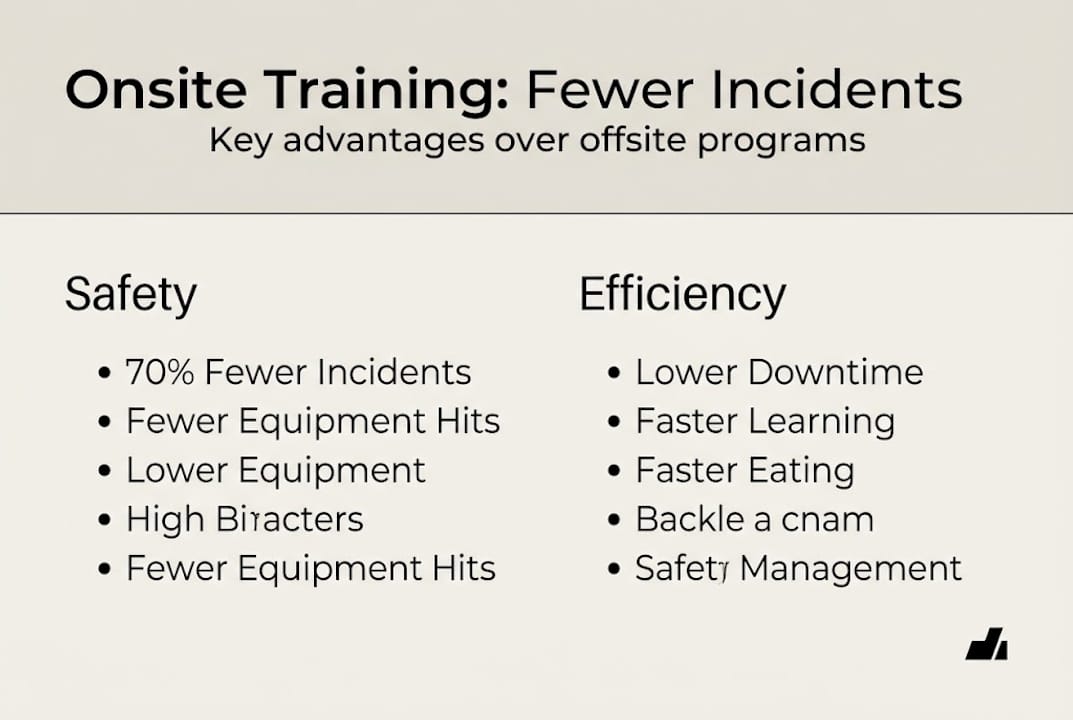
Onsite training is not just a box to check. The numbers behind it are striking. OSHA-compliant training reduces forklift incidents by up to 70%, equipment damage by 60%, and lost-time injuries by 75%. Those are not marginal gains. They represent real people not getting hurt and real money not walking out the door.
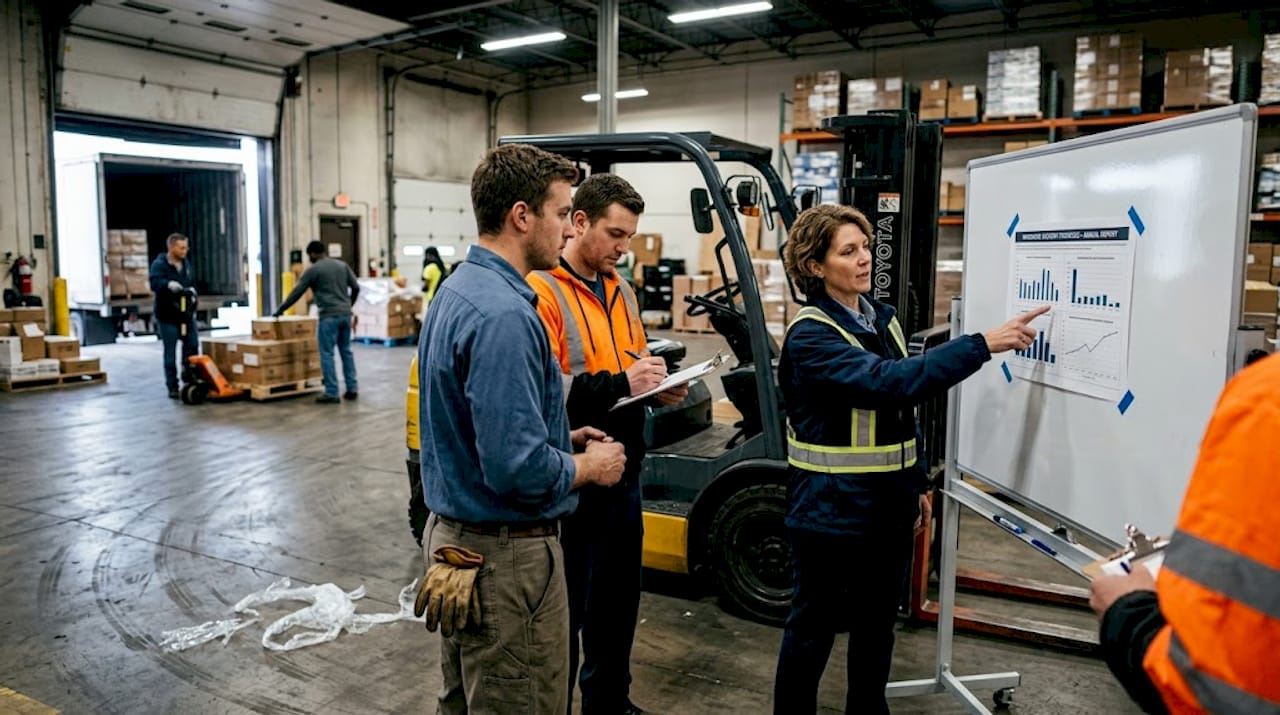
On the financial side, the math is just as clear. $1 in training yields $4 to $6 in savings through reduced accidents and lower insurance premiums, while also protecting against OSHA fines that can reach roughly $15,000 per violation. For a company running 10 to 20 operators, skipping proper certification is a financial gamble that rarely pays off.
Here is a breakdown of the impact areas:
| Benefit area | Impact with onsite training |
|---|---|
| Incident rate | Up to 70% reduction |
| Equipment damage | Up to 60% reduction |
| Lost-time injuries | Up to 75% reduction |
| Training ROI | $4-$6 saved per $1 spent |
| OSHA fine avoidance | Up to ~$15,000 per violation |
Compliance also becomes significantly easier to manage. When your OSHA operator compliance records are generated onsite and tied directly to your actual equipment and floor layout, audits are faster and cleaner. There is no ambiguity about whether training matched the actual working conditions.
Practical benefits companies report after implementation:
- Fewer near-miss incidents in the first 90 days post-training
- Operators who are more confident and decisive during high-pressure situations
- Smoother pre-shift inspections because operators know exactly what to look for
- Less supervisor intervention required during routine forklift operations
- Reduced insurance premiums after documented training programs are in place
Using a business training guide can help you build a program that integrates seamlessly with your scheduling and documentation needs.
Pro Tip: Schedule refresher training before the three-year mark, not after. Skill fade, where operators gradually revert to unsafe habits, typically begins much earlier than most safety managers expect.
Operational advantages: Cost and efficiency
Safety is the headline, but operational efficiency is what convinces operations managers to commit. Onsite training delivers on both.
Onsite training eliminates travel downtime and lets you train multiple operators in a single session, making it far more cost-effective than sending individuals to offsite classes one at a time. When you factor in travel time, lost shift hours, and per-person course fees, offsite options can cost two to three times more per operator when training larger teams.
The efficiency advantage is not just financial. Training in the real environment means operators do not need a “translation period” after certification. They already know how your machines handle. They already understand the floor hazards. They are ready to operate safely from day one back on the job.
Here is how the two approaches compare across key operational factors:
| Factor | Onsite | Offsite |
|---|---|---|
| Best for | 4+ operators | 1 to 3 operators |
| Travel required | None | Yes |
| Equipment familiarity | High (your machines) | Low (generic) |
| Schedule flexibility | High | Limited |
| Immediate feedback | Yes | Partial |
| Cost per operator (large group) | Lower | Higher |
Onsite works best for groups of four or more operators, while offsite or blended approaches make more sense for one to three individuals. Knowing this threshold helps you make a smarter decision based on your team size and budget.
For step-by-step logistics on running a program at your facility, see this step-by-step forklift training resource.
Pro Tip: If your operation runs multiple shifts, split the training across shifts rather than pulling all operators off the floor at once. This keeps production moving and reduces overtime costs during training days.
Once your program is in place, the next priority is knowing how to implement safety training as an ongoing part of your operations rather than a one-time event.
Addressing edge cases: Refresher training and compliance pitfalls
Most companies get initial training right. The problems show up later, when refresher cycles are missed, equipment changes, or a new hazard enters the facility without triggering updated training.
Refresher training prevents skill fade and is required after accidents, near-misses, equipment changes, or at a minimum every three years. Many companies treat this as a formality. In practice, it is one of the most important risk management tools available.
Generic training programs risk non-compliance in unique environments like narrow-aisle warehouses, cold storage facilities, and outdoor yards with uneven terrain. Off-the-shelf kits may cover the regulatory language, but they cannot account for hazards they have never seen.
Compliance checkpoints every company should audit:
- Are certifications tied to the specific truck types your operators use?
- Has training been updated after any changes to your equipment fleet?
- Do your records reflect the actual site conditions at the time of training?
- Have any near-misses or accidents triggered a refresher review?
- Is your documentation audit-ready, with trainer qualifications on file?
Unique hazard examples that almost always require custom onsite training:
- Cold storage facilities where condensation affects visibility and floor traction
- Facilities with pedestrian-heavy zones near active forklift paths
- Operations using multiple truck types that require separate evaluations
- Sites with outdoor loading areas exposed to weather and uneven surfaces
- High-racking environments where load stability becomes more critical
Review your current program against the OSHA training steps to confirm you are not leaving gaps that a regulatory inspection would surface.
Our take: Why onsite remains the gold standard
After more than 20 years in forklift safety training, we have seen the full spectrum: companies that invest early in onsite programs and companies that patch together generic materials and hope for the best. The difference in outcomes is not subtle.
The most common oversight we see is documentation that does not match actual worksite conditions. A company trains operators on a standard warehouse layout, then adds a mezzanine, changes their forklift fleet, or expands into a cold storage section without updating training records. The next audit or incident reveals the gap.
Blended approaches (online theory plus offsite practical) work in some situations, but they consistently underperform fully onsite programs on one key metric: hazard recognition in context. Operators who practice in their real environment build compliance habits that stick. Operators who train generically adapt slowly and often incompletely.
The upfront cost of onsite training is real. But the long-term math always favors it. Fewer incidents, cleaner audits, lower insurance costs, and operators who are genuinely safer rather than technically certified.
Pro Tip: After every training cycle, audit outcomes: check incident rates, near-miss reports, and pre-shift inspection completion rates. The data tells you whether training is actually working.
Connect with OSHA-certified onsite training solutions
Everything covered in this article points to one practical conclusion: quality forklift training requires site-specific execution, not generic programs.
At Forklift Academy, our onsite training programs are built around your equipment, your hazards, and your schedule. Whether you are managing a team of warehouse operators or need to build internal training capacity with a train-the-trainer online kit, we have solutions designed for real operational environments. Browse our full forklift training certification options to find the right fit for your team size, location, and compliance requirements across the U.S. and Canada.
Frequently asked questions
How does onsite forklift training improve workplace safety?
Onsite training cuts forklift incidents by up to 70% by teaching operators in their actual work environment with equipment-specific, hands-on practice that generic programs cannot replicate.
Is onsite forklift training cost-effective for small teams?
Onsite training delivers the best value for groups of four or more; for smaller teams of one to three, offsite or blended options are often more practical and affordable.
What regulatory standards apply to onsite forklift training in Canada?
In Canada, onsite forklift training must meet CSA B335-15 requirements for the practical evaluation component, typically paired with an approved online theory course.
How often should forklift operators receive refresher training?
OSHA and Canadian standards require refresher training every three years, and immediately following any accident, near-miss, or significant change in equipment or work environment.
Does onsite training offer immediate feedback and tailored instruction?
Yes. Onsite programs provide real-time, site-specific feedback during hands-on evaluations, helping operators correct unsafe habits before they become incidents on your floor.
Recommended
- OSHA Training Cuts Forklift Incidents 70%: Safety Guide – Top Osha Forklift Certification
- Hands-on forklift training: 70% fewer accidents in 2026 – Top Osha Forklift Certification
- Forklift training: boost safety and efficiency in 2026 – Top Osha Forklift Certification
- Guide to Onsite Forklift Training: Master Safety Skills – Top Osha Forklift Certification