
TL;DR:
- Blended learning is recommended for OSHA compliance due to its combination of online theory and hands-on evaluation.
- Practical, site-specific, and hands-on training are essential for real-world safety and hazard prevention.
- Train-the-trainer programs enable scalable, consistent forklift training while reducing costs and ensuring ongoing compliance.
Choosing the wrong forklift training method is not just a compliance risk. It puts your operators, your facility, and your bottom line in jeopardy. Warehouse managers and safety officers across the U.S. and Canada are under real pressure: OSHA and CSA standards require practical evaluation, incident rates remain stubbornly high, and scheduling constraints make one-size-fits-all programs nearly impossible to run. The good news is that blended learning options give you a flexible, compliant path forward. This article breaks down the leading training methods and gives you clear criteria to make the right call for your team.
Table of Contents
- Evaluating forklift training methods: What matters most
- Blended learning: Best for compliance and flexibility
- Hands-on and site-specific training: Essential for real-world safety
- Train-the-trainer programs: Scaling safety and efficiency
- Our take: Structured training outperforms experience
- Find the right forklift training for your team
- Frequently asked questions
Key Takeaways
| Point | Details |
|---|---|
| Blended learning recommended | Combining online theory with hands-on evaluation provides flexibility and meets OSHA/CSA requirements. |
| Hands-on skill essential | Practical, site-specific training is mandatory for real-world safety and preventing costly accidents. |
| Train-the-trainer boosts efficiency | In-house trainers help organizations scale safety programs and maintain consistent standards. |
| Compliance drives results | Structured training reduces incidents, saves money, and prevents complacency—industry ROI: $4-$6 for every $1 invested. |
Evaluating forklift training methods: What matters most
Before comparing specific methods, you need a solid set of criteria. Not all training programs are built the same, and the differences matter significantly when an OSHA inspector walks through your door or when an operator faces a real hazard on the floor.
Compliance first. Both OSHA (29 CFR 1910.178) and CSA Standard B335 require more than just online coursework. Pure online training is insufficient because both regulatory frameworks mandate a practical, in-person evaluation of each operator. No workaround exists here. Your training method must include a hands-on component or it simply does not meet the standard.
Documentation and recordkeeping. In 2026, digital records are now accepted as part of updated OSHA documentation requirements, which is a major operational shift. You can store training certificates, evaluation forms, and refresher records digitally, making audits faster and easier to manage across multiple sites.
Pro Tip: Build a centralized digital training folder for each operator, including their initial certification, evaluator signature, site-specific hazard acknowledgment, and any refresher completions. This one habit eliminates 90% of audit headaches.
Skills that matter on the floor. Look for programs that cover the core competencies your operators actually use:
- Load handling and stability under varied conditions
- Recognizing and responding to site-specific hazards (ramps, tight aisles, pedestrian zones)
- Pre-operation inspection procedures
- Fueling and battery charging safety
- Emergency response and shutdown procedures
Technology integration. VR simulators and e-learning platforms are growing in adoption, and they do add value for theory instruction and scenario visualization. However, they are supplements, not replacements. The OSHA compliance guide is clear: operators must be evaluated in the actual equipment they will use. Technology enhances learning, but it does not substitute for real-world evaluation. When selecting a training vendor, look for programs that integrate technology intelligently without cutting corners on the hands-on component. Your forklift business training compliance program should reflect that balance.
Blended learning: Best for compliance and flexibility
Blended learning is the most practical and widely recommended approach for busy operations. It combines online theory instruction with an in-person, practical evaluation conducted on your actual equipment at your actual site. That pairing is what makes it so effective.
Blended training balances practical skill development with scheduling flexibility, which is why it consistently leads compliance recommendations. Operators complete the knowledge-based portion on their own schedule, reducing downtime on the floor. The in-person evaluation then ensures they can actually perform what they learned before they ever operate independently.
The numbers support this approach strongly. Blended training programs cut incidents by up to 70% compared to facilities with minimal or non-structured training. That is not a marginal improvement. That is a fundamental shift in your facility’s risk profile.
Key benefits of blended learning:
- Operators complete online modules during off-peak hours, preserving shift productivity
- Practical evaluation covers site-specific conditions, not just generic scenarios
- Easily scalable across multiple locations or departments
- Digital completion records are generated automatically
- Allows for faster onboarding of new hires without pulling senior staff off the floor
Comparison: Training method overview
| Method | OSHA/CSA Compliant | Flexibility | Hands-On Component | Best For |
|---|---|---|---|---|
| Online only | No | High | None | Pre-study only |
| Hands-on only | Yes | Low | Full | Small teams, urgent needs |
| Blended | Yes | High | Yes (evaluation) | Most operations |
| Train-the-trainer | Yes | High | Yes | Large or multi-site teams |
If you want to boost safety with blended learning, the model works because it does not force you to choose between compliance and convenience. It delivers both. Review the full breakdown of forklift training delivery methods to find the format that fits your operational rhythm.
Hands-on and site-specific training: Essential for real-world safety
No matter how good your online modules are, there are situations that only physical, in-person training can prepare an operator for. Ramps, reversing in confined spaces, uneven surfaces, and pedestrian crossings cannot be fully replicated in a digital environment.
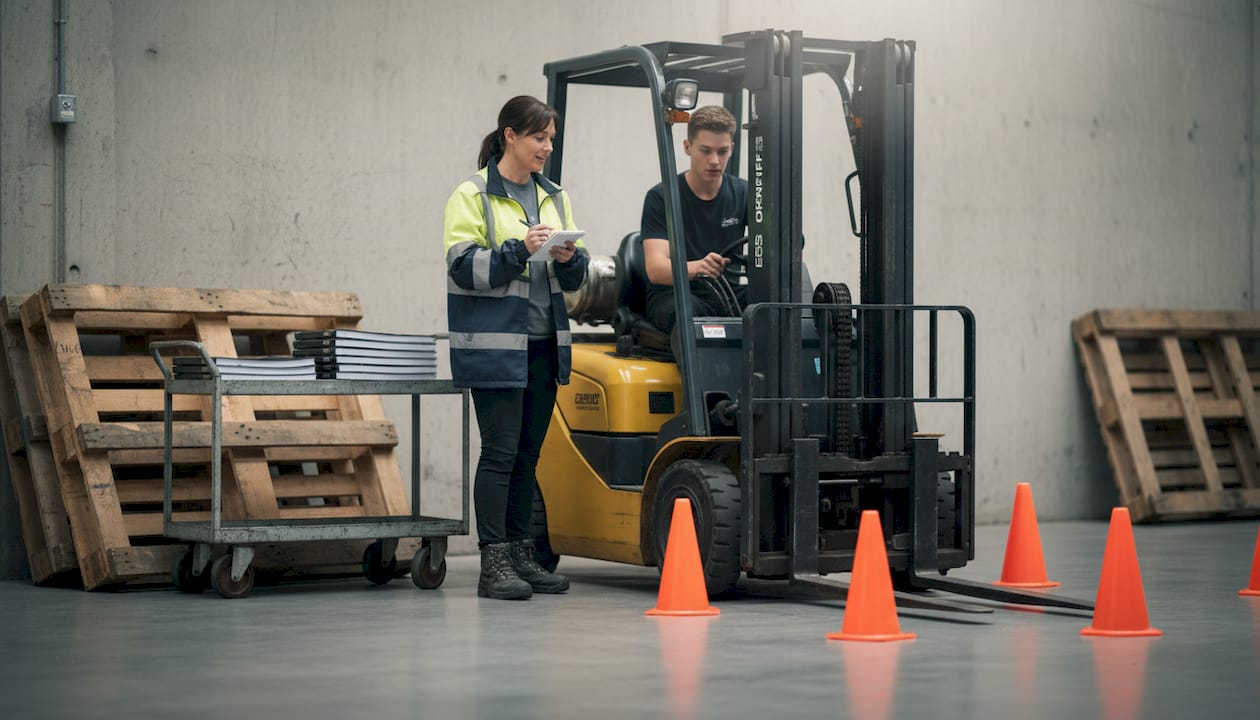
Hands-on training is critical for edge cases like ramps, reversing, and confined spaces, and consistent pre-operation checks prevent up to 70% of tip-over incidents. That statistic alone should be reason enough to make in-person evaluation non-negotiable in your program.
Site-specific training goes even further. Equipment and workplace-specific training is required under CSA B335, and any significant change to the workplace or equipment should trigger a refresher evaluation. This means that when you introduce a new racking layout, add pedestrian walkways, or bring in a different class of forklift, your operators need retraining. Full stop.
Common accident scenarios that hands-on training prevents:
- Tip-overs caused by improper load positioning or turning at speed
- Pedestrian strikes in low-visibility or high-traffic zones
- Load drops from incorrect tilt or fork positioning
- Ramp instability from incorrect travel posture or oversized loads
- Collision damage from poor spatial awareness during reversing
Pro Tip: Run a site hazard walkthrough as part of every initial evaluation. Have the evaluator walk the operator through the specific hazards in your facility before the practical test begins. This step alone closes the gap between generic training and real-world preparedness.
“Operators who receive site-specific training are measurably better at identifying hazards before they escalate into incidents. Generic certification alone is not enough for complex or high-traffic facilities.”
For a deeper look at preventing incidents, explore forklift accident prevention methods and the full breakdown of step-by-step hands-on training requirements under current standards.
Train-the-trainer programs: Scaling safety and efficiency
For organizations operating across multiple shifts, departments, or locations, train-the-trainer is one of the most cost-effective and scalable solutions available. Instead of bringing in an external trainer every time a certification is needed, you build that capability internally.
A well-structured train-the-trainer program equips your designated internal trainers with curriculum materials, coaching techniques, evaluation frameworks, and often a digital platform to manage records. The result is a self-sustaining safety program that your team controls.
One important clarification: OSHA does not require trainers to hold a formal certification. What OSHA does require is that the trainer be knowledgeable and experienced with the equipment and the training process. This means you can qualify an experienced senior operator or safety officer as your in-house trainer without sending them through a separate licensing program. That said, formal train-the-trainer programs provide structure and credibility that informal approaches lack.
What a strong train-the-trainer program includes:
- Adult learning principles and effective coaching techniques
- Curriculum aligned with OSHA 29 CFR 1910.178 and CSA B335
- Practical evaluation checklists and scoring criteria
- Documentation templates and digital record management tools
- Refresher training protocols for post-incident or post-change scenarios
Organizational benefits:
- Significant reduction in third-party training costs over time
- Faster response when new hires or operational changes require retraining
- Consistent, standardized training delivery across all shifts
- Internal accountability for ongoing compliance
Pro Tip: Rotate your designated trainers periodically and have them observe each other’s evaluations. Trainer drift, where evaluators unconsciously loosen standards over time, is a real risk. Peer review within your training team keeps standards sharp.
For guidance on organizing onsite training or strengthening your forklift compliance and safety program, the resources are available to help you build this internally.
Our take: Structured training outperforms experience
Here is an uncomfortable truth we see repeatedly working with warehouse teams: experience can breed complacency, and complacency kills. Operators who have run forklifts for 10 or 15 years without a serious incident often develop the belief that they have outgrown formal training. They have not.
The data is clear. Structured training yields $4 to $6 in savings for every $1 spent, driven by fewer incidents, lower workers’ compensation costs, and reduced equipment damage. That return is not theoretical. It is measurable and repeatable.
Veteran operators benefit from structured programs in a specific way: formal training forces a reset of habits, particularly the shortcuts that accumulate over years of repetitive work. It also gives you, as a safety officer or manager, documented proof that every operator on your floor met the standard, regardless of their experience level. That documentation is your protection in a post-incident investigation.
Refresher courses and technology integration are not optional extras. They are the mechanism by which your workplace safety compliance program stays current and effective. Build them into your annual calendar, not just your onboarding checklist.
Find the right forklift training for your team
You now have a clear picture of what separates a compliant, effective training program from one that creates liability. The next step is putting that knowledge into action.
At Forklift Academy, we offer solutions for every operational model, from individual operator certification to enterprise-level programs. Whether you need a train-the-trainer certification to build internal capacity, or want to explore our full range of forklift training programs for your workforce, we have you covered. Organizations managing larger teams can also take advantage of our business forklift certification options, designed specifically for multi-operator environments. With over 20 years of experience in OSHA and CSA compliance, we make it easy to get your team trained, documented, and protected.
Frequently asked questions
Which forklift training method is best for OSHA compliance?
Blended learning is the most effective route for OSHA compliance, combining online theory with mandatory hands-on evaluation. Pure online training does not satisfy the practical assessment requirement under OSHA or CSA standards.
Do refresher forklift courses need to be hands-on?
Yes. OSHA and CSA both require practical assessment for refresher training, especially after workplace changes or incidents. Refresher training must include a practical evaluation component to be considered compliant.
Is VR or simulator training enough to meet OSHA or CSA standards?
No. VR and simulator tools are valuable for theory and scenario practice, but hands-on evaluation on actual equipment remains mandatory for both OSHA and CSA compliance.
Who can conduct forklift operator evaluations under OSHA rules?
OSHA requires trainers to be knowledgeable and experienced with the equipment, but formal trainer certification is not mandated. An experienced, qualified employee can serve as the designated evaluator.
Recommended
- Forklift training: boost safety and efficiency in 2026 – Top Osha Forklift Certification
- Forklift Training: OSHA Compliance & Safety in 2026 – Top Osha Forklift Certification
- Maximizing Efficiency: Advanced Forklift Training Techniques That Transform Warehouse Operations
- Maximizing Efficiency: Advanced Forklift Training Techniques That Transform Warehouse Operations – Top Osha Forklift Certification