
TL;DR:
- Accurate forklift terminology is essential for safety, OSHA compliance, and effective communication.
- Misunderstanding key terms like load center and stability triangle increases accident risk.
- Ongoing vocabulary training and current standards awareness help prevent incidents and improve safety culture.
Forklift operators and warehouse supervisors share the same floor every day, yet they often speak slightly different languages. One team calls it “tipping,” another calls it a “stability triangle failure,” and neither group realizes the difference matters until someone gets hurt. Top injuries reported by NIOSH include overturns, struck-by incidents, and falls, with retraining required after each event. The root of many of these incidents is not a lack of effort; it is a lack of shared, precise vocabulary. Mastering forklift industry terminology is not optional. It is the foundation of OSHA compliance, effective training, and a workplace culture where safety is genuinely understood by everyone on the floor.
Table of Contents
- Why forklift terminology matters for safety and compliance
- Decoding essential forklift industry terms
- Common scenarios: When terminology confusion leads to incidents
- Practical tips: Embedding correct terminology into your training
- Industry perspective: Why retraining and language updates are non-negotiable
- Take the next step with expert forklift certification
- Frequently asked questions
Key Takeaways
| Point | Details |
|---|---|
| Terminology drives safety | Clear forklift terminology reduces accidents and supports OSHA compliance. |
| Retraining is essential | After incidents, updated language and knowledge prevent repeat mistakes. |
| Integrate terms into training | Embedding official vocabulary in each session boosts understanding and workplace safety. |
| Miscommunication has costs | Accidents from misunderstood terms increase liability and business risk. |
Why forklift terminology matters for safety and compliance
Accurate language is not just an administrative nicety in a forklift operation. It is the infrastructure that holds every safety standard together. When an inspector walks onto your floor and asks whether operators understand “load center” or “rated capacity,” the answers you get reveal whether your training actually stuck or just filled a checkbox.
OSHA builds its entire regulatory framework on specific industry terms. The agency does not use casual or interchangeable language in its standards. Every word in 29 CFR 1910.178, the primary OSHA standard governing powered industrial trucks, is deliberate. When your training program uses different words to describe the same concepts, you create a gap between what operators learn in the classroom and what the regulation actually requires. That gap is where liability lives.
Consider a real scenario that plays out in warehouses every year. A new operator is told during onboarding to “watch the weight limit.” The forklift’s data plate, however, refers to “rated capacity” at a specific “load center.” When a trainer uses informal language and the data plate uses technical language, the operator does not automatically connect the two. They may unknowingly exceed rated capacity because the mental bridge between informal training language and official terminology was never built.
“Miscommunication due to unclear vocabulary often leads to safety lapses that could have been prevented with standardized language from day one.”
Inaccurate terminology can also invalidate training documentation. If your training records and certifications do not reflect the correct OSHA terms, you open your business to citations and increased liability during inspections or post-incident reviews. Companies with strong forklift safety terminology programs consistently demonstrate lower incident rates and faster inspector approvals.
Building a shared vocabulary also improves daily communication between operators, supervisors, and safety managers. When everyone uses the same words for the same concepts, instructions are clearer, errors are caught faster, and the entire operation moves more smoothly. Good training vocabulary for OSHA compliance is not about memorizing a glossary. It is about creating a workplace where a single, clear word conveys the same meaning to every person who hears it.
Pro Tip: At the start of every training session, spend five minutes reviewing five key terms. Make it a warm-up exercise, not a lecture. Operators who review vocabulary regularly retain it under pressure, which is exactly when you need it most.
Decoding essential forklift industry terms
Knowing why terminology matters leads naturally to the next step: understanding exactly which terms you need to master and what they actually mean on the warehouse floor.
Powered industrial truck is OSHA’s official term for forklifts and similar powered vehicles used to lift, stack, and transport materials. This includes counterbalanced forklifts, reach trucks, order pickers, and pallet jacks. Many companies only think of the sit-down counterbalanced unit when they hear “forklift,” but OSHA’s definition is much broader. Missing this distinction means your training program may not cover all the equipment it needs to.
Load center is the horizontal distance from the front face of the forks to the center of gravity of the load. The standard measurement is 24 inches for a standard pallet. When operators do not understand this term, they often place loads too far forward on the forks, shifting the center of gravity and reducing the safe lifting capacity of the truck. NIOSH highlights that understanding overturns and stability failures is critical given the high incident rates associated with these events.
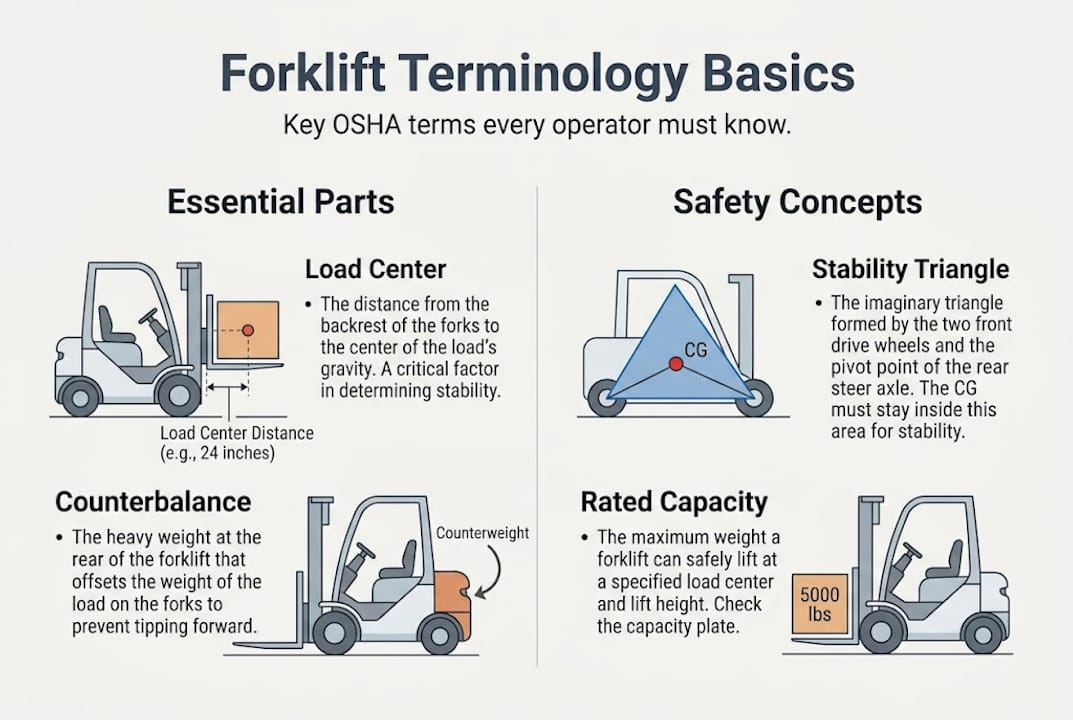
Stability triangle refers to the three-point suspension system that keeps a forklift upright. The triangle connects the two front wheels and the center of the rear axle. The forklift remains stable as long as the combined center of gravity of the truck and its load stays within this triangle. Tipping happens when that center of gravity moves outside the triangle, usually because of improper load handling or turning too fast while carrying a load.
Counterbalance is the weight built into the rear of the forklift to offset the weight of the load being lifted at the front. Understanding this term helps operators recognize why they cannot simply add attachments or extra weight without consulting the manufacturer’s data plate.
Rated capacity is the maximum weight a forklift can safely lift at a specified load center and lift height. This number appears on the data plate affixed to every forklift and must never be exceeded.
Here is a quick reference table for these core terms:
| Term | Plain meaning | Why it matters |
|---|---|---|
| Powered industrial truck | All powered lift vehicles | Determines training scope |
| Load center | Center of gravity distance on forks | Affects safe lift capacity |
| Stability triangle | Three-point balance system | Prevents tip-overs |
| Counterbalance | Rear weight to offset front load | Limits safe attachments |
| Rated capacity | Maximum safe load weight | Prevents overloading |
Most misunderstood forklift terms among new trainees include:
- Load center (confused with total load weight)
- Stability triangle (often unknown entirely)
- Rated capacity (confused with “maximum weight I’ve ever lifted”)
- Counterbalance (thought to be decorative or irrelevant)
- Mast (confused with “forks” by operators who do not know the vertical frame from the horizontal lifting arms)
Reviewing OSHA forklift terms before your next training cycle can help you spot vocabulary gaps before they become safety gaps. Understanding operation basics for forklifts in correct technical language is the first step toward genuine competence.
Pro Tip: Run a short terminology quiz at the end of each training module. Track scores over time. A consistent drop in scores on specific terms is a signal that your training material is not explaining those concepts clearly enough.
Common scenarios: When terminology confusion leads to incidents
Understanding the words is only half the battle. What happens in practice when they are misunderstood or misapplied is where the real cost shows up.
Imagine a mid-sized distribution center where a new operator is cleared to work after completing a basic training program. The trainer used the word “tipping point” to describe the stability threshold, never mentioning the stability triangle. Three weeks later, the operator takes a turn too fast while carrying a tall load and the forklift tips. No one was seriously injured, but the rack system was damaged and operations stopped for four hours while the incident was investigated.
During the post-incident review, the safety manager discovered that the operator had no idea what the stability triangle was, could not locate it on the forklift, and did not connect their trainer’s casual language with the concept OSHA actually tests on. The training records showed the operator had been certified, but the certification was based on vocabulary that did not match OSHA’s standards.
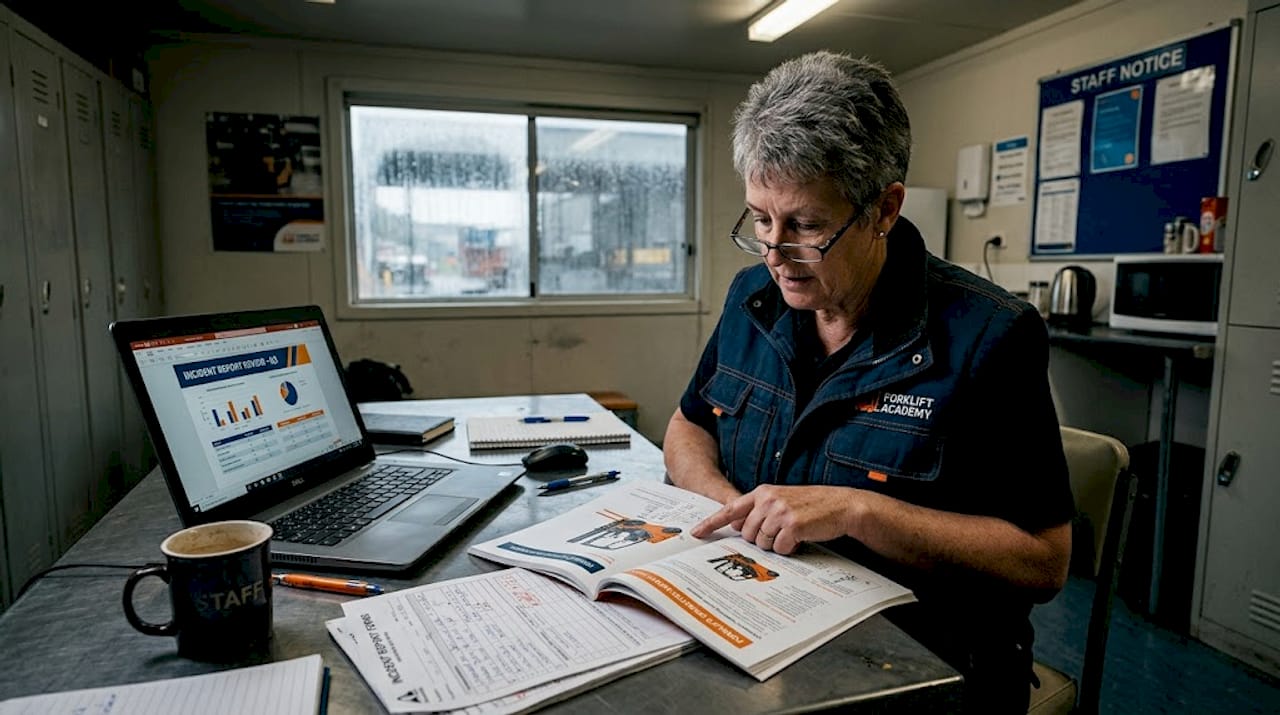
The contrast with a well-trained team is stark. At a properly trained facility, operators can explain the stability triangle in plain language, identify the three points on any piece of equipment, and describe exactly what causes the center of gravity to shift outside it. These operators do not just pass a quiz; they apply the concept every single time they pick up a load.
Top injury types are often directly linked to misunderstanding stability or operational language, making precise vocabulary a genuine safety measure rather than just a compliance box to check.
Here is a comparison of outcomes for properly trained versus undertrained teams:
| Factor | Properly trained team | Undertrained team |
|---|---|---|
| Incident rate | Significantly lower | Higher, often repeat events |
| Post-incident review | Quick resolution, clear root cause | Difficult, documentation gaps |
| OSHA inspection outcome | Minimal citations | Multiple citations, fines |
| Retraining time | Short, targeted | Lengthy, systemic overhaul |
What to do immediately after a terminology-related incident:
- Secure the area and make sure all personnel are safe.
- Document exactly what happened, including the language used in the original training.
- Identify the specific term or concept that was misunderstood.
- Pull training records and compare vocabulary against OSHA standard 29 CFR 1910.178.
- Schedule retraining that addresses the specific language gap identified.
- Update all training materials to reflect standardized OSHA terminology going forward.
Proactive investment in accident prevention strategies pays dividends far beyond the cost of a single incident. Building forklift safety skills on a foundation of correct terminology means your team is prepared for real conditions, not just the training room.
Practical tips: Embedding correct terminology into your training
With the stakes and real-world scenarios in front of you, the next question is how to make sure your training program actually gets the language right every time.
Start with an audit. Pull every piece of training material your company currently uses, including handouts, videos, quizzes, and onboarding scripts, and check every term against OSHA’s published standards. If your materials use informal substitutes for official terms, flag them for revision before the next training cycle.
Build terminology into the physical environment, not just the classroom. Label key parts of your forklifts with their correct OSHA names. Post a laminated reference card in the break room. Make the vocabulary visible every day so it becomes part of the natural workflow rather than something operators only see during formal training.
Retraining after safety incidents is mandatory, and standardized terminology reduces the errors that make that retraining necessary in the first place. Companies that treat vocabulary updates as a routine maintenance task rather than a crisis response end up with fewer crises.
Easy ways to reinforce vocabulary daily:
- Post a “term of the week” on the safety board in the break room.
- Include a one-question terminology review in daily pre-shift safety briefings.
- Build short, ungraded vocabulary quizzes into your shift management software.
- Require operators to use correct technical terms when completing incident reports.
- Pair new operators with experienced mentors who model correct terminology during normal operations.
Common mistakes companies make when rolling out terminology updates include updating written materials without briefing supervisors first, rolling out new vocabulary during a busy season when retention is low, and failing to explain why a word is changing, which causes resistance from experienced operators.
Reviewing employee training best practices regularly gives your program a structure that scales as your team grows. Understanding the trainer’s safety role means recognizing that trainers are your first line of vocabulary defense. If trainers use informal language, every operator they certify carries that gap forward. Access free safety resources to support ongoing vocabulary reinforcement without stretching your training budget.
Pro Tip: Use peer instruction for terminology practice. Have operators explain key terms to each other in their own words. If one person cannot explain “load center” to a coworker clearly, neither of them fully understands it yet. Peer explanation is one of the most effective retention tools available, and it costs nothing.
Industry perspective: Why retraining and language updates are non-negotiable
Most companies approach forklift certification as a one-time event. Operator passes the test, receives a card, file goes in the drawer. Done. This approach fundamentally misunderstands what certification is actually designed to do.
Here is the uncomfortable reality: OSHA and NIOSH guidance evolves. Terms get clarified. Equipment changes. New attachments enter the market. What was considered complete training five years ago may leave meaningful gaps today. Treating certification as permanent ignores the fact that retraining is mandatory after incidents specifically because language gaps are a leading cause of those incidents.
Experienced trainers recognize language inconsistency as a warning sign, not a minor inconvenience. When an operator uses the wrong term for a forklift component, that is not just a vocabulary error. It tells you that their mental model of how the machine works may be incomplete or incorrect. An incomplete mental model produces unpredictable behavior under stress.
The companies that lead their industries on safety are not the ones who run the most training hours. They are the ones who treat vocabulary as a living system, one that gets reviewed, updated, and reinforced as part of an ongoing safety culture. Investing in warehouse safety strategies built on accurate, current language is how you future-proof your compliance program against evolving standards and the natural turnover of experienced staff.
The question is not whether to update your training language. The question is whether you will do it proactively or reactively after an incident forces your hand.
Take the next step with expert forklift certification
Getting the terminology right is the first step. Making sure your entire team is trained, tested, and certified to OSHA standards is the next one.
At Forklift Academy, we have been helping companies across the U.S. and Canada build safety-first training programs for over 20 years. Our programs are built around current OSHA language, so your operators learn the right terms from day one. Whether you need forklift certification for your business, a flexible on-site forklift certification option that brings training directly to your facility, or a fully OSHA-compliant forklift certification program for individual operators, we have a solution ready for you. Start building a workforce that speaks the language of safety confidently and correctly.
Frequently asked questions
What does ‘powered industrial truck’ mean in OSHA terminology?
A powered industrial truck is OSHA’s official regulatory term for forklifts and similar powered vehicles used for lifting, moving, and transporting materials in the workplace, covering a much wider range of equipment than most people assume.
When is retraining required after a forklift incident?
Retraining is mandatory following incidents such as overturns, struck-by accidents, and falls, specifically to address knowledge or terminology gaps that contributed to the event.
Which forklift terms are most often misunderstood?
Terms like “load center,” “stability triangle,” and “counterbalance” are frequently misused among new operators because NIOSH identifies misunderstanding of stability and technical concepts as a primary contributor to accidents.
How can I make sure my training uses the right terminology?
Audit all training materials against OSHA and NIOSH published standards and build OSHA terminology alignment into every session, quiz, and daily communication tool your team uses.
Recommended
- Business forklift training guide: OSHA compliance 2026 – Top Osha Forklift Certification
- Forklift Terminology Explained: Driving OSHA Compliance – Top Osha Forklift Certification
- Forklift Training Terminology Explained: Safety and Compliance – Top Osha Forklift Certification
- Master forklift certification renewal for OSHA 2026 – Top Osha Forklift Certification