
TL;DR:
- OSHA requires employer-issued, equipment-specific forklift certification, not a government-issued license.
- Certification involves formal instruction, hands-on training, and workplace evaluation in person.
- Ongoing compliance includes recertification every three years and training after workplace or equipment changes.
Many warehouse managers assume their operators need a government-issued lift operator license, similar to a driver’s license. That assumption is wrong, and acting on it creates real liability. OSHA regulates forklift training under 29 CFR 1910.178(l), requiring employers to ensure operators are competent through training, evaluation, and certification. The certification comes from you, the employer, not a state agency or federal body. Understanding exactly what that means, what records you must keep, and when training must happen again is what separates a compliant operation from one sitting on a six-figure OSHA citation.
Table of Contents
- What is a lift operator license? Unpacking the OSHA standard
- The core OSHA forklift operator training requirements
- Who can train and certify your operators?
- Ongoing compliance: recertification, site-specific hazards, and avoiding pitfalls
- The overlooked realities of lift operator compliance: Our take
- Get compliant and protect your workplace — next steps
- Frequently asked questions
Key Takeaways
| Point | Details |
|---|---|
| Certification over license | OSHA requires employer-issued certification, not a government license, for forklift operators. |
| Three-part training | Training must include classroom, hands-on, and performance evaluation components to be compliant. |
| Ongoing evaluation required | Operators must be evaluated at least every three years or after safety incidents or workplace changes. |
| Trainer qualifications matter | Trainers need real knowledge and experience, but no specific federal license is required. |
| Compliance saves lives | Proper training can prevent up to 70% of lift-related injuries and fatalities in warehouses. |
What is a lift operator license? Unpacking the OSHA standard
Let’s address the terminology head-on. A “lift operator license” is not a legal term under federal OSHA. There is no wallet card issued by a government office, no DMV-style exam, and no universal credential that follows an operator from employer to employer. What OSHA actually requires is employer-issued certification, and that distinction changes everything about how you run your compliance program.
“Many workers arrive at a new job waving a certification card from their last employer, expecting it to satisfy your requirements. Under OSHA, it doesn’t. Certification is tied to the employer, the specific equipment, and the specific workplace.”
Here is what OSHA’s 29 CFR 1910.178 actually requires for a valid certification record: the operator’s name, the training date, the evaluation date, and the identity of the trainer or evaluator. You maintain those records, and they live in your facility, not in a national database. If an auditor walks in, those documents must be ready.
The second major point is type-specificity. Certification is not transferable between employers, and it must cover the actual class of equipment the operator uses. A counterbalance sit-down forklift and a reach truck are two distinct machine types. Certifying someone on one does not authorize them to operate the other. Many managers miss this, especially when cross-training workers across departments or when new equipment arrives.
Here is a side-by-side comparison to clear up the confusion once and for all:
| Feature | Government “License” (Driver’s) | OSHA Forklift Certification |
|---|---|---|
| Issued by | State agency | Employer |
| Transferable? | Yes, across employers | No, employer-specific |
| Equipment-specific? | No | Yes, by forklift type |
| Renewal agency | State DMV | Employer-driven |
| Documentation location | State records | Employer records |
| Exam type | Standardized state test | Workplace evaluation |
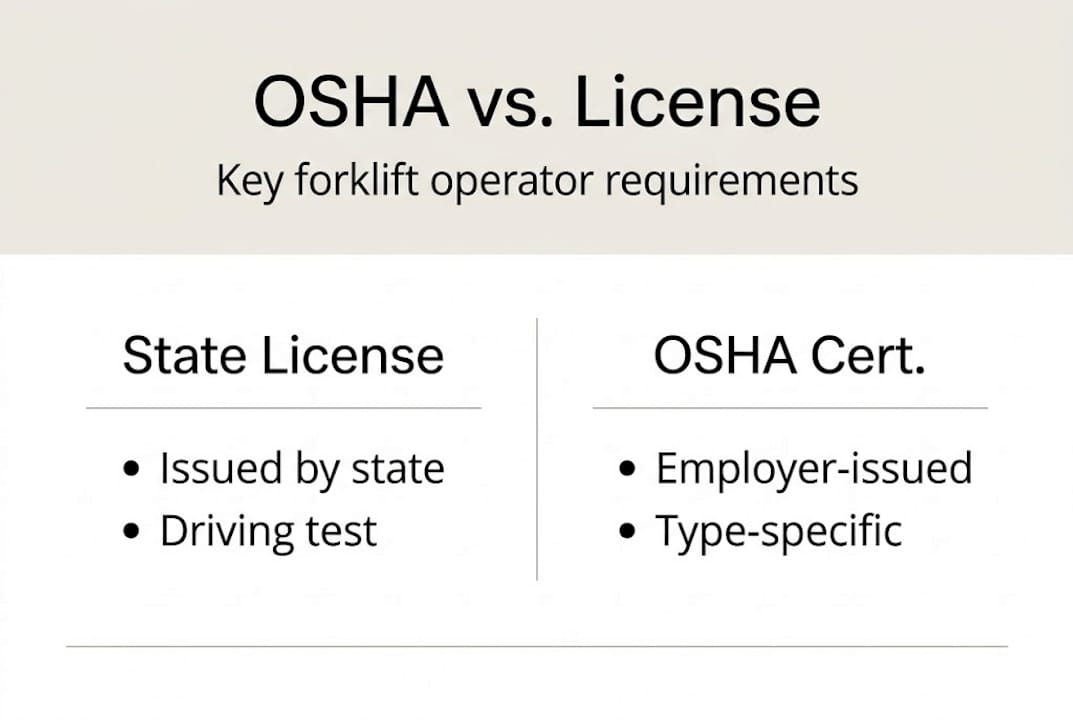
Understanding what is an OSHA card helps clarify this further. The card is a documentation tool, not a universal credential. It represents that your organization completed a valid training cycle for a specific operator on specific equipment. That is a meaningful distinction when citations are on the table.
The common confusion happens because third-party training providers often issue wallet cards or certificates that look official. Those materials are helpful documentation aids, but they only satisfy OSHA requirements when paired with your in-house practical evaluation. The card alone is not the certification. The full process is.
The core OSHA forklift operator training requirements
Now that you know what the end result looks like, here is how you get there legally. OSHA mandates a three-component training program: formal instruction, practical hands-on training, and a workplace performance evaluation. All three are required. Skipping any one of them means your certification is non-compliant, period.
The three required components are:
- Formal instruction covers the knowledge-based portion of training. This includes lectures, video content, written materials, online modules, or interactive eLearning programs. The goal is to teach operators about load handling principles, safe speeds, pre-operation inspections, refueling procedures, and the physics of forklift stability. Formal instruction can absolutely be delivered online, and that flexibility is one reason online training has grown in popularity. However, this is where the flexibility ends.
- Practical hands-on training must happen in person, on actual equipment. This is not optional, and it cannot be simulated through video alone. Operators must demonstrate skills like picking up loads, navigating ramps, operating in confined spaces, and using the specific controls on your equipment. This stage is where a skilled trainer observes and corrects technique in real time.
- Workplace performance evaluation is the formal assessment conducted by a qualified evaluator in the actual work environment. This is where the operator proves competency on the floor where they will actually work, not in a parking lot or a separate training facility.
The rule on online training is clear: it satisfies the formal instruction requirement only. Every operator still needs in-person practical training and a live evaluation. This is a point worth emphasizing to any manager who assumes a fully online course handles the entire requirement.
| Training Component | Can Be Done Online? | Who Conducts It? | Must Be Documented? |
|---|---|---|---|
| Formal instruction | Yes | Trainer or platform | Yes |
| Practical training | No | Qualified trainer | Yes |
| Performance evaluation | No | Qualified evaluator | Yes |
Pro Tip: Build your employee forklift training guide around a written checklist that tracks all three components for each operator. If an OSHA inspector shows up tomorrow, you want to point to a binder or a digital record that shows exactly what was taught, when it was evaluated, and who signed off.
Recordkeeping matters more than many managers realize. OSHA does not specify a mandatory retention period for training records, but the best practice is to keep them for the duration of employment plus three years. In the event of an accident investigation or a formal audit, gaps in your records will be treated as evidence of non-compliance. Follow the forklift training steps systematically, and document every stage as you go.
One more consideration: OSHA requires that training cover both general safe operating principles and site-specific hazards. That means every training program must account for the unique conditions in your facility, including floor surfaces, pedestrian traffic patterns, racking configurations, and loading dock layouts. Generic training that ignores your specific environment does not fully satisfy the requirement. Learning how to implement forklift safety training at the site level is a practical skill every manager needs to develop.
Who can train and certify your operators?
This is where managers often stumble. The question of who qualifies as a trainer generates a lot of confusion, partly because people assume there must be a specific credential or government-issued trainer license. There is not.
OSHA states that trainers must have knowledge, training, and experience to train and evaluate forklift operators. The standard does not require trainers to hold a specific certification from a federal agency. What it does require is that trainers genuinely understand the equipment, the hazards, and how to assess operator competency. A senior operator with ten years of experience and strong knowledge of OSHA standards can legally serve as a trainer and evaluator, provided they meet the experience threshold.
That said, experience alone is not the complete picture. A good trainer also needs to understand adult learning principles well enough to deliver effective instruction, not just demonstrate skills. Observe prospective trainers before assigning them this role. Can they explain the concept of a stability triangle clearly? Can they coach a new operator through a tight corner without taking over? Can they document an evaluation objectively?
When selecting or designating a trainer, look for these qualities:
- Direct experience operating the specific forklift type being taught
- Working knowledge of OSHA 29 CFR 1910.178 and your facility’s hazard profile
- Ability to evaluate and score operator performance without bias
- Willingness to maintain and update training records accurately
- Comfort communicating safety standards to operators of varying experience levels
- Understanding of site-specific conditions, including pedestrian zones and racking systems
Pro Tip: If you use an outside training company to deliver formal instruction and practical training, your in-house designated evaluator still needs to conduct or co-conduct the workplace evaluation. Outsourcing the whole process without an internal evaluator involved in the final assessment creates a compliance gap. Review forklift trainer qualifications with anyone you designate for this role before they conduct a single session.
Another practical consideration is documenting your trainer’s qualifications. If OSHA audits your program and questions whether your trainer was actually qualified, you want written evidence. A brief summary of their experience, the equipment they are certified on, and any formal training they have received goes a long way toward demonstrating good faith compliance.
Ongoing compliance: recertification, site-specific hazards, and avoiding pitfalls
Initial certification is just the beginning. Compliance is an ongoing responsibility, and the managers who treat training as a one-time checkbox are the ones who end up in trouble years later.
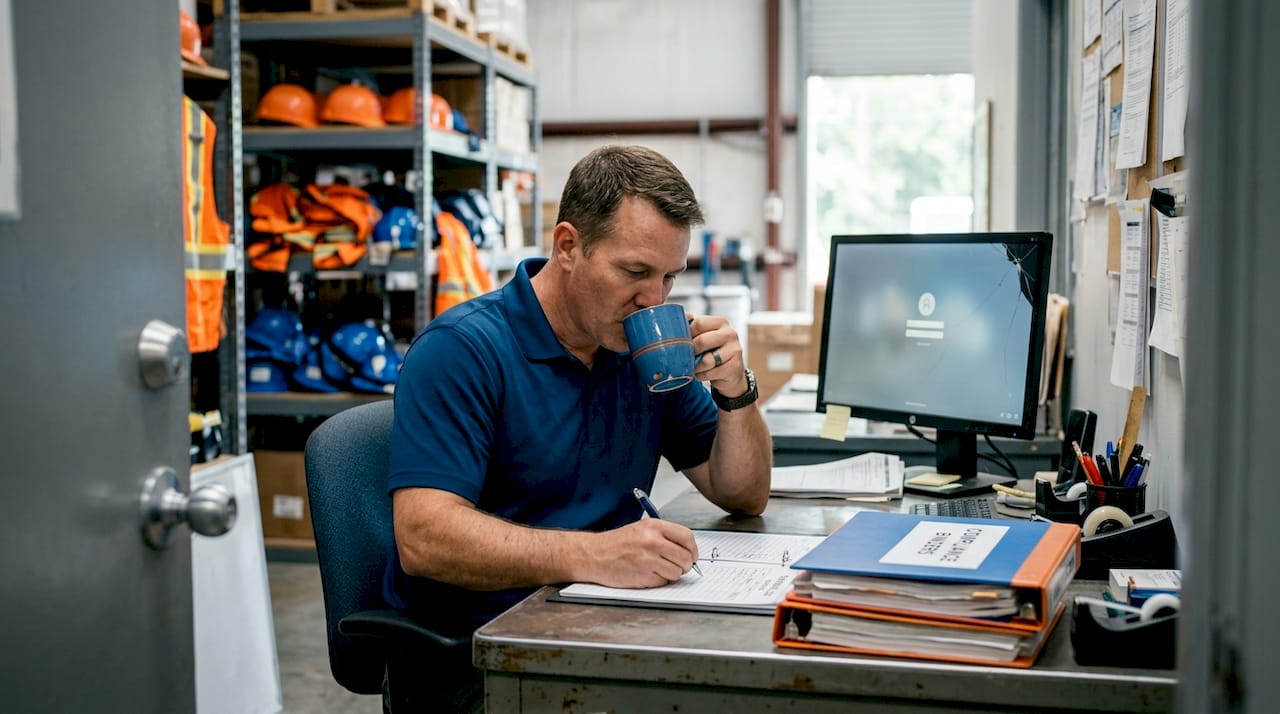
OSHA requires that employers evaluate operators at least every three years. That evaluation must include a performance observation in the workplace, not just a knowledge quiz. Beyond the three-year cycle, refresher training is required whenever specific triggering events occur. These triggers are not optional, and they apply even to your most experienced operators.
Events that require immediate refresher training:
- An accident or near-miss incident involving the operator
- Observed unsafe operation, even if no incident occurred
- A new or different type of forklift is introduced that the operator has not been trained on
- Significant changes in workplace conditions, such as new racking layouts, added pedestrian zones, or different loading dock configurations
- A supervisor’s assessment that the operator’s performance has declined
The stakes behind these requirements are not abstract. Forklift accidents cause approximately 85 fatalities and 35,000 serious injuries annually across the U.S. Proper training reduces incidents by up to 70%, and human error accounts for 70 to 87% of all forklift accidents. That means the overwhelming majority of preventable incidents trace back to gaps in training or supervision, not equipment failure.
Site-specific hazards deserve far more attention than they typically receive in compliance planning. Two warehouses operating the same model of forklift can have dramatically different risk profiles based on ceiling height, aisle width, floor condition, lighting levels, product weight variation, and foot traffic. Your training program must address the conditions operators actually encounter. A generic curriculum that doesn’t mention your cold-storage zone or your narrow-aisle racking system is leaving real risk unaddressed.
Use a forklift compliance checklist to audit your program regularly. Review training records quarterly. Confirm that refresher training was completed promptly after any triggering event, not weeks later. And schedule your three-year evaluations in advance so they don’t slip through the cracks during busy seasons. These OSHA training tips for managers are practical, low-cost habits that dramatically reduce your exposure.
The overlooked realities of lift operator compliance: Our take
After working with warehouses across the country for over 20 years, here is something worth saying plainly: most compliance failures are not caused by bad intentions. They are caused by underestimating how much work genuine compliance actually takes.
The first overlooked reality is the state-plan issue. If your facility operates in a state-plan state like California or Washington, additional requirements may apply beyond federal OSHA. Cal/OSHA, for example, has its own forklift regulations that can exceed the federal standard. Assuming federal OSHA is your only benchmark in these states is a costly mistake.
The second issue is the proliferation of quick certifications. A one-hour “certification” is simply not adequate. Legitimate training for a single forklift class typically runs two to four hours for formal instruction alone, plus hands-on time. If a provider is selling a complete certification package that fits into 60 minutes, something is being skipped, and that something will matter the moment an OSHA auditor asks questions.
The managers who genuinely protect their teams and their businesses are the ones who build safety into their culture, not just their paperwork. That means making it easy for operators to flag concerns, conducting pre-shift inspections without cutting corners, and partnering with trainers who know the business forklift training guide inside and out. Compliance on paper is easy. Compliance in practice, every shift, every week, is what actually prevents fatalities.
Get compliant and protect your workplace — next steps
Navigating forklift compliance doesn’t need to be overwhelming, but it does need to be done right.
At Forklift Academy, we have spent over 20 years helping warehouse and logistics operations across the U.S. build OSHA-compliant training programs from the ground up. Whether you need a complete OSHA forklift certification program, want to understand the full lift certification process, or need to clarify your specific OSHA compliance requirements for your facility type, we have the resources, trainers, and tools to help. Our programs cover online formal instruction, onsite practical training, train-the-trainer kits, and ongoing compliance support. Talk to our team today and take the guesswork out of certification.
Frequently asked questions
Is a forklift operator license the same as OSHA certification?
No. OSHA requires employer-issued certification, not a government license. The certification is specific to the employer, the equipment type, and the workplace, and cannot be transferred to a new employer.
How often do lift operators need to be recertified under OSHA?
Operators must receive a performance evaluation at least every three years, plus refresher training after accidents, near-misses, observed unsafe behavior, new equipment, or significant workplace changes.
Can online-only forklift operator training satisfy OSHA requirements?
No. Online training satisfies formal instruction only. Hands-on practical training and a workplace performance evaluation must still be completed in person with actual equipment.
Do all forklifts require the same operator certification?
No. Certification is type-specific, meaning an operator certified on a counterbalance sit-down forklift must complete separate training and evaluation before operating a reach truck or other equipment class.
Who is responsible if a certified forklift operator causes an accident?
The employer is ultimately responsible. Employers remain responsible for ensuring operator competency at all times, regardless of prior experience or previous certifications held by the operator.
Recommended
- Lift Certification Process for OSHA Compliance: Key Steps – Top Osha Forklift Certification
- Forklift Operator Qualification Explained: OSHA Compliance Guide – Top Osha Forklift Certification
- Top Examples of Lift Certifications for OSHA Compliance – Top Osha Forklift Certification
- Scissor Lift Operator Workflow for Safety Compliance – Top Osha Forklift Certification