
TL;DR:
- Traditional forklift training is outdated, lacking ongoing evaluation and real-time behavioral data.
- Modern technologies like telematics, AI, VR, and e-learning improve safety, compliance, and monitoring.
- Successful implementation requires phased rollout, cultural engagement, and combining tools with strong safety practices.
Forklift training hasn’t changed much in decades, at least not on the surface. Many warehouses still rely on paper checklists, a brief classroom session, and a supervisor’s sign-off to call an operator certified. But the warehousing landscape looks nothing like it did twenty years ago. Faster throughput demands, tighter margins, and rising OSHA enforcement activity mean that sticking with outdated methods isn’t just inefficient, it’s a liability. A new generation of tools including telematics, artificial intelligence, virtual reality, and mobile learning platforms is rewriting what effective, compliant forklift training actually looks like in practice.
Table of Contents
- Why traditional forklift training falls short
- Key technologies transforming forklift training
- From simulation to real-world results: Best practices for implementation
- Meeting and exceeding OSHA forklift training requirements with technology
- Why technology alone won’t solve forklift safety, and what really works
- Next steps: Modern forklift training solutions for your team
- Frequently asked questions
Key Takeaways
| Point | Details |
|---|---|
| Traditional training gaps | Old training methods lack real-time oversight and ongoing compliance tracking. |
| Tech-driven safety | Telematics, AI, and VR dramatically reduce risks and help comply with OSHA standards. |
| Best implementation practices | A phased rollout and blending hands-on with digital tools yields stronger, safer teams. |
| Beyond compliance | Combining innovative tools with strong workplace culture delivers long-term safety benefits. |
Why traditional forklift training falls short
Walk into many distribution centers today and you’ll find the same training model that’s been in place since the 1990s. An instructor lectures a group of operators, candidates run through a brief equipment checklist, and a printed card goes in the wallet. Done. Except it’s not done, not by a long shot.
The core problem with classroom-based and checklist-driven training is that it captures a single moment in time. An operator might perform flawlessly on evaluation day but develop risky habits three months later when no one is watching. Inattentional blindness, distraction from routine, and simple overconfidence build slowly. Traditional training has no mechanism to catch those behavioral shifts.
There are three major gaps that conventional methods fail to close:
- No ongoing evaluation. Most programs treat certification as a finish line rather than a starting point.
- No objective behavioral data. A supervisor’s memory is imperfect. Paper logs can be filled in retroactively. Neither creates reliable evidence.
- No personalized feedback loops. A single training event treats a 20-year veteran the same as a first-week hire.
OSHA recognized this problem decades ago. Under OSHA 1910.178(l)(4), employers must evaluate each operator at least once every three years and must provide refresher training when unsafe operation is observed or after an accident occurs. The intent is continuous competency, not a one-time checkbox.
“Telematics and AI safety systems monitor operator behavior, detect pedestrians, and provide real-time alerts, supporting post-training evaluation and refresher needs under OSHA 1910.178(l)(4).” That’s exactly the kind of structured, ongoing oversight that legacy training simply cannot replicate.
What operators actually need is a well-structured step-by-step forklift training process that connects initial instruction to ongoing performance monitoring. Technology makes that connection possible.
Key technologies transforming forklift training
The toolkit available to warehouse managers today is genuinely exciting. Each technology addresses a specific gap in the old model, and together they create a training ecosystem that is safer, more compliant, and far easier to manage at scale.
1. Telematics systems
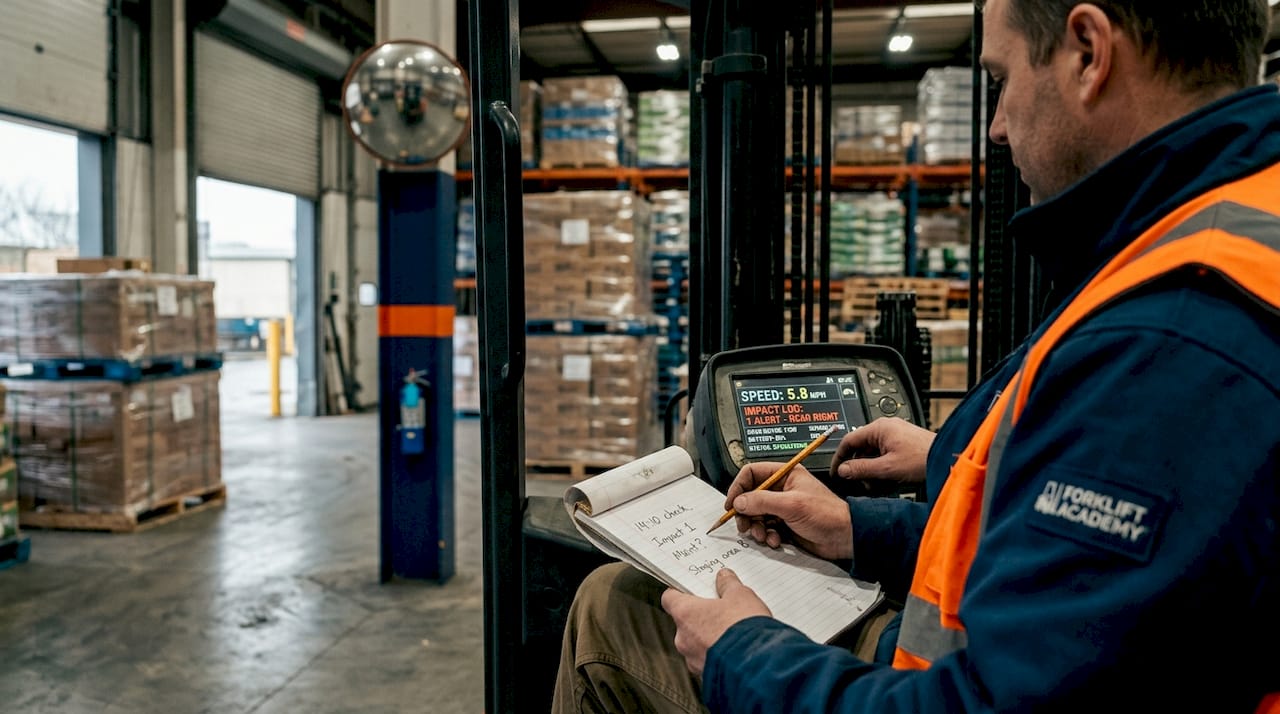
Telematics devices mount directly to the forklift and log everything: speed, impact force, braking patterns, pre-shift inspection completion, and hours of operation. This creates an objective, time-stamped record of how each operator performs every single shift. When a manager reviews a flagged incident, they’re working from data, not hearsay.
2. AI-powered safety systems
AI tools such as ELOshieldAI go further than data logging. They actively monitor the operating environment in real time. These systems detect pedestrians, issue visual and audio alerts to both the operator and nearby workers, and can even slow or stop a lift in high-risk situations. That’s not just training support, that’s active harm prevention during every working hour.
3. Virtual reality simulators
VR puts an operator inside a photorealistic warehouse environment where they can practice loading dock approaches, narrow aisle navigation, and emergency stops without any risk of real-world injury. High-risk scenarios that would be too dangerous to recreate in a live environment become training opportunities. The learning is immersive and measurable.
4. Mobile and e-learning platforms
Online platforms allow operators and managers to complete formal training modules from any device, at any time. This matters enormously for teams spread across multiple shifts or multiple facilities. Digital records update automatically, and managers can verify completion without chasing paperwork.
Here’s a side-by-side look at how these technologies compare on compliance and safety dimensions:
| Technology | Training support | Ongoing monitoring | Compliance records | Cost range |
|---|---|---|---|---|
| Telematics | Indirect (data review) | Continuous | Automated logs | Moderate |
| AI safety systems | Indirect (real-time alerts) | Continuous | Event-triggered | Moderate to high |
| VR simulators | Direct (scenario practice) | Session-based | Digital reports | High upfront |
| Mobile/e-learning | Direct (formal instruction) | Assessment-based | Instant digital | Low to moderate |
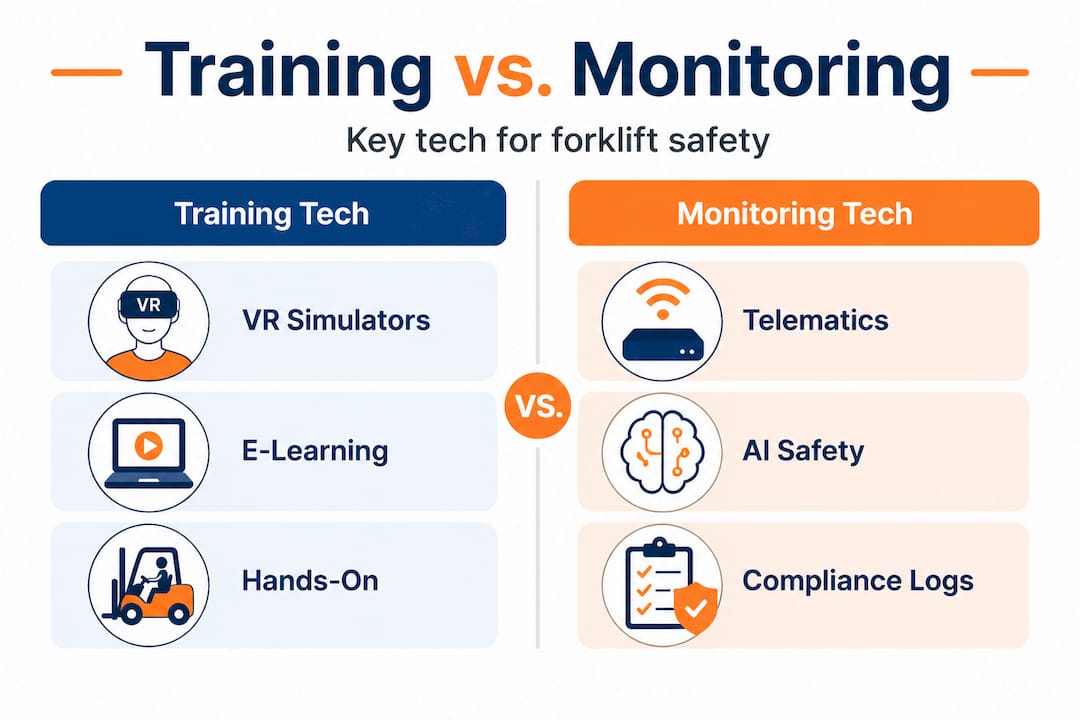
Pro Tip: Don’t pick just one technology. The most effective programs layer telematics and AI monitoring on top of a solid e-learning foundation, then add VR for skill-building in high-risk maneuvers. Staying current with safety technology trends will help you choose the right combination for your specific operation.
When managers understand how these tools work together, they can see clearly how technology doesn’t just improve training quality, it makes OSHA compliance and safety significantly easier to manage and document. The goal is to boost safety and efficiency simultaneously, not to choose between them.
From simulation to real-world results: Best practices for implementation
Knowing which technologies exist is one thing. Deploying them without disrupting your operation, wasting budget, or overwhelming operators is another challenge entirely. A phased rollout approach consistently produces better results than trying to overhaul everything at once.
Follow this sequence when integrating new training technology:
- Audit your current program. Identify which OSHA requirements you’re already meeting and where the gaps are. Do you have documented evaluations? Are refresher triggers defined?
- Run a pilot group. Choose one shift or one department. Deploy the new technology with that group, collect baseline data, and note operator feedback.
- Refine based on feedback. Operators will tell you quickly what’s working and what feels intrusive or confusing. Adjust comfort settings in VR, refine alert thresholds in telematics, or simplify the e-learning interface before scaling.
- Scale progressively. Expand to additional departments or shifts once the pilot produces clear, positive results. Trying to scale immediately is one of the most common and costly mistakes.
- Establish ongoing review cycles. Use the data your new systems generate to schedule quarterly reviews, flag operators for refresher training automatically, and update your training content when regulations change.
Research supports careful attention to how VR training is introduced. VR reduces cognitive load in complex tasks, but novices need comfort modes enabled during initial sessions to avoid disorientation. Combining VR with AI collision avoidance provides an important safety net during the transition from simulator to real equipment.
Here’s a snapshot of the metrics worth tracking once your program is running:
| Metric | Baseline measurement | Post-implementation target |
|---|---|---|
| Incident rate per 100 operators | Current average | Reduce by 20% or more |
| Refresher training triggers per quarter | Count manually | Automate with telematics flags |
| Time to complete evaluations | Days or weeks | Hours (digital records) |
| Operator compliance with pre-shift checks | Spot-check estimate | 100% digital verification |
Pro Tip: When introducing VR to experienced operators, let them explore the simulator in free-roam mode before jumping into scored scenarios. Veterans sometimes resist technology they see as “beginner tools.” Letting them discover the realism on their own converts skeptics into champions fast.
For a forward-looking perspective on how these methods will continue to evolve, the future tech in forklift training space is moving fast. Managers who build flexible, scalable programs now will be far better positioned to adopt the next wave of innovations without rebuilding from scratch. The practical path to ensuring OSHA compliance isn’t about perfecting a static program, it’s about building one that improves continuously.
Meeting and exceeding OSHA forklift training requirements with technology
Compliance is not a destination. OSHA’s forklift standard is designed to treat safety as an ongoing responsibility, and technology is the most reliable way to operationalize that mindset at scale.
Here’s how technology directly supports each major compliance obligation:
- Automated evaluation triggers. Telematics flags incidents, hard braking, and unsafe speeds automatically. Those flags become documented prompts for evaluations, exactly what OSHA 1910.178(l)(4) requires.
- Continuous real-time monitoring. Systems like ELOshieldAI provide real-time pedestrian alerts during every operating hour, creating a continuous safety layer between formal training sessions.
- Electronic recordkeeping. Digital platforms store training completion records, evaluation results, refresher training dates, and incident logs in one searchable system. When an OSHA inspector asks for documentation, you pull up a dashboard instead of digging through file cabinets.
- Refresher training triggers for high-risk operators. Telematics data can automatically flag operators who exceed incident thresholds, prompting a manager to schedule targeted refresher training before a serious accident occurs.
Here’s why this matters in numbers: OSHA reported that forklifts are involved in roughly 85 fatal accidents and nearly 35,000 serious injuries every year in the United States. Technology that reduces even a small fraction of those incidents represents enormous value, not just financially but in human terms.
The practical compliance path using technology comes back to OSHA-compliant lift truck training programs that combine formal certification with ongoing performance monitoring. These two components work in tandem. Certification establishes the knowledge baseline. Technology ensures that baseline doesn’t erode under the pressure of daily operations.
Why technology alone won’t solve forklift safety, and what really works
Here’s an uncomfortable truth that the technology vendors won’t always tell you: tools don’t create safe warehouses. People do.
We’ve worked with operations that deployed every piece of technology on the market, telematics, AI alerts, VR simulators, digital learning platforms, and still saw incident rates that didn’t move. The reason was almost always the same. The technology was running, but the culture wasn’t engaged. Supervisors dismissed alerts as background noise. Operators learned to “game” the telematics by taking approved routes on days they knew were being reviewed. Nobody felt comfortable raising safety concerns because the floor culture didn’t reward honesty.
Technology is only as powerful as the human system it operates within. That’s why the most effective programs we’ve seen at ForkliftAcademy.com combine smart tools with three non-negotiable cultural elements: regular safety communication between managers and operators, peer-driven accountability where experienced operators mentor newer ones, and a genuine open-door policy for reporting near-misses without fear of discipline.
The subtle behavioral warning signs that predict serious accidents, distraction, fatigue, overconfidence in tight spaces, an operator who’s been arguing with a coworker all morning, those are things no algorithm catches reliably. An experienced trainer who knows their operators notices. AI doesn’t build those relationships. People do.
The call to action for managers is direct: champion both sides of the equation. Push for the best technology your budget allows, but invest equally in the human infrastructure around it. Train your supervisors to act on the data the systems produce. Build safety culture deliberately, not passively.
Technology is a force multiplier for a strong safety culture. Without that culture, it’s just expensive hardware collecting data nobody uses.
Next steps: Modern forklift training solutions for your team
If this article has clarified anything, it’s that modern forklift training isn’t optional and neither is the technology that supports it. The gap between operations that lead on safety and those that lag is increasingly a technology gap, but it starts with a solid, certified foundation.
At ForkliftAcademy.com, we’ve spent over 20 years building training programs that meet OSHA standards and work in real warehouse environments. Whether you’re looking to get your team certified through a top OSHA forklift certification program, or you want to build internal capacity with an online train-the-trainer kit that scales across your facilities, we have the resources to move you forward. You can also review the full OSHA certification process to understand exactly what your team needs and when. Don’t wait for an incident to trigger a training overhaul. Start building your compliant, technology-supported program today.
Frequently asked questions
What is OSHA 1910.178(l)(4) and why does it matter for forklift training?
OSHA 1910.178(l)(4) mandates that employers evaluate every forklift operator at least once every three years and must provide refresher training whenever unsafe operation is observed, an accident occurs, or a significant change in conditions takes place. This standard makes ongoing evaluation a legal requirement, not just a best practice, which is why real-time monitoring tools that generate automatic evaluation triggers are so valuable for compliance.
How does telematics improve forklift operator safety?
Telematics devices record objective, time-stamped data on speed, impacts, braking, and inspection completion for every shift an operator runs. These systems provide real-time alerts that help prevent accidents and produce the kind of reliable electronic records that satisfy OSHA documentation requirements during audits, replacing unreliable paper logs with verifiable data.
Can technology fully replace hands-on forklift training?
No. VR reduces cognitive load in complex scenarios and builds skill in safe environments, but it must be paired with live equipment practice and a strong safety culture to produce operators who perform reliably under real-world pressure. Technology enhances training outcomes, it does not replace the judgment and mentorship that experienced trainers provide.
Is VR suitable for all operators starting forklift training?
VR is most effective when comfort modes are enabled for novice operators, preventing the disorientation that can occur in immersive environments. Research confirms that VR for novices works best as a complement to hands-on training rather than a standalone introduction, especially during the transition to operating actual equipment.
How can technology help with training documentation for OSHA audits?
Digital training platforms and telematics systems automatically generate and store records of training completion, evaluation results, refresher triggers, and incident logs in searchable electronic formats. When an OSHA inspector requests documentation, AI safety systems and digital platforms let managers produce complete, accurate records almost instantly rather than scrambling through paper files.
Recommended
- The Future of Forklift Training: Technology-Driven Innovations Transforming Workplace Safety – Top Osha Forklift Certification
- Forklift Training: OSHA Compliance & Safety in 2026 – Top Osha Forklift Certification
- Employee forklift training guide for OSHA compliance 2026 – Top Osha Forklift Certification
- Step by step forklift training for OSHA compliance 2026 – Top Osha Forklift Certification