
TL;DR:
- Forklift-related incidents in the U.S. cause approximately 85 deaths annually, with significant human and operational costs. Ensuring OSHA-compliant operator training and implementing layered safety strategies are essential to prevent accidents and protect both workers and businesses. Cultivating a safety-driven culture, rather than relying solely on compliance measures, significantly enhances warehouse safety and operational continuity.
Eighty-five workers die every year in forklift-related incidents in the United States. That number isn’t a bureaucratic statistic on a wall poster. It represents real people, real families, and real warehouses that had to shut down operations while investigators walked the floor. For warehouse and logistics managers, forklift safety is not a matter of common sense or intuition. It demands a deliberate, structured, and continuously reinforced approach that protects workers, preserves operations, and keeps your facility on the right side of OSHA regulations.
Table of Contents
- The real cost of forklift accidents
- Why OSHA-compliant training is non-negotiable
- What really causes forklift incidents?
- How layered safety strategies protect people and productivity
- Perspective: Why most forklift safety programs fall short and what actually works
- Get OSHA-compliant forklift safety solutions
- Frequently asked questions
Key Takeaways
| Point | Details |
|---|---|
| Forklift injury risk is high | Serious and fatal forklift accidents are common but largely preventable with the right strategies. |
| OSHA training is required | All operators must receive OSHA-compliant training and periodic retraining for compliance and safety. |
| Layered strategies reduce accidents | Combining operator education with site controls and pedestrian systems cuts both risk and downtime. |
| Culture drives lasting safety | Programs succeed when leaders engage routinely and connect safety to everyday workflows, not just regulations. |
The real cost of forklift accidents
Most managers know forklifts are dangerous. Fewer understand just how expensive a single incident can become. The numbers tell a stark story.
| Metric | Annual U.S. Figures |
|---|---|
| Forklift fatalities | ~85 per year |
| Serious injuries | ~34,900 per year |
| Non-serious injuries | ~61,800 per year |
| OSHA penalty per violation | Up to $16,131 |
| Repeat/willful violation penalty | Up to $161,323 |
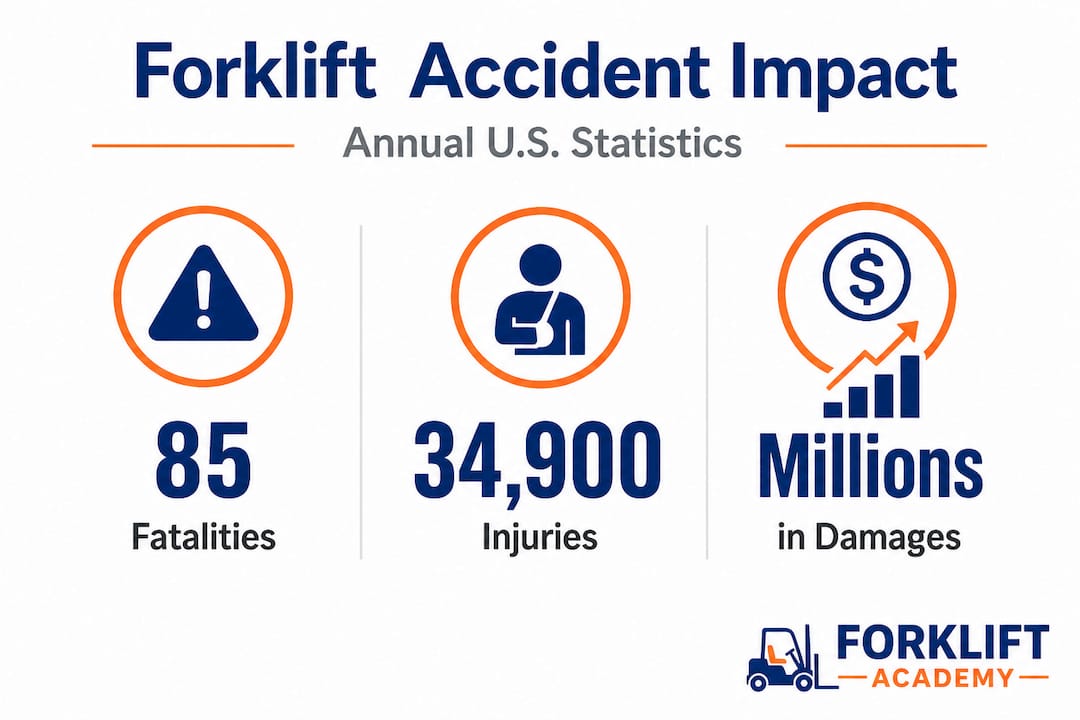
These figures come from federal safety data that shows the combined toll across warehousing, manufacturing, and distribution environments. For a warehouse manager overseeing a team of 20 to 200 workers, even a single serious incident can trigger a cascade of consequences that reaches far beyond the injured employee.
Think about the immediate aftermath of a forklift accident. OSHA investigators arrive. Your operations may halt for hours or days. Your insurance carrier opens an inquiry. Attorneys get involved. Supply chains back up. Clients notice.
“Forklift safety matters not just because regulations demand it, but because the financial and human costs of preventable incidents are simply too high to ignore.”
The indirect costs are often what managers underestimate most. Consider this list of ripple effects that never appear on an accident report:
- Lost productivity during investigation and equipment lockout
- Retraining costs for affected operators and nearby teams
- Morale damage that drives turnover and absenteeism
- Increased insurance premiums for years after a single incident
- Reputational harm with customers and recruiting candidates
- Management time diverted from operations to compliance response
Effective practical accident prevention is not just a safety investment. It’s a business continuity investment. And the core driver of risk reduction, across nearly every study and investigation, is operator training. Pairing strong training programs with smart incident prevention strategies is where serious risk reduction begins.
Why OSHA-compliant training is non-negotiable
OSHA’s standard 29 CFR 1910.178(l) is the federal regulation that governs forklift operator training in general industry. It’s specific, it’s enforceable, and it applies to every powered industrial truck operator at your facility regardless of experience or tenure.
OSHA requires that employers ensure all powered industrial truck operators are trained and evaluated as competent before they operate equipment unsupervised. The regulation also mandates refresher training after specific trigger events: unsafe operation observed, an accident or near-miss, changes in workplace conditions, and introduction of a different type of equipment.
Here’s how compliant training stacks up against outdated or minimal approaches:
| Training Element | OSHA-Compliant Training | Minimal or Outdated Training |
|---|---|---|
| Operator evaluation | Required, documented | Often skipped or verbal only |
| Equipment-specific instruction | Covered for each truck type | Generic overview only |
| Refresher after near-miss | Mandated trigger | Rarely enforced |
| Workplace-specific hazards | Addressed on-site | Not customized |
| Certification documentation | Provided and retained | Missing or informal |
| Training frequency | Ongoing as needed | One-time at hire |
The table above highlights something important: compliant training is not a one-and-done event. Many facilities treat forklift certification like a driver’s license, something you get once and carry forever. That approach creates serious legal exposure.
Pro Tip: Schedule a quarterly calendar review to identify operators who are due for refresher training based on incident history, equipment changes, or role transitions. This proactive approach keeps you ahead of compliance gaps rather than reacting to them after an incident occurs.
Reviewing a solid employee training guide helps managers understand the specific documentation and frequency requirements that OSHA inspectors look for. A lapse in training records alone can result in a citation even when no incident has occurred. Your OSHA forklift safety overview should become a living document that your safety program references regularly, not a PDF buried in a shared drive.
What really causes forklift incidents?
Ask most people what causes forklift accidents and they’ll say “operator error.” That answer is technically accurate about 70 to 80% of the time, but it’s operationally incomplete. Blaming the operator without examining why the error occurred does nothing to prevent the next one.
The real causes of most forklift incidents include a mix of behavioral, environmental, and systemic factors. Here’s what actually drives incidents at the site level:
- Excess speed relative to aisle width, floor conditions, or pedestrian traffic
- Poor visibility at corners, dock areas, and racking intersections
- Rushed timelines during peak shipping or receiving periods
- Unclear traffic flow where forklifts and pedestrians share routes
- Inadequate pre-shift inspections that allow mechanical defects to go unnoticed
- Operator fatigue during long or night shifts with high lift demand
- Inconsistent enforcement of safety rules by supervisors under pressure
Tip-overs and struck-by incidents are strongly tied to how people operate in context. Speed decisions, visibility limitations, and proximity to foot traffic all interact to create the conditions for an incident. Training reduces the likelihood of poor decisions. But site controls reduce the consequences when any decision goes wrong.
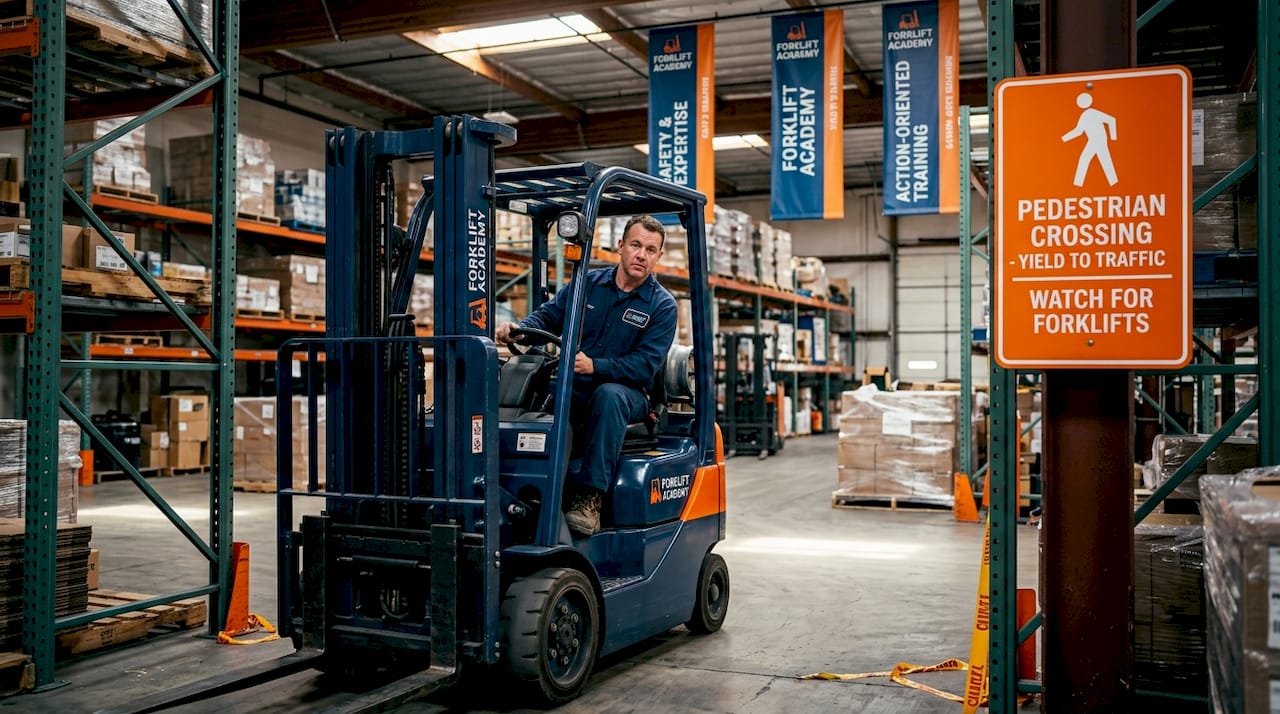
The solution is not to write a tighter rule book. The solution is to build an environment where the safest choice is also the easiest choice.
Pro Tip: Start each shift with a five-minute safety walkthrough that covers known blind spots, identifies active pedestrian zones, and confirms any operational changes from the previous shift. This habit costs almost nothing and creates a team-wide awareness reset before equipment starts moving.
For facilities looking to reduce warehouse forklift risks, the combination of contextual training and physical environment controls consistently outperforms either approach alone. Operators trained to recognize hazards in their specific environment make better real-time decisions than operators trained on generic scenarios.
How layered safety strategies protect people and productivity
Single-solution safety programs fail. A barrier without training, or training without barriers, leaves too many gaps. The facilities with the strongest safety records use multiple layers working together, and those layers reinforce each other in ways that matter in the real world.
Here are the essential layers every effective forklift safety program should include:
- Operator training and certification using OSHA-compliant programs with regular refreshers and documented evaluations
- Physical site controls including guardrails, painted pedestrian lanes, physical barriers at high-risk intersections, and clearly marked traffic flow signs
- Pedestrian awareness programs that train non-operators to recognize forklift zones, use designated walkways, and understand right-of-way rules
- Regular equipment inspection routines that identify mechanical issues before they become hazards, including daily pre-shift checklists
- Active proximity warning systems such as sensor-triggered lights at blind corners, blue safety lights, and audible alerts during reverse movement
Pedestrian interactions are one of the highest-risk edge cases in any warehouse environment. Active and passive proximity controls, combined with targeted operator training, significantly reduce both the frequency and severity of these encounters.
Consider a concrete example of how this works in practice. A distribution center with a blind corner near a receiving dock installs a sensor-activated strobe light that triggers whenever a forklift enters the zone. Simultaneously, operators receive a refresher on speed limits in low-visibility areas. Within 90 days, near-miss reporting in that zone drops significantly. Neither the light nor the refresher alone would have achieved the same result.
Efficiency is the other side of this story. Every avoided incident is a shift that runs uninterrupted. Every avoided investigation is a week of management time returned to operations. Every avoided injury is a trained employee who stays productive. Safety and efficiency are not competing values in a well-run warehouse. They are the same value measured differently.
Following a structured step-by-step training plan helps managers layer these elements in the right sequence, starting with operator certification and building outward to environmental controls and pedestrian programs that hold up under audit pressure.
Perspective: Why most forklift safety programs fall short and what actually works
After more than two decades working in forklift safety education, one pattern stands out above all others: the facilities with the worst safety records usually have safety programs. They have binders. They have posters. They have sign-off sheets. What they don’t have is a culture where safety behavior is visible, reinforced, and genuinely valued.
The checklist mentality is the single biggest failure mode in warehouse safety. Managers complete their OSHA documentation, file their certification records, and consider the obligation satisfied until the next audit cycle. This is compliance theater. It satisfies inspectors on good days but collapses the moment a supervisor looks the other way or production pressure spikes.
What actually works is deceptively simple. Visible leadership engagement changes behavior more than any rule ever written. When a shift supervisor stops a forklift during a busy period to correct an unsafe move without being asked, that moment communicates more than six months of training videos. When a manager walks the floor at the start of every shift instead of staying in the office, the team reads that signal and adjusts accordingly.
The facilities with genuinely strong safety outcomes also share one more trait: they treat near-miss reporting as a positive signal, not a disciplinary trigger. Near-misses are intelligence. They tell you exactly where your barriers, training, or workflows are breaking down before someone gets hurt. Suppressing near-miss reporting by punishing people who report it is one of the fastest ways to guarantee a future serious incident.
Following a set of essential safety rules matters. But rules without culture are just words on a wall. The managers who reduce their incident rates consistently are the ones who understand that safety is something you practice every shift, not something you document once a year.
Get OSHA-compliant forklift safety solutions
If your facility is ready to move beyond basic compliance and build a safety program that actually protects your team and your operations, the right training partner makes all the difference.
At Forklift Academy, we’ve spent over 20 years helping warehouse managers and logistics teams across the U.S. and Canada meet OSHA standards and reduce real-world risk. Our training programs cover everything from individual operator certification to full team deployments, available in both online and onsite formats. For organizations that want to build internal capacity, our train the trainer certification gives your designated safety leads the tools to deliver compliant training on their own schedule. Need to certify an entire department? Our forklift certification for teams solution is built for exactly that. Take the next step and give your team the training foundation that holds up under pressure.
Frequently asked questions
Who is required to complete forklift safety training?
Any employee operating a forklift or powered industrial truck must complete OSHA-compliant training before they operate equipment without supervision, regardless of prior experience or job tenure.
How often must forklift operators be retrained under OSHA?
Operators must be retrained after any unsafe operation observation, accident, near-miss, or change in workplace conditions or equipment, as OSHA mandates refresher training whenever these triggers occur.
What are the biggest risks if forklift training is neglected?
Neglecting training increases the risk of serious injuries and fatalities, while also exposing the business to regulatory penalties, insurance increases, and significant operational disruption.
What controls help prevent warehouse pedestrian accidents?
Active and passive proximity controls including guardrails, marked crosswalk systems, sensor warning lights, and blue safety projectors are among the most effective tools for reducing pedestrian-related forklift accidents.