
TL;DR:
- Many warehouse operations treat forklift safety plans as simple instruction sheets, risking preventable injuries and citations. A functional safety plan integrates training, inspections, traffic management, and incident response into a living system that adapts to operational changes. Effective plans focus on safety outcomes, continuous monitoring, and accountability rather than just passing audits.
Forklift safety plans are not operator instruction sheets stapled to a bulletin board. Yet far too many warehouse operations treat them exactly that way, and the consequences show up as incident reports, OSHA citations, and preventable injuries. A properly built forklift safety plan is a living system that connects training, inspection protocols, traffic management, and incident response into one coordinated strategy. This guide walks you through every essential element, from U.S. OSHA requirements to Canadian CSA standards, so you can build or strengthen a plan that actually protects your team and keeps your operation running.
Table of Contents
- What is a forklift safety plan?
- Essential components of a forklift safety plan
- How to build and maintain your forklift safety plan
- Top hazards and how a safety plan addresses them
- Why most forklift safety plans fail—and what actually works
- Get expert help building your forklift safety plan
- Frequently asked questions
Key Takeaways
| Point | Details |
|---|---|
| Holistic safety strategy | A forklift safety plan covers far more than operator training—it’s a complete, evolving system. |
| Regulatory alignment | U.S. and Canadian safety plans share core elements but differ in some provincial or federal details. |
| Stepwise implementation | Building an effective plan requires assessment, formal policies, ongoing training, and frequent review. |
| Focus on top hazards | A robust plan addresses tip-overs, pedestrian safety, and maintenance before accidents happen. |
| Continuous improvement | Regular updates and a workplace safety culture drive results beyond simple compliance. |
What is a forklift safety plan?
A forklift safety plan is a documented, organization-wide system that governs how powered industrial trucks are operated, maintained, and monitored in your facility. It is not a single policy memo. It is not a training certificate on file. It is a structured framework that covers every layer of risk associated with forklift operations, and it must evolve as your operation changes.
Think of it as the operational backbone behind every forklift decision made on your floor. When a new operator starts, the plan tells you exactly what training is required. When a forklift shows a warning light, the plan tells you who takes it out of service and what happens next. When a near-miss occurs, the plan dictates how it gets investigated and what changes follow.
“A safety plan that sits in a binder and gets reviewed once a year is not a safety plan. It is a liability document waiting to be used against you.”
The OSHA standard 1910.178 lays out the regulatory foundation for powered industrial truck safety in the U.S. Its core components include:
- Operator training under 1910.178(l), covering formal instruction, practical training, and evaluation every three years or after incidents and operational changes
- Daily pre-use inspections, both visual and functional, with immediate removal from service if defects are found under 1910.178(q)(7)
- Maintenance and repair protocols to ensure equipment stays mechanically sound
- Safe operating rules covering speed limits, load stability, and proper travel procedures
- Traffic management including defined travel lanes, signage, and pedestrian separation
- Incident investigation procedures to identify root causes and prevent recurrence
A strong safety plan integrates all six areas into a single, coordinated strategy. You can use an OSHA forklift compliance checklist to confirm you have covered each requirement before your next audit or inspection.
Essential components of a forklift safety plan
Now that you understand what a safety plan actually is, it is worth breaking down each component in detail, because each one requires a different type of action, documentation, and accountability.
1. Operator training and evaluation
Training is the most visible part of any safety plan, and it is also the one most frequently done wrong. OSHA requires both formal instruction (classroom or online) and hands-on practical training for every operator, followed by a performance evaluation before the operator is authorized to work unsupervised. Retraining is mandatory every three years and must happen sooner if an operator is involved in a near-miss, causes a property incident, or receives a new type of equipment.
Your employee forklift training guide should document who completed what, when, and who conducted the evaluation. No documentation means no proof of compliance.
2. Daily pre-use inspections
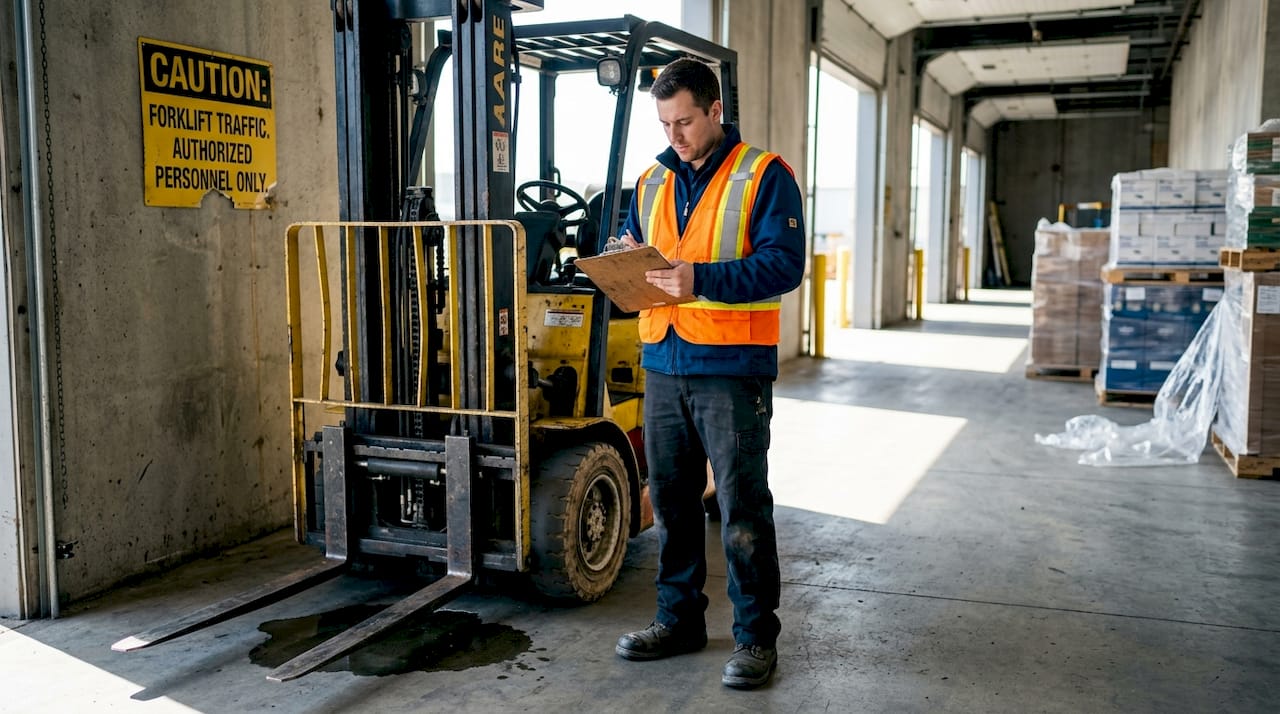
Before every shift, operators must inspect their equipment. Visual checks include looking for fluid leaks, tire condition, visible damage to forks and mast components, and any signs of unusual wear. Functional checks include testing brakes, horn, lights, steering, and the hydraulic lift system. If any defect is found, that forklift comes out of service immediately. No exceptions.
3. Maintenance and repair protocols
Your plan must name who is authorized to perform repairs and define how defective equipment is tagged, stored, and returned to service. Maintenance logs should be kept for every piece of equipment and reviewed regularly.
4. Safe operating rules and pedestrian separation
Speed limits, no-rider policies, load limits, travel procedures on ramps, and clear rules about pedestrian zones all belong in writing. Many facilities use floor markings, mirrors at blind corners, and flashing lights at intersections to reinforce these rules physically.
5. Traffic management
Defined travel lanes with adequate width, clearly marked pedestrian walkways, and signage at every major intersection and blind spot reduce conflict between foot traffic and forklifts. This is one of the most underbuilt elements in smaller warehouses.
6. Incident investigation
Every incident, including near-misses, must be documented and investigated. The goal is to find the system failure that allowed the incident to happen, not just to record that it happened.
U.S. vs. Canada: Key regulatory differences
| Requirement | U.S. (OSHA 1910.178) | Canada (CSA B335-15 / WorkSafeBC) |
|---|---|---|
| Initial training format | Formal instruction + practical | Theory, practical, and type-specific |
| Evaluation frequency | Every 3 years or after incidents | Every 3 years (mandatory in BC) |
| Pre-use inspections | Required before each shift | Required; records kept by employer |
| Employer recordkeeping | Required | Required; more prescriptive in some provinces |
| Refresher triggers | Incident, near-miss, new equipment | Same, plus scheduled intervals |
Canadian regulations under CSA B335-15 mirror OSHA requirements closely, but provinces like British Columbia add mandatory refresher intervals and stricter recordkeeping through WorkSafeBC Part 16. If you operate across the border or run facilities in both countries, your safety plan needs to address both sets of standards.
Pro Tip: Use your inspection forms and training records as a built-in audit trail. If OSHA or a provincial inspector walks in tomorrow, your documentation should tell the whole story without you having to explain anything.
Review the full breakdown of forklift training steps to make sure your training sequence meets all regulatory requirements before your next evaluation cycle.
How to build and maintain your forklift safety plan
Having a clear picture of what goes into a safety plan, you now need a practical process for building one from scratch or updating what you already have. Here is the sequence that works.
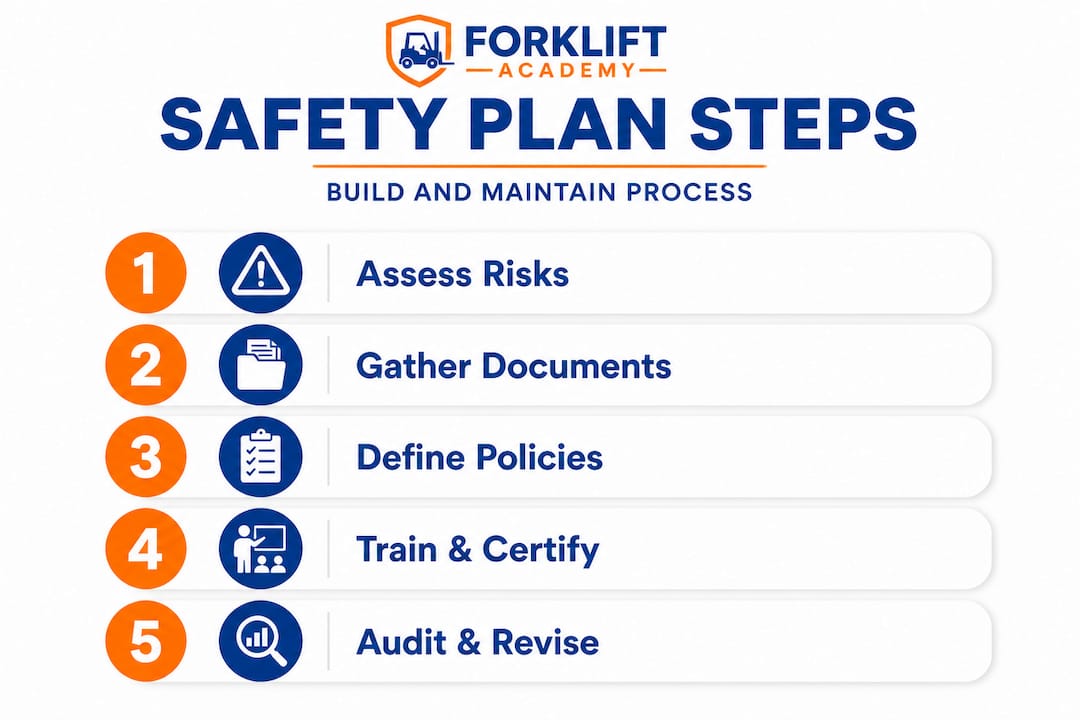
Step 1: Assess your current risk profile
Walk your facility with fresh eyes. Identify every point where forklifts and pedestrians share space, every blind corner, every ramp, and every area where equipment is stored or charged. Document what you find. Your risk assessment drives every other decision in the plan.
Step 2: Gather your baseline documents
Collect your existing training records, maintenance logs, incident reports, and any policy documents you already have. Identify the gaps. Many operations discover they have outdated training certificates, missing inspection logs, or no formal incident investigation procedure.
Step 3: Define written policies for each component
Using OSHA 1910.178 and, if applicable, CSA B335-15 as your framework, write out policies for every element covered in the previous section. Be specific. “Operators must inspect equipment before use” is not a policy. “Operators complete the pre-use inspection checklist (Form SF-01) at the start of every shift and submit it to the shift supervisor” is a policy.
Step 4: Train, certify, and document
OSHA requires formal instruction and practical training before any operator works unsupervised. Run all current operators through your updated training program, document completions, and schedule evaluation dates. Keep paper and digital copies.
Step 5: Audit and revise at defined intervals
Build a review schedule into the plan itself. Quarterly walkthroughs, annual full reviews, and immediate reviews after any incident keep your plan current. Facilities that skip this step often find themselves presenting outdated policies during OSHA inspections.
Common pitfalls to avoid:
| Pitfall | Why it happens | How to fix it |
|---|---|---|
| Skipping refresher training | Busy schedules, low incident history | Set calendar reminders 90 days before due dates |
| Poor recordkeeping | No central system | Use a shared digital folder or safety management platform |
| Ignoring near-misses | No reporting culture | Normalize anonymous reporting, investigate every event |
| Static traffic management | Layout changes not reflected | Review floor plans during every annual plan update |
| Untrained supervisors | Focus on operators only | Include supervisors in the forklift safety training process |
Pro Tip: Assign a named plan owner. Not a department, not a team, a specific person responsible for keeping the safety plan current, tracking training due dates, and scheduling audits. Plans without owners drift.
Review OSHA inspection requirements to understand exactly what inspectors look for so you can build those expectations directly into your internal audit process.
Top hazards and how a safety plan addresses them
It is easy to build a safety plan as a paperwork exercise. It is harder to remember that every element exists because real people have been seriously injured or killed when those elements were missing. The statistics are sobering.
Tip-overs
Tip-overs account for 25 to 42% of forklift fatalities. The physics are counterintuitive: a forklift’s stability triangle shifts dramatically when it is loaded, traveling on a slope, or making a sharp turn at speed. The most critical safety response is operator restraint, staying seated and belted so the overhead guard protects the operator if a tip-over occurs. Your safety plan must cover this in training and reinforce it through inspection routines and supervisor monitoring.
Pedestrian strikes
Pedestrian incidents account for up to 36% of serious forklift injuries. The fix is physical and procedural. Painted pedestrian zones, convex mirrors at blind corners, audible warnings at intersections, and strobe lights on moving equipment all reduce collision risk. Your traffic management policy needs to name every pedestrian zone, define the rules for each, and specify what happens when contractors or visitors enter the facility.
Uneven surfaces and ramps
Ramps amplify tip-over risk significantly. Operating on a grade changes the forklift’s center of gravity and requires operators to reduce speed by at least 50% and travel with loads positioned correctly on the uphill side. Your safe operating rules section must address ramps specifically, not just general speed limits.
Maintenance under raised equipment
Performing maintenance or inspections under a raised forklift mast or attachment without proper blocking is a fatality waiting to happen. Your maintenance protocols must require the use of approved safety stands, never hydraulic jacks alone, before anyone works beneath a raised load or mast.
Blind spots and intersections
Blind spots are one of the most frequently cited contributors to pedestrian incidents. Horns at intersections, mirrors on columns, and two-way radio check-ins for high-traffic areas are all plan-level solutions. Your traffic management component should map every blind spot in the facility and name the control measure assigned to each.
“Every hazard on this list has a safety plan element that directly reduces its probability. The hazard does not disappear. The plan makes it manageable.”
Using the OSHA forklift standards framework as a reference helps you connect each hazard directly to the regulatory requirements designed to control it.
Why most forklift safety plans fail—and what actually works
After more than 20 years working in forklift safety training across hundreds of facilities, the pattern is consistent. Organizations build a safety plan, it passes an audit, and then it quietly dies. The binder gets thick with forms no one reads. Training happens only when someone asks about it. Incident investigations stop at “operator error” because going deeper feels uncomfortable.
The uncomfortable truth is this: most forklift safety plans are designed to pass inspections, not to prevent injuries. They satisfy the question “do we have a plan?” without asking “does the plan actually change what happens on the floor every day?”
What actually works is different. It starts with making safety part of how supervisors talk to their teams, not something that only surfaces during audits or after an incident. It means operators know their inspection forms matter and that a defect report actually gets followed up on. It means refresher training is not treated as punishment after something goes wrong, it is treated as a normal part of staying sharp.
The organizations with the lowest incident rates also share one trait: they measure outcomes, not just activities. They do not just track “training completed.” They track near-misses reported, inspection defects caught, and incident-free days. Those numbers tell you whether your plan is working. A completion certificate tells you a box was checked.
If you want to shift your team in that direction, start with OSHA training tips for managers that address how to build accountability into your daily operations without creating a culture of blame.
The real benchmark for any safety plan is not a clean audit. It is operators who feel responsible for their equipment, supervisors who enforce rules consistently, and a floor where near-misses get reported and acted on before they become incidents.
Get expert help building your forklift safety plan
Building a compliant forklift safety plan takes time, expertise, and the right tools. If your current training program has gaps, outdated materials, or undocumented evaluations, the risk compounds every day you operate that way.
Forklift Academy has supported warehouses and distribution centers across the U.S. and Canada for over 20 years with OSHA-compliant training, certification, and the practical resources that make safety plans actually function. Whether you need to certify your whole team, build internal training capacity, or find the right forklift training programs for your operation size, the tools are ready. The train the trainer online program lets you build in-house expertise so your safety plan never depends on a third-party schedule. Explore the full range of forklift training certification options to find the right fit for your team today.
Frequently asked questions
Who is responsible for developing a forklift safety plan?
Warehouse managers and safety officers typically lead the development process, with input from operators and visible support from executive leadership to ensure the plan is properly resourced and enforced.
How often should forklift operators receive refresher training?
OSHA 1910.178(l) and CSA B335-15 both require refresher training at a minimum every three years, and sooner following any incident, near-miss, or change in equipment or operating environment.
What should be included in daily forklift inspections?
Daily inspections must cover both visual and functional checks, including brakes, lights, horn, fluid levels, fork condition, and visible structural damage, with immediate removal from service if any defect is identified.
Are forklift safety plan requirements the same in Canada as in the U.S.?
The requirements are closely aligned, but CSA B335-15 and provincial regulations like WorkSafeBC Part 16 add specific recordkeeping obligations and mandatory refresher intervals that differ from the federal U.S. standard.
What is the most common cause of forklift fatalities?
Tip-overs cause 25% to 42% of forklift fatalities, making operator restraint use and proper load handling the most critical prevention measures in any safety plan.
Recommended
- Forklift Safety Checklist Guide for OSHA Compliance – Top Osha Forklift Certification
- How to Comply With OSHA Forklift Rules: A Step-by-Step Guide – Top Osha Forklift Certification
- Forklift Evaluation Guide: Step-by-Step OSHA Compliance – Top Osha Forklift Certification
- How to Implement Forklift Safety Training for OSHA Compliance – Top Osha Forklift Certification