
TL;DR:
- Passing a forklift certification does not ensure ongoing compliance; continuous evaluation and safety systems are essential.
- OSHA’s 2025 standards emphasize regular operator re-evaluation, documented inspections, engineered workplace controls, and addressing non-forklift hazards for true safety.
Passing a forklift certification test is not the finish line for regulatory compliance. Too many warehouse managers treat certification as a box to check and then move on, only to face OSHA citations months later when an inspector walks through the door. The reality is that 29 CFR 1910.178 demands far more than a one-time credential. This guide breaks down exactly what OSHA expects in 2025 and 2026, from ongoing operator evaluations and daily inspection routines to ergonomic controls and pedestrian separation, so you can build a system that actually holds up.
Table of Contents
- Understanding 2025 OSHA forklift safety standards
- Operator training: More than just a certificate
- Maintenance and workplace controls: Daily routines for lasting safety
- Beyond forklifts: Addressing additional warehouse hazards
- Manual material handling: Using the Revised NIOSH Lifting Equation for ergonomic compliance
- Why one-time certification misses the mark: A manager’s real-world view
- Need to streamline forklift safety and certification?
- Frequently asked questions
Key Takeaways
| Point | Details |
|---|---|
| OSHA compliance is ongoing | Regulations require continuous training, evaluation, and maintenance—not just one-time certification. |
| Training must be practical | Compliant training involves formal instruction, hands-on practice, and workplace performance evaluation. |
| Daily routines ensure safety | Routine inspections and workplace controls are essential to prevent forklift accidents and injuries. |
| Non-forklift hazards matter | Holistic safety includes managing exit routes, fire risks, and walking-working surfaces alongside forklift operations. |
| Ergonomic tools help reduce injury | Applying the NIOSH Lifting Equation benchmarks material handling risk and guides ergonomic improvements. |
Understanding 2025 OSHA forklift safety standards
The single most important document governing forklift operations in U.S. general industry is 29 CFR 1910.178, which covers powered industrial trucks (PITs) in warehouses, manufacturing plants, and distribution centers. The standard addresses five core areas: operator training and evaluation, safe operating rules, vehicle maintenance and inspection, workplace conditions such as aisle widths and clearances, and refueling or battery charging procedures.
Understanding what the standard actually requires separates managers who stay compliant from those who get cited. Here is a quick comparison of how requirements have evolved:
| Requirement | Pre-2020 common practice | 2025 expectation |
|---|---|---|
| Operator training | One-time classroom certification | Formal instruction + practical training + workplace evaluation |
| Evaluation frequency | At initial hire | At hire and after incidents, changes, or observed unsafe behavior |
| Maintenance records | Paper logs, sometimes inconsistent | Documented daily pre-shift inspections on file |
| Workplace controls | General signage | Engineered pedestrian separation, defined traffic patterns |
| Re-training triggers | Rare, often after accidents | Triggered by workplace changes, near misses, and performance issues |
Notice that the gap between old habits and current expectations is widest in two areas: ongoing evaluation and engineered controls. Many operations still rely on practices from 10 years ago.
Key areas that forklift safety rules 2025 addresses include:
- Operator certification is required before unsupervised operation, with no exceptions for experienced hires
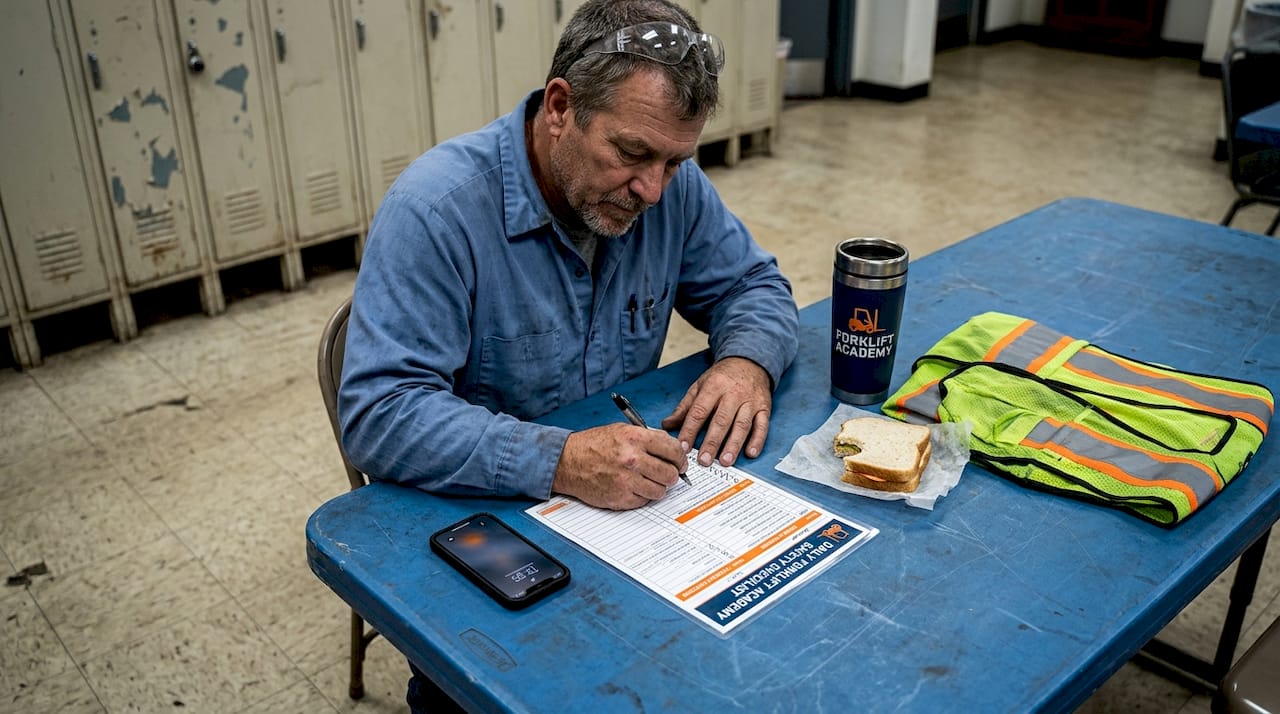
- Pre-shift inspections must be completed and documented before each shift
- Aisle width minimums depend on load size and must be consistently maintained
- Refueling and battery charging areas need to meet specific ventilation and safety standards
- Load capacity plates must be legible and never altered
A sobering fact: powered industrial trucks consistently rank among OSHA’s most frequently cited standards year after year. That is not because warehouses are reckless. It is because the standard requires active, ongoing management rather than a set-it-and-forget-it approach.
Operator training: More than just a certificate
OSHA’s training requirements under 29 CFR 1910.178 are specific and non-negotiable. Formal instruction, practical training, and workplace evaluation must all occur before an operator is allowed to work unsupervised. Each element serves a distinct purpose, and skipping any one of them puts you out of compliance regardless of what certificates are hanging on the wall.
Here is how to structure a fully compliant training program:
- Formal instruction: Cover all truck-related topics including controls, stability, load handling, refueling, and pre-operation inspection. This can happen in a classroom or through a structured online module.
- Practical training: Put the operator in the seat with hands-on exercises. They need to demonstrate load placement, turning, ramp navigation, and emergency stopping under real or simulated conditions.
- Workplace evaluation: A qualified trainer observes the operator in your specific facility, on your specific equipment, navigating your aisles, racking, and pedestrian zones. Generic training does not substitute for this step.
- Documentation: Record who was trained, by whom, on what date, and with what equipment. Keep these records accessible.
- Re-evaluation: Schedule re-evaluation at least every three years, and more frequently when workplace conditions change or performance issues arise.
Pro Tip: Build re-training triggers directly into your incident reporting form. Every time a near miss or unsafe behavior is documented, the form should automatically flag a re-evaluation for that operator. This removes the guesswork and keeps your records clean for any OSHA inspection.
“The most common mistake is treating training as a one-time event. OSHA views operator competence as a condition that changes with the job environment, the equipment, and the operator’s habits over time.”
The OSHA training tips 2025 you implement today will shape your compliance posture for years. If you are building or refreshing a training program, a solid forklift training guide gives you a practical framework to follow rather than starting from scratch.
Re-training is required whenever an operator is observed operating in an unsafe manner, is involved in an accident or near-miss incident, receives an evaluation revealing unsafe operation, is assigned to drive a different type of truck, or works in a facility where conditions change materially. That last trigger is the one most managers miss. A new racking layout, a freshly added pedestrian crossing, or a change in floor surface all qualify as workplace condition changes requiring re-training.
Maintenance and workplace controls: Daily routines for lasting safety
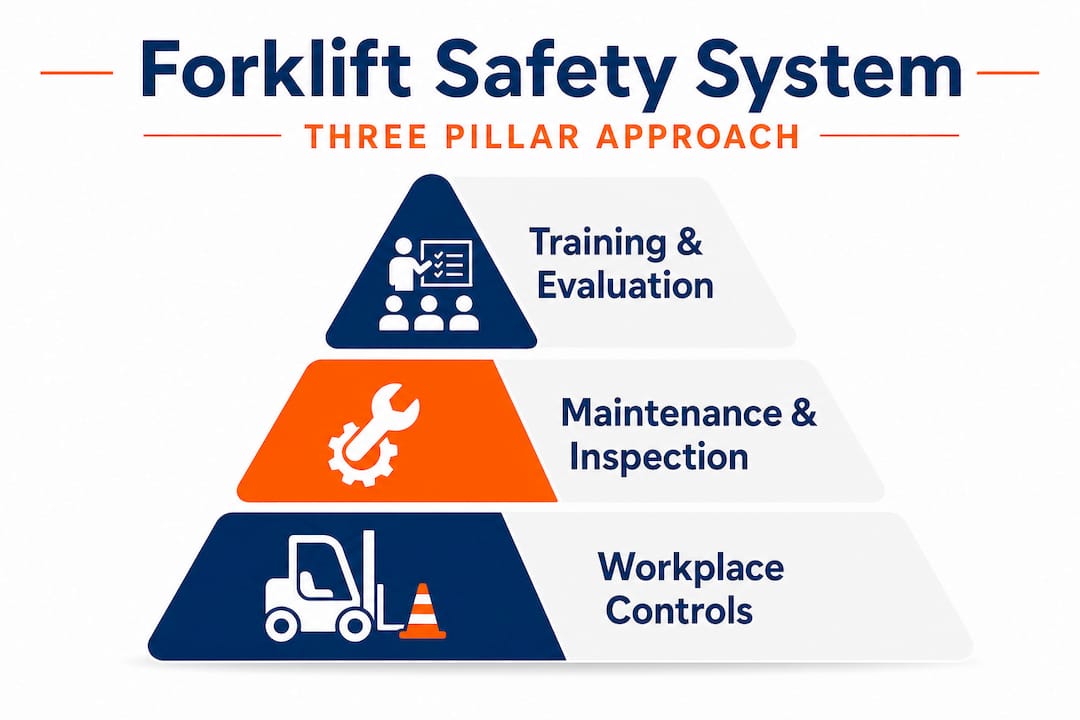
Think of 29 CFR 1910.178 as a three-legged stool: training and evaluation, maintenance and inspection, and engineered workplace controls. Remove any one leg and the stool falls. High-performing warehouses treat compliance as a daily operating system rather than an annual review.
Daily and periodic maintenance expectations:
| Maintenance task | Frequency | Who is responsible |
|---|---|---|
| Pre-shift visual inspection | Before every shift | Operator |
| Fluid levels check (fuel, hydraulic, coolant) | Before every shift | Operator |
| Tire condition and pressure | Daily | Operator or maintenance staff |
| Fork inspection (cracks, welds, height difference) | Daily | Operator |
| Brake and steering function test | Before every shift | Operator |
| Battery condition check (electric trucks) | Before charging and after charging | Operator |
| Full mechanical inspection | Per manufacturer schedule (typically every 250 hours) | Certified maintenance technician |
The forklift compliance checklist you use should mirror these intervals. A pre-shift inspection that takes three minutes can prevent a $15,000 OSHA citation and, more importantly, a serious injury.
Engineered workplace controls matter just as much as the equipment itself. The most effective warehouse layouts share several characteristics:
- Clearly marked pedestrian lanes using floor paint or physical barriers that separate foot traffic from forklift routes
- Convex mirrors at blind intersections and column-obstructed corners
- Speed limit signs posted at entry points and inside high-traffic aisles
- Floor condition monitoring to identify cracked concrete, loose grating, or debris accumulation that could destabilize loads
- Dock door protocols that prevent a forklift from backing off an unoccupied dock
Pro Tip: Walk your facility from a pedestrian’s perspective once a month. Start at the employee entrance and follow the path a warehouse associate would take to their workstation. Every point where a forklift crosses that path is a hazard that needs a control. You will notice things you miss from the safety office.
Treating the standard as a compliance system rather than a list of rules is the mindset shift that separates reactive safety programs from proactive ones. Use your forklift safety checklist as a living document that evolves with your facility.
Beyond forklifts: Addressing additional warehouse hazards
Forklift compliance is your anchor, but it does not cover everything OSHA looks for when an inspector visits. Warehouse safety compliance means addressing non-forklift hazards including egress, fire protection, walking-working surfaces, and other hazards that commonly appear in inspection findings alongside forklift citations. OSHA inspectors do not enter a building looking for just one problem.
The most common non-forklift hazards cited during warehouse inspections include:
- Blocked or obstructed exit routes from product overflow, pallets, or equipment left in aisles
- Inadequate fire extinguisher placement or missing inspection tags
- Walking-working surface violations from damaged flooring, uncovered floor openings, or unmarked elevation changes
- Improper material storage creating tip-over risks from unsecured stacking
- Insufficient lighting in storage areas, stairwells, or loading docks
- Lack of lockout/tagout procedures for equipment maintenance tasks
“Every warehouse that achieves true safety culture starts from the same realization: OSHA compliance is not department-specific. It belongs to every person who works in the building.”
The practical approach is to link your forklift safety walkthrough with a broader warehouse safety compliance review. Use the same cadence. When you complete monthly forklift inspections, add a 15-minute egress and fire protection check. When you review operator evaluations, also review walking surface conditions in high-traffic corridors. This integration reduces the chance that non-forklift violations go unnoticed between formal audits. Your inspection requirements overview should account for all of these areas, not just the truck.
Manual material handling: Using the Revised NIOSH Lifting Equation for ergonomic compliance
Even when forklift operations are perfectly managed, ergonomic injuries from manual material handling continue to drive workers’ compensation costs and lost workdays in warehouses. Here is something many managers do not realize: OSHA does not set a force limit for manual lifting tasks. There is no single weight threshold that automatically triggers a violation.
Instead, OSHA references the Revised NIOSH Lifting Equation as a mathematical risk-evaluation method for manual lifting. This equation calculates a Recommended Weight Limit (RWL) for any specific lifting task by factoring in six variables: load weight, horizontal distance from the body, vertical starting height, vertical travel distance, frequency of lifts, and hand-to-object coupling quality.
Here is how to apply the equation practically:
- Identify tasks: List every manual lifting task in your facility, from receiving and sorting to returns processing and restocking.
- Measure task variables: Record horizontal distance, vertical height, lift frequency, and load weight for each task.
- Calculate the RWL: Use the NIOSH formula or an online calculator to determine the safe weight limit for each task’s specific conditions.
- Calculate the Lifting Index: Divide the actual load weight by the RWL. A Lifting Index above 1.0 signals elevated risk; above 3.0 indicates high risk requiring immediate redesign.
- Redesign high-risk tasks: Adjust lift height with adjustable tables, reduce horizontal reach with conveyor positioning, or limit lift frequency through task rotation.
For warehouses that mix forklift operations with substantial manual lifting, benchmarking ergonomic risk with the Revised NIOSH Lifting Equation helps target redesign alongside forklift safety rather than treating the two as unrelated programs.
Pro Tip: Do not wait for a musculoskeletal injury to prompt an ergonomic review. Map your highest-volume manual tasks against the NIOSH equation quarterly, especially after seasonal product changes or when receiving new SKUs with different packaging dimensions.
Developing forklift skills and safety alongside ergonomic controls creates a warehouse where both powered equipment and manual tasks are managed under a unified safety framework.
Why one-time certification misses the mark: A manager’s real-world view
Here is something worth saying plainly: the warehouses with the fewest OSHA citations are not the ones with the most impressive certification binders. They are the ones where safety is embedded into the daily shift routine so deeply that it does not require a reminder.
After working with thousands of warehouse operations across the country, a clear pattern emerges. Facilities that invest heavily in initial certification but neglect follow-through tend to see incident rates creep back up within 18 months. The certification was real. The learning was real. But without ongoing evaluation, maintained controls, and leadership that reinforces safe behavior daily, the lessons fade.
The most effective safety programs share three characteristics that no certificate can provide. First, they treat near misses as data, not embarrassments. Every time a forklift clips a rack or a pedestrian takes an unplanned shortcut through a forklift lane, that event gets documented and analyzed. Second, they hold supervisors accountable for safety observations, not just production numbers. Third, they review master forklift safety rules with operators regularly as part of toolbox talks, not just at annual recertification.
The contrarian view worth considering is this: initial certification is actually the easiest part of compliance. Any motivated operator can pass a written test and demonstrate basic skills on a clear day. What separates safe warehouses from dangerous ones is what happens on the busiest day of the fourth quarter, when pressure is high and shortcuts are tempting. That is when your system either holds or it does not. Build the system first. Let the certification be a byproduct of that system, not the goal itself.
Need to streamline forklift safety and certification?
If this article has made one thing clear, it is that managing compliance in 2025 and 2026 requires more than paperwork. It requires a repeatable training system, consistent documentation, and the right tools to keep everything current.
Forklift Academy has been helping warehouse managers and safety officers build exactly these kinds of systems for over 20 years. Whether you need to certify a new team, refresh existing operators, or empower your own safety staff through a train the trainer online program, the resources are here. Explore top OSHA forklift certification options for your operation, or get clarity on the full lift certification process to make sure you are covering every step OSHA requires. Your compliance system starts with the right training infrastructure.
Frequently asked questions
What are the main requirements for forklift operator training in 2025?
OSHA mandates formal instruction, practical training, and workplace evaluation before operators are allowed unsupervised operation. All three elements must be documented to satisfy 29 CFR 1910.178.
Do I need to retrain forklift operators if our workplace changes?
Yes. OSHA treats workplace-change triggers as mandatory re-training events, including layout changes, new hazards, and incidents. A new racking configuration or modified traffic pattern qualifies as a workplace change.
How does OSHA handle manual material handling risk?
OSHA does not prescribe a force limit but instead points to the Revised NIOSH Lifting Equation as the standard method for evaluating and controlling manual lifting risk in warehouse environments.
What non-forklift hazards should warehouse managers watch for?
Common inspection findings include blocked exit routes, fire protection gaps, and walking-working surface violations. These hazards frequently appear alongside forklift citations during OSHA warehouse inspections.
What’s the most overlooked part of warehouse safety compliance?
Daily maintenance routines and engineered controls are consistently neglected. Treating 29 CFR 1910.178 as a system rather than a checklist is the single biggest shift a manager can make to close compliance gaps and reduce incident rates.
Recommended
- OSHA forklift compliance checklist 2026: Warehouse safety – Top Osha Forklift Certification
- Forklift Training: OSHA Compliance & Safety in 2026 – Top Osha Forklift Certification
- Forklift safety checklist 2026: ensure OSHA compliance – Top Osha Forklift Certification
- Forklift training: boost safety and efficiency in 2026 – Top Osha Forklift Certification