
TL;DR:
- Most warehouse managers underestimate the OSHA regulations that apply to all pallet jacks, risking fines and safety breaches. Both manual and powered pallet jacks require proper training, inspections, and documentation to ensure compliance and safety. Building a culture of ongoing safety and regular record-keeping is essential for a compliant and accident-free operation.
Pallet jacks move millions of tons of product through U.S. warehouses every day, yet most managers treat them as low-risk tools that barely register on the compliance radar. That assumption is a costly mistake. OSHA’s regulations cover both manual and powered pallet jacks, and the gap between what managers think is required and what the agency actually enforces can expose your facility to fines, injury claims, and operational shutdowns. This guide breaks down exactly what the standards require, where compliance programs commonly fall short, and how to build a durable, audit-ready program that protects your people and your operation.
Table of Contents
- What are pallet jack regulatory standards?
- Key OSHA requirements for pallet jack compliance
- Common compliance pitfalls and how to avoid them
- Practical steps: creating a compliant pallet jack program
- What most managers miss about pallet jack compliance
- Strengthen your compliance with expert-backed training
- Frequently asked questions
Key Takeaways
| Point | Details |
|---|---|
| OSHA applies to all pallet jacks | Both manual and powered pallet jacks have OSHA safety standards you must follow. |
| Training is essential | Proper operator training and refresher courses reduce violations and accidents. |
| Inspections are non-negotiable | Daily inspections and documentation are required for ongoing compliance. |
| Avoid common pitfalls | Neglecting manual jacks or skipping documentation can lead to costly penalties. |
| Proactive compliance is best | Establish a documented, regularly updated compliance program for lasting warehouse safety. |
What are pallet jack regulatory standards?
Before you can build a compliant program, you need a clear picture of what regulatory standards actually mean in a warehouse context. Put simply, pallet jack regulatory standards are the OSHA rules that govern how these pieces of equipment are maintained, operated, and documented inside your facility.
If you have ever wondered what is a pallet jack in the eyes of a regulator, the answer is straightforward: OSHA classifies pallet jacks as material handling equipment, which means they fall under the same safety framework that governs forklifts and other industrial vehicles. OSHA’s general industry safety standards apply to all material handling equipment, including pallet jacks, regardless of whether they are powered or manual.
This is where most managers are surprised. The common belief is that a simple hand-pump pallet jack is just a tool, like a dolly or a hand cart, with no formal regulatory baggage. OSHA does not see it that way. Here is how the two main types compare under the regulatory lens:
Manual pallet jacks:
- Operated by hand pump, no motor
- Lower formal training requirements under OSHA
- Still must be maintained in safe condition
- Must be included in your general workplace safety program
Electric (powered) pallet jacks:
- Classified as powered industrial trucks (PITs)
- Subject to OSHA 29 CFR 1910.178, which requires formal documented training
- Require pre-shift inspections and maintenance logs
- Operators must be evaluated and recertified every three years
“Many serious warehouse injuries occur with equipment that managers considered too simple to require a formal safety program. Every piece of material handling equipment, powered or not, deserves a documented safety process.”
Understanding this distinction is the foundation of your compliance program. Both types require attention. Powered models require a higher, more structured level of oversight.
Key OSHA requirements for pallet jack compliance
With the definitions clear, the next step is mapping OSHA’s actual requirements onto your daily operations. The core areas OSHA focuses on are training, equipment maintenance, and operational practices. Getting all three right is what separates a compliant facility from one that is one inspector visit away from a citation.
Training requirements
Operators must receive training on safe operation per OSHA 29 CFR 1910.178 for all powered pallet jack users. This is not optional and not a one-time event. Training must cover:
- Pre-operation inspection procedures
- Safe load capacities and load stability
- Travel speed and turning protocols in your specific facility
- Pedestrian safety zones and traffic patterns
- Refueling or recharging procedures for electric models
- Emergency shutdown procedures
Reviewing your operator safety responsibilities in detail with every new hire and after any near-miss incident is not just good practice, it is what OSHA expects to see documented in your records. For manual pallet jacks, formal certification is not mandated, but training records still demonstrate your due diligence during an inspection.
Inspection and maintenance
OSHA requires daily pre-shift inspections for powered pallet jacks. Your inspection requirements should cover the following before each shift:
- Check forks for cracks, bends, or uneven heights
- Inspect wheels and casters for wear or damage
- Test hydraulic function for smooth raise and lower
- Verify battery charge level and connector condition (electric models)
- Confirm load capacity label is legible and intact
- Look for fluid leaks, loose parts, or structural damage
Any equipment found out of service must be tagged and removed from use immediately. Documented corrective actions should follow every finding.
Comparison: manual vs. powered pallet jack compliance
| Requirement | Manual pallet jack | Powered pallet jack |
|---|---|---|
| Formal OSHA training | Recommended | Mandatory |
| Written training records | Best practice | Required |
| Pre-shift inspection | Recommended | Required |
| Recertification cycle | Not mandated | Every 3 years |
| Operator evaluation | Best practice | Required |
| Maintenance log | Recommended | Required |
Pro Tip: Do not wait for an OSHA inspection to audit your training records. Run a quarterly internal check to confirm every powered pallet jack operator has current, documented certification. A 15-minute records review can prevent a five-figure citation.
Understanding pallet jack certification requirements in full detail is one of the smartest investments a warehouse manager can make. Operators who know they are properly trained also tend to report issues faster and operate more carefully, creating a compounding safety benefit well beyond simple regulatory compliance.
Common compliance pitfalls and how to avoid them
Knowing the requirements is half the battle. The other half is recognizing where experienced managers still drop the ball. These four pitfalls show up repeatedly across warehouse operations of every size.
1. Skipping operator refresher training
OSHA requires recertification every three years for powered pallet jack operators, or sooner after any observed unsafe behavior, near-miss, or accident. Many managers get operators trained once and then let that certification sit for years beyond the three-year window. Failure to train leads to a significant percentage of OSHA violations related to pallet jacks, and it is one of the easiest violations to avoid with a simple calendar reminder.
2. Neglecting to document inspections
A verbal pre-shift check is not compliance. OSHA expects written records. If an inspector asks for your last 30 days of inspection logs and you cannot produce them, that is a citation regardless of whether the actual inspections were performed. Use a simple paper or digital log, attach it to the equipment, and make sure supervisors sign off daily.
3. Overlooking non-powered pallet jacks
Here is the pitfall that catches the most managers off guard. Because manual pallet jacks do not require the same level of formal training as electric models, they often get left out of compliance programs entirely. The result is that workers who use them daily receive no safety guidance at all, and the equipment goes uninspected. Following warehouse safety best practices means including all equipment in your safety program, not just the powered variety.
4. Failing to communicate updated OSHA guidelines
OSHA updates its guidance documents and enforcement priorities regularly. A compliance program built five years ago may not reflect current expectations. Designate one person as your compliance point of contact responsible for monitoring OSHA updates, attending industry safety webinars, and translating new guidance into policy updates. This role does not need to be full-time, but it does need to be real.
Here is a quick checklist to audit your current program:
- Are all powered pallet jack operators currently certified (within the last three years)?
- Do you have written pre-shift inspection logs on file for the last 30 days?
- Are manual pallet jack users included in at least basic safety briefings?
- Does someone in your facility actively monitor OSHA updates and communicate changes to the team?
- Are damaged or out-of-service jacks tagged and removed from use immediately?
If you answered “no” to any of these, you have a compliance gap that needs immediate attention.
Statistic callout: According to OSHA data, struck-by and caught-between incidents involving material handling equipment account for a significant portion of annual warehouse fatalities. The majority are preventable with proper training and equipment maintenance protocols already required under existing regulations.
Practical steps: creating a compliant pallet jack program
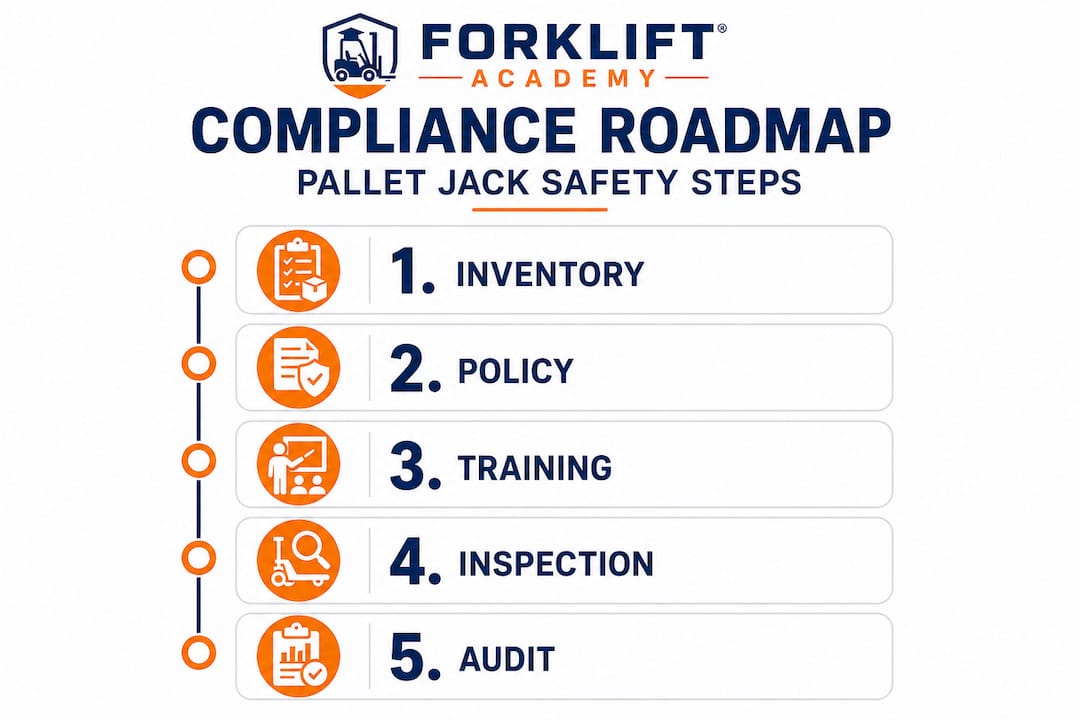
Having identified the risks and requirements, here is a step-by-step roadmap for building or rebuilding your pallet jack compliance program from the ground up.
Step 1: Assess your current compliance status
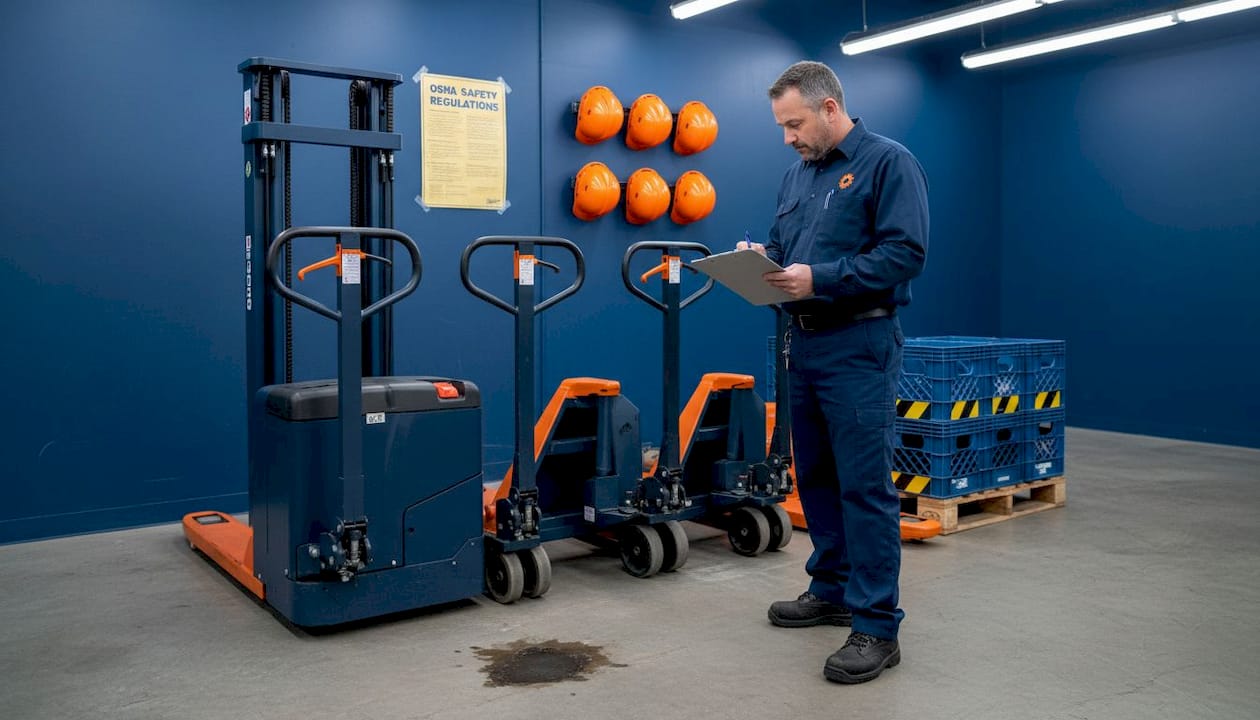
Walk your facility and inventory every pallet jack, manual and powered. Note the make, model, capacity, and current condition of each unit. Then cross-reference your training records to identify any operators without current certification.
Step 2: Develop a written safety policy
A written policy formalizes your commitment and gives employees clear expectations. Your policy should cover equipment inspection procedures, training requirements, reporting protocols for damaged equipment, and consequences for unsafe operation.
Step 3: Build and schedule your training program
Using a structured training program setup, schedule initial training for all new operators and refresher courses for anyone approaching their three-year recertification date. Include manual pallet jack operators in at least basic safety orientation.
Step 4: Implement daily inspection documentation
Create a simple inspection form for each pallet jack and establish a process for supervisors to collect and file logs daily. A well-documented training and inspection program significantly lowers the risk of injuries and OSHA citations, and these records are your first line of defense during an audit.
Step 5: Schedule regular program audits
Set a calendar reminder every six months to review your compliance program. Check training records, review inspection logs for gaps, and assess whether your written policy reflects any OSHA updates issued since your last review.
| Program element | Frequency | Owner | Documentation required |
|---|---|---|---|
| Pre-shift equipment inspection | Daily | Operator/Supervisor | Written inspection log |
| Operator training (new hire) | At hire | Safety manager | Training completion record |
| Operator recertification | Every 3 years | Safety manager | Updated certification record |
| Equipment maintenance check | Monthly | Maintenance team | Maintenance log |
| Program compliance audit | Every 6 months | Safety manager | Audit report |
| Policy review and update | Annually | Management | Revised policy document |
This structured approach converts compliance from a reactive scramble before an inspection into an ongoing, manageable process. The goal is to make safety a predictable routine, not an emergency response.
What most managers miss about pallet jack compliance
Here is an uncomfortable reality: many warehouse managers treat OSHA compliance as a documentation exercise rather than a genuine safety commitment. They get operators certified, file the paperwork, and then return to business as usual until the next audit cycle. That approach technically satisfies the letter of the law, but it leaves the spirit of the regulation completely unfulfilled, and it does not actually make your warehouse safer.
The managers who build genuinely safe operations do something different. They use compliance requirements as a framework for broader warehouse safety culture, not just a checklist. They train their frontline workers to see themselves as the first line of defense, empowering them to pull a pallet jack from service if it feels off, without fear of pushback from supervisors focused on throughput targets.
The feedback loop matters enormously here. When a worker reports a damaged jack and sees it get tagged and repaired promptly, they learn that the system works and that their input matters. When they report the same issue three times with no action taken, they stop reporting. That silence is where serious accidents grow.
Compliance documentation tells you what was happening. Frontline engagement tells you what is happening. The strongest compliance programs we have seen over more than two decades in this industry integrate both. They use the required training and inspection records as the backbone, but they build a communication culture on top of that backbone that keeps safety alive between audits and recertification cycles.
If you are only meeting the minimum, you are always one near-miss away from a compliance failure. If you build the culture, the compliance tends to take care of itself.
Strengthen your compliance with expert-backed training
Meeting OSHA’s evolving pallet jack standards requires more than good intentions. It requires structured, documented, repeatable training processes that hold up under inspection. If your current program has gaps or you are starting from scratch, professional resources can accelerate your path to full compliance significantly.
At Forklift Academy, we have supported warehouse managers across the U.S. for over 20 years with OSHA forklift certification programs built specifically for industrial environments like yours. If you want to bring training in-house and maintain ongoing compliance without repeated external costs, our online train the trainer program equips your designated safety leads with everything they need to certify operators internally. For a clear breakdown of the full OSHA lift certification process, our resource library walks you through every step so there are no surprises when an inspector walks through your door.
Frequently asked questions
What OSHA standard applies to pallet jacks?
OSHA 29 CFR 1910.178 details requirements for powered industrial trucks, including powered pallet jacks, covering operator training, equipment maintenance, and workplace safety protocols.
Do manual pallet jacks require certification?
Manual pallet jacks do not require formal OSHA certification, but training is part of best practice guidelines and demonstrates due diligence during an inspection.
How often should pallet jacks be inspected?
Regular inspections before each shift or daily ensure equipment is safe, catch damage early, and satisfy OSHA’s documentation expectations for powered equipment.
Can a powered pallet jack be operated without training?
No. Operator training for powered pallet jacks is mandatory under OSHA guidelines, and operating without documented certification exposes both the operator and the employer to significant liability.
What documentation is needed for compliance?
Documentation is a key element in maintaining compliance and is frequently audited by OSHA. Maintain records of training completions, daily inspection logs, maintenance activities, and any incident or near-miss reports.
Recommended
- Pallet Jack Operator Responsibilities: Safety & Compliance – Top Osha Forklift Certification
- Pallet Jack Inspection Checklist: Ensure Safe Operation – Top Osha Forklift Certification
- How Pallet Jacks Work: Boost Warehouse Safety and Efficiency – Top Osha Forklift Certification
- What is a Pallet Jack? Understanding Its Functionality – Top Osha Forklift Certification