
TL;DR:
- Skipping a pre-shift forklift inspection is a leading cause of OSHA violations in warehouses. A comprehensive checklist ensures safety, regulatory compliance, and early defect detection before each shift. Regularly updating and enforcing this safety routine creates a strong safety culture that protects operators and operations alike.
Skipping a pre-shift forklift inspection might seem like a minor shortcut, but it consistently ranks among the top causes of OSHA citations in warehouse and distribution environments. A forklift safety checklist is a structured list used to verify a powered industrial truck is safe to operate before each shift, including both visual inspection items and operational tests, and OSHA provides sample daily checklists to help facilities get this right. This guide breaks down what a compliant checklist includes, how to build one that actually works, and why treating it as a genuine safety tool rather than a paper formality protects your people and your operation.
Table of Contents
- What is a forklift safety checklist?
- OSHA requirements and critical checklist components
- Visual vs. operational checks: The two-phase approach
- Tailoring checklists for different forklift types and attachments
- Implementing and documenting forklift safety checklists for compliance
- Why most forklift safety checklists fail and how to fix it
- Advance safety and compliance with expert forklift training
- Frequently asked questions
Key Takeaways
| Point | Details |
|---|---|
| Daily requirement | Forklift safety checklists must be completed before every shift for OSHA compliance. |
| Two-phase process | Checklists include visual engine-off and operational engine-on steps to catch all safety risks. |
| Customization matters | Each checklist should be tailored to forklift type, equipment, and attachments for full safety coverage. |
| Documentation is critical | Maintaining records of checklist results supports inspections and fosters workplace accountability. |
| Ongoing training | Regular training and updated procedures turn checklists from routine tasks into real safety tools. |
What is a forklift safety checklist?
A forklift safety checklist is a documented, systematic review of a powered industrial truck conducted before each operating shift. It is not optional. It is not a suggestion. It is a regulatory requirement under OSHA standard 1910.178(q)(7), which mandates that industrial trucks be examined before being placed in service. Think of it as the equivalent of a pre-flight check for a commercial pilot. No pilot takes off without running through their panel. No forklift operator should either.
The checklist serves two equally important functions. First, it catches real mechanical problems before they cause accidents. Second, it creates a paper trail that demonstrates your facility’s commitment to OSHA forklift compliance and due diligence. If OSHA walks into your facility following an incident and you cannot produce inspection records, the penalties multiply fast.
What does a compliant checklist actually cover? Here is a breakdown of the core categories:
- Fluid levels: Engine oil, coolant, fuel, battery charge level
- Tires: Wear, pressure, damage to pneumatic tires, condition of solid tires
- Forks: Cracks, bends, heel wear, pin retention
- Mast and chains: Lubrication, stretch, visible damage
- Overhead guard: Structural integrity, no missing or bent components
- Load backrest: Securely in place, no damage
- Hydraulic systems: Hoses, cylinders, fittings for leaks or visible wear
- Safety devices: Horn, lights, alarms, seatbelt or seat interlock
- Brakes and steering: Responsive, no unusual pull or resistance
- Engine and exhaust: No unusual smoke, sounds, or odors
Following a detailed checklist guide helps you make sure nothing slips through the cracks during these reviews.
Pro Tip: Whether you use paper or a digital app, keep a running log of every completed checklist and every deficiency found. Patterns in that data are gold. Three consecutive shifts noting the same brake issue mean something is about to fail, and that log is your early warning system.
“A forklift safety checklist is not just about passing an audit. It is about sending every operator home the same way they arrived.”
OSHA requirements and critical checklist components
OSHA’s requirements under 29 CFR 1910.178 are direct: industrial trucks must be inspected before each shift. If a truck is used around the clock across multiple shifts, each shift gets its own inspection. There are no shortcuts, no “we checked it yesterday” exceptions, and no waivers for small facilities. The rule applies equally to a two-forklift warehouse and a multi-site distribution center.
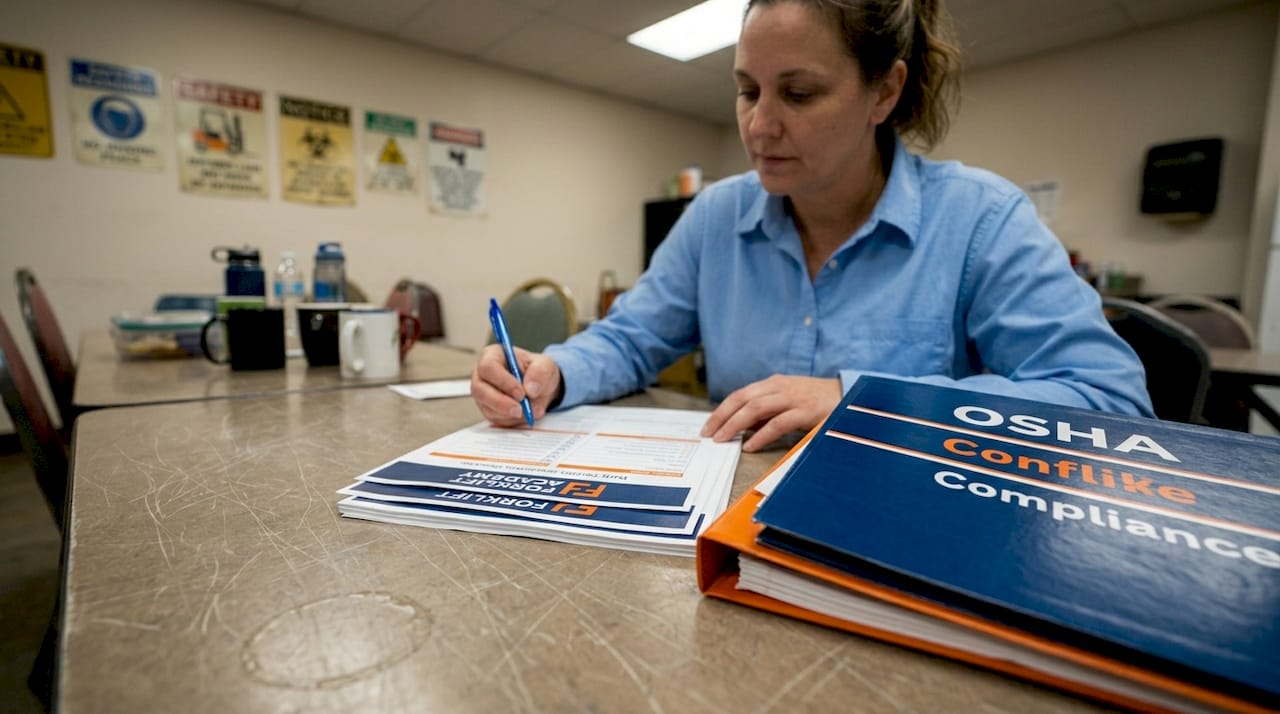
What does an OSHA-aligned checklist actually cover? OSHA’s sample checklists typically include the condition of critical components such as forks, mast, hoses, chains, and the overhead guard, as well as safety devices like the horn, alarms, and seatbelt or seat interlock if equipped, plus operational function tests including brakes, steering, and hydraulic controls. These are the minimum expectations. Your checklist should meet them every time.
Here is a comparison of which components fall under each phase of the inspection:
| Component | Phase | Why it matters |
|---|---|---|
| Tires and wheels | Visual | Worn tires affect stability and stopping distance |
| Fork condition | Visual | Cracked or bent forks can fail under load |
| Hydraulic hoses | Visual | Leaks create slip hazards and system failure risk |
| Overhead guard | Visual | Protects against falling objects |
| Brakes | Operational | Cannot be fully tested with the engine off |
| Steering response | Operational | Pulling or delay signals hydraulic issues |
| Horn and alarms | Operational | Critical for pedestrian safety in active aisles |
| Lift and tilt functions | Operational | Mast instability often shows only under load |
Reviewing OSHA forklift checklist examples gives your team a concrete starting point to build from rather than guessing.
Forklifts are involved in roughly 85 fatal accidents and nearly 35,000 serious injuries every year in the United States, according to OSHA data. A significant portion of those incidents involve equipment that had detectable defects before the shift started. That is not a statistic to read and move past. That is a daily operational reality that a consistent pre-shift checklist directly addresses. Understanding the full scope of forklift inspection requirements puts that number in sharp focus.
Key checklist items that are most frequently missed:
- Checking tire condition on electric forklifts (often skipped because operators assume electric equipment needs less inspection)
- Verifying the seat interlock functions before each shift
- Testing the horn in both low-speed and high-speed modes
- Inspecting hydraulic hose connections at the cylinder base, not just along the visible hose run
- Confirming the load backrest is firmly seated, not just visually present
Visual vs. operational checks: The two-phase approach
One of the most practical concepts in forklift safety is the two-phase inspection structure. The two-phase checklist process works like this: first, you perform pre-operation visual checks with the engine off to identify obvious defects and hazards; second, you perform operational tests with the truck powered to verify that brakes, steering, and lift and tilt functions work correctly, because some problems simply cannot be detected with the engine off.
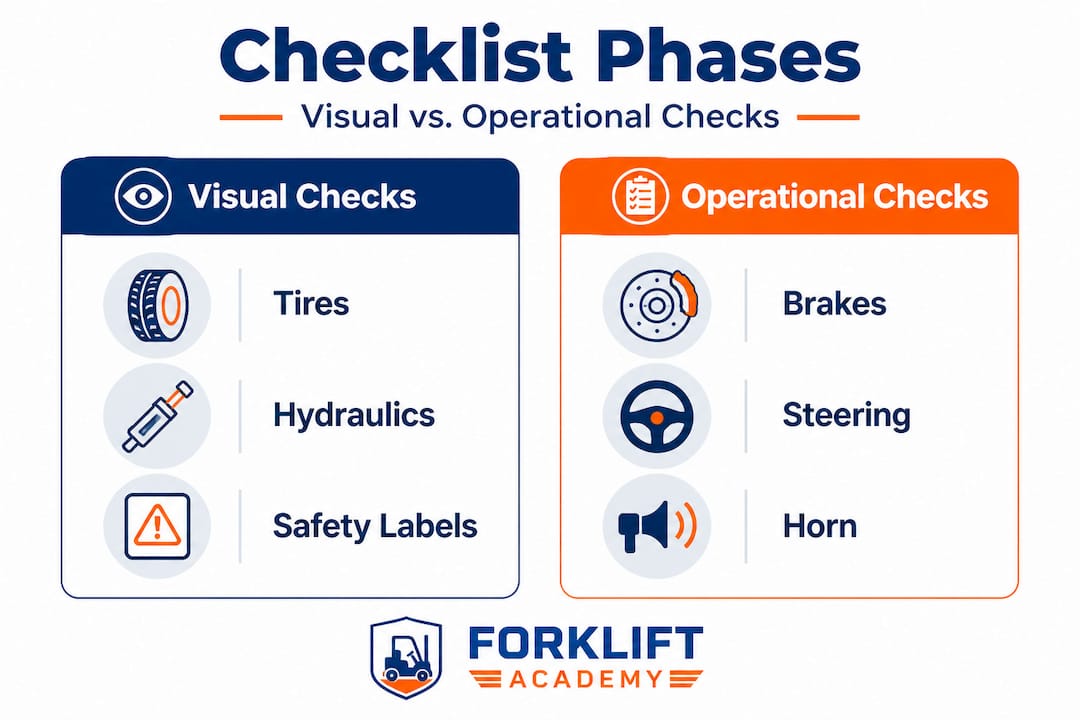
Think of it like a car mechanic who checks fluid levels visually but still takes the car for a test drive before handing back the keys. Both phases catch different categories of problems. Skipping either one means sending an operator into a shift with incomplete information about the equipment they are trusting with their safety.
Visual checks (engine off) should include:
- Walk a full circle around the truck, looking for obvious damage, leaks, or missing components
- Inspect forks from above and below, looking for cracks at the heel and heel plate
- Check tire inflation or solid tire condition on all four corners
- Examine the mast chains for wear, elongation, or kinking
- Confirm overhead guard is structurally sound with no cracked welds
- Check battery connections or fuel lines for visible damage or corrosion
- Look under the truck for puddles of oil, hydraulic fluid, or coolant
Operational checks (engine on) should include:
- Start the engine and listen for unusual sounds in the first 30 seconds
- Test the horn and any backup alarms at low speed
- Operate the lift, tilt, and side shift controls through their full range
- Test brake performance at slow speed in a safe area before entering active aisles
- Check steering for smooth response with no excessive play
- Verify all lights function, especially in facilities with low ambient lighting
- Confirm the seat interlock cuts power when the operator leaves the seat
Following the OSHA inspection process guide helps your team internalize both phases as a single habit rather than two disconnected tasks.
Pro Tip: Train operators to understand the “why” behind each check, not just the “what.” An operator who knows that a cracked fork heel can fail catastrophically under a heavy pallet will inspect that fork with real attention. One who is just checking boxes will look without seeing. Building that understanding is the difference between compliant checklist practices and genuinely safe ones.
Tailoring checklists for different forklift types and attachments
Here is a mistake that costs facilities real money and real safety: using the same generic checklist for every piece of powered industrial truck equipment on the floor. A sit-down counterbalanced forklift, a reach truck operating in narrow aisles, and a walkie pallet jack are fundamentally different machines. They have different operational hazards, different wear points, and different inspection priorities.
OSHA notes on checklist modification make this very clear: each type and configuration of powered industrial truck is unique, and checklists should be modified for the truck type and attachments. They should also be consistent with the manufacturer’s instructions and the operator’s actual responsibilities for that equipment. A generic template downloaded from the internet and applied to every machine in your fleet is not a compliant checklist. It is a liability.
“Using a one-size-fits-all checklist for every forklift in your fleet is like using the same maintenance schedule for a sports car and a semi-truck. They share some basics, but the differences are where failures happen.”
Attachments make this even more specific. A forklift equipped with a rotating clamp for paper rolls has inspection points that a standard fork truck simply does not have. The clamp rotation mechanism, hydraulic connections specific to that attachment, and clamping pressure all need verification. A sideshifter adds hydraulic hose connections that standard checklists omit. Each attachment changes the load dynamics and the failure modes, and your checklist needs to reflect that.
Steps to tailor your checklists effectively:
- Pull the manufacturer’s operator manual for each truck model in your fleet and cross-reference its maintenance inspection points
- List every attachment currently in service and add attachment-specific checks to the relevant truck’s checklist
- Involve experienced operators in reviewing draft checklists because they know the quirks of each machine
- Review your near-miss log and maintenance work orders to identify recurring issues that should become checklist items
- Update checklists at least annually, or immediately after a significant maintenance event or incident
Streamlining checklist workflows also means making the customized versions easy to access and easy to complete at the start of each shift. And reviewing compliance for different forklift types helps your team understand what each configuration actually requires.
Implementing and documenting forklift safety checklists for compliance
Knowing what belongs on a checklist is only part of the job. Actually making checklists happen consistently, across every shift, every operator, and every machine, is the operational challenge that separates high-performing safety programs from ones that look good on paper but fall apart in practice.
OSHA provides sample daily checklists as a guide, noting that they should be modified for each truck type and workplace. The key word is “modified.” These are starting points, not finished products. Your job as a warehouse or logistics manager is to take that framework and make it work for your specific fleet and your specific operating environment.
Here is how to build a sustainable implementation system:
- Standardize the format across your fleet, with truck-specific versions clearly labeled so operators always grab the right sheet
- Designate a checklist station at each machine’s home position so the document is never an excuse to skip the check
- Make operator signature mandatory on every completed checklist, along with the date, time, and shift number
- Create a clear deficiency protocol: if an item fails, the operator documents it, the truck goes out of service, and maintenance gets notified before the next use
- Store completed checklists in a location accessible to supervisors and safety personnel for at least 30 days, or longer per your internal policy
- Assign a supervisor to spot-check completed checklists weekly, not just when something goes wrong
Integrating checklist completion into your operator training from day one builds the habit early. When new operators learn that the checklist is part of the job, not an add-on, they carry that behavior forward. Preparing for OSHA inspections is much easier when your documentation is consistent and current.
Pro Tip: Pull all completed checklists once a month and look for patterns. If your second-shift operators are consistently noting a steering issue on truck number three, that is not a coincidence. That is a maintenance problem waiting to become an incident. Systematic review is how checklists earn their keep, and understanding OSHA compliance explained helps your entire team know what standards they are working toward.
Why most forklift safety checklists fail and how to fix it
After working in forklift safety training for over 20 years, we have seen a consistent pattern. The facilities that have the most checklist paperwork are not always the safest ones. Why? Because the checklist stopped being a safety tool and became a daily ritual that operators complete in under two minutes without leaving their seat.
The real failure is cultural, not procedural. When operators treat the checklist as a hurdle between them and getting to work, they rush through it. Items get checked without being inspected. Issues get noted as “OK” because reporting a defect means the truck goes down and someone has to explain why. That dynamic is dangerous, and it is more common than most managers want to admit.
The second major failure is outdated templates. A checklist written three years ago for a fleet that has since added new attachments, newer truck models, and different aisle configurations is not fit for purpose. It has blind spots built into every box. Templates need to be living documents, updated after every significant change to the fleet or the facility.
Fixing these failures requires more than a memo. It requires building a feedback loop. Involve operators in reviewing and updating the checklist annually. Use near-miss reports and maintenance logs to identify items the current checklist misses. Recognize operators who accurately report defects rather than treating them as problems. And connect checklist discipline directly to building a safety culture that rewards honest reporting over speed.
The checklist is a diagnostic tool. Treat it like one.
Advance safety and compliance with expert forklift training
Forklift safety checklists are one piece of a much larger compliance picture. Operators who understand what they are checking, and why each item matters, conduct better inspections and make safer decisions throughout their shift.
At Forklift Academy, we help facilities close the gap between having a checklist and having a safety culture that makes checklists work. Our Forklift Train the Trainer Online program equips your internal trainers to deliver consistent, OSHA-aligned instruction to every operator on your floor. Understanding the full lift certification process ensures your team meets compliance requirements from day one. And if you are evaluating your options, our top OSHA forklift certification programs are designed to be accessible, thorough, and immediately applicable to real warehouse environments.
Frequently asked questions
How often must a forklift safety checklist be completed under OSHA rules?
A forklift safety checklist must be completed before every shift, with OSHA’s sample checklists confirming that trucks must be verified safe to operate before each use. If a truck runs three shifts per day, it gets inspected three times.
What happens if a forklift fails a daily inspection?
Any truck that fails a checklist item should be immediately removed from service and repaired before it is used again. OSHA’s sample checklists make clear that issues found during inspection render the truck out of service until resolved.
Do checklist requirements vary by forklift type?
Yes, OSHA notes on checklist modification confirm that checklists should be modified for each truck type, configuration, and any specialized attachments in use. A single generic template does not meet this expectation.
Can electronic checklists replace paper logs for OSHA documentation?
Digital checklists are fully acceptable as long as they are accurate, consistently completed, and accessible to supervisors and OSHA inspectors when requested. The format matters less than the content and the consistency.
Who is responsible for completing the checklist each shift?
The forklift operator is responsible for conducting and documenting the inspection before operation begins each shift. Supervisors are responsible for ensuring that system is followed and that deficiencies are addressed.
Recommended
- Forklift Safety Checklist Guide for OSHA Compliance – Top Osha Forklift Certification
- Streamline Forklift Safety Checklist Workflows: OSHA – Top Osha Forklift Certification
- OSHA forklift compliance checklist 2026: Warehouse safety – Top Osha Forklift Certification
- Forklift safety checklist 2026: ensure OSHA compliance – Top Osha Forklift Certification