
TL;DR:
- OSHA requires forklift operator evaluations every three years and after unsafe incidents or equipment changes.
- Proper preparation, documentation, and structured processes are essential for effective and audit-ready evaluations.
- Regular, meaningful evaluations improve safety, reduce incidents, and foster a safety-focused workplace culture.
Forklift accidents don’t just happen because of faulty equipment. ~85 fatalities and 34,900 serious injuries occur every year in U.S. workplaces, and the majority trace back to operator error, not mechanical failure. For warehouse and logistics managers, that statistic carries real weight: every operator who hasn’t been properly evaluated is a liability waiting to surface. OSHA’s evaluation requirements exist precisely to close that gap. This guide walks you through the full process, from understanding what the regulations actually demand to running evaluations that genuinely protect your team and keep your facility audit-ready.
Table of Contents
- Understanding OSHA requirements for forklift operator evaluations
- Preparing for an effective forklift operator evaluation
- Step-by-step guide to conducting the evaluation
- Verifying evaluation effectiveness and ongoing compliance
- Our take: The hidden ROI of great forklift evaluations
- Get expert help for your next OSHA forklift evaluation
- Frequently asked questions
Key Takeaways
| Point | Details |
|---|---|
| OSHA sets clear standards | You must follow specific OSHA guidelines for evaluating forklift operators. |
| Preparation is crucial | Having the right tools and records in place ensures effective and compliant evaluations. |
| Step-by-step process works | Following structured steps helps reduce operator errors and workplace incidents significantly. |
| Keep improving | Track your results over time and adjust evaluations to maintain safety and compliance. |
Understanding OSHA requirements for forklift operator evaluations
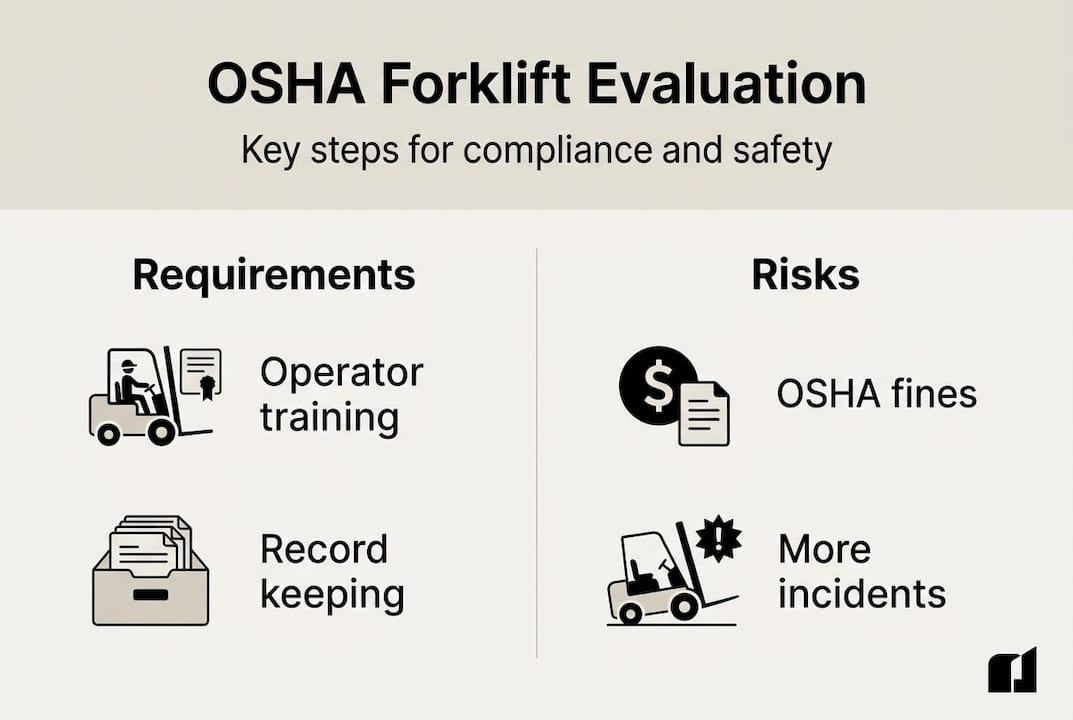
OSHA’s powered industrial truck standard, 29 CFR 1910.178, makes operator evaluation a legal requirement, not a suggestion. Every forklift operator must be evaluated by a qualified person to confirm they can operate the specific equipment they’re assigned to, in the actual conditions of your facility. This isn’t a one-and-done checkbox. Evaluations must be repeated at least every three years and must be triggered again any time an operator is observed performing unsafely, involved in an accident or near-miss, or assigned to a different type of equipment.
The consequences of skipping or rushing evaluations are serious. OSHA fines for forklift violations can reach tens of thousands of dollars per citation, and repeated or willful violations carry even steeper penalties. Beyond fines, inadequate evaluations expose your company to civil liability if an operator injures a coworker or damages property. The good news is that OSHA-compliant training reduces forklift incidents by up to 70%, which means the investment pays back fast.
Review the forklift compliance essentials to understand how evaluation fits into your broader safety obligations. For a full breakdown of what your team needs to complete, the employee training requirements page covers documentation, frequency, and trainer qualifications in detail.
| OSHA requirement | What it means for your facility |
|---|---|
| Evaluation by a qualified person | Must be someone with knowledge, training, and experience to assess operators |
| Equipment-specific evaluation | Operators must be evaluated on each truck type they use |
| Minimum every 3 years | Regardless of incident history, re-evaluation is required on a set schedule |
| Triggered re-evaluation | Required after unsafe behavior, accidents, or equipment changes |
| Written documentation | Records must be kept and available for OSHA inspection |
Evaluation documentation you must keep:
- Signed evaluation checklists for each operator
- Date and type of equipment evaluated
- Name and qualifications of the evaluator
- Results, including any areas requiring retraining
- Records of any follow-up training completed
Safety warning: Skipping or delaying evaluations doesn’t just risk a fine. It puts every person in your facility at risk. An operator who hasn’t been formally assessed may have developed unsafe habits that go undetected until something goes wrong.
Preparing for an effective forklift operator evaluation
Knowing the rules is step one. Actually being ready to run a clean, defensible evaluation is another matter entirely. Many managers underestimate how much preparation goes into an evaluation that holds up under audit scrutiny. Rushing into it without the right materials and environment is one of the most common mistakes we see.
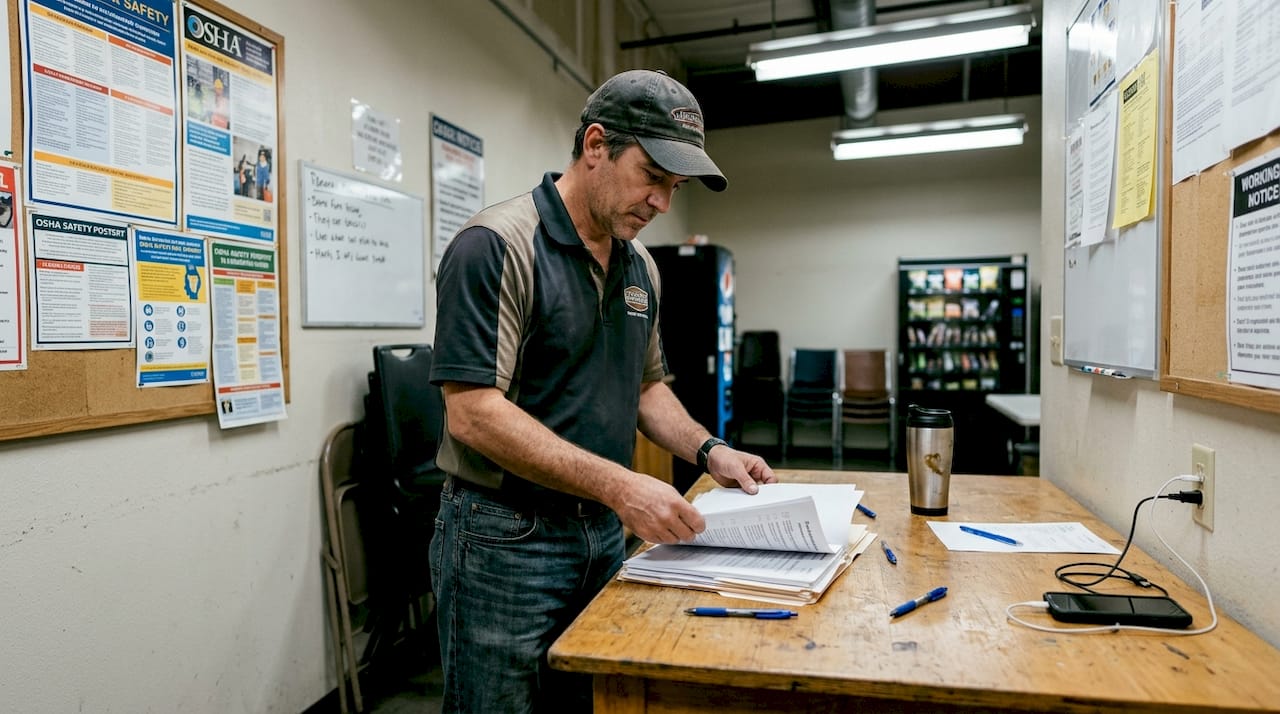
Start by pulling together your existing operator records. You need to know each operator’s training history, what equipment they’re certified on, and when their last evaluation occurred. Proper preparation improves evaluation effectiveness and compliance rates significantly, so don’t treat this step as administrative busywork.
For a structured approach to getting your team ready, the step-by-step forklift training resource lays out exactly how to sequence your preparation. If you want a ready-to-use framework, the evaluation process checklist gives you a practical starting point.
| Preparation step | OSHA required | Best practice |
|---|---|---|
| Review operator training records | Yes | Also note any incident history |
| Confirm evaluator qualifications | Yes | Use a certified trainer or qualified supervisor |
| Select evaluation environment | No | Use actual work conditions, not an empty lot |
| Prepare standardized checklist | No | Reduces subjectivity and improves consistency |
| Notify operators in advance | No | Reduces anxiety and improves performance accuracy |
Supplies and environment readiness checklist:
- Printed or digital evaluation forms for each operator
- Personal protective equipment for the evaluator
- Clear, realistic operating area that mirrors daily conditions
- Equipment in proper working order, pre-inspected
- A quiet space for the knowledge check portion
Pro Tip: Store all evaluation records in a single dedicated folder, either physical or digital, organized by operator name and date. When an OSHA inspector arrives, you want to pull records in under two minutes, not spend 20 minutes searching through filing cabinets.
Common preparation pitfalls include using generic checklists that don’t match your specific equipment, evaluating operators on equipment they rarely use, and failing to document the evaluator’s qualifications. Each of these can invalidate an otherwise solid evaluation.
Step-by-step guide to conducting the evaluation
With your preparation complete, here’s how to run the evaluation itself. A structured process protects both your operators and your organization.
70 to 87% of forklift incidents result from operator error, which means the evaluation is your best tool for catching dangerous habits before they cause harm. Follow these steps every time.
- Pre-evaluation briefing. Meet with the operator before the evaluation begins. Explain what you’ll observe, what equipment is involved, and how results will be used. This isn’t about catching people out; it’s about confirming competency.
- Pre-operation inspection check. Ask the operator to perform their standard pre-shift inspection. Watch for thoroughness, accuracy, and whether they identify any real or simulated defects. This step alone reveals a lot.
- Practical skills observation. Observe the operator performing typical tasks: picking, transporting, stacking, and maneuvering in tight spaces. Use your checklist to score each skill area objectively.
- Knowledge check. Ask targeted questions about load limits, right-of-way rules, and what to do in emergency situations. This doesn’t need to be a formal written test, but it should be documented.
- Feedback session. Review results with the operator immediately after. Be specific. “Your load was tilted forward during travel” is more useful than “watch your load positioning.”
- Documentation. Complete and sign the evaluation form. Note pass or fail for each skill area, and record any retraining requirements. File the record immediately.
OSHA standard: An operator who does not demonstrate safe operation must not be permitted to operate the equipment until retraining and a follow-up evaluation are completed.
For a deeper look at how to structure each stage, the step-by-step evaluation guide covers each phase with examples. You’ll also find practical forklift safety training tips that help evaluators give feedback that actually sticks.
Pro Tip: Frame feedback as coaching, not criticism. Operators who feel supported are far more likely to retain corrective guidance and apply it consistently on the floor.
Verifying evaluation effectiveness and ongoing compliance
Running evaluations is not the finish line. The real question is whether your process is actually making your facility safer. Tracking outcomes after evaluations gives you hard data to answer that question.
Start by monitoring incident rates, near-miss reports, and equipment damage logs in the weeks and months following each evaluation cycle. Ongoing evaluation and training can reduce equipment damage by 60% and cut lost-time injuries by 75%, but only when the process is implemented consistently and reviewed regularly.
Review your forklift safety rules framework periodically to make sure your evaluation criteria stay aligned with current OSHA guidance and any changes in your facility layout or equipment fleet.
| Metric | Before evaluation program | After 12 months |
|---|---|---|
| Forklift-related incidents per quarter | 8 to 12 | 2 to 4 |
| Equipment damage reports | High frequency | Reduced by up to 60% |
| Lost-time injuries | Baseline | Reduced by up to 75% |
| OSHA audit findings | Multiple citations | Minimal or none |
Signs your evaluation process needs attention:
- Repeated near-misses involving the same operators or equipment
- Operators who passed evaluations but continue to show unsafe habits
- Documentation gaps discovered during internal audits
- High equipment damage rates despite recent evaluations
- Evaluators who aren’t consistently applying the same scoring criteria
When you spot these warning signs, the fix isn’t always retraining the operator. Sometimes the evaluation process itself needs updating. Review your checklist for gaps, confirm your evaluators are calibrated to the same standards, and consider whether your evaluation environment accurately reflects real working conditions. An evaluation done in an empty warehouse at 8 a.m. doesn’t tell you much about how an operator performs during a busy afternoon shift.
Schedule a formal review of your entire evaluation program at least once a year. Update checklists when you add new equipment, change facility layouts, or receive updated OSHA guidance.
Our take: The hidden ROI of great forklift evaluations
Most managers approach forklift evaluations as a compliance obligation, something to complete, document, and file away. We’ve seen this mindset across hundreds of facilities, and it consistently leads to the same outcome: evaluations that satisfy the paperwork requirement but don’t actually change behavior on the floor.
Here’s what the data and our experience show: facilities that treat evaluations as a genuine performance tool, not a formality, see returns that go well beyond avoiding fines. Insurance premiums drop when carriers see consistent, documented safety programs. Staffing challenges ease when operators feel their skills are recognized and developed. Equipment lifespan extends when operators are held to real standards.
The cultural shift is the biggest payoff. When operators know evaluations are serious and consistent, safety becomes a shared value rather than a rule imposed from above. That shift is hard to quantify, but it shows up in retention, morale, and the kind of proactive hazard reporting that prevents accidents before they happen. For more on building that culture across your organization, business forklift training insights offers a practical framework for scaling these practices.
Get expert help for your next OSHA forklift evaluation
Running evaluations that are both thorough and fully OSHA-compliant takes the right tools, the right training, and a process you can trust. Forklift Academy has been supporting warehouse and logistics teams across the U.S. for over 20 years, and we’ve built our programs specifically for managers who need results without the guesswork.
Whether you want to train your own evaluators with our Train the Trainer Online program, get operators certified quickly through OSHA Forklift Certification, or get clarity on OSHA forklift compliance requirements for your specific operation, we have a solution that fits. Take the next step today and give your team the evaluation process they deserve.
Frequently asked questions
How often must forklift operators be evaluated according to OSHA?
Operators must be evaluated at least every three years, or sooner if unsafe operation is observed, an accident occurs, or the operator is assigned to a new type of equipment.
What records should I keep from a forklift operator evaluation?
You need signed evaluation checklists, training dates, equipment types covered, evaluator credentials, and any follow-up retraining records, all kept as proof of OSHA compliance and available for inspection.
What are the signs that my evaluation process isn’t working?
Repeated operator errors, near-misses, or rising equipment damage rates after evaluations are clear signals, since operator error drives most incidents and a strong evaluation process should reduce them over time.
Does using a third-party evaluation service help with OSHA compliance?
Yes. A reputable third-party provider brings structured documentation, qualified evaluators, and expert-led processes that cut incidents dramatically, making compliance easier and more defensible during audits.
Recommended
- Forklift Operator Qualification Explained: OSHA Compliance Guide – Top Osha Forklift Certification
- Forklift Safety Checklist Guide for OSHA Compliance – Top Osha Forklift Certification
- OSHA Forklift Compliance Guide for Safe Operations – Top Osha Forklift Certification
- Forklift Evaluation Guide: Step-by-Step OSHA Compliance – Top Osha Forklift Certification