
TL;DR:
- Proper forklift training modules cover equipment operation, hazard recognition, and safety procedures beyond basic certification.
- Structured, OSHA-compliant modules can reduce forklift accidents by up to 70 percent.
- Regular updates and customized training increase safety, efficiency, and legal compliance in warehouses.
Most warehouse managers assume that getting operators certified is enough. Hand them a card, check the box, move on. But OSHA’s requirements go well beyond a basic certification test, and the gap between what managers think is sufficient and what the standard actually demands is where most workplace accidents happen. Forklift incidents injure nearly 95,000 workers annually in the U.S. The right training modules close that gap. This guide breaks down what forklift training modules actually cover, why they matter for your operation, and how to select and implement them so your team stays safe, compliant, and productive.
Table of Contents
- What are forklift training modules and why do they matter?
- Core components of forklift training modules
- How forklift training modules enhance safety and efficiency
- Selecting, updating, and implementing training modules for your warehouse
- Why savvy managers invest in more than the basics
- Get OSHA-compliant forklift training for your team
- Frequently asked questions
Key Takeaways
| Point | Details |
|---|---|
| OSHA compliance | Training modules are mandated by OSHA and help prevent costly violations and fines. |
| Reduced accident risk | Comprehensive training can decrease forklift-related injuries by as much as 70 percent. |
| Boosted efficiency | Well-trained teams operate more smoothly, with fewer disruptions or downtime. |
| Ongoing improvement | Regularly updating modules and offering refreshers keeps safety and compliance top of mind. |
What are forklift training modules and why do they matter?
Forklift training modules are structured learning units that cover every aspect of safe and legal forklift operation. Think of them as chapters in a complete training program, each one targeting a specific competency area. Together, they build a fully trained operator, not just someone who knows how to move a pallet.
A well-designed module set typically covers:
- Equipment operation: Controls, load handling, maneuvering, and speed management
- Pre-operation safety checks: Inspecting fluid levels, tires, forks, and safety devices before each shift
- Hazard awareness: Identifying floor conditions, pedestrian zones, blind spots, and overhead obstacles
- Load management: Calculating load capacity, center of gravity, and proper stacking techniques
- Emergency procedures: Responding to tip-overs, spills, and equipment failures
- Worksite-specific rules: Navigating the unique layout and risks of your facility
This level of detail is not optional. OSHA’s powered industrial truck standard mandates that employers provide training that is specific to the equipment being used and the environment in which it operates. Generic training that ignores your warehouse layout or your specific forklift models does not meet that bar.
Why does this matter beyond compliance? Because the stakes are real. Untrained or undertrained operators make small errors that compound fast. A miscalculated load on a wet floor can tip a forklift in seconds. Understanding why forklift certification matters goes beyond avoiding fines. It directly protects your team and your operation’s continuity.
Managers who treat training as a one-time event rather than a structured program also expose themselves to legal liability. When an incident occurs and OSHA investigates, auditors look for documented, module-based training records. Gaps in those records translate directly into citations. Learning about the forklift certification process helps you understand what documentation OSHA actually expects to see.
Stat callout: Forklift-related incidents account for roughly 85 fatal accidents and 34,900 serious injuries every year in U.S. workplaces, making structured training one of the highest-ROI safety investments a warehouse can make.
Core components of forklift training modules
OSHA Standard 1910.178(l) lays out three required elements for every compliant forklift training program: formal instruction, practical training, and performance evaluation. A solid module structure maps directly to these three pillars.
Here is what a trainee typically moves through:
- Formal instruction (classroom or online theory): Covers OSHA rules, equipment mechanics, load physics, and hazard identification. This is the knowledge foundation.
- Practical training (hands-on operation): The trainee operates the actual equipment under supervision, applying what they learned in theory to real conditions.
- Performance evaluation: A qualified trainer observes the operator in the actual work environment and confirms competency before certifying them.
Training delivery formats vary, and each has real trade-offs:
| Format | Pros | Cons |
|---|---|---|
| Online only | Flexible, cost-effective, scalable | Cannot satisfy hands-on OSHA requirement alone |
| Onsite only | Fully hands-on, site-specific | Scheduling challenges, higher per-head cost |
| Blended (online + onsite) | Best of both, OSHA-compliant | Requires coordination between platforms |
For most warehouse operations, the blended format is the practical winner. Operators complete theory modules on their own schedule, then move to hands-on evaluation with a qualified trainer. This approach reduces downtime and still satisfies every OSHA requirement.
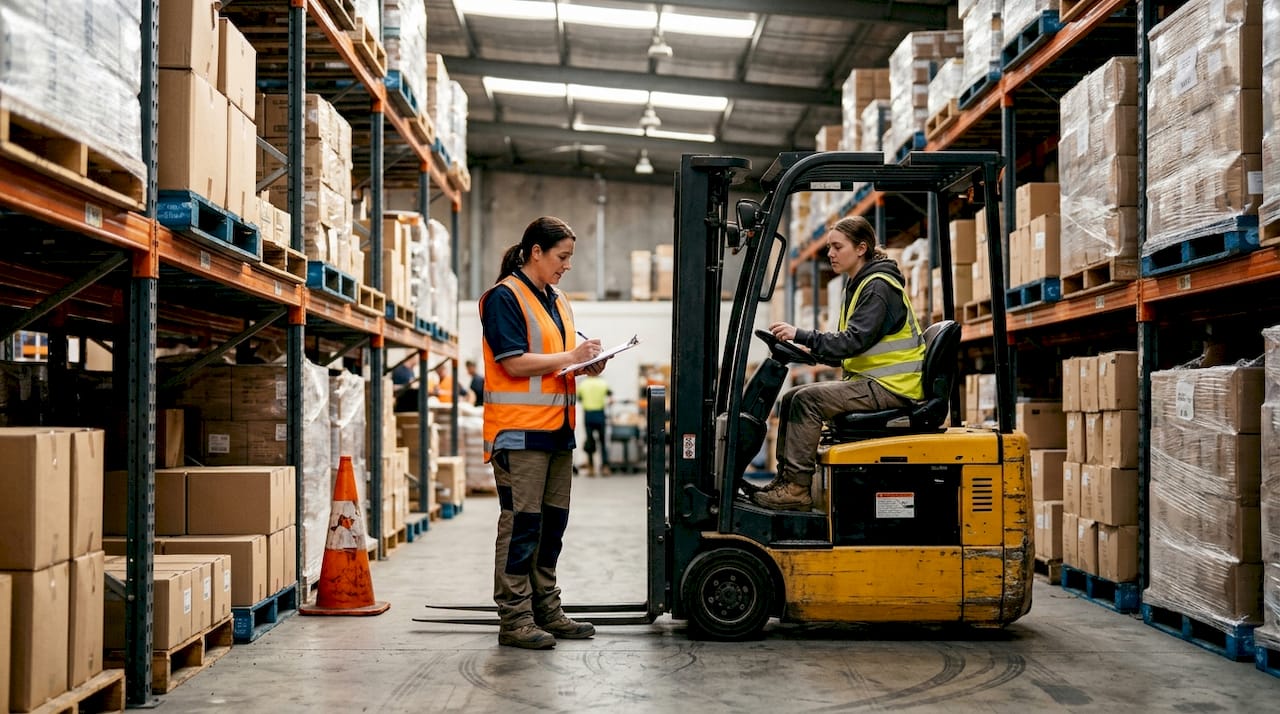
Following forklift training best practices means going beyond the minimum. Equipment-specific modules for sit-down riders, stand-up reach trucks, and order pickers each require separate training. A module designed for one class of equipment does not cover another.
Pro Tip: When implementing forklift safety training, customize each module to reflect your actual facility layout, floor markings, and load types. Generic modules miss the site-specific hazards that cause most real-world incidents.
How forklift training modules enhance safety and efficiency
The numbers tell a clear story. Proper training cuts accident rates by up to 70% in warehouses that implement structured, module-based programs. That is not a marginal improvement. That is a fundamental shift in risk profile.
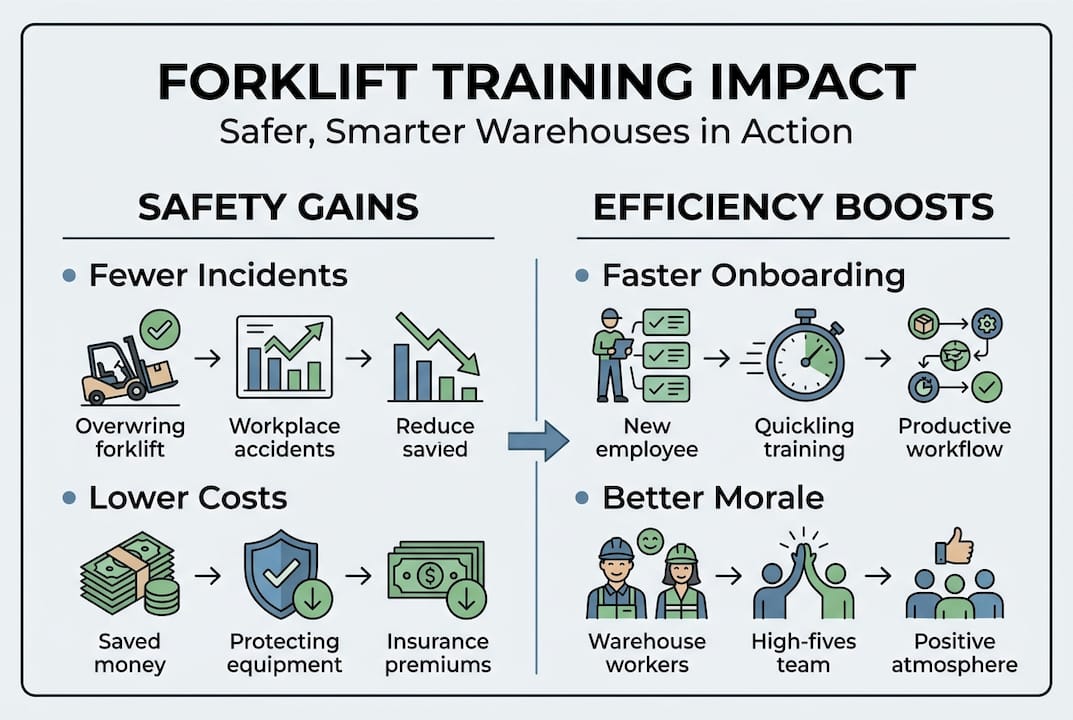
Here is what that looks like in practice:
| Metric | Before structured modules | After structured modules |
|---|---|---|
| Forklift incidents per year | 8-12 | 2-4 |
| Workers’ comp claims | High frequency | Significantly reduced |
| Equipment damage costs | $15,000+ annually | Under $5,000 annually |
| Operator downtime | Frequent | Minimal |
These figures reflect patterns seen across mid-size distribution centers that moved from informal training to a documented module system. The reductions are consistent because modules address the root causes of accidents rather than just reminding operators to be careful.
Beyond accident prevention, trained operators simply work better. They move loads faster because they understand load dynamics. They navigate tighter spaces with confidence. They spot hazards before they become incidents, which means fewer work stoppages. Understanding forklift accident prevention basics shows how trained behavior directly translates to smoother daily operations.
“The most effective forklift safety programs are those that combine formal instruction with hands-on training and regular evaluation, creating operators who understand not just what to do, but why.”
The efficiency gains compound over time. When operators are confident and competent, supervisors spend less time correcting mistakes and more time managing throughput. Warehouse leaders who understand what makes a good warehouse boss recognize that investing in operator competency is one of the clearest levers for improving overall facility performance.
- Fewer near-misses mean less time spent on incident reports and investigations
- Lower insurance premiums follow a documented reduction in claims
- Reduced equipment repair costs free up budget for other priorities
- Higher operator confidence leads to better retention and morale
Selecting, updating, and implementing training modules for your warehouse
Choosing the right modules is not just about finding a program that checks OSHA’s boxes. It is about finding one that fits your equipment, your team, and your operational environment. Here is a practical checklist to evaluate any training module before you commit:
- Equipment specificity: Does the module cover the exact class of forklift your operators use? Class I through Class VII each have distinct operating requirements.
- Site-specific content: Can the module be customized to reflect your facility’s layout, hazard zones, and traffic patterns?
- Evaluation component: Does the program include a documented performance evaluation by a qualified trainer?
- OSHA alignment: Is the curriculum explicitly mapped to 1910.178(l) requirements?
- Record keeping: Does the provider give you documentation you can produce during an OSHA inspection?
OSHA requires training updates whenever equipment changes, processes shift, or conditions in the workplace evolve. This means your training program is never truly finished. If you add a new forklift model, introduce a new racking system, or change your facility layout, your modules need to reflect those changes.
Refresher training is another non-negotiable. Reviewing forklift refresher courses helps you understand when and how to schedule retraining so your compliance stays current without disrupting operations. The benefits of online forklift certification become especially clear when you need to update training quickly across a large team.
Pro Tip: Involve your operators in the module review process. Ask them which hazards feel underrepresented in training or which procedures feel unclear. Their input improves content relevance and dramatically increases buy-in, which directly improves retention.
Why savvy managers invest in more than the basics
Here is something the compliance-focused conversation misses: the warehouses with the best safety records are not the ones that barely meet OSHA minimums. They are the ones that treat training as an ongoing operational investment, not a regulatory hurdle.
We have seen this pattern consistently over more than 20 years in forklift training. Managers who view modules as a checkbox tend to retrain only when forced, usually after an incident. Managers who view training as a strategic tool schedule regular refreshers, update modules proactively, and use training outcomes to identify operational gaps before they become accidents.
The hidden costs of undertrained operators go far beyond OSHA fines. Damaged racking, product losses, and elevated turnover from a stressful work environment all trace back to inadequate training. Understanding good warehouse leadership means recognizing that your training program reflects your culture. A team that sees management invest in their development operates with more care and more confidence. That is not soft reasoning. That is a measurable operational advantage.
Get OSHA-compliant forklift training for your team
You now know what strong forklift training modules look like and what they deliver. The next step is putting that knowledge to work for your warehouse.
Forklift Academy offers fully OSHA-compliant training programs built for warehouse and logistics operations of every size. Whether you need online theory modules, onsite hands-on evaluation, or a complete blended program, our curriculum is designed to meet 1910.178(l) requirements and fit your schedule. Explore our forklift training certification options for business teams, including refresher courses and train-the-trainer kits that scale with your operation. Protecting your employees and your bottom line starts with the right training foundation.
Frequently asked questions
What does a forklift training module cover?
A forklift training module covers equipment operation, worksite safety, hazard recognition, and OSHA compliance requirements specific to the operator’s equipment class and work environment.
How often do forklift operators need refresher training?
OSHA requires refresher training when workplace conditions change, an operator is involved in an incident, or every three years at minimum, whichever comes first.
Can forklift training be completed online?
Theory and formal instruction modules can be completed online, but OSHA Standard 1910.178(l) requires hands-on practical training and in-person performance evaluation for full certification.
What happens if my warehouse skips required training modules?
Skipping required modules exposes your operation to OSHA citations and fines, higher insurance premiums, and significantly increased risk of workplace accidents and associated liability.
Recommended
- Forklift Hazard Awareness Explained: Reducing Warehouse Risks – Top Osha Forklift Certification
- Maximizing Efficiency: Advanced Forklift Training Techniques That Transform Warehouse Operations
- Maximizing Efficiency: Advanced Forklift Training Techniques That Transform Warehouse Operations – Top Osha Forklift Certification
- Role of Training in Warehouse Safety: Preventing Accidents and Ensuring Compliance – Top Osha Forklift Certification