
TL;DR:
- Proper training, clear responsibilities, and regular inspections are key to preventing pallet jack injuries.
- Operators must have OSHA certification, follow safe practices, and understand their specific roles.
- Ongoing supervised training and accountability are essential for maintaining warehouse safety and compliance.
Many warehouse managers assume pallet jack operation is straightforward, but that assumption quietly drives some of the most preventable injuries on the floor. Improper training and unclear responsibilities are a leading cause of pallet jack accidents in warehouses. When operators don’t know exactly what they’re accountable for, small oversights compound fast. This guide breaks down every core responsibility, compares roles, and gives managers the tools to build a training program that holds up under OSHA scrutiny. Whether you’re onboarding new hires or tightening up an existing program, this is the practical foundation you need.
Table of Contents
- Core duties of a pallet jack operator
- Best practices for safe operation
- Pallet jack operator responsibilities vs. forklift operators
- Training and compliance: What managers must know
- Why mastering operator responsibilities is the missing link in warehouse safety
- Get your team certified and compliant
- Frequently asked questions
Key Takeaways
| Point | Details |
|---|---|
| Clear daily duties | Pallet jack operators must consistently inspect equipment, handle loads carefully, and communicate hazards. |
| Compliance is ongoing | Regular training, proper documentation, and periodic evaluations are essential for OSHA compliance. |
| Distinct roles matter | Differentiating pallet jack and forklift responsibilities prevents legal risks and training errors. |
| Best practices reduce risk | Implementing routine safety habits and operator accountability sharply lowers preventable accidents. |
Core duties of a pallet jack operator
Understanding pallet jack basics is the starting point, but daily operator duties go well beyond simply moving loads from point A to point B. Operators carry legal and operational accountability for every shift they work.
Here’s what that looks like in practice:
- Conduct a pre-use inspection before every shift. Operators must conduct visual pre-use inspections and are accountable for secure load handling. Check forks, wheels, hydraulics, and the horn before touching a load.
- Organize and secure loads properly. Loads must be stable, evenly distributed, and within the jack’s rated capacity. Overloading is one of the fastest ways to cause a tip-over.
- Navigate designated travel paths. Operators are responsible for staying on approved routes, watching for pedestrians, and slowing at intersections and blind corners.
- Maintain the work area. Spills, debris, and obstructions in travel lanes are the operator’s responsibility to report or clear immediately.
- Communicate with teammates. Using clear signals, verbal alerts, and eye contact with co-workers reduces collision risk, especially in high-traffic zones.
- Report equipment defects and hazards immediately. An operator who notices a cracked fork or a leaking hydraulic line and says nothing is a liability risk for the entire operation.
That last point is one managers often underestimate. Operators aren’t just equipment users; they’re the first line of safety inspection on the floor. Building a culture where reporting is rewarded, not penalized, is a direct extension of pallet jack safety essentials.
“An operator who stays silent about a hazard isn’t being cautious. They’re creating the next incident.”
Pro Tip: Musculoskeletal injuries, including back strain and wrist injuries, account for a significant share of pallet jack-related workers’ comp claims. Train operators to use their legs when pulling heavy loads, keep wrists neutral, and avoid twisting the spine while steering. A five-minute stretch routine before each shift makes a measurable difference over months of repetitive work.
Best practices for safe operation
Understanding responsibilities is only part of the picture; knowing how to act on them every shift is next. Solid operation techniques are what separate operators who stay safe from those who become incident statistics.
Here are the daily and weekly habits every operator should practice:
- Inspect loads before lifting. Check for overhang, damaged pallets, and unsecured items before inserting forks.
- Travel with forks low. Forks should be 2 to 4 inches off the ground while moving to maintain stability and visibility.
- Never exceed rated capacity. Every electric pallet jack has a data plate. Operators should know that number by heart.
- Slow down at corners and doorways. Blind spots are where most pedestrian near-misses happen.
- Use spotters in congested areas. One person operating, one person watching, especially during receiving or shipping rushes.
- Follow posted speed limits. In most warehouse environments, walking pace is the standard. Running is never acceptable.
- Secure loads on inclines. Slopes are high-risk zones. Operators should always position themselves on the uphill side and keep loads facing uphill when traveling.
Sticking to a pre-shift checklist and established safe routes reduces accidents by up to 30%. That’s not a minor margin. In a facility running two or three shifts daily, that reduction translates to real injuries prevented and real OSHA citations avoided.
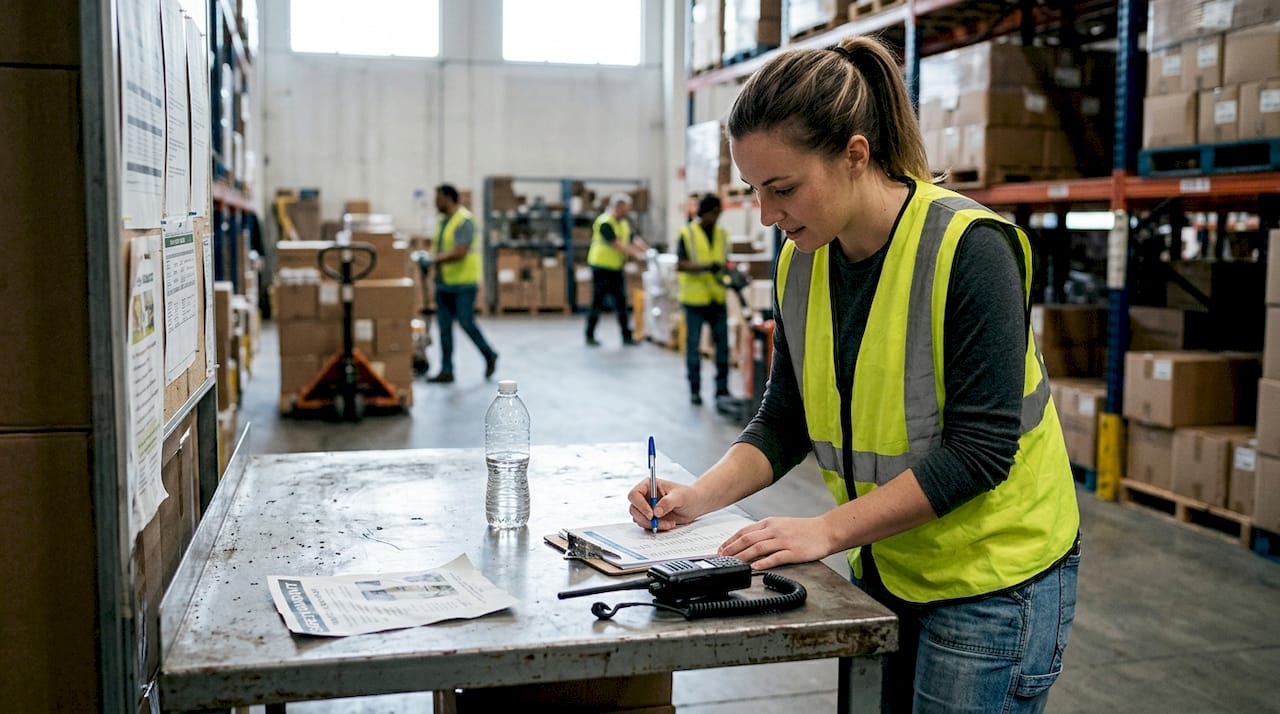
Pro Tip: Low-visibility conditions, such as dimly lit loading docks or areas with heavy dust or steam, require operators to slow to a near stop and use verbal alerts. Install convex mirrors at blind intersections if your facility doesn’t already have them. It’s a low-cost fix with a high safety return.
Teamwork is an underrated safety tool. Clear, standardized hand signals for stop, go, and back up should be part of every operator’s training. OSHA requirements for powered industrial trucks include communication protocols, and hand signals are one of the simplest ways to meet them. Pair that with certification importance and you have a workforce that’s both skilled and legally covered.
Pallet jack operator responsibilities vs. forklift operators
While operational best practices are universal, it’s crucial to distinguish pallet jack and forklift operator roles for legal and safety reasons. Treating these roles as interchangeable is one of the most common and costly mistakes in warehouse management.
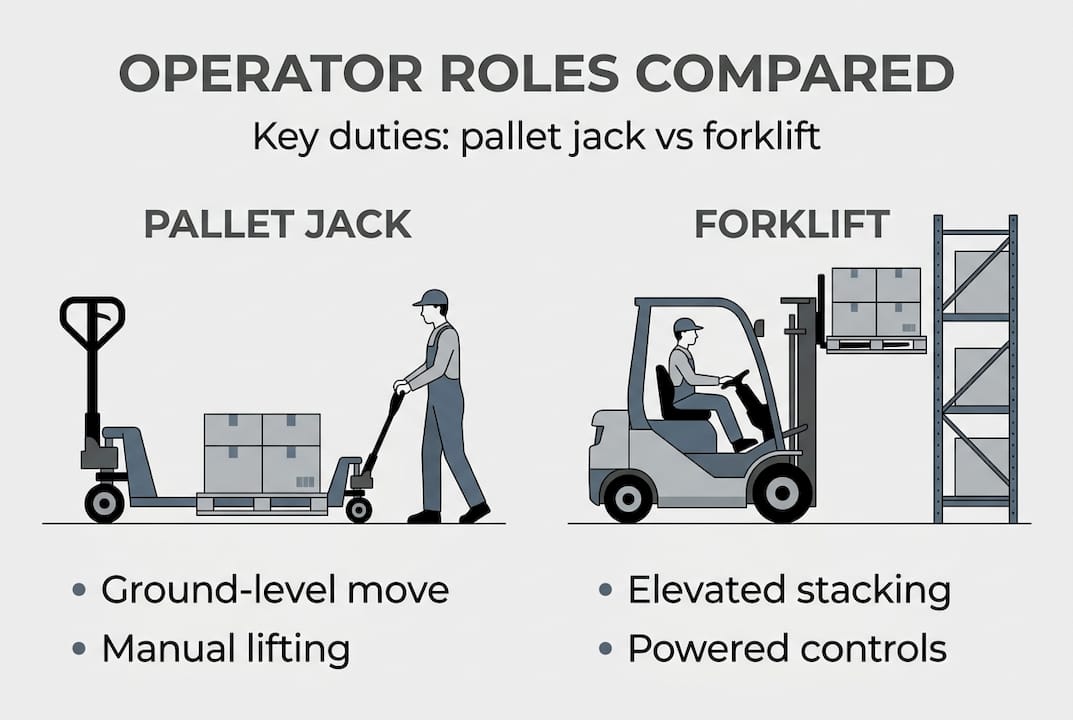
Misclassification of operator roles leads to certification gaps and OSHA fines. Here’s a clear side-by-side comparison:
| Responsibility | Pallet jack operator | Forklift operator |
|---|---|---|
| Equipment type | Manual or electric pallet jack | Sit-down, stand-up, or reach truck |
| Load elevation | Ground level only | Elevated racking and mezzanines |
| Certification required | OSHA-compliant pallet jack training | Full powered industrial truck certification |
| Pre-use inspection | Required | Required |
| Load capacity management | Yes, within jack specs | Yes, with attachment considerations |
| Elevated load travel | Not permitted | Core function |
| Refresher training cycle | Every 3 years or after incident | Every 3 years or after incident |
The distinction matters during audits. Insurance carriers and OSHA inspectors will check whether your operators hold the correct credentials for the equipment they actually operate. An operator certified only for pallet jacks who is found operating a reach truck is an immediate violation.
Risks of cross-assigning duties without proper certification include:
- Voided insurance claims after an incident involving an uncertified operator
- OSHA fines that can reach thousands of dollars per violation
- Increased injury risk because operators lack equipment-specific skills
- Failed audits that trigger mandatory retraining and operational shutdowns
Review your forklift operator job description and your pallet jack operator roles separately. Make sure forklift compliance tasks are assigned only to operators with the matching certification on file.
Training and compliance: What managers must know
With roles and best practices defined, managers need robust training programs to ensure ongoing compliance. A well-built program isn’t just about initial certification. It’s a living system.
Here are the steps to build or review a compliant training program:
- Assess current operator certifications. Pull records and confirm every active pallet jack operator has valid, documented training.
- Identify gaps and schedule training. Use your inspection checklist guide as a benchmark for what operators should know before certification.
- Deliver formal instruction and practical evaluation. Training must include both classroom-style content and hands-on evaluation per OSHA standards.
- Document everything. Operator name, training date, trainer name, and evaluation results must be on file.
- Schedule refresher training proactively. Don’t wait for an incident. Set calendar reminders for three-year renewal cycles.
- Supervise and coach continuously. Compliance doesn’t end at certification. Managers should conduct regular floor observations and address unsafe behaviors immediately.
Failure to provide OSHA-compliant training is a leading cause of workplace injuries and regulatory action. The documentation piece is where many facilities fall short during surprise inspections.
| Record type | When required | Retention period |
|---|---|---|
| Initial training record | Before first operation | Duration of employment |
| Refresher training record | Every 3 years or after incident | Duration of employment |
| Evaluation documentation | After each training cycle | Duration of employment |
| Incident or near-miss report | Immediately after event | Minimum 5 years |
“Compliance is not a one-time event. It’s a system of habits that managers build and operators maintain every single shift.”
OSHA regulation 1910.178 spells out exactly what’s required. Pair that with a strong pallet jack certification program and your facility is positioned to pass any audit without scrambling.
Why mastering operator responsibilities is the missing link in warehouse safety
Most safety programs focus on what operators should do. Far fewer focus on whether operators actually understand why those responsibilities exist. That gap is where incidents happen.
In our experience, facilities with the highest accident rates aren’t necessarily the ones with the least training. They’re the ones where responsibilities are vague, accountability is inconsistent, and refresher training only happens after something goes wrong. Defining duties clearly on paper is not enough if supervisors don’t reinforce them on the floor daily.
Ongoing evaluation and accountability are the real differentiators between merely compliant and truly safe operations. The managers who get this right treat operator responsibilities as a living process. They review duties after near-misses, update procedures when equipment or workflows change, and build a culture where peer intervention is normal and respected.
The shift from reactive to proactive safety is not complicated. It starts with operator training insights that go beyond the basics and with managers who hold themselves as accountable as their operators.
Get your team certified and compliant
Raising the bar for warehouse safety starts with making sure every operator has the right credentials and every manager has the tools to maintain them.
At Forklift Academy, we’ve spent over 20 years helping warehouses across the U.S. and Canada build training programs that actually hold up under OSHA scrutiny. Whether you need train the trainer certification to build internal capacity, guidance on OSHA forklift compliance for your entire fleet, or a direct path to OSHA forklift certification for individual operators, we have the programs to get you there. Online, onsite, and train-the-trainer options make it easy to fit training into your operation without downtime.
Frequently asked questions
What are the main pallet jack operator responsibilities?
Operators must conduct visual pre-use inspections and are accountable for secure load handling, hazard reporting, safe navigation, and clear communication with their team every shift.
Do pallet jack operators need OSHA certification?
Yes. Certification is mandatory under OSHA for all powered industrial truck operators, including those operating electric and manual pallet jacks, before they touch equipment on the floor.
How often should pallet jack operator training be renewed?
OSHA requires employers to evaluate operators at least every three years, and sooner if an incident, near miss, or observed unsafe behavior occurs.
What is the difference between pallet jack and forklift operator duties?
Pallet jack operators handle ground-level transport with manual or electric jacks, while forklift operators manage elevated loads and require additional equipment-specific certifications. Misclassification of operator roles leads to certification gaps and OSHA fines.
What are common safety mistakes pallet jack operators make?
Skipping pre-use inspections, ignoring designated travel routes, and failing to secure loads are the top offenders. A pre-shift checklist and safe routes reduce accidents by up to 30% when followed consistently.
Recommended
- Pallet Jack Inspection Checklist: Ensure Safe Operation – Top Osha Forklift Certification
- How to Operate Pallet Jack: Master Key Techniques – Top Osha Forklift Certification
- What is Pallet Jack Certification? Understanding Its Importance – Top Osha Forklift Certification
- All About the Electric Pallet Jack – Forklift Academy