
TL;DR:
- Forklift incidents follow preventable patterns, and safety must be embedded as a measurable system rather than a simple rule.
- Compliance with OSHA’s detailed training, inspection, and facility control requirements is essential for reducing accidents and ensuring legal protection.
- Building a safety culture involves frequent behavior observation, thorough documentation, and integrating active controls to protect workers effectively.
Forklift incidents are not random. They follow patterns, and those patterns are preventable. OSHA estimates around 85 fatalities per year from forklift accidents, plus tens of thousands of serious injuries that drain workers’ compensation budgets, halt operations, and expose employers to significant fines. The warehouses that consistently avoid these outcomes share a common trait: they treat safety as a measurable, documented system rather than a list of rules posted on a break room wall. This guide gives you the practical framework to build that system, from regulatory requirements through shift-level execution and facility design.
Table of Contents
- Understand OSHA forklift safety requirements
- Key steps to safer forklift operations
- Inspection and maintenance for incident prevention
- Reduce pedestrian risks with facility controls
- A practical take: Where most forklift safety programs fall short
- Enhance safety and meet OSHA standards with professional training
- Frequently asked questions
Key Takeaways
| Point | Details |
|---|---|
| OSHA compliance structure | Training, evaluation, and documentation are the legal backbone of safer forklift operations. |
| Behavior-based safety | Ongoing observation and feedback are more effective than knowledge tests alone for reducing incidents. |
| Inspection is prevention | Removing defective trucks from service prevents accidents before they happen. |
| Layered pedestrian controls | Combining barriers, warnings, and site-specific training reduces injuries where people and forklifts mix. |
| Professional program benefits | Using expert-led certification ensures both compliance and a measurable safety culture. |
Understand OSHA forklift safety requirements
Before you can improve anything, you need to know exactly what the law demands. Many safety managers underestimate how specific OSHA’s forklift rules actually are, and that gap creates real compliance exposure.
OSHA compliance for powered industrial trucks is governed by 29 CFR 1910.178, which requires a structured, multi-part operator training program and documented certification for every operator. This standard covers a wider range of equipment than most people expect. Under the powered industrial truck definition, the rules apply to sit-down counterbalanced forklifts, reach trucks, order pickers, pallet jacks with powered lift, and other similar material handling equipment. If it’s motorized and moves materials, there is a good chance 29 CFR 1910.178 applies to it.
The OSHA powered industrial truck rules break operator training into three required components:
- Formal instruction: Classroom, video, or online learning covering safe operation principles, load handling, refueling, and hazard recognition
- Practical training: Hands-on exercises that replicate real workplace tasks under the supervision of a qualified trainer
- Workplace performance evaluation: A documented assessment where the operator is observed performing actual job functions in the real work environment
Every operator must complete all three components before operating independently. And the training must be tailored to the specific types of trucks used in your facility and the conditions of your workplace. Generic training alone does not satisfy the standard.
| Training component | OSHA requirement | Common mistake |
|---|---|---|
| Formal instruction | Must cover truck-specific and workplace-specific topics | Using only generic online modules |
| Practical training | Must include hands-on exercises | Skipping this step entirely |
| Performance evaluation | Must be documented and workplace-specific | Evaluating in a parking lot, not the actual warehouse |
| Recertification | Required every 3 years minimum | Letting certifications lapse without tracking |
Understanding why operator training matters goes beyond just checking a box. Documented training creates a paper trail that protects your company legally, demonstrates due diligence during OSHA inspections, and gives you data to identify which operators need refresher work before an incident occurs.
Pro Tip: Set calendar reminders for every operator’s evaluation renewal date the moment they complete certification. A simple spreadsheet with names, truck types, certification dates, and renewal deadlines can prevent costly lapses that put both workers and your company at risk.
Key steps to safer forklift operations
With OSHA’s requirements in mind, it’s time to focus on what actions make day-to-day operations reliably safer. Knowing the rules is the starting point. Embedding those rules into daily routines is what actually prevents accidents.
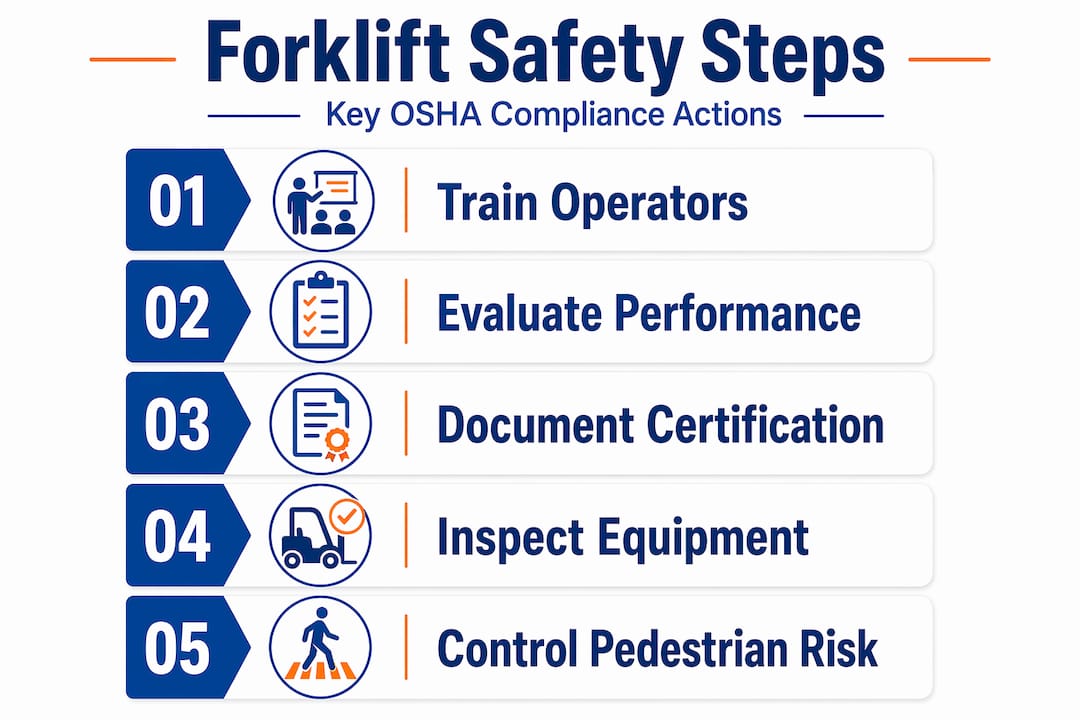
Effective safety improvement centers on training, evaluating actual workplace behavior, and documenting performance, not just checking off rules. That distinction matters enormously. An operator can pass a written test and still make dangerous decisions when navigating a crowded aisle at the end of a long shift.
Here is a practical sequence for building a daily safety routine that sticks:
- Start every shift with a documented equipment inspection. Operators should sign off on a checklist before moving a single load. This builds accountability and creates a legal record.
- Conduct a brief pre-shift safety reminder. A 90-second verbal reminder about the day’s specific hazards (new inventory layout, wet floors, high pedestrian traffic) keeps situational awareness sharp.
- Assign a supervisor to observe at least one operator per shift. Direct observation of actual behavior is more valuable than any test score. Rotate who gets observed to avoid a performance-only-when-watched culture.
- Document near-misses immediately. Near-miss reporting is one of the most underused safety tools in warehousing. Every unreported near-miss is a missed chance to prevent a real injury.
- Review forklift operator requirements during weekly team meetings. Short, focused discussions keep safety top of mind without becoming repetitive.
- Schedule quarterly reviews of your overall safety data. Look for patterns in near-misses, inspection flags, and operator evaluations to spot systemic risks early.
- Invest in advanced forklift training techniques annually. Refresher training that reflects your actual facility layout and equipment keeps skills sharp and satisfies OSHA’s recertification expectations.
“The difference between a compliant program and a truly safe one is whether supervisors are regularly watching operators work, noting what they see, and using that data to drive real conversations about performance.” This is the shift most warehouses need to make.
Pro Tip: Create a one-page shift safety checklist that operators fill out at the start and end of every shift. Keep a 90-day rolling file of completed checklists. This documentation becomes invaluable during OSHA inspections and any incident investigation.
Inspection and maintenance for incident prevention
Beyond operator actions, maintaining safe equipment is often the easiest way to prevent incidents before they occur. A well-trained operator on a defective forklift is still a hazard.
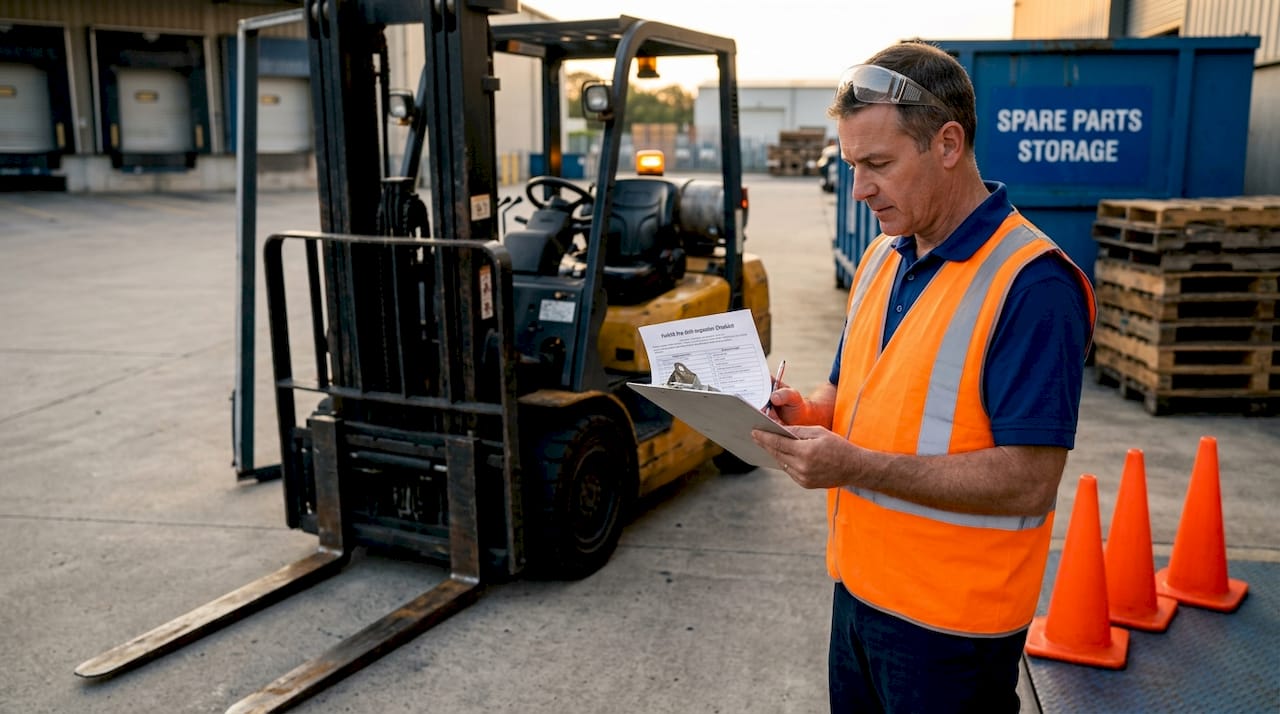
Forklift inspections prevent accidents by ensuring safety-critical parts like brakes, steering, alarms, forks, hydraulics, and tires function properly. If any of these systems are compromised, the truck must be immediately removed from service until repairs are completed. This is not optional under OSHA’s standard.
Every pre-shift inspection should cover the following:
- Forks: Check for cracks, bends, and correct spacing
- Mast and hydraulic system: Inspect for leaks, smooth operation, and proper chain tension
- Brakes: Test both service and parking brakes for responsiveness
- Steering: Verify smooth, responsive steering with no excessive play
- Tires: Check for wear, damage, and correct inflation on pneumatic types
- Alarms and lights: Confirm the backup alarm, horn, and warning lights all function
- Fuel or battery: Check fluid levels or battery charge before the shift begins
- Overhead guard and load backrest: Inspect for structural integrity and secure attachment
The person conducting the inspection should sign and date the report. In facilities with multiple shifts, a separate inspection is required at the start of each shift, not just once per day. If a supervisor or maintenance technician finds a defect during their own review, they must also document what was found and what action was taken.
| Inspection type | Frequency | Who signs off | What it covers |
|---|---|---|---|
| Pre-shift inspection | Every shift | Assigned operator | All safety-critical systems |
| Supervisor spot-check | Weekly minimum | Shift supervisor | Spot verification of operator inspection accuracy |
| Full maintenance service | Per manufacturer schedule | Certified technician | All mechanical, hydraulic, and electrical systems |
| Post-incident inspection | After any collision or tip | Maintenance staff + supervisor | Full damage and system assessment |
Documenting inspections also supports your insurance position. In the event of a claim, insurers and attorneys look for evidence that the company exercised reasonable care. A complete, signed inspection log is one of the clearest ways to demonstrate that. Review the basic forklift operator job requirements to ensure your operators fully understand their inspection responsibilities before their first shift.
Reduce pedestrian risks with facility controls
Operator and mechanical safety set the foundation, but preventing the most serious accidents also means controlling how forklifts and people interact on the warehouse floor. Pedestrian injuries from forklift incidents are disproportionately severe, often resulting in crush injuries, broken bones, or fatalities.
The reality is that even skilled, certified operators cannot fully compensate for a facility layout that forces forklifts and pedestrians to share the same path without any separation. Layered pedestrian safety combines operator training with active and passive controls around site-specific hazards. No single measure is sufficient on its own.
Where incidents happen most often:
- Blind corners and 90-degree turns at the end of rack rows
- Dock doors and loading areas where delivery drivers and pedestrians enter
- Intersections between forklift travel aisles and pedestrian walkways
- Narrow aisles where passing is required
- Areas near charging stations and staging zones
Facility modifications that reduce risk:
- Convex mirrors at blind corners give operators a line of sight before turning
- Physical barriers and guardrails separate pedestrian paths from forklift aisles at a structural level, which is more reliable than painted lines alone
- High-visibility floor marking with bright yellow striping designates dedicated pedestrian walkways that workers are trained never to step outside of
- Improved lighting in low-visibility areas like dock doors, corners, and under mezzanine structures
- Pedestrian-only entry gates at loading docks prevent delivery personnel from wandering into active forklift zones
Technology add-ons that provide active protection:
- Blue safety lights projected on the floor in front of or behind the forklift warn pedestrians of an approaching truck before it comes into view
- Speed limiters in designated zones keep travel speeds at safe levels without relying on operator judgment alone
- Proximity detection systems can alert both the operator and nearby pedestrians when they are within an unsafe distance of each other
| Control method | Risk reduction strength | Cost range | Best use location |
|---|---|---|---|
| Convex mirrors | Moderate | Low | Blind corners, aisle ends |
| Physical barriers | High | Medium to high | High-traffic pedestrian paths |
| Blue safety lights | High | Medium | Dock doors, intersections |
| Proximity detection | Very high | High | Entire facility or specific zones |
| Floor marking alone | Low to moderate | Low | Secondary control only |
The key insight here is that painted lines and posted signs are passive controls that rely entirely on human behavior. Combine them with structural barriers and active technology, and you create a system where human error is far less likely to result in injury.
A practical take: Where most forklift safety programs fall short
Here is something that most safety training vendors will not tell you: the majority of OSHA violations and workplace injuries happen at facilities that already have safety programs in place. The programs exist. The paperwork is filed. And people still get hurt.
The problem is that most programs are built around documentation of knowledge rather than documentation of behavior. An operator signs a training completion form. A supervisor checks a box on a quarterly audit. The form goes into a folder. And then everyone goes back to doing exactly what they were doing before the training.
Real safety improvement requires a cultural shift that most warehouses are not fully prepared to make. It means supervisors have to spend time on the floor watching operators work, not just reviewing paperwork at the end of the week. It means operators have to feel safe enough to report near-misses without fear of discipline. And it means leadership has to treat safety data the same way they treat productivity data, as something that gets reviewed, discussed, and acted on regularly.
Most defensible programs measure operator behavior in the workplace and document it consistently. That word “defensible” is important. When OSHA investigates an incident, they are asking: what did you actually do, and can you prove it? Knowing the rules is not enough. Observing, measuring, and recording actual operator performance is what separates the companies that improve from the ones that repeat the same mistakes year after year.
The warehouses with the best safety records are not the ones with the thickest compliance binders. They are the ones where a supervisor can tell you exactly how each operator performed during last month’s observations and what coaching conversations happened as a result.
Pro Tip: Involve both operators and managers in your monthly safety observations. When operators see that their managers are also being held accountable for safe behaviors, the culture shifts from “rules I follow to avoid trouble” to “standards we all own together.”
If you want to understand what a truly audit-ready program looks like, start by reviewing the in-depth OSHA requirements for powered industrial trucks and map your current practices directly against each requirement. Gaps will become obvious quickly.
Enhance safety and meet OSHA standards with professional training
Building a safer warehouse takes more than good intentions. It takes properly structured training, current certification documentation, and the kind of practical program design that actually holds up during an OSHA inspection.
Forklift Academy has spent over 20 years helping warehouses and logistics operations across the United States and Canada build certification programs that work in the real world. Whether you need individual operator certification, onsite group training, or a complete train-the-trainer kit that puts qualified instructors inside your facility, the options are designed to fit your operation and your schedule. Explore the full range of forklift training programs and find the right path to OSHA compliance for your team. Getting started is straightforward, and the documentation your team needs to stay protected is built into every program.
Frequently asked questions
What are the core components of OSHA forklift operator training?
OSHA requires formal instruction, practical training, and workplace evaluation for every operator, and all three must be documented. No single component can substitute for the others.
How often should forklift operators be re-evaluated?
Evaluations must occur at least every three years under 29 CFR 1910.178, but OSHA also requires re-evaluation whenever unsafe operation is observed, an accident or near-miss occurs, or an operator is assigned to a different type of truck.
What should a forklift pre-operation inspection cover?
Inspections should evaluate brakes, steering, alarms, forks, mast, hydraulics, and tires at the start of each shift, with the operator signing and dating the completed form.
How can warehouses minimize pedestrian accidents around forklifts?
Layered controls including training, barriers, and technology are most effective, particularly at high-risk locations like blind corners, dock doors, and aisle intersections where forklifts and people share space.
What happens if a forklift is found defective during inspection?
Defective forklifts must be removed from service immediately until all identified issues are repaired and the equipment is cleared by a qualified technician. This applies regardless of how minor the defect appears.
Recommended
- How to Implement Forklift Safety Training for OSHA Compliance – Top Osha Forklift Certification
- How to Comply With OSHA Forklift Rules: A Step-by-Step Guide – Top Osha Forklift Certification
- Workplace forklift safety: OSHA compliance explained – Top Osha Forklift Certification
- Step by step forklift training for OSHA compliance 2026 – Top Osha Forklift Certification