
TL;DR:
- A forklift card is employer-issued proof of training, not a government license.
- Certification is valid for three years and must be renewed with site-specific evaluation.
- Misunderstanding the card’s legal meaning risks safety violations and costly fines.
Most people assume a forklift card works like a driver’s license, something issued by a government agency that travels with you from job to job. That assumption is wrong, and it creates real compliance gaps for employers and operators alike. A forklift card is actually employer-issued proof of training and evaluation under OSHA 29 CFR 1910.178(l), the federal standard governing powered industrial truck operation. Getting this distinction right matters more than most people realize. Certified operators reduce workplace injuries significantly, and businesses that misunderstand the card’s legal meaning often end up exposed to serious fines and preventable accidents.
Table of Contents
- What is a forklift card?
- How do you earn a forklift card?
- What does a forklift card include?
- How long is a forklift card valid?
- Limits and common myths about forklift cards
- Why calling it a ‘license’ hurts safety and compliance
- Get certified with trusted forklift training
- Frequently asked questions
Key Takeaways
| Point | Details |
|---|---|
| Forklift card definition | A forklift card is employer-issued proof of OSHA-required training, not a government license. |
| Certification process | To obtain a forklift card, you must complete formal instruction, a written test, hands-on practice, and site-specific evaluation. |
| Validity and renewal | Forklift cards are valid for three years and must be renewed after incidents or workplace changes. |
| Employer responsibility | Employers issue and track cards, ensuring certification matches equipment and site. |
| Common myths | Forklift cards are not driver’s licenses and can’t be transferred job to job without retraining. |
What is a forklift card?
Now that we’ve addressed the confusion, let’s clarify exactly what a forklift card is and what it is not.
A forklift card, sometimes called a certification card or wallet card, is a portable document that OSHA 29 CFR 1910.178 requires employers to issue after an operator completes training and evaluation. It is not a government-issued credential. No federal or state agency prints or distributes forklift cards. The employer is fully responsible for issuing the card, maintaining training records, and ensuring the operator stays current.
This is one of the most misunderstood points in the industry. Many operators assume their card works like a driver’s license, portable, transferable, and universally recognized. It does not. You can read more about the distinction between a forklift license vs. certification to understand why the difference matters legally and practically. For a broader look at license requirements for forklifts, the picture becomes even clearer: there is no standardized government license for forklift operation in the U.S.
Here is what a standard forklift card typically includes:
- Operator’s full name
- Date of training completion
- Date of evaluation
- Name and signature of the trainer
- Employer name and location
- Forklift classes the operator is authorized to use
“The certification must include the operator’s name, the date of training, the date of evaluation, and the identity of the person who performed the evaluation. OSHA does not regulate the physical format of the card.”
The operator carries the wallet card as quick proof of certification. The employer, however, must keep full training records on file. Those records are what OSHA inspectors actually review during an audit.
| Feature | Forklift card | Government-issued license |
|---|---|---|
| Issued by | Employer | Government agency |
| Transferable between jobs | No | Yes |
| Regulated format | No | Yes |
| Tied to specific equipment | Yes | No |
| Required by OSHA | Yes | N/A |
Operators in the U.S. must be at least 18 years old to operate a forklift in most workplaces, and Canadian provinces have similar minimums. Age alone does not qualify someone. Training and evaluation are both required before a card can be issued.
How do you earn a forklift card?
Understanding the forklift card’s purpose, the next step is to know how to earn one.
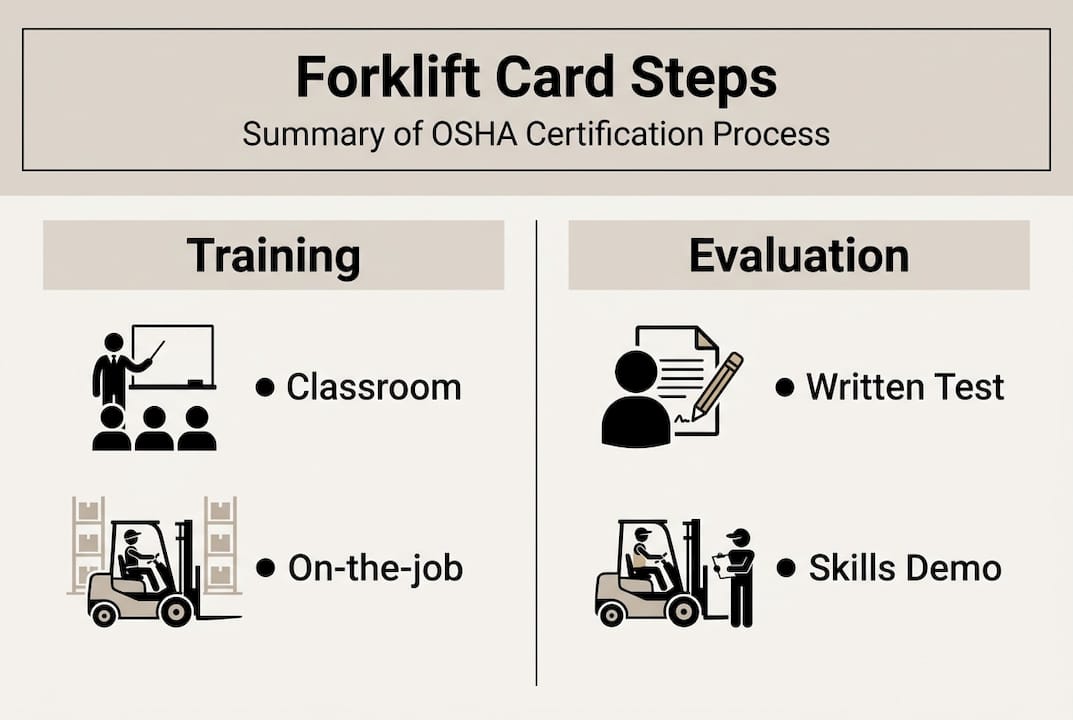
The OSHA 29 CFR 1910.178 standard requires four distinct components before a card can be issued. Skipping any one of them means the certification is not valid, even if a card gets printed.
Here is how the process works from start to finish:
- Formal instruction. This covers the theory side: pre-operation inspections, load capacity, stability, hazard recognition, and OSHA rules. This portion can be completed online or in a classroom setting. Many operators complete this stage through online forklift certification programs, which offer flexibility without sacrificing content quality.
- Practical training. The operator gets hands-on time with the actual equipment they will use on the job. This must happen at the worksite or a comparable environment. No online module replaces this step.
- Written examination. Most programs require a passing score of at least 70%. This tests whether the operator retained the formal instruction content.
- Hands-on evaluation. A qualified trainer observes the operator using the forklift in real work conditions. This evaluation must be site-specific, meaning it reflects the actual environment, surfaces, loads, and hazards the operator will encounter.
The forklift operator certification workflow follows this same sequence whether you are a first-time operator or renewing after three years. The employer or a designated trainer supervises the evaluation and signs off on the card.
Want to feel confident going into your exam? Reviewing strategies for passing the OSHA forklift test can help you identify the topics most likely to appear and avoid common mistakes.
Pro Tip: Before you enroll in any training program, check with your employer to confirm which providers they approve. Some companies have preferred vendors or internal trainers, and using an unapproved provider could mean redoing the training.
What does a forklift card include?
Once you’ve completed your certification, what exactly will your forklift card look like, and what information must it contain?

OSHA does not mandate a specific card design, size, or layout. What it does require is that certain information is documented, including the operator’s name, the dates of training and evaluation, and the identity of the trainer. Everything else, color, logo, lamination, QR codes, is up to the employer.
Here is what you will typically find on a forklift wallet card:
- Operator’s name
- Training completion date
- Evaluation date
- Trainer’s name
- Employer name and address
- Forklift class or classes authorized (Classes I through VII)
- Expiration date (three years from evaluation)
Some employers include a QR code that links to the operator’s full training record. This makes verification faster during audits or when an operator is working at a client site. It is a smart feature, though not required by OSHA forklift certification requirements.
| Field | Required by OSHA | Common but optional |
|---|---|---|
| Operator name | Yes | |
| Training date | Yes | |
| Evaluation date | Yes | |
| Trainer identity | Yes | |
| Forklift class | No | Yes |
| QR code | No | Yes |
| Expiration date | No | Yes |
One important point: if an operator switches to a different forklift class or moves to a new worksite with different conditions, the card must be updated. A card issued for a Class IV counterbalanced sit-down truck does not cover a Class II reach truck. The environments, controls, and hazards are different enough that a new evaluation is required.
How long is a forklift card valid?
Now that we know what’s on your forklift card, let’s explore how long it remains valid and what to do when it’s time to renew.
Forklift certification is valid for three years under OSHA standards. After three years, the operator must complete a new evaluation to keep their card current. But three years is the maximum, not a guaranteed window. Several situations require earlier renewal:
- The operator is observed operating unsafely
- The operator is involved in an accident or near-miss
- The operator is assigned a different class of forklift
- The worksite conditions change significantly
- A supervisor or trainer has reason to believe retraining is needed
Letting certification lapse carries serious consequences. 85% of forklift accidents involve non-certified operators, and certified operators reduce injury rates by 60%. Beyond the human cost, OSHA fines for violations can reach $161,000 per incident for willful or repeated offenses. That is not a number any business wants to face.
The process for renewing forklift cards follows the same evaluation requirements as initial certification. In many cases, operators who have been working consistently can complete the renewal faster because they already have hands-on experience. Still, the evaluation must happen, and the card must be reissued with updated dates.
For businesses managing multiple operators, staying on top of expiration dates is a real administrative challenge. Reviewing certification renewal tips can help you build a system that keeps your whole team compliant without scrambling at the last minute.
Pro Tip: Set a calendar reminder 60 days before each operator’s card expires. That window gives you enough time to schedule training, complete the evaluation, and issue a new card without any lapse in compliance.
Limits and common myths about forklift cards
Having covered the essentials of forklift cards, it’s crucial to recognize what a card does NOT do and common misconceptions that can cost you.
Myths about forklift cards are everywhere, and believing them creates real compliance and safety risks. Here are the most common ones:
- Myth: A forklift card is a transferable license. Fact: Certification is site and employer-specific. If you change jobs or move to a new facility, your new employer must verify your training and conduct a site-specific evaluation before you operate.
- Myth: A forklift card substitutes for a driver’s license. Fact: It does not grant any driving privileges on public roads. It only authorizes operation within the workplace. The minimum age is 18, but age does not replace training.
- Myth: One card covers all forklift types. Fact: OSHA recognizes seven forklift classes (I through VII), and retraining is required when switching between classes. A card for a walkie stacker does not cover a rough terrain forklift.
- Myth: Online certification alone is enough. Fact: The hands-on evaluation must always be conducted in person at the actual worksite.
“There is no standardized forklift ‘license’ in the United States. The legal term is certification, and it is the employer’s responsibility, not a government agency’s, to issue and maintain it.”
Understanding why certification matters goes beyond checking a compliance box. Each of these myths, if believed, leads to shortcuts that put operators and coworkers at risk.
Why calling it a ‘license’ hurts safety and compliance
With myths exposed, here is a frank perspective on why the language we use about forklift cards can make or break workplace safety.
When businesses treat a forklift card like a driver’s license, they start making dangerous assumptions. They assume a card from a previous employer means the operator is ready to go. They assume one card covers every truck on the floor. They assume that once the card is issued, the training obligation is done. None of that is true, and true OSHA compliance requires understanding the difference.
The deeper problem is cultural. Businesses that treat certification as a paperwork exercise rather than a safety investment consistently see higher incident rates. The card is not the goal. Safe, confident, site-specific operation is the goal. The card is just evidence that you got there.
We have seen it repeatedly over more than 20 years in this industry: companies that invest in quality training, not just minimum-compliant cards, have fewer accidents, lower insurance costs, and better operator retention. The language you use shapes the culture you build. Call it a license, and people treat it like one. Call it what it is, a certification tied to real skills and real conditions, and people take it seriously.
Get certified with trusted forklift training
If you’re ready to get certified and want peace of mind about OSHA compliance, here’s how to take the next step.
At Forklift Academy, we have spent over 20 years helping individuals and businesses across the U.S. and Canada get certified the right way. Our OSHA-compliant training programs cover everything from initial certification to renewal, with both online and onsite options designed to fit your schedule and worksite.
Whether you are an individual operator looking to get your card or a business managing a team of 50, we have solutions that match your needs. From train-the-trainer kits to bulk certification options, our programs make compliance straightforward. Ready to get started? Get forklift certified today and keep your team safe, compliant, and productive.
Frequently asked questions
Is a forklift card the same as a forklift license?
No. A forklift card is employer-issued proof of OSHA-required training and evaluation. There is no government-issued license for forklift operation in the U.S. or Canada.
How long does a forklift card last?
Forklift cards are valid for three years, but early renewal is required after accidents, unsafe operation, new equipment types, or significant worksite changes.
Do I need a separate card for different forklift types?
Yes. OSHA requires retraining for each class of forklift (Classes I through VII), so your card must reflect the specific equipment you are authorized to operate.
Is a forklift card valid at any company or site?
No. Forklift cards are employer and site-specific. Changing jobs or worksites means your new employer must verify training and conduct a new site-specific evaluation.
What happens if I operate a forklift without certification?
Operating without certification exposes you and your employer to fines up to $161,000 per violation, and non-certified operators are involved in 85% of forklift accidents.
Recommended
- Forklift License vs Certification: OSHA Compliance Impact – Top Osha Forklift Certification
- Understanding Forklift Certification Explained for Operators – Top Osha Forklift Certification
- OSHA Compliance: Navigating Forklift Certification Requirements – Top Osha Forklift Certification
- What Is a Forklift Training Card: OSHA Compliance Benefits – Top Osha Forklift Certification