
Forklift operation safety remains a critical concern across North American warehouses, with 85 fatalities and 35,000 serious injuries occurring annually. Operators and managers need a clear, detailed responsibilities list to reduce accidents and meet OSHA standards effectively. This article covers key responsibilities, operational best practices, and compliance essentials for 2026, equipping you with actionable insights to create safer workplaces. Understanding these responsibilities transforms safety culture, protects workers, and ensures regulatory compliance in an evolving industrial landscape.
Table of Contents
- Core Forklift Operator Responsibilities And Safety Criteria
- Understanding Forklift Mechanics And Operational Best Practices
- Empirical Data On Forklift Accidents And The Importance Of Training
- Emerging Technologies And Compliance Perspectives In Forklift Operation
- Explore Expert Forklift Training And Certification Options
Key takeaways
| Point | Details |
|---|---|
| Daily inspections required | Operators must check brakes, tires, hydraulics, forks, lights, and horn before every shift to identify potential hazards. |
| PPE is mandatory | Hard hats, high-visibility vests, and steel-toed boots protect operators from workplace injuries and meet OSHA requirements. |
| Load stability prevents tip-overs | Understanding the stability triangle and keeping loads low reduces the 25% of accidents caused by tip-overs. |
| Training reduces 70% of incidents | Proper operator training and adherence to safety protocols prevent the majority of forklift-related injuries. |
| Technology enhances safety | Proximity sensors, cameras, and speed limiters complement human skill to improve operational safety outcomes. |
Core forklift operator responsibilities and safety criteria
Forklift operators carry significant responsibility for workplace safety and regulatory compliance. Core responsibilities include operating forklifts safely, conducting daily inspections, following safety protocols, maintaining inventory records, and reporting issues. These foundational duties form the backbone of effective forklift operation in 2026 warehouses.
Daily pre-shift inspections represent the first line of defense against equipment failure. Operators must systematically examine critical components before beginning work. Check brakes for responsiveness, inspect tires for proper inflation and tread depth, test hydraulic systems for leaks or pressure loss, verify fork integrity for cracks or bends, confirm all lights function properly, and test the horn for audible warning capability. This routine takes 10 to 15 minutes but prevents costly breakdowns and dangerous malfunctions during operation.
Personal protective equipment requirements are non-negotiable in compliant facilities. Operators must wear hard hats to protect against falling objects, high-visibility vests to ensure visibility in busy warehouse environments, and steel-toed boots to guard against crush injuries from dropped loads or equipment contact. These items might seem basic, but they significantly reduce injury severity when incidents occur.
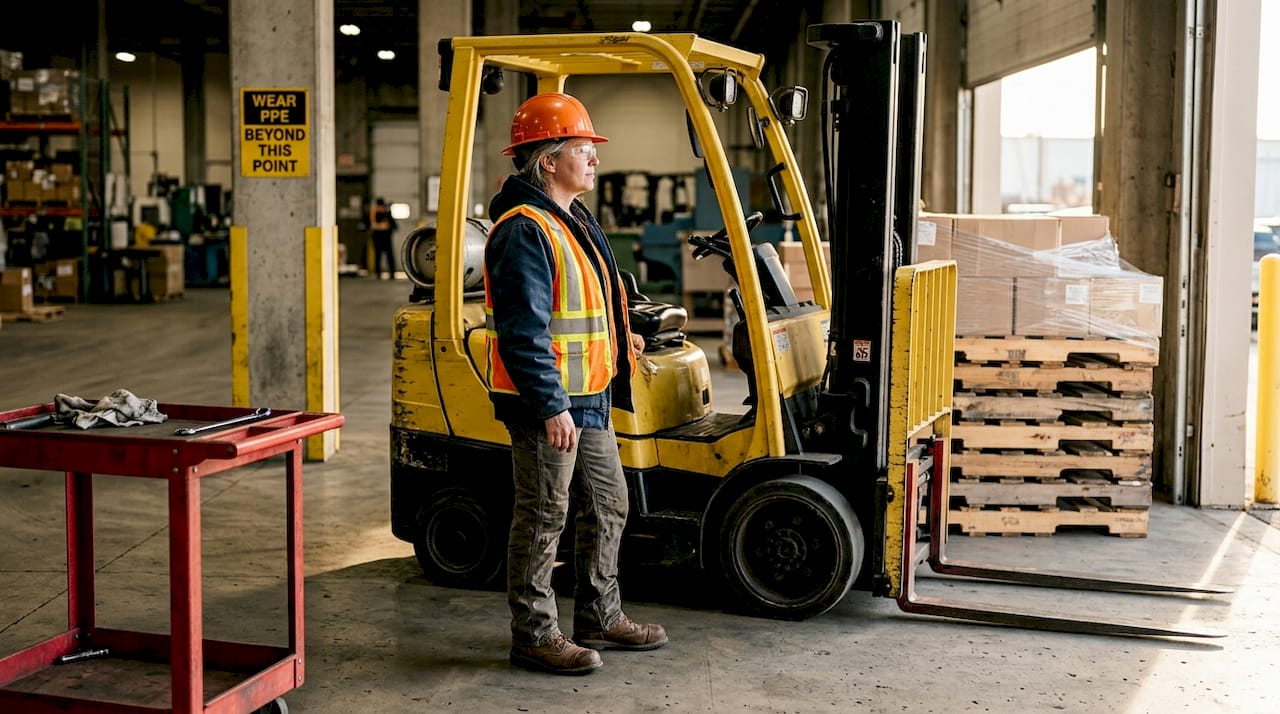
Operational speed and visibility management directly impact accident prevention. Travel at safe speeds appropriate for warehouse conditions, typically 5 to 8 miles per hour in open areas and slower in congested zones. Maintain clear forward visibility at all times; if the load blocks your view, travel in reverse to ensure you can see pedestrians and obstacles. Never compromise visibility for speed or convenience.
Documentation responsibilities extend beyond physical operation. Maintain accurate inventory records as you move materials, noting quantities, locations, and any discrepancies. Complete incident reports immediately when accidents or near-misses occur, providing detailed information that helps prevent future occurrences. Report equipment malfunctions, unsafe conditions, or procedural concerns to supervisors promptly, creating a feedback loop that strengthens overall safety culture.
Pro Tip: Create a personal pre-shift inspection checklist on a laminated card you carry daily. This physical reminder ensures you never skip critical safety checks, even during rushed morning starts or shift changes.
Understanding forklift inspection procedures and following the OSHA compliance guide for safe operations provides operators with structured frameworks that transform abstract responsibilities into concrete daily actions.
Understanding forklift mechanics and operational best practices
Technical knowledge separates competent operators from truly safe ones. Operators must understand the stability triangle, maintain forks 4 to 8 inches off the ground when traveling, tilt the mast back for stability, and reverse if visibility is blocked. These mechanical principles prevent the most common and dangerous forklift incidents.
The stability triangle concept is fundamental to preventing tip-overs. Imagine a triangle formed by the two front wheels and the pivot point of the rear axle. Your forklift remains stable when the combined center of gravity of the machine and load stays within this triangle. When you lift loads too high, travel too fast on turns, or operate on slopes incorrectly, you shift the center of gravity outside this triangle, causing tip-overs that account for 25% of all forklift accidents.
Load center management requires understanding weight distribution. Standard forklifts are rated for loads with a 24-inch load center, meaning the weight is evenly distributed 24 inches from the fork face. If your load extends further, the effective capacity decreases significantly. Always verify load weight and distribution before lifting, and consult capacity charts when handling unusual loads.
Proper travel techniques minimize risk during material transport:
- Keep forks 4 to 8 inches above the ground while traveling to clear obstacles without raising the center of gravity dangerously high.
- Tilt the mast back slightly, typically 5 to 10 degrees, to secure the load against the backrest and improve stability.
- Travel with the load upgrade when moving on ramps or inclines to maintain control and prevent the load from sliding.
- Reduce speed significantly before turns, as centrifugal force can shift loads or cause the forklift to tip sideways.
- Sound the horn at blind corners, doorways, and intersections to alert pedestrians and other operators of your approach.
Reversing protocols protect both operators and pedestrians. When your load blocks forward visibility, travel in reverse while looking in the direction of travel. Use mirrors and backup alarms, but never rely on them exclusively. Some facilities require spotters for reverse travel in high-traffic areas, adding an extra layer of safety through human oversight.
Turn and ramp navigation demands heightened attention. Slow down to walking speed before entering turns, as forklifts have a high center of gravity that makes them prone to tipping during sharp turns at speed. On ramps, always travel straight up or down rather than at angles, and never turn on an incline. These simple rules prevent rollovers that cause severe injuries and fatalities.
Pro Tip: Practice emergency stops in a safe area when you first operate a new forklift model. Understanding how quickly the machine stops and how the load reacts builds muscle memory that could prevent accidents during actual emergencies.
Mastering these operational mechanics through comprehensive forklift training transforms theoretical knowledge into practical skills that keep warehouses safe and productive.
Empirical data on forklift accidents and the importance of training
Statistics reveal the urgent need for rigorous operator training and responsibility adherence. OSHA reports approximately 85 fatalities per year in the US and 34,900 serious injuries annually, with 70% preventable through proper training. These numbers represent real people whose lives were changed or ended by preventable accidents.
Tip-overs cause 25% of forklift accidents, making them the single largest category of serious incidents. These accidents occur when operators fail to respect the stability triangle, travel too fast on turns, or lift loads beyond the forklift’s capacity. The severity of tip-over injuries is particularly high because operators often instinctively jump from the cab, placing themselves in the path of the falling machine. Proper training teaches operators to stay in the seat, brace themselves, and lean away from the impact point.
Manufacturing and transportation industries experience the highest forklift accident rates due to the volume of forklift operations and the complexity of their warehouse environments. These sectors move massive quantities of materials daily, creating numerous opportunities for incidents when operators cut corners or facilities neglect safety protocols. However, companies that prioritize training, enforce inspection routines, and maintain equipment see dramatically lower accident rates.
“The difference between a safe warehouse and a dangerous one isn’t the equipment or the workload; it’s the culture of responsibility and the quality of training that operators receive. When every team member understands their role in safety, incidents drop by more than two-thirds.”
The financial impact of forklift accidents extends far beyond immediate medical costs. Consider the following breakdown:
| Accident Type | Average Direct Cost | Average Indirect Cost | Total Impact |
|---|---|---|---|
| Minor injury (no lost time) | $3,000 to $5,000 | $6,000 to $10,000 | $9,000 to $15,000 |
| Serious injury (lost time) | $25,000 to $50,000 | $50,000 to $100,000 | $75,000 to $150,000 |
| Fatality | $500,000 to $1,000,000 | $1,000,000+ | $1,500,000+ |
Indirect costs include productivity loss, investigation time, increased insurance premiums, potential OSHA fines, equipment damage, and the immeasurable impact on team morale and company reputation. These figures demonstrate why investing in comprehensive operator training and safety infrastructure delivers substantial returns.
Prevention strategies proven to reduce incidents include mandatory pre-shift inspections that catch equipment problems before they cause accidents, comprehensive initial training covering all operational and safety aspects, regular refresher training every three years or sooner when needed, strict enforcement of PPE requirements without exceptions, clear traffic patterns and pedestrian separation in warehouse layouts, and a reporting culture where near-misses are investigated and addressed proactively.
Implementing forklift accident prevention strategies based on this empirical data transforms safety from a compliance checkbox into a core operational value that protects both workers and business interests.
Emerging technologies and compliance perspectives in forklift operation
The forklift industry is evolving as technology integration reshapes traditional operational responsibilities. Manual forklifts remain the standard across most facilities, but technological aids are enhancing safety in challenging scenarios. Technologies like proximity sensors, cameras, and speed limiters complement manual operation, while autonomous forklifts pick orders faster but have operational limitations.
Proximity sensors detect pedestrians and obstacles in the forklift’s path, providing audible or visual warnings to operators. These systems reduce accidents in high-traffic areas where visibility is compromised. However, they supplement rather than replace operator vigilance. Sensors can malfunction or fail to detect certain materials, so operators must maintain constant awareness regardless of technological assistance.
Camera systems provide enhanced visibility around the forklift, particularly for reverse travel and blind spots. Multi-camera setups display real-time feeds on in-cab monitors, giving operators a comprehensive view of their surroundings. These systems are particularly valuable in facilities with tight aisles or complex layouts where traditional mirrors provide limited visibility.
Speed limiters automatically restrict maximum forklift velocity in designated zones, preventing operators from traveling too fast in high-risk areas. Facilities can program different speed limits for warehouse zones, creating slower speeds near pedestrian areas and faster speeds in open storage sections. This technology removes the human judgment element from speed management, ensuring consistent compliance with safety protocols.
Autonomous forklifts represent the cutting edge of warehouse technology. These machines navigate predetermined routes, pick orders, and transport materials without human operators. Early adopters report faster order picking speeds and reduced labor costs. However, autonomous systems have significant limitations. They struggle with unexpected obstacles, require extensive facility mapping and infrastructure investment, cannot handle non-standard loads or situations, and still need human oversight for exceptions and maintenance.
| Technology Type | Primary Benefit | Implementation Cost | Operational Limitation |
|---|---|---|---|
| Proximity sensors | Collision prevention | Low to moderate | False positives, limited range |
| Camera systems | Enhanced visibility | Moderate | Requires operator attention to monitors |
| Speed limiters | Consistent speed compliance | Low | May slow productivity in some scenarios |
| Autonomous forklifts | Reduced labor costs, faster picking | Very high | Limited flexibility, high maintenance needs |
Medical certification requirements present an interesting compliance perspective. Recent research indicates medical certifications alone do not significantly reduce forklift incidents. While medical screening can identify conditions that might impair operation, the study found no correlation between medical certification programs and reduced accident rates. This suggests that comprehensive training and safety management systems are far more effective than medical gatekeeping.
Balancing human skill with technology integration offers the best path forward for warehouse safety. Experienced operators bring judgment, adaptability, and problem-solving abilities that current technology cannot replicate. Technology provides consistent monitoring, data collection, and assistance in specific scenarios where human limitations create risk. The optimal approach combines well-trained operators with targeted technological aids that address specific safety gaps.
Managers should evaluate technology adoption based on their facility’s unique needs and workforce capabilities. Consider current accident patterns and identify which technologies address your specific risks. Assess whether your team has the technical skills to maintain and troubleshoot new systems. Calculate realistic return on investment including both direct costs and indirect benefits like reduced insurance premiums. Pilot new technologies in limited areas before facility-wide deployment to identify integration challenges.
Staying current with OSHA compliance and forklift certification requirements ensures your facility leverages both traditional best practices and emerging technologies effectively.
Explore expert forklift training and certification options
Transforming safety knowledge into operational excellence requires professional training that meets current OSHA standards. Certified training enhances operator skill while ensuring your facility maintains full regulatory compliance in 2026. Comprehensive courses cover essential operating responsibilities, safety protocols, and the mechanical knowledge that prevents accidents.
Forkliftacademy.com offers top-rated OSHA forklift certification programs designed for both individual operators and entire teams. These courses provide the detailed instruction operators need to master the responsibilities outlined in this article, from daily inspections to advanced load handling techniques. Online and onsite formats accommodate different learning preferences and facility schedules.
Maintaining valid certification requires regular renewal as OSHA mandates refresher training every three years. Our forklift certification renewal programs streamline this process, ensuring your operators stay current without disrupting productivity. For facilities managing their own training programs, train-the-trainer courses equip your safety personnel with the tools and knowledge to deliver compliant instruction internally.
What are the daily inspection steps a forklift operator should perform?
Operators should check brakes, tires, hydraulics, forks, lights, and horn before each shift to identify potential equipment failures. This systematic inspection takes 10 to 15 minutes and covers all critical safety systems. Report any malfunctions immediately to maintenance personnel and tag the equipment out of service until repairs are completed. Never operate a forklift with known defects, as this violates OSHA standards and creates serious safety risks.
How often should forklift operators receive safety training to comply with OSHA?
Initial training is mandatory before operators begin independent forklift operation in any workplace setting. OSHA requires refresher training every three years at minimum to maintain certification and ensure operators stay current with safety protocols. Additional training is required whenever an operator is involved in an accident or near-miss, when they begin operating a different type of forklift, or when workplace conditions change significantly. Learn more about OSHA forklift training frequency requirements to ensure your facility maintains full compliance.
What are key safety practices to prevent forklift tip-overs?
Keep loads low and centered within the stability triangle formed by the front wheels and rear pivot point to maintain balance. Travel at safe speeds, particularly on turns and ramps where centrifugal force can shift the center of gravity dangerously. Tilt the mast back 5 to 10 degrees when traveling to secure loads against the backrest. Never turn on ramps or inclines; always travel straight up or down. Implementing comprehensive forklift tip-over prevention strategies reduces the 25% of accidents caused by stability failures.
Are medical certifications effective in reducing forklift accidents?
Recent research indicates that medical certifications alone do not significantly reduce forklift incidents or show measurable improvements in operator safety outcomes. While medical screening can identify certain health conditions, comprehensive training and robust safety management systems prove far more effective at preventing accidents. Focus resources on quality operator training, regular refresher courses, strict enforcement of safety protocols, and creating a workplace culture where safety is prioritized over productivity pressures.
Recommended
- Understanding Forklift Operator Responsibilities Explained – Top Osha Forklift Certification
- Forklift safety checklist 2026: ensure OSHA compliance – Top Osha Forklift Certification
- Forklift Operator Requirements 2025: Complete Guide – Top Osha Forklift Certification
- 7 Essential Forklift Safety Rules for 2025 Compliance – Top Osha Forklift Certification