
Many warehouse managers believe OSHA inspections only happen after accidents. That’s a dangerous misconception. OSHA inspections for forklifts are also triggered by complaints and programmed plans targeting high-risk facilities. Understanding inspection requirements for forklift and scissor lift operations isn’t just about avoiding fines, it’s about protecting your workforce and ensuring daily operations meet federal and provincial standards. This guide clarifies what OSHA inspects, how to prepare, and what documentation keeps you compliant.
Table of Contents
- Introduction To OSHA Inspections In Warehousing
- OSHA Standards Specific To Forklift Operations
- OSHA Standards Governing Scissor Lift Operations
- Common OSHA Violations And Misconceptions
- Jurisdictional Differences: US OSHA Vs Canadian Regulations
- Preparing For OSHA Inspections: Best Practices
- Importance Of Operator Training In OSHA Compliance
- Practical Compliance Solutions With Forkliftacademy.com
- Frequently Asked Questions About OSHA Inspection Requirements For Forklift And Scissor Lifts
Key takeaways
| Point | Details |
|---|---|
| Inspection triggers | OSHA inspections occur after accidents, employee complaints, or as part of programmed inspection plans targeting high-risk warehouses. |
| Distinct equipment standards | Forklifts fall under 29 CFR 1910.178, while scissor lifts are governed by 29 CFR 1910.67, each with unique documentation and inspection requirements. |
| Training and documentation | Operator training records and daily equipment inspection logs are the two most scrutinized compliance areas during OSHA inspections. |
| US vs Canada differences | Canadian regulations require quarterly lift inspections, while US OSHA frequency varies, creating distinct compliance challenges for cross-border operations. |
| Proactive preparation | Using pre-inspection checklists, maintaining updated training records, and conducting regular internal audits dramatically reduce violation risks. |
Introduction to OSHA inspections in warehousing
OSHA doesn’t wait for disaster to strike. Inspections happen for three primary reasons: workplace accidents involving injury or death, formal employee complaints alleging unsafe conditions, and scheduled inspections under programmed plans targeting industries with elevated hazard profiles. Warehouses using powered industrial trucks like forklifts and scissor lifts fall squarely into this high-risk category.
When OSHA walks through your door, inspectors focus on employer responsibilities across seven critical areas. These include hazard identification protocols, mitigation strategies, equipment maintenance records, operator training documentation, and safe operation procedures. The OSHA forklift inspection process is systematic and thorough, examining both physical equipment conditions and paper trails.
What triggers an inspection:
- Fatalities or hospitalizations reported within 8 hours
- Employee complaints submitted directly to OSHA offices
- Programmed inspections targeting warehouses in high-hazard industries
- Follow-up visits after previous violations or abatement deadlines
Warehouses operating forklifts face particular scrutiny because powered industrial trucks account for thousands of serious injuries annually. OSHA’s focused inspection program specifically targets facilities where these machines operate daily. Inspectors arrive with detailed checklists covering 7 critical employer compliance areas, from training records to physical equipment safeguards.
“Employers must ensure all powered industrial truck operators receive comprehensive training and evaluation before operating equipment independently. This training must be documented and accessible during inspections.”
OSHA Compliance Directive CPL 02-01-054
Understanding the inspection process transforms your approach from reactive scrambling to proactive readiness. Daily forklift and scissor lift operations generate documentation trails that tell a compliance story. When that story shows consistent training, regular inspections, and immediate hazard corrections, OSHA inspections become routine verifications rather than stressful ordeals.
OSHA standards specific to forklift operations
Forklift safety lives and dies by 29 CFR 1910.178, the regulation governing powered industrial trucks. This standard mandates specific operator training, equipment maintenance schedules, and daily inspection protocols. Violating any component can result in citations ranging from minor paperwork issues to willful violations carrying five-figure penalties.
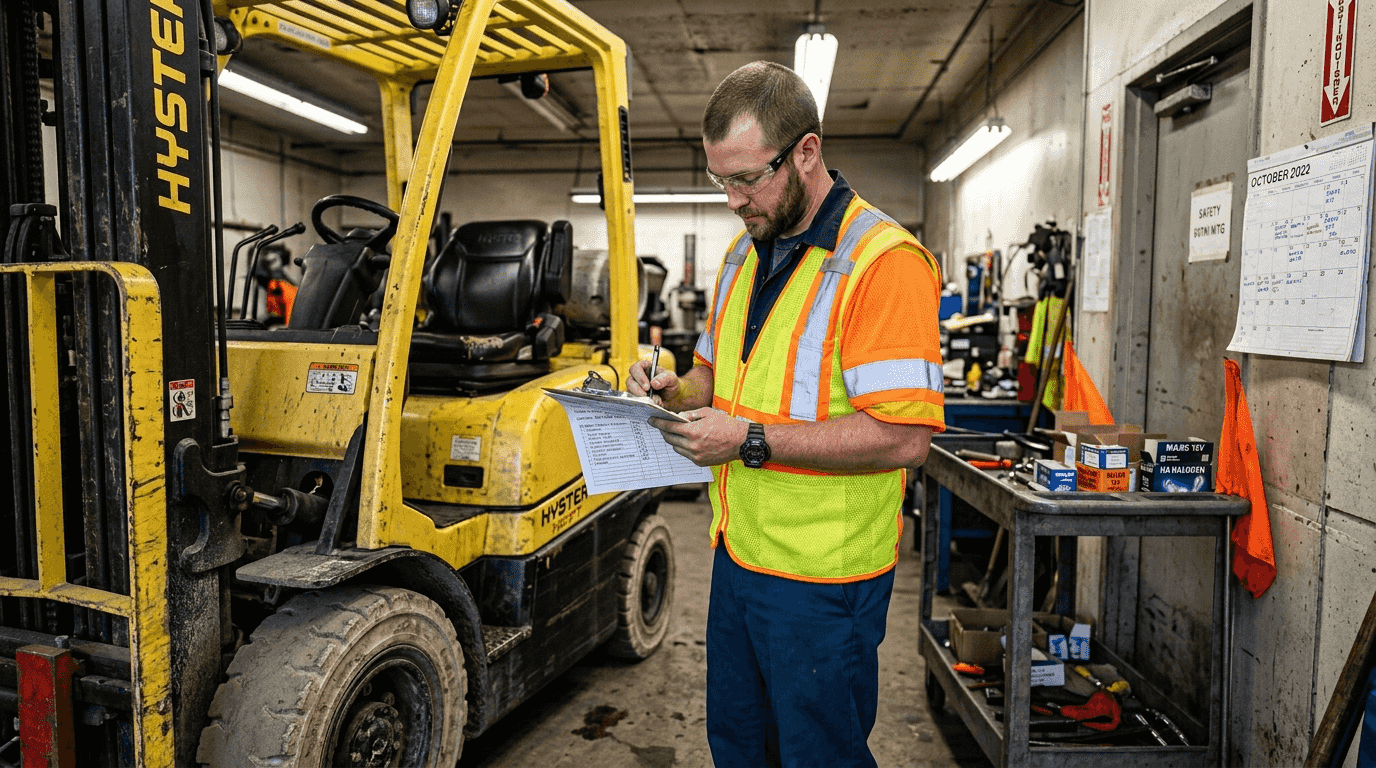
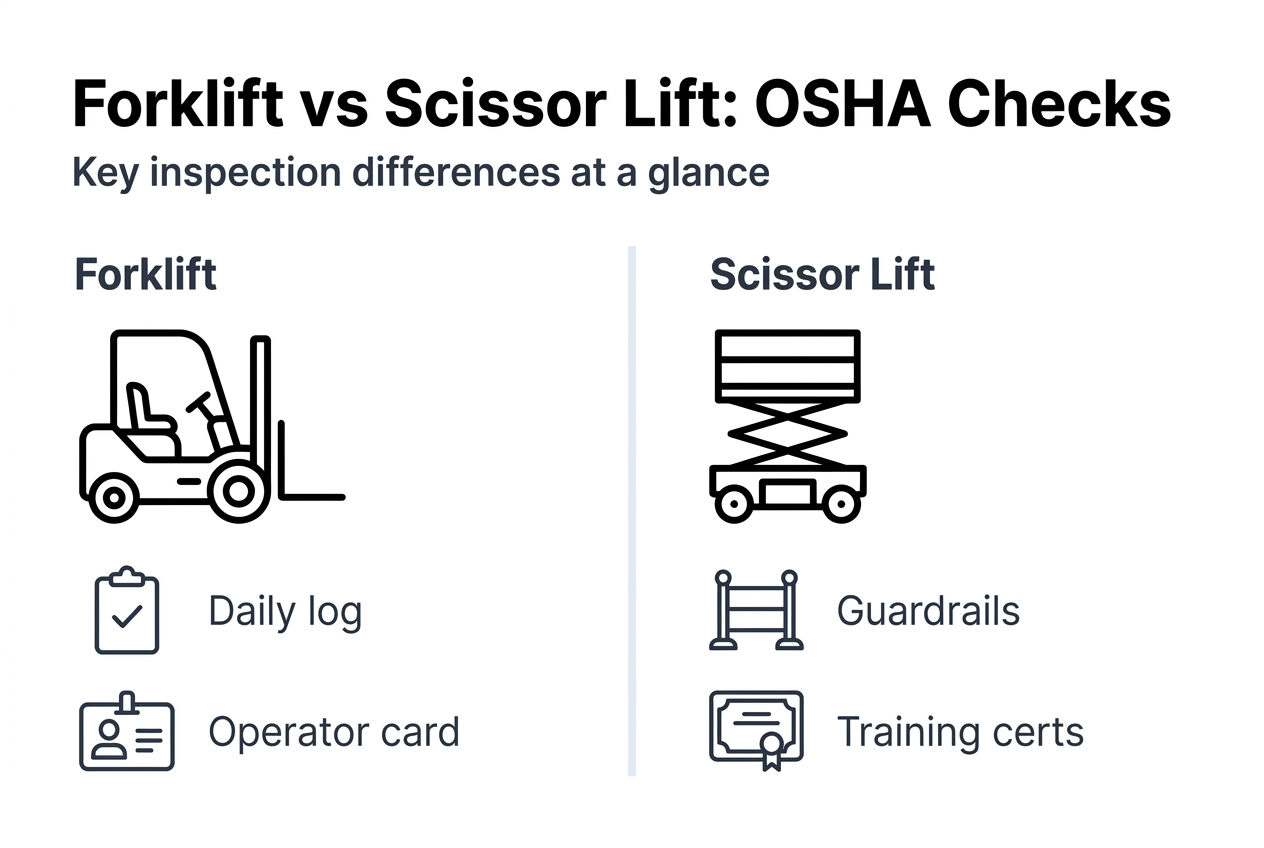
Daily pre-use inspections form the backbone of forklift compliance. Operators must examine at least 10 critical components before each shift, including brakes, steering mechanisms, warning devices, hydraulic systems, tires, and overhead guards. The catch? Visual inspections alone don’t satisfy OSHA. Daily documented inspections must be recorded with dates, operator signatures, and any deficiencies noted with corresponding corrective actions.
Required forklift inspection components:
- Brakes (service and parking)
- Steering mechanism and controls
- Warning devices (horn, lights, backup alarms)
- Hydraulic systems (lift and tilt functions)
- Tires and wheels
- Forks and carriage assembly
- Overhead guard and load backrest
- Fluid levels (fuel, oil, coolant)
- Battery condition and connections (electric models)
- Safety devices (seatbelts, deadman switches)
Operator training requirements go beyond basic operation skills. OSHA demands classroom instruction covering truck controls, load capacity, stability principles, and workplace-specific hazards. Hands-on training must demonstrate competence in actual operating conditions. Evaluations verify operators can safely perform assigned tasks. This three-part training structure isn’t optional, it’s the legal minimum detailed in the OSHA forklift compliance guide.
Refresher training becomes mandatory every three years, but that’s just the baseline. OSHA requires additional training after any accident or near-miss incident, when operators demonstrate unsafe behavior, or when equipment types change. Many warehouses fail inspections not because operators lack skills, but because training records don’t document refresher sessions or updated evaluations.
Maintenance documentation extends beyond daily checklists. Annual comprehensive inspections by qualified technicians must be recorded with detailed findings and repairs. When equipment shows defects, it must be immediately removed from service until repairs are completed and verified. The OSHA forklift training steps emphasize that training and maintenance records work together, operators need to know what to inspect and how to document findings properly.
Pro Tip: Create a simple daily inspection form that fits on a single page and store completed forms for at least three years. During inspections, OSHA often requests 12 to 24 months of daily logs to verify consistent compliance patterns. Missing even a few weeks of documentation can trigger citations.
OSHA standards governing scissor lift operations
Scissor lifts operate under different rules than forklifts, specifically 29 CFR 1910.67, which covers vehicle-mounted elevating and rotating work platforms. While the equipment differs, the compliance framework mirrors forklift requirements: daily inspections, operator training, and meticulous documentation.
Daily pre-use inspections for scissor lifts focus on platform integrity, guardrail systems, emergency controls, and stability mechanisms. Operators must verify that guardrails are intact and properly secured, control systems respond correctly, emergency lowering functions work, and there’s no visible damage to hydraulic lines or structural components. Just like forklifts, these inspections must be documented with operator identification and dates.
Critical scissor lift inspection points:
- Guardrail system (rails, mid-rails, toe boards)
- Platform surface condition and anti-slip features
- Emergency lowering and stop controls
- Hydraulic system operation and leak checks
- Stabilizers or outriggers (if equipped)
- Tire pressure and condition
- Battery charge level (electric models)
- Visual inspection for structural damage or wear
Guardrail requirements represent a frequent citation area. OSHA mandates that guardrails remain in place and functional whenever the platform is elevated. Removing or disabling guardrails to access tight spaces creates immediate fall hazards and serious violations. The scissor lift operating guidelines stress that workarounds compromising safety systems always fail compliance scrutiny.
Operator training for scissor lifts must cover safe operation procedures, load capacity limits, fall protection requirements, and emergency descent protocols. Training programs need to address workplace-specific hazards like overhead obstructions, uneven surfaces, or proximity to energized electrical systems. Evaluations must confirm operators understand these risks and can respond appropriately.
Documentation standards match forklift requirements: training certificates with operator names and dates, evaluation records showing competency assessments, and daily inspection logs spanning multiple months. Many warehouses maintain separate documentation systems for forklifts and scissor lifts, which makes sense given the different regulatory standards. The scissor lift training steps provide a structured approach to building compliant training programs that survive OSHA scrutiny.
Common OSHA violations and misconceptions
Documentation failures dominate OSHA violation lists for powered industrial trucks. Warehouses often conduct daily inspections but fail to record them properly. Operators complete training but certificates lack required elements like evaluation dates or trainer signatures. These aren’t trivial paperwork complaints, incomplete documentation means OSHA can’t verify compliance actually occurred.
The biggest misconception? That OSHA only inspects after accidents. This belief creates complacency until an unannounced inspection exposes systematic documentation gaps. Programmed inspections target warehouses regardless of accident history. Employee complaints trigger inspections even when no injuries occurred. Waiting for an incident before addressing compliance is like waiting for a fire before installing smoke detectors.
Most frequent forklift and scissor lift violations:
- Inadequate or missing operator training documentation
- Failure to conduct or document daily equipment inspections
- Operating equipment with known defects or safety system bypasses
- No refresher training after incidents or unsafe observations
- Training programs lacking required classroom, practical, and evaluation components
- Missing maintenance records or annual comprehensive inspection reports
Another dangerous misconception holds that visual inspections without documentation satisfy OSHA requirements. Inspectors don’t care what you say you do, they care what you can prove you did. A supervisor’s verbal confirmation that “we inspect equipment daily” carries zero weight without dated, signed inspection forms. The OSHA forklift compliance guide repeatedly emphasizes this documentation imperative.
Lax training updates create cascading compliance failures. Operators trained three years ago may be operating with outdated knowledge if refresher training was postponed. When equipment types change or new models arrive, additional training becomes immediately mandatory. Warehouses sometimes assume experienced operators can figure out new equipment, but OSHA demands formal training for each truck type.
Pro Tip: Conduct quarterly internal compliance audits reviewing training records, inspection logs, and maintenance documentation. Identifying gaps during self-audits gives you time to correct deficiencies before OSHA arrives. Treat these audits like practice inspections, because that’s exactly what they are.
Jurisdictional differences: US OSHA vs Canadian regulations
Cross-border operations face compliance complexity. US OSHA and Canadian provincial regulations share similar safety goals but differ significantly in inspection frequency, enforcement approaches, and documentation specifics. Warehouses operating in both countries can’t assume one compliance program covers both jurisdictions.
US OSHA inspection frequency varies widely based on industry hazard profiles, regional office priorities, and complaint activity. A warehouse might go years without an inspection or face multiple visits in a single year. This variability makes reactive compliance strategies risky. Canadian regulations in many provinces mandate more predictable schedules, with quarterly inspections required for certain lift equipment categories.
| Compliance Factor | US OSHA | Canadian Regulations |
|---|---|---|
| Inspection frequency | Variable, complaint and program driven | Often quarterly for lift equipment |
| Operator certification | Training and evaluation required | Provincial certification programs vary |
| Documentation retention | Minimum 3 years recommended | Often 5 years or equipment lifetime |
| Penalty structure | Per-violation fines, can exceed $10,000 | Provincial variation, often lower than US |
| Refresher training | Every 3 years or after incidents | Provincial requirements, often annual |
Penalty structures differ substantially. US OSHA violations carry penalties ranging from thousands to over $10,000 per serious violation, with repeat violations multiplying costs exponentially. Canadian provincial penalties tend to be lower but enforcement can include equipment seizure or operation shutdowns until compliance is achieved. Some provinces prioritize corrective action orders over fines, while others mirror OSHA’s punitive approach.
Documentation standards show important variations. Several Canadian provinces require inspection records maintained for the equipment’s operational lifetime, not just three to five years. Training certification programs may require provincial registration or approval, adding administrative layers beyond basic OSHA compliance. Binational warehouses must navigate these requirements simultaneously, often maintaining parallel documentation systems.
Companies operating in both countries should treat the stricter standard as their baseline. If Canadian regulations demand quarterly inspections while OSHA accepts less frequent schedules, implement quarterly inspections everywhere. Unified compliance programs built around the highest requirements simplify management and eliminate gaps where violations can hide.
Preparing for OSHA inspections: best practices
Inspection readiness starts with systematic preparation, not last-minute scrambling when the inspector arrives. Warehouses that maintain continuous compliance treat every day like inspection day. This mindset shift transforms OSHA visits from crisis events to routine verifications.
Pre-inspection checklists should mirror OSHA’s evaluation criteria. Review operator training files monthly to verify certificates are current, evaluations are documented, and refresher training schedules are on track. Audit daily inspection logs weekly to catch missing dates or incomplete entries. Check that equipment with documented defects was removed from service and repairs were properly recorded. The OSHA forklift inspection process guide provides detailed checklists aligned with inspector priorities.
Essential preparation steps:
- Maintain centralized training records with certificates, evaluation forms, and refresher documentation
- Store daily inspection logs in organized binders or digital systems with easy retrieval
- Create equipment maintenance files showing annual inspections and repair histories
- Post operator qualification lists in equipment storage areas
- Conduct monthly management reviews of all compliance documentation
- Schedule refresher training proactively before three-year deadlines expire
- Document all safety meetings and toolbox talks addressing powered industrial trucks
Operator training quality directly impacts inspection outcomes. Well-trained operators complete accurate daily inspections, recognize hazards before they cause violations, and respond correctly to inspector questions. Training programs should emphasize why documentation matters, not just how to fill out forms. When operators understand that inspection logs protect them and the company, compliance becomes cultural rather than procedural.
Documentation accessibility matters during inspections. OSHA inspectors have limited time and patience for disorganized record systems. Training files scattered across multiple offices, inspection logs stuffed in equipment cabs, and maintenance records buried in technician toolboxes create the appearance of poor compliance management. Centralize documentation in a single location with clear organization and quick retrieval.
Pro Tip: Designate a compliance coordinator responsible for maintaining all powered industrial truck documentation. This person becomes your first point of contact during inspections and ensures consistent record keeping. Even small warehouses benefit from assigning this role, even if it’s only 10% of someone’s job responsibilities.
Importance of operator training in OSHA compliance
Comprehensive training programs represent your strongest defense against OSHA violations and workplace injuries. Compliant training programs reduce incidents by up to 70% compared to minimal or informal instruction. This dramatic reduction isn’t coincidental, properly trained operators recognize hazards, follow safe procedures, and maintain equipment correctly.
OSHA-compliant training requires three distinct components working together. Classroom instruction builds foundational knowledge about equipment controls, load dynamics, stability principles, and workplace hazards. Hands-on practice allows operators to develop skills under supervision in actual working conditions. Evaluations verify competency before operators work independently. Skipping or shortcutting any component creates compliance gaps and safety risks.
Core training program elements:
- Formal classroom instruction covering equipment operation, safety procedures, and regulatory requirements
- Practical hands-on training in the actual work environment with qualified trainers
- Performance evaluations documenting operator competency in assigned tasks
- Refresher training every three years at minimum
- Additional training after any accident, near-miss, or unsafe operation observation
- Documentation including training dates, content covered, trainer qualifications, and evaluation results
Refresher training cycles matter more than many warehouses realize. The three-year requirement sets a maximum interval, not an optimal schedule. Leading safety programs implement annual refreshers to maintain operator awareness and update training as equipment or processes change. This proactive approach catches skill degradation before it causes incidents or violations.
Training effectiveness depends heavily on instructor quality. The OSHA forklift training steps emphasize that trainers must have knowledge, training, and experience to evaluate operator competence. Generic online videos don’t satisfy this requirement. Qualified instructors understand equipment capabilities, recognize unsafe behaviors, and can demonstrate correct techniques. Investment in trainer development pays dividends through better operator performance and stronger compliance.
“Effective operator training programs combining classroom instruction, hands-on practice, and documented evaluations create measurable reductions in equipment-related incidents while strengthening OSHA compliance outcomes.”
National Safety Council Forklift Safety Report
The scissor lift training steps follow similar principles but address equipment-specific hazards like fall protection and platform stability. Warehouses operating both forklifts and scissor lifts need separate training programs because the hazards and safety systems differ substantially. Cross-training operators on both equipment types requires distinct certification for each.
Understanding why train forklift operators transforms training from a compliance checkbox into a strategic safety investment. Trained operators cost less in equipment damage, reduce insurance premiums through better safety records, and create positive inspection outcomes that avoid penalty costs. The return on investment appears in both measurable metrics and avoided incidents.
Practical compliance solutions with Forkliftacademy.com
Maintaining OSHA compliance requires ongoing commitment, but you don’t have to build training programs from scratch. Forkliftacademy.com delivers OSHA-compliant training solutions designed specifically for warehouses managing forklift and scissor lift operations. With over 20 years of experience, their programs address the exact documentation and training requirements OSHA inspectors verify.
Their training programs include online courses for flexible scheduling and onsite options when hands-on instruction is preferred. Business packages address multiple operator certifications efficiently, while train-the-trainer courses enable companies to build internal training capacity. These solutions support the documentation rigor that transforms OSHA inspections from stressful audits into routine verifications. The forklift certification business programs provide scalable options whether you’re certifying five operators or fifty.
Frequently asked questions about OSHA inspection requirements for forklift and scissor lifts
What triggers an OSHA inspection for forklifts or scissor lifts?
OSHA inspections are triggered by three primary mechanisms: workplace accidents resulting in fatalities or hospitalizations, formal employee complaints alleging unsafe conditions, and programmed inspections targeting high-risk industries like warehousing. Warehouses using powered industrial trucks face increased inspection likelihood due to their hazard profile. Follow-up inspections also occur to verify abatement of previous violations.
How often must forklift operators undergo refresher training?
OSHA requires refresher training at least every three years. However, additional training becomes immediately mandatory after any accident or near-miss incident, when operators demonstrate unsafe behavior, or when they’re assigned to operate different equipment types. Many leading safety programs implement annual refreshers rather than waiting for the three-year maximum interval.
What documentation is required to pass an OSHA inspection?
Inspectors review operator training certificates with dates and trainer signatures, documented daily equipment inspection logs spanning multiple months, maintenance records including annual comprehensive inspections, and evaluation forms proving operator competency. Training records must show classroom instruction, hands-on practice, and performance evaluations. Missing any component can result in citations even if training actually occurred.
Are OSHA requirements the same in the US and Canada?
No, significant differences exist between US OSHA and Canadian provincial regulations. Canadian rules often mandate more frequent inspections, with some provinces requiring quarterly checks for lift equipment. Documentation retention periods may be longer in Canada, sometimes requiring lifetime equipment records. Penalty structures and enforcement approaches also vary. Warehouses operating in both countries should implement the stricter requirements as their baseline standard.
What should I do if cited during an OSHA inspection?
Respond promptly to all citations and don’t ignore deadlines. Review each violation carefully to understand the specific compliance failure. Develop and implement corrective actions immediately, documenting all steps taken. You have the right to contest citations through OSHA’s formal appeals process if you believe they’re unwarranted. Consider consulting with safety professionals or legal counsel for serious or willful violations. Most importantly, use citations as learning opportunities to strengthen overall compliance programs.
Recommended
- Forklift Inspection Requirements: Ensuring OSHA Compliance – Top Osha Forklift Certification
- Master the OSHA Forklift Inspection Process Easily – Top Osha Forklift Certification
- Forklift Safety Checklist Guide for OSHA Compliance – Top Osha Forklift Certification
- OSHA Forklift Compliance Guide for Safe Operations – Top Osha Forklift Certification