

TL;DR:
- Workplace safety in 2025 focuses on OSHA’s top cited standards, penalties, recordkeeping, and proactive hazard correction.
- Focusing safety efforts on fall protection, hazard communication, and lockout/tagout reduces enforcement risk and protects workers effectively.
Workplace safety standards in 2025 are defined by OSHA’s updated regulations, penalty increases, and a clear list of the most frequently cited violations that employers must address. OSHA’s Top 10 Most Frequently Cited Standards for FY 2025 set the compliance agenda for safety officers, HR professionals, and business leaders across every industry. Understanding these standards, the new penalty amounts, and the recordkeeping deadlines is the fastest way to reduce enforcement risk and protect your workforce. This guide covers each priority area with the specificity you need to act.
OSHA’s top 10 cited standards for FY 2025 reveal exactly where enforcement pressure lands hardest. Fall protection led the list with 6,992 citations. Hazard communication followed with 3,010, ladders with 2,842, and lockout/tagout with 2,562. These four standards alone account for a significant share of all citations issued nationwide.
The industries most exposed include construction, warehousing, manufacturing, and logistics. Workers operating at heights, handling chemicals, or working near powered equipment face the highest citation risk. For safety officers, this list is not just a report card. It is a prioritization tool.
| OSHA Standard | FY 2025 Citations |
|---|---|
| Fall protection (general requirements) | 6,992 |
| Hazard communication | 3,010 |
| Ladders | 2,842 |
| Lockout/tagout | 2,562 |
| Powered industrial trucks | Listed in top 10 |
| Respiratory protection | Listed in top 10 |
Concentrating your safety program on OSHA’s top cited hazards significantly reduces enforcement risk and improves employee safety outcomes. A generic safety program spread thin across every possible hazard misses the point. Targeted programs that address fall protection, hazard communication, and lockout/tagout deliver measurable compliance gains.
Powered industrial trucks also appear in the top 10, which directly affects warehouse and distribution operations. Safety officers in those environments should review forklift OSHA requirements as a specific compliance priority for 2025.
Pro Tip: Use the top 10 list as your audit triage checklist. Before any internal audit, pull your written programs, training records, and implementation evidence for each of these ten standards first. OSHA inspectors ask for exactly those three things.
OSHA raised its maximum penalty amounts in january 2025, and the increases are significant enough to change how safety leaders should think about risk. The updated figures are:
These numbers mean that a single unresolved serious violation, left open past its deadline, can compound daily into a six-figure liability. That changes the math on deferred corrective action.
Updated penalties in 2025 underscore the need for prompt hazard abatement and strong documentation to control risk exposure. Safety leaders who treat abatement deadlines as administrative tasks rather than financial risk events are underestimating their exposure.
Penalty exposure changes quickly after OSHA identifies hazards and sets abatement deadlines. Safety leaders should treat documentation and correction deadlines as risk management elements, not just injury prevention.
OSHA enforcement focuses on high-likelihood hazard categories, which mirrors the top 10 cited standards list. This means inspectors are not randomly sampling workplaces. They are targeting the same categories year after year. If your written program for fall protection or hazard communication is outdated, that is where an inspector will find the gap.
Pro Tip: Build abatement deadlines into your safety management calendar the same way you track financial reporting deadlines. Assign an owner, set a completion date, and document the corrective action taken. That paper trail is your defense if OSHA returns.
OSHA recordkeeping compliance rests on three forms with distinct roles. The Form 300 is the injury and illness log, updated throughout the year. The Form 301 is the incident report completed within seven days of each recordable event. The Form 300A is the annual summary, which pulls data from the Form 300 and must be posted in the workplace.
Employers must post Form 300A annually from february 1 to april 30. The summary must be certified by a company executive and displayed where employees can see it. Records must be retained for five years. Missing the posting window or skipping the certification step are the most common compliance failures, even among organizations that maintain accurate internal logs.
Certain employers must electronically submit their 300A data through OSHA’s Injury Tracking Application (ITA) by march 2, 2026 for calendar year 2025 data. The ITA submission requirement applies to establishments above specific size thresholds and in designated high-hazard industries. Check your establishment’s coverage status before the deadline.
Steps to maintain recordkeeping compliance:
Pro Tip: Many organizations fail not because their logs are wrong, but because posting and certification steps get skipped during busy periods. Automate the reminder and assign a backup owner so the february 1 deadline never slips.
OSHA’s On-Site Consultation Program is a free, confidential service that sends safety professionals to your workplace to identify hazards and recommend corrections. Critically, consultation visits do not trigger citations and are completely separate from enforcement inspections. This distinction makes the program one of the most underused tools available to safety officers.
The program is designed primarily for small businesses, but the principles apply broadly. A consultant visits your site, reviews your safety programs, and identifies hazards. You receive a written report. No citations are issued, and OSHA enforcement is not notified.
Treating OSHA consultation results as formal corrective action projects with timeline management ensures compliance gains and reduces the risk of later citations. The mistake most safety teams make is filing the consultation report and moving on. The right approach is to assign each finding an owner and a deadline, then track completion the same way you would track any other project.
Advantages of using the On-Site Consultation Program:
Pro Tip: Schedule a consultation visit before you expand operations, add new equipment, or bring on a new workforce segment. New activities introduce new hazards, and catching them early is far cheaper than addressing them after an inspection.
Effective compliance with 2025 workplace safety guidelines requires four parallel workstreams: written programs, training, documentation, and hazard control. Safety officers who treat these as separate projects instead of an integrated system create gaps that inspectors find quickly.

Written safety programs must address each of OSHA’s top cited standards by name. A generic safety manual does not satisfy the requirement for a specific written program on hazard communication or lockout/tagout. OSHA inspectors look beyond documentation to assess actual workplace implementation, including recent training records and real-time evidence of procedure application.
Training records must show who was trained, when, what was covered, and who delivered the training. The trainer’s qualifications matter. If your trainer cannot demonstrate competency in the subject matter, the training record loses its value as compliance evidence. For powered industrial truck operations, this means your trainer must be certified to evaluate operators, not just deliver classroom content. Forkliftacademy’s warehouse safety compliance resources cover this distinction in detail.
| Compliance action | Recommended frequency |
|---|---|
| Written program review | Annually or after any incident |
| Employee safety training | Annually and at onboarding |
| Internal hazard assessment | Quarterly |
| OSHA Form 300 log review | Monthly |
| Emergency response drill | Twice per year |
Hazard assessments should be tied directly to the top 10 cited standards. Walk your facility with the list in hand. Identify where fall protection, ladder safety, and lockout/tagout procedures are applied and where they are missing. Document what you find and what you corrected.
Pro Tip: Build your compliance calendar around OSHA’s enforcement priorities, not your own comfort level. If fall protection is the most cited standard nationally, it should be the first item on your internal audit checklist every single year.
Workplace safety compliance in 2025 requires targeting OSHA’s most cited standards, meeting updated penalty and recordkeeping deadlines, and using consultation proactively to correct hazards before enforcement finds them.
| Point | Details |
|---|---|
| Top cited standards drive risk | Fall protection, hazard communication, and lockout/tagout generate the most citations and should anchor your safety program. |
| Penalties increased in 2025 | Willful or repeated violations now reach $165,514 per violation, making prompt abatement a financial priority. |
| Recordkeeping has hard deadlines | Post Form 300A by february 1, certify it, and submit electronically via ITA by march 2, 2026 for 2025 data. |
| Consultation is citation-free | OSHA’s On-Site Consultation Program identifies hazards without triggering enforcement, making it a low-risk audit tool. |
| Training records must show implementation | Written programs and training logs must be backed by real-time evidence of procedure application to satisfy inspectors. |
After years of working with safety programs across industries, the pattern I see most often is not ignorance of OSHA standards. It is the gap between documentation and implementation. Organizations spend significant time building written programs and training records, then fail to verify that those programs are actually being followed on the floor.
OSHA inspectors are trained to spot this gap. They ask for your written fall protection program, then they walk the facility and look for evidence that workers are actually using it. If the program says workers must use personal fall arrest systems above six feet and the inspector sees workers at eight feet without them, the written program becomes evidence against you, not for you.
The 2025 penalty increases make this gap more expensive than ever. A willful violation, defined as one where the employer knew about the hazard and failed to correct it, now carries a maximum of $165,514. A documented but unimplemented safety program is exactly the kind of evidence OSHA uses to establish willful knowledge.
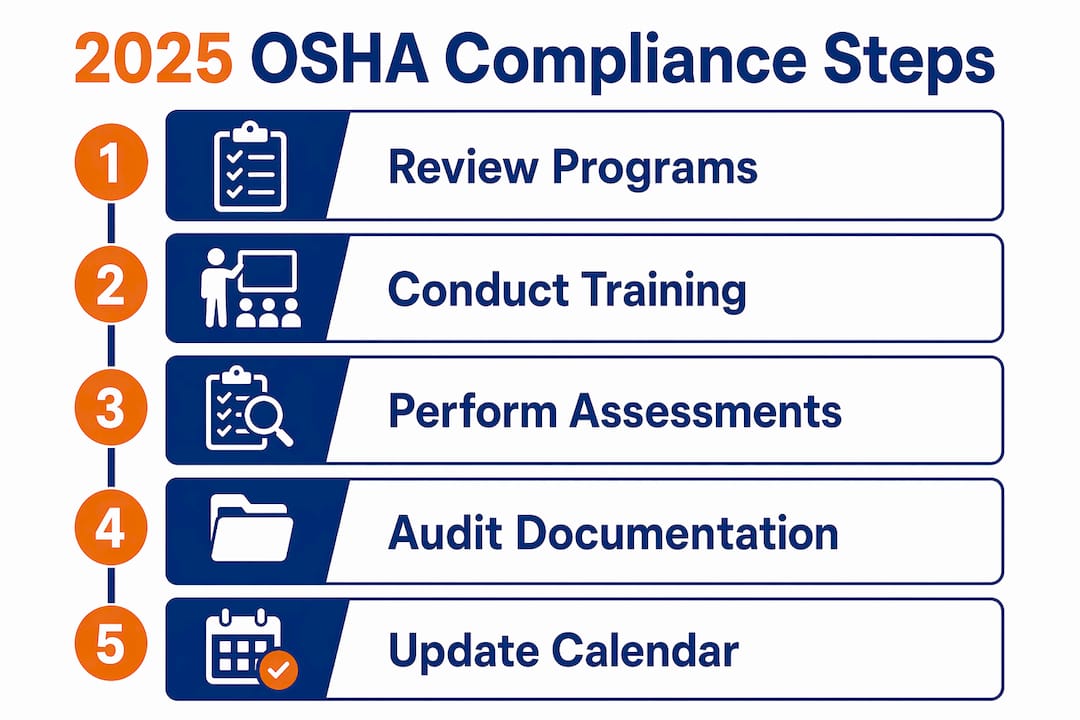
My advice is direct: audit implementation, not just paperwork. Walk the floor with your top 10 checklist. Watch what workers actually do. Fix what you see before an inspector does. The OSHA compliance steps for 2025 are not complicated. The discipline to follow through on them consistently is where most programs fall short.
— Juiced
Powered industrial trucks appear in OSHA’s top 10 most cited standards every year. Meeting that standard requires certified trainers who can evaluate operators, not just deliver a lecture.
Forkliftacademy offers a Train the Trainer Online program that certifies your in-house trainers to deliver OSHA-compliant forklift safety training and operator evaluations. With over 20 years of experience and locations across the United States and Canada, Forkliftacademy also provides forklift certification for businesses that need to bring their entire workforce into compliance quickly. Both programs are built around OSHA’s powered industrial truck standard and designed to hold up under inspection.
Fall protection led with 6,992 citations, followed by hazard communication at 3,010, ladders at 2,842, and lockout/tagout at 2,562. These four standards represent the highest enforcement risk for most employers.
Serious violations carry a maximum of $16,550 per violation. Willful or repeated violations reach $165,514, and failure to abate costs $16,550 per day beyond the correction deadline.
Employers must post Form 300A from february 1 through april 30 each year. The summary must be certified by a company executive and displayed where employees can read it.
Covered establishments must submit their 2025 injury and illness data through OSHA’s Injury Tracking Application by march 2, 2026.
No. Consultation visits are confidential and completely separate from enforcement. No citations are issued, and OSHA enforcement is not notified of the visit or its findings.