


TL;DR:
- Effective onsite forklift training involves careful preparation of participant documentation, equipment verification, and scheduling with certified trainers. Proper coordination ensures OSHA compliance, safety, and minimizes operational disruptions during training days. Post-training follow-up records, assessments, and refresher schedules are essential for maintaining long-term safety and regulatory adherence.
Onsite forklift training is the process of delivering OSHA-compliant powered industrial truck instruction at your facility, using your actual equipment and workforce. Knowing how to schedule onsite forklift training correctly is the difference between a compliant, well-prepared team and a costly regulatory violation. The scheduling process involves coordinating certified trainers, verifying participant documentation, preparing your training area, and aligning the program with your operational calendar. This guide gives you a step-by-step onsite training workflow built for safety officers, operations managers, and HR teams responsible for keeping their workforce certified in 2026.
Preparation is the most overlooked part of the scheduling process. Companies that skip it face delays, incomplete certifications, and OSHA audit exposure. Before you contact a trainer or pick a date, work through this checklist.
Identify eligible participants and verify documentation. Participants must provide consistent ID on training day to participate, often through a 100-point ID verification system in certain jurisdictions. Collect employee names, job titles, and equipment types operated well in advance so your trainer can prepare the right curriculum.
Assess and confirm your equipment. Training on inappropriate equipment leads directly to compliance and safety risks. Every operator must be trained and evaluated on the exact model they use daily, whether that is a counterbalance forklift, reach truck, or order picker.
Here is a preparation checklist to complete before booking:
Pro Tip: Send a written notification to all department supervisors at least one week before training day. This gives them time to adjust shift coverage and prevents last-minute operational conflicts.
Advance coordination of training dates and equipment availability is a non-negotiable prerequisite for a smooth training day. Skipping this step is the single most common reason companies reschedule at the last minute.
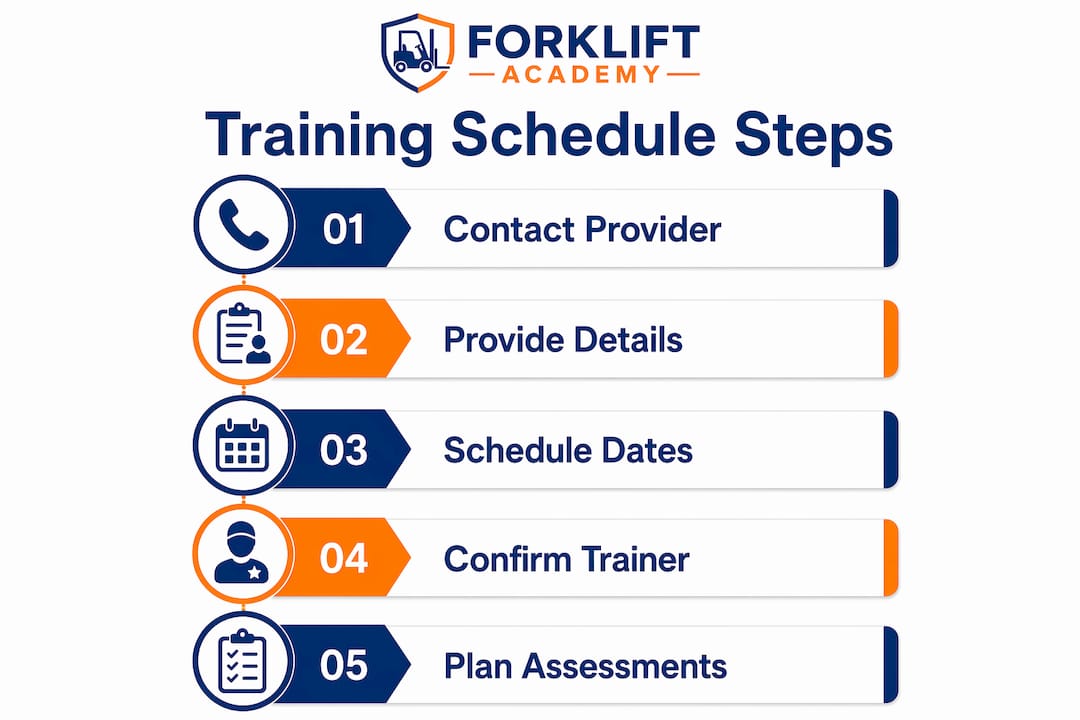

Once your prerequisites are in order, the actual scheduling process follows a clear sequence. Each step builds on the last, so do not skip ahead.
Step 1: Contact a certified, OSHA-compliant training provider. Verify that the provider delivers instruction aligned with OSHA 29 CFR 1910.178(l), the federal standard governing powered industrial truck operator training. Forkliftacademy, for example, has over 20 years of experience delivering OSHA-compliant forklift certification programs across the United States and Canada.
Step 2: Provide your training details. Give the provider the number of participants, the specific forklift models involved, your facility address, and any site-specific hazards. The more detail you share upfront, the more tailored the training will be.
Step 3: Agree on dates and times. Onsite training can be scheduled any day of the week, giving you the flexibility to work around production schedules, shift rotations, or seasonal demand peaks. Choose a time slot that minimizes disruption to your core operations.
Step 4: Confirm trainer qualifications and equipment compatibility. Ask specifically whether the trainer has experience with your forklift models. A trainer unfamiliar with a particular machine cannot deliver a credible practical assessment.
Step 5: Plan for assessments and certification timing. A typical training day includes practical operation, safety lectures, pre-operation inspections, and a final evaluation. Build enough time into your schedule for all components, not just the classroom portion.
Here is a quick reference for what to provide when booking:
| Information Needed | Why It Matters |
|---|---|
| Number of participants | Determines trainer-to-student ratio and session length |
| Forklift models in use | Ensures curriculum and assessment match actual equipment |
| Facility address and layout | Allows trainer to prepare site-specific safety content |
| Preferred dates and shift times | Confirms scheduling flexibility and trainer availability |
| PPE and equipment status | Confirms training area readiness before arrival |
Pro Tip: Book your training session at least two weeks out. Last-minute bookings limit your choice of trainers and reduce the time available for proper site preparation.
Even well-organized companies run into problems on training day. Knowing what to expect lets you address issues before they derail the session.
“The most preventable training failures come from poor internal communication, not from the training itself. When supervisors do not know the schedule, equipment disappears, participants show up late, and the whole day falls apart.” — Common observation from experienced onsite training coordinators
Here are the most frequent challenges and how to address each one:
Addressing these challenges in advance is what separates a productive training day from a wasted one.
Training does not end when the instructor leaves. The follow-up phase determines whether your investment translates into lasting compliance and safer operations.
Confirm all assessments are complete and documented. Operators must complete practical assessments and receive certification confirming compliance with OSHA forklift operator training requirements. Any participant who did not pass needs a clear remediation plan, not just a note in a file.
Collect structured feedback from participants and supervisors. Ask operators what was unclear, what felt rushed, and whether the training reflected their actual daily tasks. This feedback directly improves your next forklift certification course scheduling process.
Maintain training records for OSHA audits. Keep copies of completion certificates, assessment scores, and trainer credentials in a centralized file. OSHA inspectors can request these records at any time, and disorganized documentation is treated the same as missing documentation.
Schedule refresher training proactively. OSHA requires retraining when an operator is observed operating unsafely, is involved in an accident, or receives an evaluation that reveals deficiencies. Beyond those triggers, best practice is to schedule a refresher every three years. Build these dates into your compliance calendar now, not after an incident.
Here is a post-training follow-up checklist:
The role of onsite forklift training extends beyond the training day. Consistent follow-up is what converts a one-time event into a sustained safety culture.
Scheduling onsite forklift training requires advance preparation, certified trainer coordination, and structured follow-up to achieve lasting OSHA compliance.
| Point | Details |
|---|---|
| Prepare before you book | Compile participant lists, confirm equipment, and verify PPE before contacting a trainer. |
| Match training to actual equipment | Operators must be trained on the exact forklift models they use daily to meet OSHA standards. |
| Use a structured booking process | Provide participant count, equipment types, and facility details when scheduling the session. |
| Communicate internally | Notify supervisors and staff at least one week out to prevent operational disruptions. |
| Follow up with documentation | File certificates and assessment records immediately and schedule refresher training in advance. |
Most safety managers I have spoken with treat scheduling as the first step. They call a trainer, pick a date, and then scramble to get everything else in order. That approach creates exactly the problems described above: missing IDs, unavailable equipment, and supervisors who had no idea training was happening.
The companies that run the smoothest training days treat scheduling as the last step in preparation, not the first. They spend a week getting their participant list clean, walking the training area, and confirming their equipment is ready. Then they call the trainer. The booking call takes ten minutes because every question the trainer asks has already been answered.
There is also a tendency to underestimate the value of training on your own equipment in your own facility. Real-world applicability improves operator competence in ways that generic classroom training simply cannot replicate. An operator who has been evaluated on the specific reach truck in Bay 3 of your warehouse is a fundamentally different safety asset than one who passed a generic course on a different machine in a different building.
My strongest recommendation: treat your first onsite training session as a pilot. Document everything, collect feedback aggressively, and use that data to build a repeatable scheduling template your team can run without you. That is how you build a safety culture rather than just checking a compliance box.
— Juiced
Forkliftacademy delivers OSHA-compliant onsite forklift training programs customized to your facility, your equipment, and your workforce. With over 20 years of industry experience and training locations across major U.S. cities, Forkliftacademy makes it straightforward to book certified forklift training for your team without the guesswork.
Whether you need to certify a single operator or train an entire warehouse crew, Forkliftacademy’s expert instructors handle the curriculum, assessments, and certification documentation. For organizations that want to build internal training capacity, the Train the Trainer online program gives your designated trainers everything they need to run compliant sessions in-house. Start your scheduling process today and get your team certified on the equipment they actually use.
A standard onsite forklift training session covers safety lectures, pre-operation inspections, practical operation on your equipment, and a final evaluation. Operators who pass receive certification documenting OSHA compliance.
Book at least two weeks before your target training date. This gives you time to prepare participant documentation, confirm equipment availability, and notify your staff of schedule changes.
Group size depends on the number of trainers and available equipment, but most providers recommend no more than 6–8 operators per trainer per day to allow adequate time for individual practical assessments.
Participants must present identification that matches their enrollment documentation. Many jurisdictions use a 100-point ID verification system, so confirm the specific requirement with your training provider when booking.
OSHA mandates retraining when an operator is observed operating unsafely, is involved in an accident, or fails an evaluation. Beyond those triggers, scheduling a refresher every three years is the recognized best practice for maintaining ongoing compliance.