


TL;DR:
- Passing the forklift test requires demonstrating safe operation, knowledge of OSHA standards, and controlled driving skills. Preparation involves understanding the exam format, practicing safety procedures aloud, and focusing on procedural accuracy rather than speed. Retakes are available and feedback helps improve performance for successful certification.
Passing the forklift test means demonstrating safe operation, accurate knowledge of OSHA standards, and controlled driving skills under direct evaluation. The certification process, formally called a forklift operator evaluation, combines a written exam and a hands-on practical assessment. Both parts carry equal weight. Most candidates who fail do so not from lack of driving ability but from skipping safety steps or misreading written questions. This guide breaks down exactly how to pass the forklift test on your first attempt, with updated 2026 evaluation standards and insider strategies that go beyond generic advice.
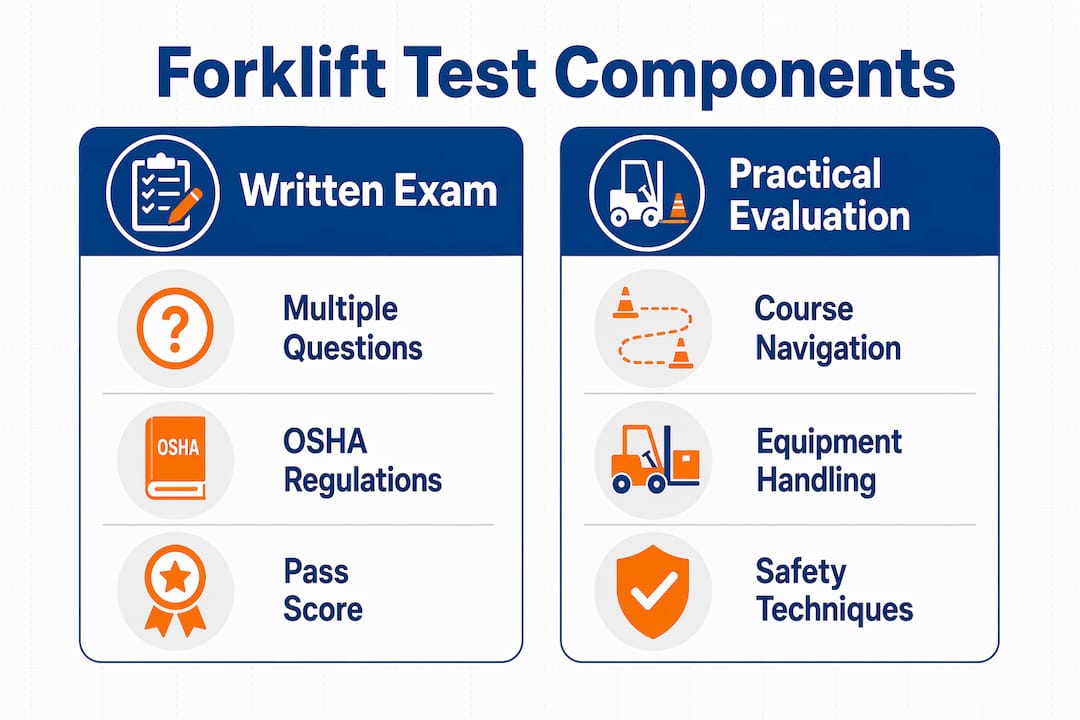
The forklift certification exam has two distinct components, and understanding both is the fastest way to prepare.
Written Exam
The written portion covers OSHA regulations, load capacity, pre-operation inspection steps, and workplace safety rules. Most written exams contain 20–50 multiple-choice questions, with a passing score between 70% and 80%. That means you can miss a handful of questions and still pass. The test typically runs 30–60 minutes. Time pressure is rarely the issue. Misreading safety-specific language is.
Practical Evaluation
The practical portion requires you to operate a forklift through a set course while an examiner scores your technique, safety habits, and procedural accuracy. You will perform a pre-operation inspection, drive with a load, navigate turns and tight spaces, and execute a proper shutdown. Examiners score consistency, not just whether you complete the task.
| Component | Details |
|---|---|
| Written exam length | 20–50 multiple-choice questions |
| Passing score | 70%–80% correct answers |
| Test duration | 30–60 minutes for written portion |
| Practical evaluation focus | Inspection, load handling, maneuvering, shutdown |
| Automatic fail triggers | Seatbelt violations, dropped loads, hitting cones or pedestrians |
Initial attempt failure rates hover around 10–15%. That number is low enough to be encouraging, but high enough to take preparation seriously. Retakes are typically available the same day or the next day, so a first-attempt fail is not a career setback. It is a diagnostic.
Preparation for the forklift certification test is not about cramming. It is about building the right habits before you walk into the evaluation.
Study materials that actually work:
What to bring on test day:
Arriving 30 minutes early gives you time to observe the test equipment, ask clarifying questions, and settle your nerves before the clock starts. Candidates who rush in at the last minute make avoidable mistakes in the first five minutes of the practical.
Pro Tip: When reading written exam questions, scan for words like “always,” “never,” and “only.” Safety qualifiers like these signal the correct answer in confusing multiple-choice scenarios. The right answer in a safety context is almost always the most cautious one.
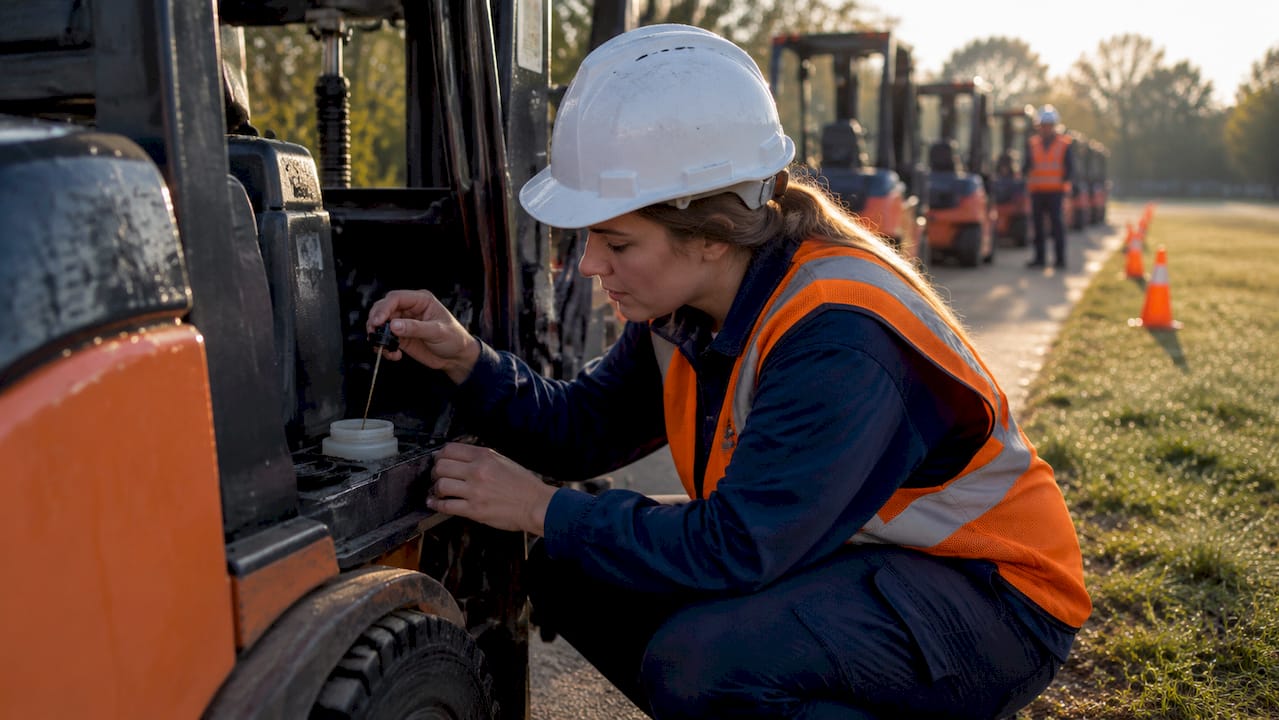
The practical test is where most candidates lose points. The driving itself is rarely the problem. The procedural steps before and after driving are where examiners find failures.
Follow this sequence to cover every scored element:
Conduct the pre-operation inspection out loud. Walk around the forklift and verbalize each check: tires, forks, fluid levels, lights, horn, and seatbelt. Practicing inspection steps aloud helps you internalize the procedure and prevents critical omissions under pressure. Examiners notice when you skip the engine compartment or rush the fluid check.
Mount correctly and buckle up immediately. Use three-point contact when climbing into the cab. Fasten your seatbelt before touching the controls. Traveling without a seatbelt is an automatic failure regardless of how well you drive the rest of the course.
Keep forks at the correct travel height. Forks should be 6–8 inches off the ground while traveling. Raising them higher shifts the center of gravity and signals poor load management to the examiner.
Control your speed deliberately. Examiners prefer smooth, controlled operation over speed. Rushing is one of the top failure causes. Treat every turn, stop, and load placement as a scored moment.
Handle pedestrian scenarios by the book. Stop when a pedestrian is within 10 feet of your path. Make eye contact. Use your horn at every blind intersection. This is heavily emphasized in 2026 evaluations, and missing it costs points fast.
Execute the shutdown sequence exactly. The correct order is: forks down, neutral, parking brake, key off, three-point exit. Memorizing this shutdown sequence and performing it without hesitation shows examiners you have internalized OSHA-compliant procedure.
Pro Tip: Before the practical begins, ask your examiner one clarifying question about the course layout or load placement expectations. This shows professionalism and gives you a mental map of what is coming. Examiners respond well to candidates who demonstrate situational awareness before the engine starts.
Understanding the failure patterns is as useful as knowing the correct procedures. Most candidates who fail share the same handful of habits.
The most common failure causes:
If you fail, treat it as a diagnostic tool. Ask your evaluator to walk through the specific criteria you missed. Targeted review after a failure leads to near-certain success on the retake. Candidates who approach the retake with focused improvement on their weak areas pass at a significantly higher rate than those who simply repeat the same preparation. You can also review Forkliftacademy’s forklift tips and tricks to sharpen specific operational skills before your next attempt.
Passing the forklift certification test requires mastering the pre-operation inspection sequence, understanding OSHA safety rules, and executing controlled, deliberate operation throughout the practical evaluation.
| Point | Details |
|---|---|
| Know the test format | Written exams have 20–50 questions; passing requires 70%–80% correct answers. |
| Prepare with the right tools | Use OSHA standards, practice tests, and inspection checklists as your core study materials. |
| Nail the practical sequence | Inspect aloud, buckle up first, control speed, and complete the full shutdown procedure. |
| Avoid automatic failures | Never travel without a seatbelt, drop a load, or skip pedestrian clearance checks. |
| Use failure constructively | Ask evaluators for specific feedback and focus retake prep on the exact criteria you missed. |
The candidates who fail are rarely bad drivers. They are candidates who trained for the driving and forgot to train for the procedure. I have seen experienced warehouse workers fail because they skipped the engine compartment check or forgot three-point contact on the exit. The examiner does not care how smoothly you handled the load if you climbed out of the cab wrong.
The mindset shift that changes everything is this: stop thinking of the forklift test as a driving test. Think of it as a safety behavior audit. Every step of the inspection, every horn use at a blind corner, every deliberate stop near a pedestrian is a scored safety behavior. Speed is irrelevant. Consistency is everything.
Muscle memory is your best preparation tool. Run the inspection sequence ten times before your test date. Say it out loud. Walk through the shutdown steps without looking at your notes. When you are in the cab with an examiner watching, your brain will default to what it has practiced most. Make sure what it defaults to is the correct OSHA sequence, not a shortcut.
One more thing: if you fail, do not treat it as a verdict on your ability. The forklift certification process is designed to be passed. The failure rate is 10–15%, not 50%. Use the evaluator’s feedback, fix the specific gap, and come back sharper. That is exactly how the system is supposed to work.
— Juiced
Forkliftacademy has delivered OSHA-compliant forklift certification programs for over 20 years across the United States and Canada. Whether you prefer to study online or need hands-on onsite forklift training at a physical location, Forkliftacademy has a format that fits your schedule and learning style. Programs are built around the exact evaluation criteria covered in this guide, so you train for what actually gets scored.
Start your path to certification today through Forkliftacademy’s OSHA forklift certification program. You will get structured training, practice materials, and a clear path to your operator card.
Most forklift written exams require a score between 70% and 80% to pass. The exam typically contains 20–50 multiple-choice questions covering OSHA regulations, load handling, and pre-operation inspection procedures.
Automatic failures are issued for safety-critical violations including traveling without a seatbelt, dropping a load, hitting cones or pedestrians, and performing an improper exit from the cab.
Practice the full pre-operation inspection sequence out loud until it is automatic. Memorize the OSHA shutdown steps: forks down, neutral, parking brake, key off, and three-point exit.
Yes. Retakes are typically available the same day or the next day. Ask your evaluator for specific feedback on what you missed, then focus your practice on those exact criteria before retesting.
The written portion runs approximately 30–60 minutes. The practical evaluation time varies by facility, but most candidates complete both components within a half day.