

TL;DR:
- Lift safety prevents injuries, fatalities, and equipment failures during lifting operations in workplaces.
- Implementing proper training, equipment safeguards, and regular inspections enhances operational efficiency and compliance.
Lift safety is the practice of protecting workers and equipment during lifting operations to prevent injuries, equipment failures, and regulatory violations. Back injuries alone account for 1 in 5 work-related injuries and illnesses in the United States, making lifting one of the most hazardous routine tasks in any warehouse or industrial facility. OSHA, ISO, and state-level agencies have built entire compliance frameworks around this reality. Whether your team operates forklifts, scissor lifts, aerial work platforms, or goods lifts, understanding why lift safety matters is the first step toward protecting your people and your bottom line.
Lift safety is important because it directly prevents the injuries, fatalities, and financial losses that result from uncontrolled lifting operations. The risks are not theoretical. Proper lifting procedures reduce the frequency of injuries, unplanned absences, and the cascading costs that follow a single serious incident. For warehouse managers and safety professionals, the stakes include workers’ compensation claims, OSHA citations, legal liability, and the human cost of a preventable injury.
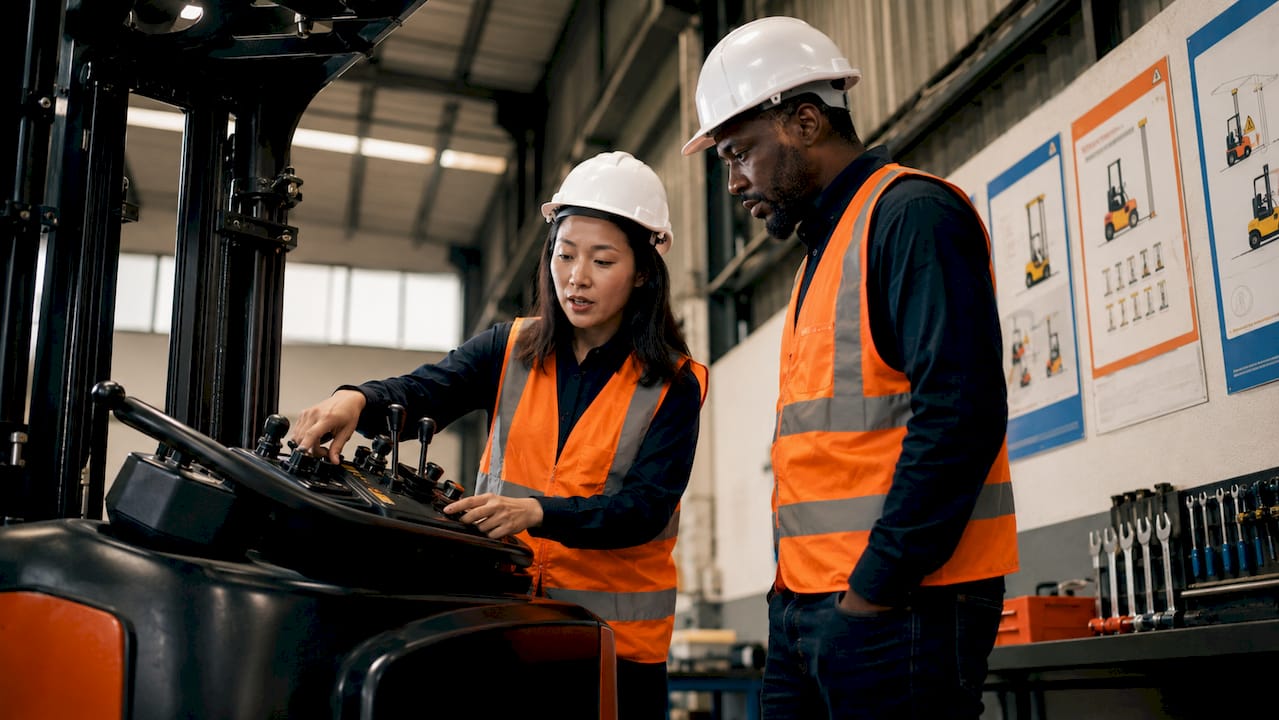
The equipment involved raises the stakes further. Forklifts, scissor lifts, aerial lifts, and goods lifts all introduce mechanical hazards that manual handling alone does not. A forklift collision, a fall from an elevated platform, or a crush injury from a goods lift without proper guarding can result in permanent disability or death. These are not edge cases. They are documented, recurring events across distribution centers, manufacturing plants, and construction sites throughout North America.
Regulatory frameworks exist precisely because voluntary compliance has never been sufficient. OSHA’s powered industrial truck standard (29 CFR 1910.178) and its aerial lift requirements under 29 CFR 1926.453 set minimum thresholds for training, inspection, and equipment condition. Ignoring these standards exposes employers to fines that can reach tens of thousands of dollars per violation. The importance of lift safety is therefore both a moral obligation and a legal one.
The hazards associated with lifting operations fall into two broad categories: manual lifting injuries and mechanical equipment failures. Both are preventable with the right protocols in place.
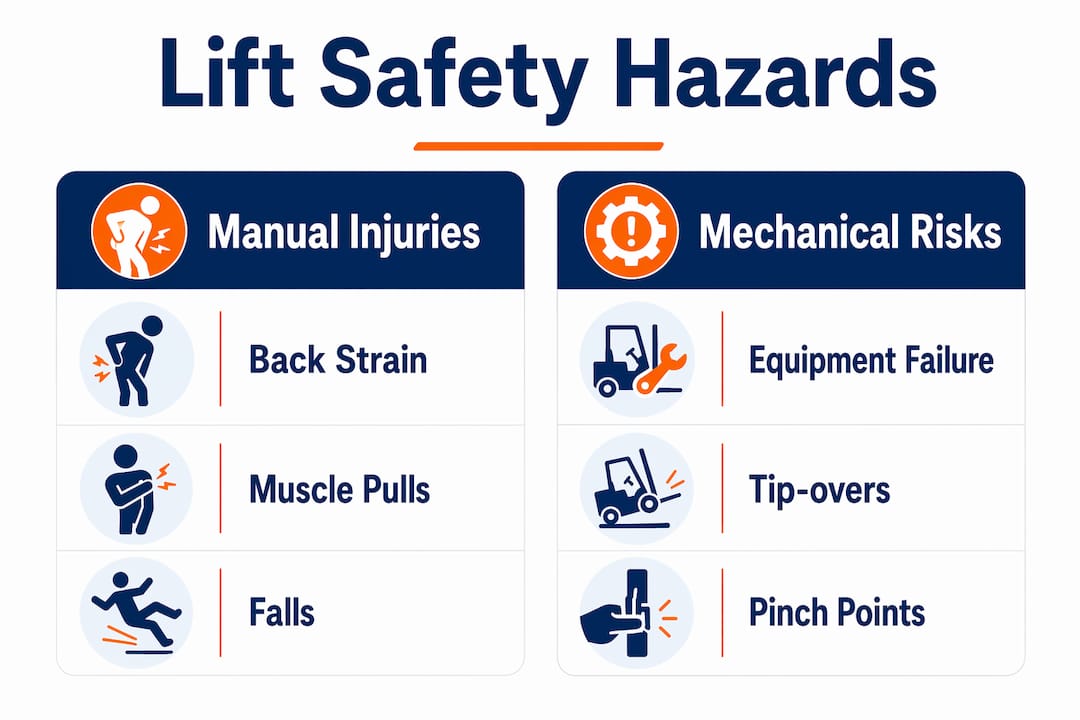
Manual lifting generates musculoskeletal disorders, particularly in the lower back, shoulders, and knees. These injuries develop gradually and are often underreported until they become chronic. The cumulative cost to employers, through lost productivity, medical treatment, and modified duty arrangements, is substantial.
Mechanical lifting equipment introduces a separate set of hazards:
Different lift types carry different risk profiles. Scissor lifts are stable on flat surfaces but tip easily on uneven ground. Aerial boom lifts expose operators to electrocution risks near overhead power lines. Goods lifts in mezzanine warehouses create fall and entrapment hazards if not properly enclosed. Recognizing these distinctions is the foundation of any effective forklift incident prevention strategy.
Pro Tip: Conduct a lift-type-specific hazard assessment for every piece of lifting equipment in your facility. A single generic risk assessment misses the specific failure modes of each machine.
Lift safety is not only about preventing harm. It is a direct driver of operational performance. Facilities that invest in proper equipment, training, and maintenance consistently outperform those that treat safety as a compliance checkbox.
The efficiency gains from mechanical lifting solutions are measurable. Pillar lifts cut repositioning cycle times from 60 to 90 seconds with ladders down to 12 to 20 seconds with joystick-driven lifts. That difference compounds across hundreds of daily cycles into significant labor savings. The same study found that replacing two-person ladder tasks with single-operator pillar lifts saves over 100 labor hours annually, with a payback period well inside the first year.
Consider the hidden costs of unsafe lift practices:
Worker confidence is also a measurable factor. Operators who trust their equipment and understand their safety protocols work faster and with greater accuracy. Fear of equipment failure or injury slows decision-making and reduces throughput.
Pro Tip: Track near-miss incidents alongside recordable injuries. Near-misses are leading indicators of future accidents and reveal systemic hazards before they cause harm.
| Efficiency factor | Impact of strong lift safety |
|---|---|
| Cycle time reduction | Mechanical lifts cut repositioning time by up to 75% vs. ladders |
| Labor hours saved | Over 100 hours annually per replaced ladder task |
| Downtime reduction | Fewer incidents mean fewer unplanned operational stops |
| Insurance costs | Lower incident rates reduce workers’ compensation premiums |
OSHA and ISO set the primary compliance benchmarks for lift safety in North American and international workplaces. Understanding both frameworks is non-negotiable for safety professionals managing mixed equipment fleets.
OSHA’s key lift-related standards include:
Operator training and OSHA aerial lift compliance significantly reduce incidents and maximize equipment uptime. This is not a correlation. It is a direct causal relationship documented across OSHA enforcement data.
On the international side, ISO 8100-1:2026 standardizes safety rules for passenger and goods lifts, covering design requirements that protect users, maintenance inspectors, and bystanders. Facilities operating goods lifts on warehouse mezzanines should treat ISO 8100-1:2026 as a design and inspection reference even where it is not legally mandated.
Compliance is not a one-time event. It requires documented training records, scheduled equipment inspections, and a process for removing unsafe equipment from service. The OSHA forklift compliance checklist approach, where every inspection item is recorded and signed off, creates the paper trail that protects employers during OSHA audits and litigation. Lift safety training is the mechanism that turns regulatory requirements into daily operator behavior.
Lift accident prevention requires layered controls. No single measure is sufficient on its own. The most effective programs combine equipment design, physical safeguards, operator training, and scheduled maintenance.
Equipment and design controls:
Full enclosures and interlocked gates on goods lifts create a fail-safe safety zone that prevents falls, falling goods, and crush injuries in warehouse settings. The critical insight here is that physical protective systems eliminate reliance on operator memory, providing consistent protection regardless of fatigue, distraction, or experience level. Emergency stop buttons, load sensors, and anti-fall devices belong on every piece of mechanical lifting equipment.
Inspection and maintenance:
Daily pre-use inspections catch hydraulic leaks, brake failures, and tire damage before they cause incidents. Annual third-party inspections verify structural integrity and compliance with manufacturer specifications. Removing a forklift from service for a $200 repair prevents a $200,000 incident.
Training and certification:
Lift safety training is the bridge between written procedures and actual operator behavior. Certified operators understand load capacity limits, travel speed restrictions, and the specific hazards of their equipment type. Forkliftacademy offers OSHA-compliant certification for forklifts and scissor lifts, covering both the knowledge and practical evaluation components that OSHA requires.
Pro Tip: Refresh operator training after any incident, near-miss, or observed unsafe behavior. OSHA requires retraining in these circumstances, and the timing reinforces the lesson when it is most relevant.
Lift safety protects workers, satisfies OSHA and ISO requirements, and directly reduces the operational costs that accumulate from accidents, downtime, and equipment damage.
| Point | Details |
|---|---|
| Injury frequency is high | Back injuries account for 1 in 5 workplace injuries, making lift safety a top priority. |
| Mechanical lifts outperform ladders | Pillar lifts cut cycle times by up to 75% and save over 100 labor hours annually. |
| Compliance is mandatory | OSHA standards 29 CFR 1910.178 and 1926.453 require documented training and regular inspections. |
| Physical safeguards beat memory | Interlocked gates and full enclosures provide consistent protection independent of operator behavior. |
| Training drives behavior | OSHA-compliant lift safety training is the most direct way to reduce incident rates. |
Most safety professionals I have worked with understand the injury prevention argument for lift safety. What gets underestimated is the operational case. Facilities that treat safety investment as a cost center are measuring the wrong thing. The ROI from replacing ladders with mechanical lifts, from certifying every operator, and from installing interlocked enclosures on goods lifts does not show up only in the accident column. It shows up in cycle times, labor hours, insurance premiums, and equipment longevity.
The misconception I see most often is that safety and speed are in tension. They are not. A certified operator on a well-maintained forklift moves more product per shift than an untrained operator on a machine with deferred maintenance. The data on pillar lifts versus ladders makes this concrete: a 75% reduction in repositioning time is not a safety benefit. It is a throughput benefit that also happens to eliminate a fatal fall hazard.
The other underestimated factor is the shift from behavior-based to design-based safety. Relying on operators to remember every procedure, every time, under every condition is a system designed to fail. Physical barriers, interlocks, and sensors remove the human memory variable from the equation. ISO 8100-1:2026 and OSHA both push in this direction, and the facilities that adopt this mindset ahead of regulatory pressure gain a competitive advantage.
My honest recommendation: audit your current lift safety program not just for compliance gaps but for efficiency gaps. You will likely find both in the same places.
— Juiced
Forkliftacademy has delivered OSHA-compliant forklift and scissor lift certification programs for over 20 years, serving individual operators and enterprise warehouse teams across the United States and Canada. Whether you need online certification for a single operator or an onsite train-the-trainer program for your entire facility, Forkliftacademy provides the documentation, evaluation tools, and compliance support your team needs. Start with OSHA forklift certification to meet 29 CFR 1910.178 requirements, or explore scissor lift certification for aerial work platform operators. Both programs include the operator evaluation records OSHA requires you to keep on file.
Lift safety prevents the injuries, fatalities, and regulatory violations that result from uncontrolled forklift, scissor lift, and goods lift operations. Back injuries alone account for 1 in 5 workplace injuries, and falls from height are among the leading causes of workplace fatalities.
OSHA standard 29 CFR 1910.178 requires that forklift operators complete formal instruction, practical training, and a performance evaluation before operating a powered industrial truck. Recertification is required every three years or after an observed unsafe operation.
Certified operators understand load limits, travel restrictions, and equipment-specific hazards, which directly reduces the frequency of collisions, tip-overs, and falls. OSHA-compliant training is documented to reduce incident rates and maximize equipment uptime.
ISO 8100-1:2026 is the international standard that sets safety rules for passenger and goods lifts, covering design, installation, and inspection requirements. Facilities operating goods lifts on warehouse mezzanines should use it as a design and maintenance reference to protect workers and inspectors.
Conduct a lift-type-specific hazard assessment, certify all operators through an OSHA-compliant program, and install physical safeguards such as interlocked gates and full enclosures on goods lifts. These three steps address the most common causes of lift-related injuries simultaneously.