


TL;DR:
- Certification cards verify that workers have completed required training and meet safety standards.
- Digital verification features like QR codes are essential, and employers must confirm authenticity through official portals.
Certification cards are defined as official documents that verify an individual has completed required training and meets established competency standards for a specific skill or role. The role of certification cards extends far beyond a laminated wallet insert. For forklift operators, healthcare workers, and equipment technicians, these credentials determine who gets hired, who stays compliant with OSHA, and who can legally operate heavy machinery. Organizations like the American Heart Association (AHA) and training platforms like Forkliftacademy have built entire verification systems around them because the stakes, legally and physically, are that high.
Certification cards act as verifiable credentials that employers and regulatory bodies recognize as proof of competency. This matters most for workers who do not hold four-year degrees. A first job-relevant certification delivers a 7.1% wage premium for workers without college degrees. That translates to real money: women see an average wage increase of $1,600 per year, while men gain $916 per year from verified credentials.
The importance of certification cards shows up most clearly at the hiring stage. HR departments in clinical and industrial settings treat valid cards as non-negotiable paperwork. A valid BLS provider card is often required before an application advances, with hiring paused if the card is expired or missing. The same logic applies in warehousing and logistics, where forklift certification cards signal that an operator has passed both written and practical evaluations.
The benefits of certification cards also compound over time. Workers who maintain current credentials across multiple certifications build a portfolio of verified skills that opens doors to supervisory roles, higher-wage positions, and cross-industry employment. Certification is not a one-time event. It is a career-long asset.
Pro Tip: Keep a digital copy of every certification card in cloud storage. Physical cards get lost; a timestamped digital backup protects your employment record and speeds up HR verification.
Different roles require different cards, and the cost and renewal cycle vary significantly by certification type.
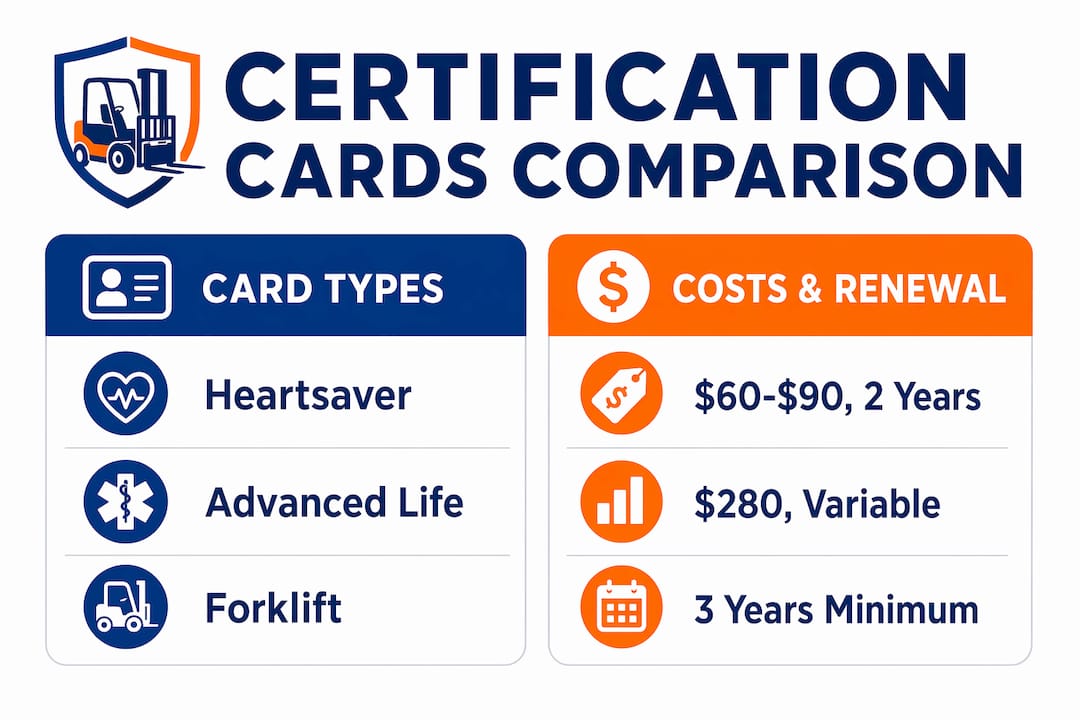
| Card type | Typical cost | Validity period | Renewal cost |
|---|---|---|---|
| Heartsaver (AHA) | $60–$90 | 2 years | $30–$50 |
| BLS Provider (AHA) | $80–$110 | 2 years | $30–$70 |
| ACLS / Advanced cards | $200–$280 | 2 years | $50–$70 |
| Forklift operator card | Varies by provider | 3 years (OSHA) | Varies |
Certification card costs range from $60 for a basic Heartsaver card to $280 for advanced life support credentials. Renewals cost significantly less, especially through online or blended learning formats. That cost gap makes renewal the smarter financial choice over letting a card lapse and retaking the full course.
Choosing a legitimate training provider matters as much as the card itself. Unauthorized issuers can produce cards that look official but are rejected by credentialing bodies because the issuing organization lacks current authorization status. A card from an unaccredited source offers no legal protection and no career value.
Digital verification is now the standard. In 2026, eCards with QR codes and unique serial numbers are required by most credentialing offices. A laminated physical card without a digital verification mechanism is a red flag. Forklift operators and healthcare workers alike should confirm their card includes a scannable verification element before accepting it as valid.
Pro Tip: Before enrolling in any certification course, verify the training provider’s authorization status directly through the issuing organization’s official website, such as atlas.heart.org for AHA credentials.
Counterfeit certification cards are a real and growing problem. They expose organizations to serious legal liability and put lives at risk when unqualified individuals operate equipment or respond to emergencies. Verification through official portals like AHA’s atlas.heart.org is the most reliable way to confirm a card’s legitimacy.
The risks of accepting fraudulent credentials include:
“Verification protects teams and employers from hiring unqualified staff. A card that cannot be confirmed through an official portal is not a credential. It is a liability.”
Physical cards without digital verification elements are increasingly rejected by credentialing offices. Employers should build a verification step into every onboarding checklist. For forklift operations specifically, Forkliftacademy recommends checking both the card’s expiration date and its connection to a verifiable training record before an operator touches any equipment.
Certification cards certify that the holder has trained under current, science-based protocols. This standardization is what makes coordinated emergency response possible. When multiple certified responders arrive at an incident, they share the same procedural knowledge and can work together without confusion.
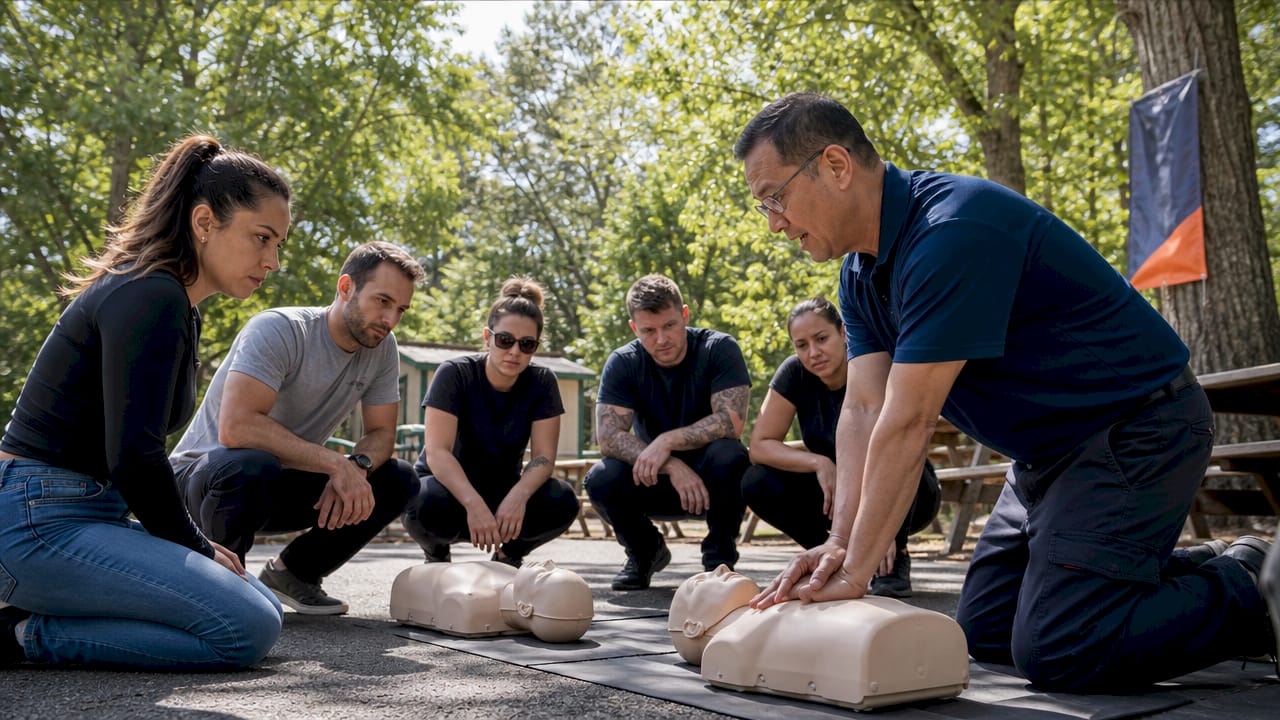
The clearest example is CPR. The 30:2 compression-to-breath cadence is universally accepted among certified responders. Every AHA-certified provider has practiced this ratio to the point of muscle memory. Without that shared standard, two responders might work at cross-purposes during a cardiac event.
Renewal cycles exist because skill retention drops sharply over time. CPR knowledge declines significantly within six months of initial training. Renewals every two years maintain competency above a reliable threshold. The certification card is the mechanism that enforces this cycle.
The standardization benefits extend to legal protection as well. Certified individuals acting in good faith during emergencies are generally protected under Good Samaritan laws in most U.S. states. That protection depends on the individual having current, valid credentials. An expired card weakens that legal standing considerably.
Forklift certification cards are required by OSHA for every powered industrial truck operator in the United States. The importance of forklift certification cards goes beyond paperwork. They confirm that an operator has completed both classroom instruction and a hands-on practical evaluation under a qualified trainer.
Employers carry direct responsibility for verifying that every operator holds a current, valid card before assigning them to equipment. The key compliance points include:
Forkliftacademy offers both online and onsite certification programs across the United States and Canada, with physical training locations in major cities. Their programs produce OSHA-compliant cards that include the operator’s name, training date, and equipment type. That specificity matters because OSHA certification is equipment-specific, not a blanket license to operate any forklift.
Certification cards are the single most verifiable proof that a worker meets safety and compliance standards required by OSHA, employers, and industry regulators.
| Point | Details |
|---|---|
| Career wage impact | Verified certifications deliver a 7.1% wage premium for workers without college degrees. |
| Verification is non-negotiable | Cards without digital verification elements like QR codes are rejected by most credentialing offices in 2026. |
| Authenticity protects employers | Counterfeit cards expose organizations to OSHA fines, legal liability, and safety failures. |
| Standardization saves lives | Shared protocols like the 30:2 CPR ratio depend on all responders holding current, valid certifications. |
| OSHA requires forklift cards | Forklift operators must hold equipment-specific certification cards and renew every three years at minimum. |
I have spent years watching companies treat certification cards as a formality. They collect them at onboarding, file them away, and never look at them again until something goes wrong. That approach is exactly backward.
The card is not the end of the process. It is proof that a process happened correctly. When I see an operator hand over a card with a QR code that links to a verified training record, I know that employer takes safety seriously. When I see a laminated card with no serial number and no digital trail, I start asking harder questions.
The shift toward digital verification is the most important development in certification management in the past decade. Employers who have not updated their verification workflows to check digital credentials are running a compliance gap they may not discover until an OSHA inspector does. The good news is that platforms like Forkliftacademy have built this into their certification process from the start.
My strongest advice: treat certification renewal as a scheduled business event, not a reaction to an expiration notice. Build renewal dates into your HR calendar the same way you schedule equipment maintenance. A lapsed card is a liability. A current card is protection.
— Juiced
Forkliftacademy has delivered OSHA-compliant forklift and scissor lift certification for over 20 years, serving both individual operators and businesses across the United States and Canada.
Their top OSHA forklift certification programs cover everything from initial operator training to full train-the-trainer online courses that let your in-house staff certify your entire workforce. Both online and onsite formats are available, and every program produces equipment-specific certification cards that meet OSHA’s documentation requirements. If your team needs current, verifiable credentials fast, Forkliftacademy is the direct path to compliance.
Certification cards prove that a worker has completed required training and meets current safety standards. Employers and regulators use them to verify competency before allowing individuals to operate equipment or perform safety-critical tasks.
OSHA requires forklift operators to renew certification every three years at minimum. Retraining is also required after observed unsafe behavior, an accident, or a change in equipment type.
Yes. A first job-relevant certification delivers a 7.1% wage premium for workers without college degrees, and HR departments in many industries treat valid cards as required hiring documents.
Employers should check for digital verification elements like QR codes and unique serial numbers, then confirm the card through the issuing organization’s official portal, such as atlas.heart.org for AHA credentials.
Physical cards are still used, but they must include digital verification mechanisms to be accepted by most credentialing offices. A laminated card with no scannable verification element is frequently rejected as insufficient proof of valid certification.