
TL;DR:
- Mastering load capacity, stability, and proper inspections prevents forklift tip-overs and fatalities.
- Consistent, smooth handling and effective communication are essential for safe forklift operation.
- Ongoing skills, safety culture, and regular training are critical beyond initial certification.
Missing one essential forklift skill isn’t just a training gap. It can be a fatal mistake. Tip-overs cause 42% of all forklift fatalities, and most are preventable with the right operator knowledge. Whether you’re working on a busy warehouse floor or managing a logistics team across multiple facilities, the skills your operators carry into each shift directly affect lives, liability, and compliance. This article breaks down the must-have forklift skills every operator should master and every manager should prioritize, covering load capacity, precision handling, inspections, and situational awareness.
Table of Contents
- Understanding load capacity and stability: The foundation
- Precision handling: Controls, steering, and maneuvering
- Pre-use inspection and maintenance awareness
- Situational awareness and communication on the job
- Our take: Why skill mastery, not just compliance, defines forklift safety
- Next steps: Get certified and build a culture of safety
- Frequently asked questions
Key Takeaways
| Point | Details |
|---|---|
| Master load handling | Understanding capacity limits and stability is the foundation of forklift safety. |
| Practice precise control | Safe operation demands smooth maneuvering and clear communication every shift. |
| Inspect daily | Pre-shift equipment checks are crucial for compliance and accident prevention. |
| Stay situationally aware | Awareness of people and hazards in real time helps avoid costly mistakes. |
| Certification matters | Formal training and ongoing learning keep skills sharp and workplaces safe. |
Understanding load capacity and stability: The foundation
Every forklift has a data plate bolted to the machine. That plate is not decoration. It tells you the maximum load weight the machine can safely carry at a specific load center distance. The load center is the horizontal distance from the front face of the forks to the center of gravity of the load. Most capacity ratings are based on a 24-inch load center. Move that center further out, and load capacity decreases rapidly, which is why tip-overs remain one of the deadliest forklift incidents on record.
The stability triangle is the invisible framework that keeps a forklift upright. It connects the two front wheels and the rear axle pivot point. Every load, every turn, and every incline either keeps the center of gravity inside that triangle or pushes it outside. When it goes outside, the machine tips. It’s that straightforward, and it’s that dangerous.
Common mistakes that lead to tip-overs include:
- Carrying loads that exceed the rated capacity
- Raising loads too high during travel
- Turning on a slope or uneven surface
- Ignoring the data plate because a load “looks fine”
- Stacking items that shift the center of gravity forward
Here’s the practical daily process every operator should follow before picking up any load:
- Locate and read the capacity data plate on the forklift
- Estimate or measure the load’s weight and dimensions
- Identify the load center distance and compare it to rated capacity
- Confirm the ground surface is level and clear
- Use the OSHA warehouse safety checklist to verify readiness before every lift
For a deeper look at daily operator obligations, the 2026 operator compliance guide outlines responsibilities beyond just load checks. If you want to go further into forklift stability and load resources, CCOHS offers detailed technical guidance.
Pro Tip: Never estimate load weight by eye. Use a scale or documentation from the supplier. Guessing costs lives.
Precision handling: Controls, steering, and maneuvering
Knowing your capacity limits keeps the machine upright. Knowing how to actually move it keeps everyone around you safe. Precision handling is a practiced skill, not something that just comes naturally after a few weeks on the job. It requires deliberate technique and consistent habits.
Smoothness is everything. Jerky acceleration, hard braking, and sharp turns all transfer momentum forces that can destabilize a load or knock into racking and people. Think of the load as a glass of water: you want to move without spilling it. That mental model actually works for building smoother operating habits faster.
Here are the core precision handling techniques every operator needs to practice:
- Smooth acceleration and braking: Gradually increase speed and reduce it well before stopping points. Sudden stops on wet or smooth floors are a major cause of load shifts.
- Three-point turns in tight spaces: In narrow aisles, executing a controlled three-point turn prevents racking collisions. Practice this until it becomes instinct.
- Keeping loads low during travel: Loads must travel low to the ground, typically 6 to 8 inches above the floor, to maintain center-of-gravity stability. This applies on every surface, especially inclines.
- Horn use at intersections and blind spots: Sound the horn before every intersection, corner, and doorway. This is a non-negotiable safety protocol under OSHA, CCOHS, and CSA standards.
- Reverse travel when vision is blocked: When a load blocks your forward sightline, travel in reverse and use a spotter.
“Precision comes from repetition. The operators who handle tight spaces and heavy loads safely are the ones who practice these techniques on purpose, not just when they have to.”
For a clear breakdown of day-to-day handling expectations, the operator job basics page provides a practical reference. Managers looking to build a stronger culture around movement safety can explore workplace safety explained for a broader framework.
Pre-use inspection and maintenance awareness
A forklift that looks fine from the outside can have a hydraulic leak, worn brake pads, or cracked forks that make it dangerous to operate. Pre-use inspections are a regulatory requirement under both OSHA and CCOHS, not an optional best practice. Every operator must complete a check before the first use of each shift.
Here’s what a thorough pre-use inspection covers:
- Tires: Check for cuts, flat spots, and correct inflation on pneumatic tires. Damaged tires affect stability and braking.
- Forks: Inspect for cracks, bends, or uneven wear. Any visible damage means the equipment is out of service until repaired.
- Hydraulic systems: Look for fluid leaks under the machine and test mast operation for smooth, controlled movement.
- Lights and horn: Confirm all warning lights, headlights, and the horn function properly before you move.
- Brakes: Test both the service brake and the parking brake before entering a work zone.
If something is wrong, the correct action is to tag the machine out of service immediately and report it to your supervisor. Do not operate a faulty forklift because it’s the only one available or because the issue seems minor. That decision alone has caused serious injuries.
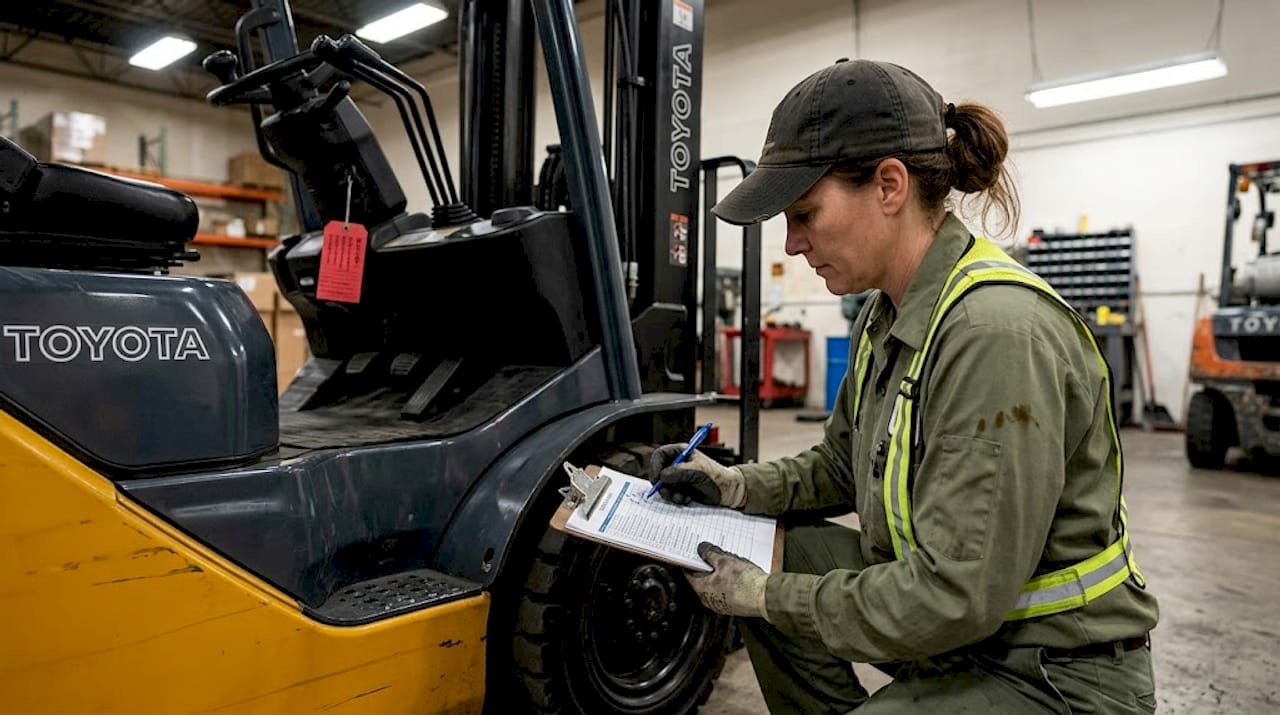
Documentation matters just as much as the inspection itself. Written records prove compliance during audits and provide a trail if an incident occurs. For full details on what’s legally required, review the forklift inspection requirements outlined for both the U.S. and Canada. The safety checklist guide offers a ready-to-use format for keeping those records consistent.
Pro Tip: Keep a standardized inspection form attached to every forklift. Operators who fill it out before every shift build the habit faster and managers get the documentation they need automatically.
Situational awareness and communication on the job
Skilled operators don’t just manage their machine. They manage the entire environment around them. Situational awareness means continuously scanning for pedestrians, obstacles, floor hazards, and layout changes that weren’t there yesterday. Warehouses are dynamic environments, and what was a clear path at 7 a.m. can be a blocked aisle by 9 a.m.
Key awareness habits every operator should practice:
- Scan intersections before entering, even at slow speeds
- Watch for pedestrians stepping out from behind racking
- Check for floor changes: wet spots, uneven surfaces, or recently moved equipment
- Stay alert to overhead clearance when raising loads near mezzanines or doorways
Horn use, low load travel, and vigilant observation are consistent requirements across OSHA, CCOHS, and CSA standards because they address the most common causes of pedestrian incidents.
Communication is the other half of the equation. Hand signals, eye contact with pedestrians, and clear confirmation from spotters reduce the guesswork that leads to accidents. For guidance on building strong communication habits, the employee forklift training guide provides proven frameworks, and the business training guide helps managers roll those practices out team-wide.
| Behavior | Effective communication | Poor communication |
|---|---|---|
| At intersections | Sound horn, make eye contact, wait | Proceed without warning |
| Working with spotters | Confirm signals before moving | Assume the area is clear |
| Reporting hazards | Inform supervisor immediately | Ignore or work around it |
| Blind spot navigation | Slow down, horn, use mirror | Speed through without checking |
| Pedestrian interaction | Stop and wait for clearance | Wave them on while moving |
Our take: Why skill mastery, not just compliance, defines forklift safety
Here’s something that doesn’t get said enough: certified operators still cause serious accidents. A certification proves someone completed training. It does not prove they apply what they learned three months later, under pressure, on a busy Friday afternoon shift.
Real forklift safety lives in the daily decisions that nobody watches. Does your operator still check the capacity plate on a load they’ve moved 50 times before? Do they actually slow down at every blind intersection, or only when a supervisor is nearby? Those habits erode over time without reinforcement.
We believe the biggest gap in most safety programs isn’t training access. It’s culture. Managers who reward skill application, not just course completion, see fewer incidents over time. Recognizing the operator who flagged a hydraulic issue before it became a failure is more powerful than any poster on the wall.
Ongoing skill checks, refresher training, and a workplace that treats safety as a professional standard rather than a compliance checkbox are what move the needle. Review your ensuring safe operations checklist not as a regulatory obligation but as a living standard your team actually owns.
Next steps: Get certified and build a culture of safety
You now have a clear picture of what separates a safe, skilled forklift operator from one who’s just getting through the shift. The next move is turning that knowledge into action for yourself and your team.
At Forklift Academy, we’ve spent over 20 years helping operators and managers across the U.S. and Canada meet OSHA forklift certification standards with confidence. Whether you’re an individual operator looking to get certified quickly or a logistics manager building a facility-wide safety program, we have the right format for your situation. Our Train the Trainer online certification gives your in-house trainers the tools to keep skills sharp on an ongoing basis. Start by reviewing OSHA certification requirements so you know exactly what’s needed before your next audit.
Frequently asked questions
What is the most common mistake forklift operators make?
Exceeding load capacity or improperly positioning a load are the most common mistakes, and they directly cause the 42% of fatalities attributed to tip-overs. Both errors are avoidable with proper pre-lift habits.
How often should forklift operators perform equipment inspections?
Operators must complete a pre-use inspection before every shift under OSHA and CCOHS requirements. Skipping even one inspection creates both a safety gap and a compliance violation that pre-use inspections are specifically designed to prevent.
Are there key differences between U.S. and Canadian forklift safety standards?
OSHA and CCOHS standards are closely aligned on core safety requirements like pre-use inspections, load handling, and operator training. The OSHA/CCOHS/CSA standards share the same foundational operator safety rules, though some administrative processes differ by jurisdiction.
Why is situational awareness considered a must-have forklift skill?
Constant attention to pedestrians, floor conditions, and layout changes prevents the majority of workplace forklift incidents. Vigilant observation is a core requirement across all major North American safety standards for exactly that reason.
Recommended
- Master essential forklift skills: 70% fewer incidents – Top Osha Forklift Certification
- 7 Essential Forklift Operator Skills Examples for Success – Top Osha Forklift Certification
- 7 Essential Forklift Operator Skills for Safety and Success – Top Osha Forklift Certification
- 5 Essential Skills Every Forklift Operator Should Master