

TL;DR:
- Onsite forklift training uses real equipment at your facility, creating faster skill transfer and better OSHA compliance.
- It builds team consistency and safety culture by training groups together on site-specific hazards and procedures.
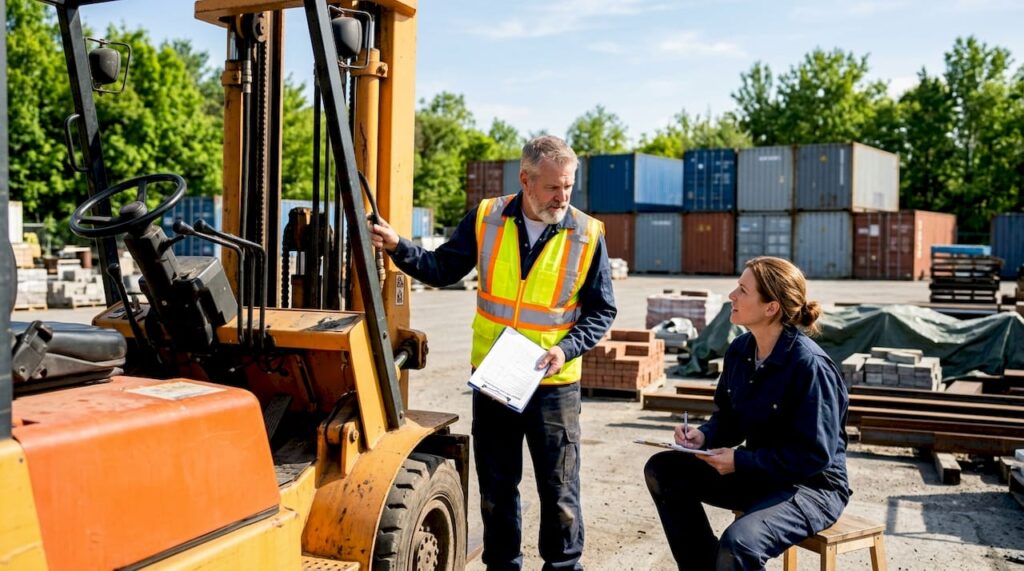
Onsite training is defined as a structured learning program delivered directly at the workplace, using real equipment and actual site conditions to build certified operator skills. For companies managing forklift fleets and OSHA compliance obligations, this format is the most direct path from classroom instruction to safe, confident operation. Generic offsite courses teach principles. Onsite programs teach your operators on your equipment, in your facility, against your specific hazards. Forkliftacademy has delivered this model across the United States and Canada for over 20 years, and the operational difference is clear from day one.
Onsite training produces faster, more durable skill transfer because operators learn in the exact environment where they will work. Training with actual forklifts and surfaces removes the gap between what was taught and what gets practiced on the next shift. That gap is where accidents happen.
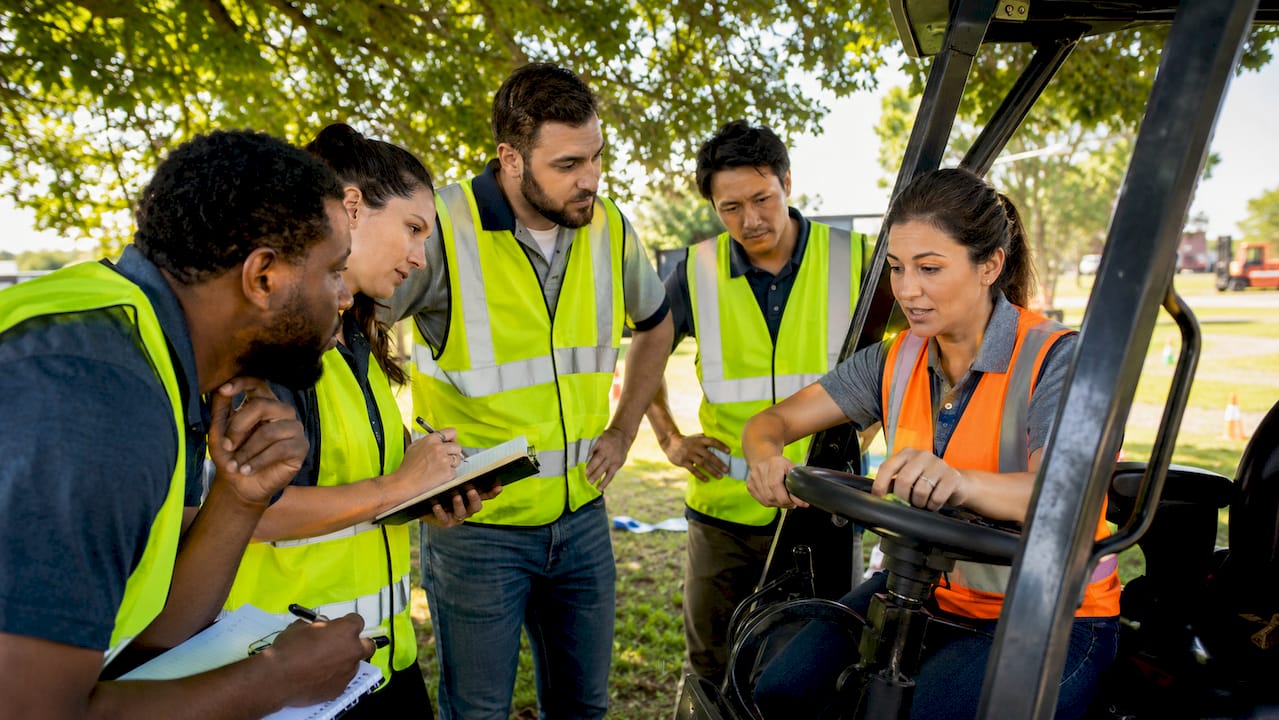
The contextual relevance of onsite programs is their defining advantage. When a trainer walks an operator through a real pedestrian crossing in your warehouse, or demonstrates a load on your actual racking system, the lesson sticks. Abstract instruction at an offsite facility requires operators to mentally translate what they learned into your specific conditions. That translation is imperfect and often incomplete.
Onsite programs also allow trainers to integrate site-specific hazards directly into practical drills. A trainer who walks your floor before the session can build those hazards into every exercise. The result is an operator who has already rehearsed the exact situations they will face.
Pro Tip: Schedule onsite sessions during mid-week, mid-shift windows. Operators are alert, operational pressure is lower, and trainers get full attention without the distraction of shift handovers or Monday morning chaos.
Contextual learning leads to immediate behavior change in daily operations. That is the clearest argument for why companies with real compliance exposure should not settle for a course that happens somewhere else.
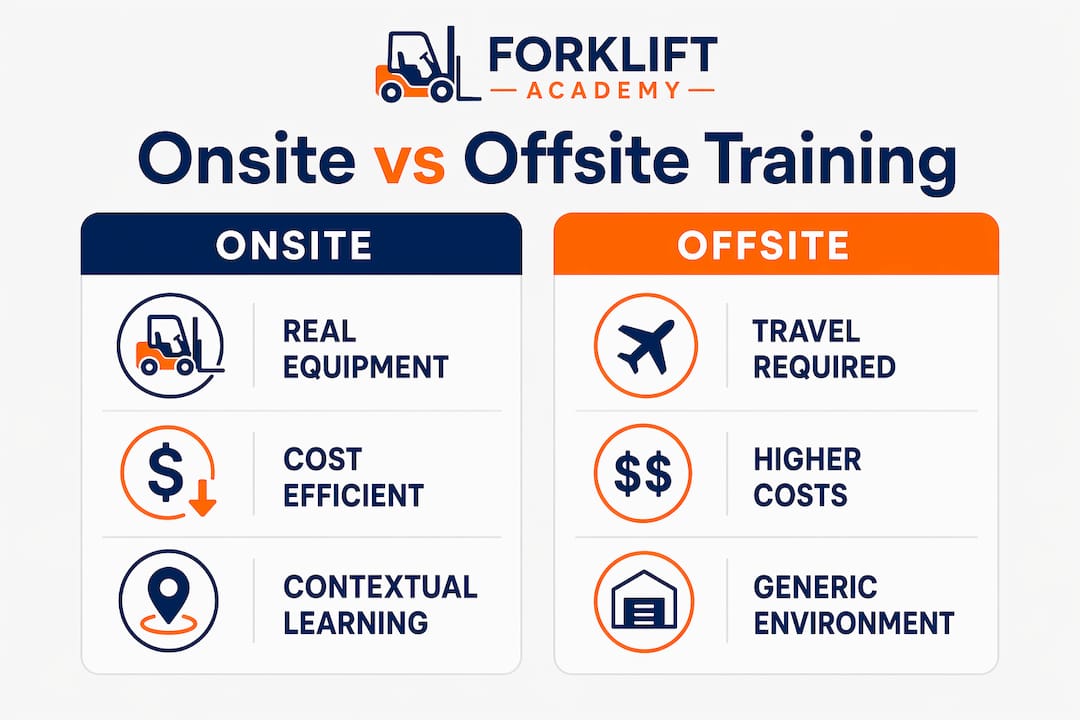
For groups of four or more operators, onsite training delivers better per-head cost efficiency than public courses once indirect expenses are included. A flat daily trainer rate spreads across every attendee, lowering the unit cost as group size grows.
The hidden costs of offsite training are where most organizations underestimate the true price difference. Travel time, mileage reimbursements, parking fees, and accommodation for multi-day courses all add up before a single operator has touched a forklift. Add the cost of backfilling shifts while employees are away, and the per-person fee on a public course brochure looks very different from the actual invoice.
Scheduling flexibility is another financial lever. Onsite training lets managers place sessions around peak operational hours, keeping the facility running and avoiding the productivity loss that comes with pulling an entire team offsite for a day.
| Factor | Onsite training | Offsite or public course |
|---|---|---|
| Pricing model | Flat daily trainer rate | Per-person enrollment fee |
| Travel costs | None | Mileage, parking, accommodation |
| Shift disruption | Minimal with smart scheduling | High, full day away from site |
| Equipment familiarity | Your actual forklifts | Unfamiliar training equipment |
| Content customization | Site-specific hazards included | Generic curriculum |
| Cost efficiency for groups | Improves as group size grows | Fixed per-head regardless of group |
Pro Tip: Before comparing costs, list every indirect expense for an offsite option: travel time, fuel or mileage, any accommodation, and the cost of covering absent operators. Comparing per-head costs without these figures misrepresents the true price gap.
The financial case for onsite training is strongest when you factor in what does not appear on the public course invoice. Organizations that run the full cost comparison almost always find onsite wins for teams of meaningful size.
Team-based onsite learning builds a shared operational language across your workforce. When your entire forklift team trains together in the same facility, they leave with the same procedures, the same hazard awareness, and the same vocabulary for communicating risk. That consistency is the foundation of a real safety culture.
Offsite and online formats train individuals. Onsite formats train teams. The distinction matters because forklift safety is not a solo activity. Operators work alongside pedestrians, other equipment, and supervisors who all need to understand the same rules. When one operator attends a public course and another completes an online module, the result is two people with slightly different mental models of how to handle the same situation.
Onsite training is superior for complex problem-solving and team alignment compared to online formats. Colleagues can work through site-specific challenges together in a controlled environment, building the collaborative habits that carry over into daily operations.
The contrast with individual online training is sharpest here. An online module can certify an individual. It cannot align a team. For companies where OSHA compliance depends on every operator behaving consistently, that alignment is not optional.
Choosing the right onsite program requires more than confirming a trainer can show up at your facility. The following factors determine whether the investment produces lasting compliance and skill improvement.
Group size and cost threshold. Onsite training becomes cost-effective at four or more operators. Below that number, a blended approach combining online theory with onsite evaluation may deliver better value.
Trainer qualifications and OSHA knowledge. Confirm that the trainer understands OSHA forklift training requirements and can produce documentation that satisfies a compliance audit. A trainer who is strong on technique but weak on regulatory paperwork creates a liability gap.
Content customization depth. Ask specifically whether the trainer will walk your site before the session. Trainers who incorporate your actual pedestrian routes, load types, and racking configurations deliver measurably better outcomes than those who arrive with a fixed curriculum.
Scheduling around operations. Work with the training provider to identify windows that minimize operational disruption. Mid-week sessions during lower-traffic hours keep the facility productive while giving operators the focus the training requires.
Full cost accounting. Build a complete cost comparison that includes travel, backfill labor, and productivity loss for any offsite alternative. Organizations that skip this step routinely underestimate the value of keeping training on site.
Blended reinforcement. Onsite training delivers the highest impact for initial certification and hands-on skill building. Pairing it with online refresher modules extends retention between certification cycles. Effective onsite programs are designed around adult learning principles and built for immediate practical application, which makes them the right anchor for a blended approach.
The goal is not simply to check a compliance box. The goal is an operator who performs safely and consistently on your equipment, in your facility, every shift.
Onsite training is the most effective format for building certified operator skills because it combines contextual relevance, team alignment, and cost efficiency in a single program.
| Point | Details |
|---|---|
| Contextual skill transfer | Operators train on real equipment in their actual facility, closing the gap between instruction and practice. |
| Cost efficiency for teams | A flat daily trainer rate beats per-person public course fees once travel and downtime are included for groups of four or more. |
| Team alignment | Group onsite sessions build shared procedures and consistent safety language across every operator and supervisor. |
| OSHA compliance fit | Site-specific content and proper documentation satisfy OSHA audit requirements better than generic offsite curricula. |
| Blended reinforcement | Pairing onsite certification with online refreshers extends skill retention between training cycles. |
Most safety managers I speak with focus on the certification card. They want proof that an operator completed a course and passed an evaluation. That is the floor, not the ceiling.
What I have seen repeatedly is that operators who train offsite or online can hold a valid certification and still hesitate at a real decision point on the floor. They were certified on equipment they will never drive again, in a facility that looks nothing like their actual workplace. The certification is real. The confidence is not.
Onsite training closes that gap in a way no other format can replicate. When an operator has already navigated your specific blind corners, practiced your load sequences, and heard your site rules from a trainer standing in your facility, the certification reflects actual readiness. That is what OSHA compliance is supposed to mean.
The other mistake I see is treating onsite training as a one-time event. Adult learning research is clear: skills decay without reinforcement. The organizations that get the most from onsite programs are the ones that follow up with scheduled online refreshers and periodic re-evaluation. The onsite session builds the foundation. The follow-up keeps it solid.
My honest advice: do not select a training provider based on price alone. Select based on whether the trainer will walk your floor, customize the content, and produce documentation that holds up under scrutiny. That combination is rarer than it should be, and it is the difference between a compliance exercise and a genuine safety improvement.
— Juiced
Forkliftacademy brings over 20 years of OSHA-compliant forklift training experience directly to your facility. Its onsite training programs are built around your equipment, your site conditions, and your compliance requirements, not a generic curriculum designed for someone else’s warehouse.
For companies that want to build in-house training capacity, Forkliftacademy’s train-the-trainer certification equips your own staff to conduct OSHA-compliant evaluations on an ongoing basis. This reduces long-term training costs while keeping certification current across your entire operator workforce. Contact Forkliftacademy to discuss the right program structure for your team size, equipment type, and compliance timeline.
An onsite training program delivers OSHA-compliant forklift instruction directly at the employer’s facility, using the operator’s actual equipment and site conditions. This format produces faster skill transfer and more accurate compliance documentation than offsite alternatives.
Onsite training uses your real forklifts, your facility layout, and your site-specific hazards, which produces better skill retention and team alignment. For groups of four or more, it also delivers lower per-head costs once travel and downtime are factored in.
Onsite training allows trainers to incorporate your actual pedestrian routes, load types, and internal safety rules into every drill, producing documentation that reflects real site conditions. That specificity satisfies OSHA audit requirements more reliably than generic course records.
Online and in-person training produce comparable knowledge outcomes, but onsite training is superior for hands-on skill application, team alignment, and complex problem-solving. A blended approach using onsite certification with online refreshers delivers the strongest long-term results.
Onsite training typically becomes more cost-effective than public courses at four or more operators, because the flat daily trainer rate spreads across the group while eliminating travel, accommodation, and shift-coverage costs.