
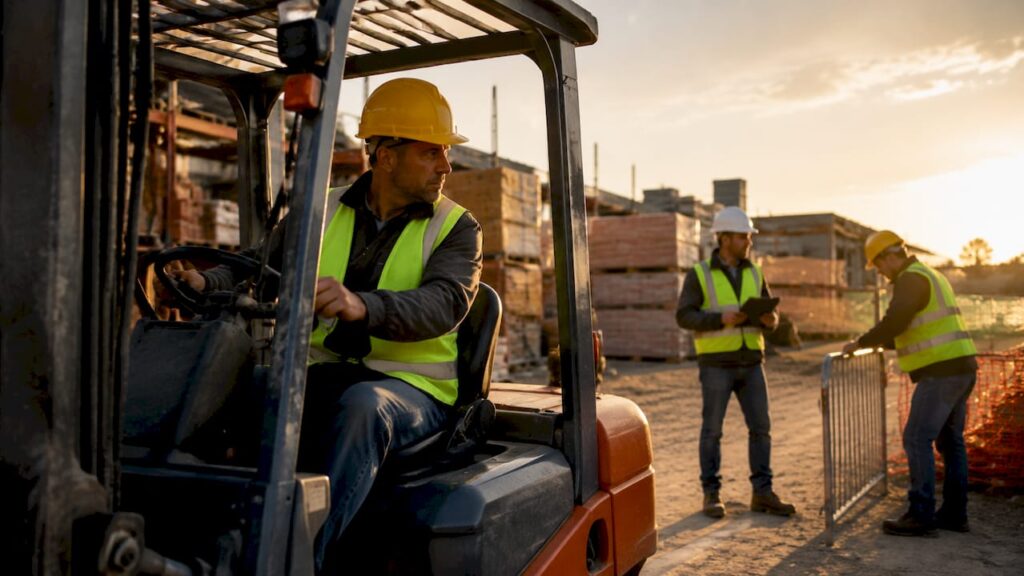

TL;DR:
- Forklift safety in 2025 integrates AI detection, updated OSHA rules, and new electrical standards to reduce incidents. Combining technology, training, and facility design creates the most effective safety system. Proactive, layered approaches protect workers and ensure legal compliance.
Forklift safety improvements in 2025 are defined by the integration of AI-powered detection, updated OSHA certification rules, and new electrical safety standards that together reduce preventable incidents in warehousing and logistics. U.S. workplaces record over 70 forklift fatalities and 7,000 injuries annually, with OSHA penalties reaching $165,514 for willful violations. Those numbers make proactive investment in forklift safety standards a financial and legal necessity, not just a best practice. The most effective 2025 safety programs combine AI vision systems like OmniPro, telemetry analytics, ANSI/ITSDF B56.5 compliance, and EN 1175:2025 electrical requirements into a single, layered approach.

Technology is the fastest-moving pillar of forklift safety improvements 2025. AI vision systems, telemetry platforms, and proximity detection tools now give safety managers real-time data that was simply unavailable five years ago.
AI-powered vision systems detect pedestrians and obstacles in blind spots before a collision occurs. Systems like OmniPro Vision AI alert operators in real time, reducing the reaction gap that causes most intersection incidents. The practical result is fewer near-misses logged and faster operator response in high-density pick zones.
Telemetry and data analytics shift safety management from reactive to proactive. Telemetry systems capture real-time impact data, speed, and operator behavior across an entire fleet. Safety managers use that data to identify high-traffic hotspots and coach operators before incidents escalate.
Additional technology-based improvements include:
Pro Tip: Select vendor-agnostic AI detection systems that require no beacon infrastructure. They lower deployment cost and work across multiple forklift brands in a mixed fleet.
Forklift operator certification under 29 CFR 1910.178(l) requires formal training, hands-on evaluation, and renewal every three years. Post-incident and post-observation refresher training is mandatory whenever an operator is seen performing unsafely. These rules are not new, but enforcement and documentation expectations have tightened in 2025.
A compliant training program follows three structured components:
The “three-bucket” model for re-evaluation is a useful framework. Refresher training is required after an observed unsafe act, after a near-miss or accident, and after an operator is assigned to a different type of forklift. Documenting each trigger and the corresponding training event protects your facility during an OSHA audit.
Training compliance directly reduces citation risk. The connection between documented training records and lower OSHA penalty exposure is well established. Safety managers who treat certification as a continuous operating system rather than an annual checkbox build a measurable safety culture over time.
Two regulatory developments define the forklift safety regulations 2025 landscape. OSHA is moving to incorporate ANSI/ITSDF B56.5 standards, which cover obstacle detection and emergency braking for autonomous forklifts, with proposed integration targeted for Q2 2026. EN 1175:2025 sets new electrical and electronic safety requirements for industrial trucks, specifically targeting fire and electrical hazard mitigation. Both updates require safety managers to audit current equipment and documentation now, not after the effective date.
OSHA’s updated penalty structure also changed in mid-2025. Facilities with 25 or fewer employees qualify for up to 70% penalty reductions, and a 15% Quick-Fix credit applies when hazards are corrected rapidly. That structure rewards early action and makes compliance programs more financially accessible for smaller operations.
| Regulation | Scope | Key Requirement | Effective |
|---|---|---|---|
| ANSI/ITSDF B56.5 | Autonomous forklifts | Obstacle detection, emergency braking | Q2 2026 (proposed) |
| EN 1175:2025 | All industrial trucks | Electrical and electronic safeguards | 2025 |
| 29 CFR 1910.178 | All powered industrial trucks | Operator training, daily inspections | Ongoing |
| OSHA Penalty Update | All facilities | Up to 70% reduction for small businesses | July 2025 |
Daily pre-shift inspections under 29 CFR 1910.178 remain a core compliance requirement. Digital checklist tools that timestamp and log each inspection create an audit-ready record that paper logs cannot match. Safety managers who use OSHA compliance checklists consistently find fewer citation gaps during inspections.
Facility design is the physical layer of a complete forklift safety guide 2025. Technology and training reduce human error, but a poorly designed floor plan creates hazards that no alert system fully eliminates. Physical segregation measures such as guardrails, automated gates, and dedicated pedestrian pathways create a failsafe layer that operates independently of operator behavior.
Key facility design improvements include:
The multi-layered approach combining physical barriers with electronic sensors is the industry gold standard for forklift safety. Each layer compensates for the failure modes of the others.
Pro Tip: Conduct a congestion audit during your busiest shift, not during off-peak hours. The hazard patterns that appear at peak volume are the ones that cause incidents.
Safety managers working with limited budgets need to prioritize. The table below compares the three primary improvement methods by impact, cost, and complexity.
| Method | Incident Reduction | Implementation Cost | Compliance Assurance | Best For |
|---|---|---|---|---|
| Technology (AI, telemetry) | High | Medium to high | Indirect | Facilities with recurring near-miss patterns |
| Training and certification | High | Low to medium | Direct | All facilities; mandatory baseline |
| Regulatory compliance | Medium | Low | Direct | Audit preparation and penalty avoidance |
| Multi-layered combination | Highest | Medium to high | Strongest | High-volume distribution and logistics centers |
Training delivers the highest compliance assurance per dollar spent because it directly satisfies OSHA’s mandatory requirements under 29 CFR 1910.178. Technology amplifies training outcomes by giving operators real-time feedback that classroom instruction alone cannot provide. Regulatory compliance work, including daily inspections and documentation, creates the audit trail that protects facilities when OSHA arrives.
The combination of all three methods produces the strongest results. A facility that installs AI detection but skips operator certification renewals still faces citation risk. A facility that trains well but ignores facility design creates physical hazards that training cannot remove.
Forklift safety improvements in 2025 require combining AI-powered technology, OSHA-compliant training, and updated regulatory compliance into one integrated system to achieve lasting incident reduction.
| Point | Details |
|---|---|
| AI detection reduces blind-spot incidents | Systems like OmniPro provide real-time alerts without requiring beacon infrastructure. |
| Certification is mandatory every 3 years | OSHA requires renewal and post-incident refresher training under 29 CFR 1910.178(l). |
| New regulations demand equipment audits | EN 1175:2025 and ANSI/ITSDF B56.5 require updated electrical and braking compliance. |
| Facility design is a standalone safety layer | Physical segregation through guardrails and dedicated pathways reduces hazards technology cannot eliminate. |
| Penalty reductions reward fast action | OSHA’s July 2025 update allows up to 70% reductions for small businesses that correct hazards quickly. |
Most safety managers I talk with still treat forklift safety as a compliance event. They schedule training before an audit, update checklists after a citation, and install technology after an incident. That sequence is backwards, and the injury statistics prove it.
The facilities that consistently outperform on safety metrics treat it as a daily operating system, not a periodic project. They use telemetry data every week to coach operators on specific behaviors. They review near-miss logs before they become accidents. They update facility layouts based on congestion data, not gut instinct.
The uncomfortable truth about forklift safety trends 2025 is that technology alone does not change behavior. An AI alert system that operators learn to ignore is just expensive hardware. The behavioral change comes from shared accountability, where supervisors, operators, and safety managers all see the same data and act on it together.
My strongest advice for compliance officers right now is this: get your documentation in order before OSHA’s ANSI/ITSDF B56.5 integration takes effect. Autonomous and semi-autonomous forklift operations that lack documented obstacle detection protocols will face the steepest scrutiny. Start the audit now, while the penalty reduction window for quick fixes is still open.
— Juiced
Forkliftacademy delivers OSHA-compliant forklift training and certification programs built specifically for safety managers and compliance officers who need documented, audit-ready results. With over 20 years of experience, Forkliftacademy offers online certification, onsite training programs, and a complete Train the Trainer online course that lets your internal trainers certify operators directly. Every program satisfies the 29 CFR 1910.178(l) requirements for formal instruction, practical evaluation, and employer certification. Whether you need to renew a single operator or build a facility-wide certification program, Forkliftacademy provides the tools to get it done and keep your records inspection-ready.
The most critical improvements combine AI-powered pedestrian detection, mandatory OSHA operator certification renewals every three years, and compliance with EN 1175:2025 electrical safety standards. Facilities that address all three areas see the greatest reduction in incidents and citation risk.
OSHA requires forklift operator certification renewal every three years under 29 CFR 1910.178(l). Refresher training is also mandatory after any observed unsafe act, near-miss, or assignment to a different forklift type.
EN 1175:2025 sets new electrical and electronic safety requirements for industrial trucks to reduce fire and electrical hazard risks. Safety managers should audit current equipment against these standards and document any upgrades made to maintain compliance.
Yes. OSHA’s July 2025 penalty update allows facilities with 25 or fewer employees to qualify for up to 70% penalty reductions. A 15% Quick-Fix credit also applies when identified hazards are corrected promptly after an inspection.
The multi-layered approach combining physical segregation, AI detection technology, and continuous operator training produces the strongest results in high-volume environments. Each layer compensates for the failure modes of the others, creating a system that does not rely on any single control.