
TL;DR:
- Warehouse safety depends on layered strategies, proactive measurement, and a safety culture beyond PPE reliance.
- Common risks include forklift incidents, falls, and musculoskeletal injuries, requiring targeted controls and compliance.
Warehousing ranks among the most hazard-dense work environments in North America, yet many facilities still rely on outdated assumptions about what keeps workers safe. 2.488 million recordable injury cases were documented in private industry in 2024 alone, with sprains, strains, and falls accounting for a disproportionate share. The dangerous misconception is that a hard hat and a high-visibility vest solve the problem. They don’t. Real warehouse safety requires layered strategy, proactive measurement, and a culture where every worker from the loading dock to the mezzanine understands exactly why the rules exist and what happens when they’re ignored.
Table of Contents
- The real risks in warehouse environments
- OSHA requirements and compliance essentials
- Moving beyond PPE: Building a safety culture
- Measuring what matters: Proactive safety and leading indicators
- Why compliance is not enough: A frontline perspective
- Enhance your warehouse safety and certification now
- Frequently asked questions
Key Takeaways
| Point | Details |
|---|---|
| Safety is proactive | Effective warehouse safety programs anticipate and eliminate risks before incidents happen. |
| Compliance is a starting point | Meeting OSHA rules is essential but real impact comes from building a safety culture beyond regulations. |
| Data-driven prevention | Tracking leading indicators like near-miss reports and training outcomes reduces accidents and compliance risk. |
| Layered defenses matter | Combining traffic management, training, and site controls works better than relying on PPE alone. |
The real risks in warehouse environments
After understanding that the stakes are high, let’s clarify exactly where and how risks emerge in warehouses.
Warehouses are built for speed and volume, which means machinery, people, and cargo occupy the same spaces under constant pressure. That combination creates a predictable set of danger zones. Loading docks are the most obvious: vehicle traffic enters and exits, workers handle heavy freight, and the transition between indoor and outdoor surfaces creates slip and fall conditions year-round. Aisle intersections are equally dangerous, especially where visibility is limited by high shelving or stored pallet loads.
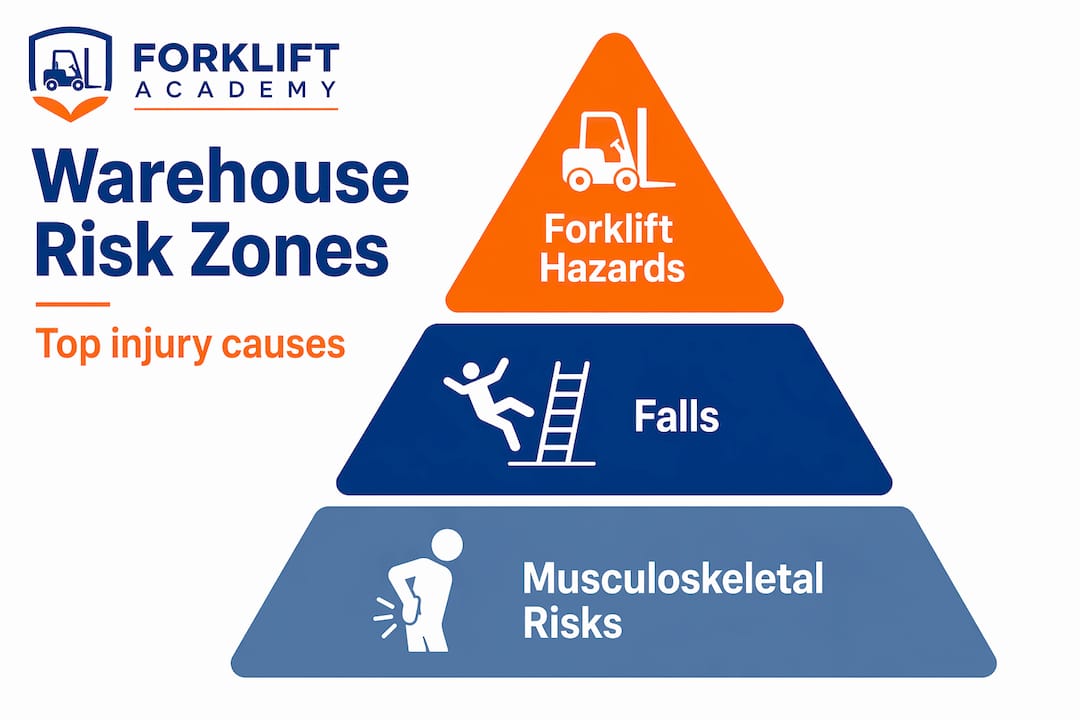
Powered industrial trucks, falls, and musculoskeletal risks can cause serious injury or death even during completely routine operations. A forklift traveling at normal warehouse speed carries enormous kinetic energy. A worker stepping around a corner doesn’t have time to react. Those are the conditions where incidents happen, and they happen often enough that treating them as rare is itself a safety failure.
Consider the most common injury categories and how they play out in a real distribution center:
| Injury/illness type | Frequency | Typical outcome |
|---|---|---|
| Sprains, strains, tears | Very high | Lost workdays, chronic pain, disability |
| Falls, slips, trips | High | Fractures, head injury, fatality |
| Forklift/vehicle incidents | Moderate | Crush injuries, amputations, fatality |
| Struck-by incidents | Moderate | Lacerations, fractures, TBI |
| Overexertion | High | Musculoskeletal disorders, long-term absence |
The numbers matter because they show where to put resources first. Sprains and strains are the most frequent, but forklift incidents carry the highest fatality risk per event. Both categories demand attention, but they require completely different interventions.
- Loading docks: Collision risk between vehicles and pedestrians, dock leveler hazards, and vehicle restraint failures
- Aisle intersections: Forklift blind spots, inadequate signage, and competing traffic patterns
- Racking areas: Falling objects from improper loading or damaged racking infrastructure
- High-traffic zones: Workers on foot sharing lanes with powered equipment
“Even routine warehouse tasks carry serious risk when powered equipment and pedestrians share the same space without clearly defined protocols.”
Strategies for reducing forklift risks must start with understanding exactly where those risks concentrate, not with a generic checklist applied across the whole facility.
OSHA requirements and compliance essentials
Understanding the hazards, it’s vital to know what’s required by law and what raises the bar for safety culture.
OSHA’s 29 CFR 1910.178 is the foundational regulation covering powered industrial trucks (PITs), and it touches every part of how forklifts are operated, maintained, and managed in your facility. This isn’t a short standard. It covers operator training, certification, daily inspection, travel rules, load handling, and the maintenance of safe workplace conditions where forklifts and pedestrians interact. OSHA enforces powered-industrial-truck rules including operator training and certification, vehicle maintenance, and management of pedestrian and vehicle interactions across all warehouse environments.
Beyond 1910.178, OSHA’s National Emphasis Programs (NEPs) create additional scrutiny on facilities that appear on certain industry classifications or that have documented injury history. OSHA’s enforcement emphasis increases scrutiny on heat illness and fall hazards, which means warehouses with poor safety records aren’t just liable for fines. They’re more likely to receive unannounced inspections, expanded audits, and media attention that follows a fatality investigation.
Here’s a numbered list of critical steps every warehouse must take to maintain compliance and avoid costly penalties:
- Certify all forklift operators through OSHA-compliant training that includes formal instruction, hands-on evaluation, and workplace-specific certification.
- Conduct daily pre-shift inspections on every powered industrial truck, documenting findings and removing defective equipment from service immediately.
- Review and update training records every three years at minimum, or sooner when an operator is observed operating unsafely or involved in an incident.
- Post speed limits, warning signs, and pedestrian routes throughout the facility and enforce them consistently.
- Maintain separation between pedestrians and vehicles through physical barriers, painted lanes, and access controls wherever possible.
- Document near-misses and use them to trigger formal hazard reviews, not just verbal reminders.
- Audit your facility against the OSHA forklift compliance checklist at least once per quarter.
For warehouses operating in Canada, provincial occupational health and safety legislation covers similar ground, though enforcement mechanisms and specific thresholds vary by province. The table below highlights the most significant parallels and differences.
| Requirement | OSHA (U.S.) | Canadian standards (provincial OHS) |
|---|---|---|
| Operator certification | Required, employer-specific | Required, varies by province |
| Equipment inspection | Daily pre-shift inspection required | Daily inspection required |
| Training renewal | Every 3 years or after incident | Varies; typically 3 years or post-incident |
| Pedestrian separation | Required by 1910.178 | Required under general duty clause |
| Heat illness prevention | NEP enforcement priority | Varies by province; fewer formal standards |
Pro Tip: Don’t treat OSHA compliance as the ceiling for your safety program. Think of it as the floor. A facility that just barely passes inspection is one near-miss away from a tragedy and a citation. Build systems that exceed the minimum so that even on a bad day, you’re still operating safely.
Understanding the full scope of OSHA forklift standards gives warehouse managers the technical grounding to build programs that survive audits and, more importantly, protect real people.
Moving beyond PPE: Building a safety culture
Now, let’s break out of the compliance mindset and see what truly robust safety looks like.
Personal protective equipment serves an important role. Hard hats, steel-toed boots, and high-visibility vests all reduce injury severity when incidents occur. But they do almost nothing to prevent incidents in the first place. Relying primarily on PPE is a form of wishful thinking: you’re essentially hoping that workers absorb the impact of a hazard rather than eliminating the hazard itself.
The highest-risk interactions occur at intersections, blind corners, and loading dock transitions, and the most effective protocols combine layout redesign, traffic management, reinforced training, and consistent enforcement rather than depending on PPE alone. That sentence contains the entire blueprint.
A hierarchical controls mindset addresses hazards in order of effectiveness: eliminate first, then engineer out the risk, then apply administrative controls and training, and use PPE last. In a warehouse context, this looks like:
- Eliminate: Remove unnecessary pedestrian access from active forklift zones entirely, routing workers through dedicated walkways with physical separation.
- Engineer: Install convex mirrors at blind corners, use automatic door sensors at dock entrances, apply anti-slip flooring at dock transitions, and consider proximity warning systems on forklifts.
- Administrative controls: Establish and enforce traffic management plans, require horn use at every intersection, implement shift-change protocols that clear pedestrians before vehicles move.
- Training: Reinforce rules through hands-on practice, not just classroom review. Experienced operators develop habits. Training shapes those habits early.
- PPE: Issue high-visibility vests, foot protection, and hearing protection as the last layer, not the primary defense.
Here are practical controls that make a real difference in day-to-day operations:
- Painted pedestrian lanes with clear color coding (yellow for caution, green for safe zones)
- Convex safety mirrors installed at every blind corner and aisle intersection
- Scheduled forklift maintenance logged and tracked to prevent mechanical failures
- Real-time feedback systems that flag speed violations or unusual operating patterns
- Mandatory horn protocols at every intersection, dock door, and pedestrian crossing
- Designated staging areas that keep workers away from active loading zones
- Weekly walkthrough audits conducted by frontline supervisors, not just safety officers
“True warehouse safety is designed into the facility. If workers have to choose between speed and safety, your layout is the problem.”
Pro Tip: Make incident reporting easy, fast, and completely non-punitive. Workers who fear discipline for reporting near-misses stop reporting them. When that happens, you lose your best early warning system for serious incidents. Anonymous reporting channels and visible management responses to reported hazards build the trust that makes your safety program functional.
Understanding key forklift hazards goes hand in hand with building these layered defenses. Each hazard type has a corresponding engineering or administrative solution, and combining multiple controls creates redundancy that PPE alone can never provide.
Measuring what matters: Proactive safety and leading indicators
Finally, measuring and acting on the right metrics can keep your warehouse both safe and compliant.
Most warehouse safety programs measure the wrong things. They count injuries, calculate rates, and report incidents after the fact. These are called lagging indicators, meaning they tell you what already went wrong. They’re useful for identifying patterns over time, but by the time the data appears, workers have already been hurt.
Leading indicators are measurements of the activities and conditions that predict safety outcomes before incidents occur. The most effective programs measure leading indicators like hazard elimination rates, traffic rule adherence, and training effectiveness to prevent incidents rather than respond to them. That shift in measurement philosophy is what separates facilities with genuine safety cultures from those that are simply reactive.
Here’s how to build a leading indicator tracking system in four actionable steps:
- Track near-miss reports per shift, per zone, and per operator. A spike in near-misses in a specific aisle tells you exactly where to intervene before a serious incident occurs.
- Measure training completion and evaluation scores for every certified operator. Low scores on practical evaluations predict future performance problems.
- Conduct and document checklist audits during daily pre-shift inspections. The rate of defect discovery tells you whether your maintenance program is functioning or just paperwork.
- Monitor traffic rule adherence through direct observation or speed-monitoring technology. If operators routinely exceed posted speed limits, the limit isn’t being enforced, regardless of what the policy says.
The contrast between leading and lagging indicators becomes clearest when you lay them side by side:
| Metric type | Example metric | What it tells you | When it’s useful |
|---|---|---|---|
| Lagging | Recordable injury rate | What went wrong | Post-incident analysis |
| Lagging | Lost workdays per quarter | Severity of past injuries | Insurance and compliance reporting |
| Leading | Near-miss reports per week | Where risk is building | Before incidents occur |
| Leading | Training completion rate | Whether operators are prepared | Ongoing readiness assessment |
| Leading | Checklist audit defect rate | Equipment and facility condition | Preventive maintenance effectiveness |
| Leading | Traffic rule violations observed | Behavioral compliance | Real-time culture assessment |
Shifting your safety meetings to focus on leading metrics changes the conversation entirely. Instead of reviewing last month’s injury totals, you’re discussing what near-misses revealed, which training scores need attention, and where the checklist audits found problems. The safe forklift operations guide provides additional frameworks for translating this data into operational action.
Why compliance is not enough: A frontline perspective
After 20 years in forklift safety training, the pattern we see most consistently is this: facilities that treat compliance as the finish line never actually get safer. They get better at passing inspections. Those are not the same thing.
The warehouses with genuinely low incident rates share a specific characteristic. Frontline workers feel personally responsible for safety, not just accountable to a policy. That distinction matters enormously. Accountability is external: you do the thing because someone is watching. Responsibility is internal: you do the thing because you believe it matters. You can’t train responsibility into someone with a one-day certification course. You build it through culture, and culture is built by leadership behavior, not leadership announcements.
What does effective safety leadership actually look like in practice? It means walking the floor regularly, and not just during formal audits. It means asking workers what they think is the most dangerous thing in their area right now, and then doing something visible about the answer. It means celebrating a worker who stopped an operation because something felt wrong, even when the stoppage cost time. It means never dismissing a near-miss as a lucky break.
The facilities that struggle most are the ones where management talks about safety in meetings and then implicitly pressures workers to prioritize throughput when volume spikes. Workers are perceptive. They notice the gap between what’s said and what’s rewarded. When speed and safety compete, and speed consistently wins, the safety program becomes theater.
Understanding why workplace safety matters at a values level, rather than just a regulatory level, is what allows managers to lead authentically instead of just administering rules.
Pro Tip: Frequent, informal check-ins with operators and warehouse staff do more to build a safety culture than annual all-hands training sessions. A two-minute conversation at the start of a shift where a manager asks, “Anything feel off today?” sends a clearer signal about organizational priorities than any policy document ever will.
The goal isn’t a warehouse that survives OSHA audits. The goal is a warehouse where no one goes home hurt. Those two outcomes require different levels of commitment, and only one of them is worth building a program around.
Enhance your warehouse safety and certification now
As you look to lead change in your facility, practical resources are available to elevate warehouse safety and compliance across your entire team.
Investing in robust certification programs multiplies safety across every shift and every operator. At Forkliftacademy.com, you get OSHA-compliant training built for real warehouse environments, available both online and onsite. Whether you need to get operators certified quickly or want to develop in-house capacity through the Forklift Train-the-Trainer Online program, the tools are ready. Understanding the full lift certification process ensures your team meets every regulatory requirement while building the skills that actually prevent incidents. With over 20 years of experience behind every course, OSHA Forklift Certification through Forklift Academy is the next logical step for any warehouse serious about safety.
Frequently asked questions
What are the most common injuries in warehouses?
Sprains, strains, tears, and falls are the leading warehouse injuries based on the most recent Bureau of Labor Statistics data from 2024, which documented 2.488 million total recordable cases in private industry.
How does OSHA enforce warehouse safety?
OSHA enforces safety through specific training and certification standards, regular inspections, and targeted National Emphasis Programs. OSHA enforces powered-industrial-truck rules covering operator training, vehicle maintenance, and pedestrian-vehicle interaction management, while enforcement emphasis programs increase scrutiny on facilities with documented heat illness and fall hazards.
What is the best way to reduce forklift accidents?
Integrating layout design, traffic management, frequent operator training, and strict rule enforcement is far more effective than depending on PPE. The highest-risk interactions occur at intersections and dock transitions, making layout and behavioral controls the primary defense.
Which safety metrics should warehouse managers track?
Leading indicators like near-miss reports, training completion rates, and traffic rule adherence give you actionable data before incidents occur, rather than after. Lagging indicators like injury rates should supplement, not replace, these proactive measurements.
Recommended
- Warehouse Safety: Reduce Forklift Risks & OSHA Compliance – Top Osha Forklift Certification
- Role of Training in Warehouse Safety: Preventing Accidents and Ensuring Compliance – Top Osha Forklift Certification
- Warehouse Safety – How It Transforms Accident Prevention – Top Osha Forklift Certification
- Importance of Safety Training – OSHA Compliance for Warehouses – Top Osha Forklift Certification