
TL;DR:
- Many warehouses mistakenly assume online forklift certification meets OSHA’s strict standards, risking costly violations. OSHA mandates hands-on training, formal instruction, and documented performance evaluations to ensure operator competency and safety. Compliant certification not only prevents legal penalties but also improves workplace safety, operational efficiency, and workforce development.
Walk into any warehouse that recently received an OSHA citation, and you’ll likely find the same root cause: someone believed an online-only forklift certification card was enough to satisfy federal requirements. That assumption is expensive. Several sources confirm that OSHA-compliant operator certification requires hands-on practice and a documented performance assessment, not just a digital quiz. For warehouse managers and safety compliance officers in the U.S. and Canada, understanding the true standard is not optional. It’s the difference between a protected operation and a liability waiting to happen.
Table of Contents
- Legal foundations: What OSHA compliance really means
- The OSHA-compliant certification process: What to expect
- Comparing certification options: OSHA-compliant vs. non-compliant
- Real impacts: Safety, liability, and operational performance
- Why cutting corners on certification is a costly mistake
- How to get compliant and stay protected
- Frequently asked questions
Key Takeaways
| Point | Details |
|---|---|
| Legal compliance | OSHA-compliant forklift certification is mandated by law for U.S. employers and involves thorough training and skills evaluation. |
| Beyond online courses | Hands-on practice and performance assessments are essential—online-only training is not compliant or sufficient for safety. |
| Safety benefits | Fully compliant certification reduces accident risk, protects workers, and strengthens warehouse operations. |
| Documentation matters | OSHA requires detailed certification records, including proof of both practical and formal instruction. |
Legal foundations: What OSHA compliance really means
OSHA’s Powered Industrial Trucks standard sits at the heart of every forklift certification conversation in the United States. It is not a suggestion. It is a federal mandate with teeth.
Under 29 CFR 1910.178, employers bear full responsibility for certifying every forklift operator before allowing unsupervised operation. The regulation covers everything from training content to re-evaluation triggers. If an operator causes an incident or OSHA conducts an inspection, the employer must produce documentation proving that each certified operator completed formal instruction, hands-on practice, and a workplace performance evaluation. Missing any of those three elements means non-compliance, regardless of what a certificate card says.
Many managers are surprised to learn that OSHA compliance, as described in this workplace safety overview, is an active, ongoing duty rather than a one-time paperwork event. Certification must be renewed every three years, and re-evaluation is required any time an operator is observed operating unsafely, is involved in an accident, or begins working with a different type of powered industrial truck.
Canadian operations face a different but equally serious regulatory landscape. While OSHA governs U.S. workplaces, Canadian provinces each set their own rules, and CSA B335-15, the Canadian standard for industrial lift trucks, is widely referenced across the country. Provinces like Ontario, Alberta, and British Columbia have adopted specific training requirements that can differ substantially from U.S. federal standards.
Key takeaway: A U.S. OSHA-compliant certification does not automatically satisfy Canadian provincial requirements. Cross-border operations need to verify both sets of standards before certifying operators.
Here is a quick comparison of the regulatory landscape on both sides of the border:
| Requirement | United States (OSHA) | Canada (CSA B335-15) |
|---|---|---|
| Governing standard | 29 CFR 1910.178 | Provincial legislation + CSA B335-15 |
| Employer responsibility | Yes, mandatory | Yes, mandatory |
| Hands-on evaluation required | Yes | Yes |
| Renewal frequency | Every 3 years | Varies by province |
| Documentation required | Yes | Yes |
| Online-only accepted | No | No |
Core employer responsibilities under OSHA include:
- Selecting qualified trainers with both knowledge and practical experience with the specific equipment
- Providing equipment-specific instruction that matches the exact forklift type the operator will use
- Conducting a formal skills evaluation on the actual equipment in the actual work environment
- Retaining certification records that can be produced during an OSHA inspection
- Triggering re-evaluation when specific safety events or operational changes occur
The OSHA-compliant certification process: What to expect
Once you understand the legal framework, the actual certification process becomes much clearer. OSHA does not leave this to interpretation. Compliant certification requires formal instruction, workplace-specific practical training, and a final skills evaluation. All three parts are mandatory. Skipping one invalidates the others.
Here is what a fully compliant certification sequence looks like:
- Formal instruction: This includes classroom training, online modules, written materials, or a combination. It covers pre-operation inspections, load handling, refueling and charging procedures, traffic and pedestrian safety, and hazard recognition. This phase can be completed online with the right provider.
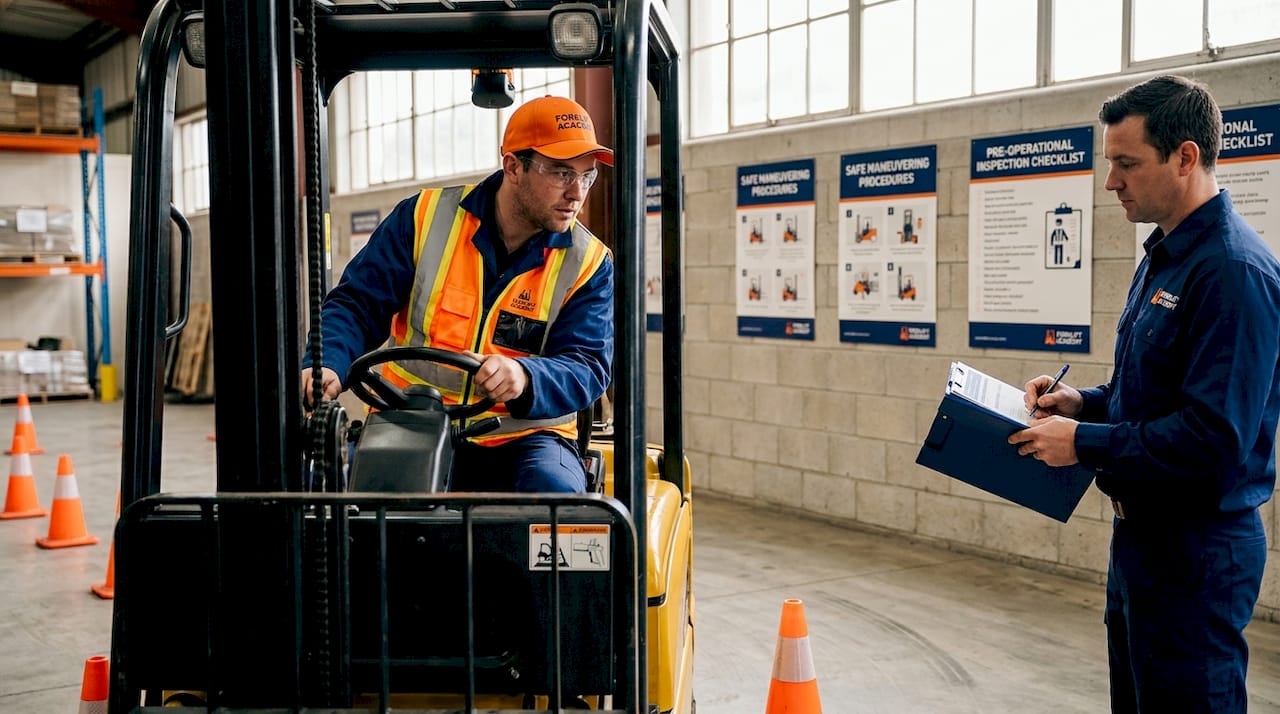
- Hands-on practice: The operator must actually operate the specific type of forklift they will use on the job. Practice must occur in a real or simulated work environment and must be supervised by a qualified trainer.
- Performance evaluation: A qualified trainer observes the operator performing real tasks and formally documents whether each required skill was demonstrated safely and competently.
- Equipment-specific sign-off: If an operator will use more than one class of powered industrial truck, they must be evaluated separately on each type.
- Documentation and record keeping: The employer must retain records of who was trained, what equipment they were trained on, who performed the evaluation, and when certification was issued.
- Scheduled renewal: Every three years, operators must be re-evaluated to maintain active certification.
The OSHA forklift training guide breaks this down further for managers responsible for overseeing multiple operators or multiple forklift classes. Understanding the step-by-step OSHA training sequence is especially important when onboarding new staff at scale.
Pro Tip: Before purchasing any certification program, ask the vendor directly: “Does your program include a supervised hands-on evaluation component?” If the answer is “the operator self-certifies” or “evaluation is built into the online module,” walk away. OSHA requires a qualified evaluator to observe and document the practical performance assessment in person.
| Certification component | Can be done online? | Requires in-person? |
|---|---|---|
| Formal instruction | Yes | No |
| Hands-on practice | No | Yes |
| Performance evaluation | No | Yes |
| Documentation | Yes | No |
| Equipment-specific training | Partial | Yes |
This table makes clear why “online-only” certification is structurally impossible under OSHA. The online portion handles knowledge delivery, but physical competence must be observed, assessed, and recorded by a qualified person on-site.
Comparing certification options: OSHA-compliant vs. non-compliant
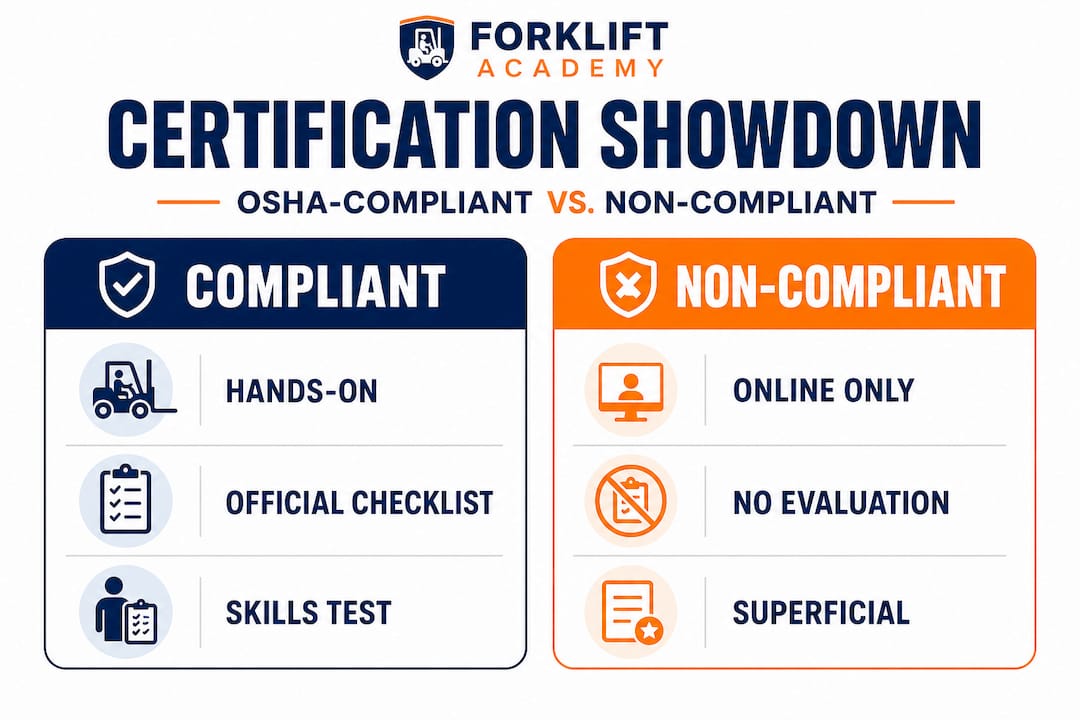
With the steps defined, the contrast between compliant and non-compliant certification options becomes striking. Understanding this gap is critical for any manager evaluating vendors or reviewing your current program.
Verifying a vendor’s methodology, specifically whether they require a practical evaluation, is the single most important due-diligence step you can take before purchasing a program.
Here is how the two approaches compare side by side:
| Feature | OSHA-compliant certification | Online-only (non-compliant) |
|---|---|---|
| Formal instruction | Yes | Yes |
| Hands-on practice | Yes, required | No |
| Performance evaluation | Yes, documented | No or self-reported |
| Equipment-specific training | Yes | Rarely |
| Site-specific training | Yes | No |
| OSHA-valid documentation | Yes | No |
| Acceptable for inspection | Yes | No |
| Penalty protection | Yes | No |
The risks of shortcut certifications extend well beyond a failed inspection:
- OSHA fines: Serious violations can carry penalties of up to $16,550 per violation under current federal guidelines. Willful violations can reach $165,514.
- Workers’ compensation exposure: An injured operator whose certification was non-compliant creates direct employer liability that insurance carriers scrutinize closely.
- Civil litigation: If an under-trained operator injures a coworker or visitor, the lack of compliant certification becomes evidence of negligence.
- Operational downtime: Accidents result in equipment damage, facility disruption, investigation periods, and retraining, all of which cost far more than proper certification upfront.
- Morale and culture damage: Operators who sense that management cut corners on safety lose trust quickly. Turnover in warehouses with poor safety culture is measurably higher.
For a detailed breakdown of how these programs differ in practice, the comparison of online vs onsite forklift certification offers a practical framework many safety officers find useful when building or auditing their programs.
The bottom line is that non-compliant certification creates the illusion of safety without the substance. Operators receive a card. Managers check a box. But the actual skills gap remains, and so does the legal exposure.
Real impacts: Safety, liability, and operational performance
The case for full OSHA compliance is not just regulatory. It is operational. Data consistently shows that proper training and OSHA compliance drive measurable reductions in workplace incidents and better overall risk control. For warehouse managers, those numbers translate directly into business outcomes.
Tangible benefits of full certification compliance include:
- Fewer injuries and near-misses: Operators who completed all three certification components demonstrate stronger hazard recognition and safer load-handling practices. This shows up in reduced first-aid events, property damage incidents, and OSHA recordables.
- Lower insurance premiums: Many commercial liability and workers’ compensation carriers offer rate reductions to operations that document consistent OSHA-compliant training programs. Your broker may be leaving money on the table if your current program does not qualify.
- Faster inspection clearance: When OSHA arrives, having clean, complete certification records for every active operator significantly reduces inspection duration and the likelihood of citations.
- Reduced equipment damage: Properly trained operators handle loads more precisely, make better decisions in tight spaces, and perform pre-operation inspections that catch mechanical issues before they become expensive breakdowns.
- Stronger safety culture: When operators see that management invested in real, rigorous training, they internalize that safety is a priority. That cultural signal reduces at-risk behaviors across the floor.
Pro Tip: Conduct an internal certification audit every 12 months, not just when renewals come due. Pull every operator’s file, verify that formal instruction, hands-on practice, and evaluation documentation are all present, and confirm that any operator who experienced an incident or changed equipment types has been re-evaluated. This single habit prevents the vast majority of OSHA citation scenarios.
“A well-structured forklift training program does more than satisfy a regulator. It builds the institutional knowledge that keeps experienced operators sharp and gives new operators a reliable foundation from the first day on the floor.”
Strategies for reducing forklift risks and implementing forklift incident prevention strategies often start with a compliance audit that reveals certification gaps managers did not know existed. That audit is one of the highest-return safety investments a warehouse can make.
Why cutting corners on certification is a costly mistake
Here is the honest take after more than two decades working with warehouse managers, safety officers, and compliance teams across the U.S. and Canada: the managers who choose cheaper, faster, online-only certification options are not making a budget decision. They are making a risk transfer decision, and they are usually transferring that risk onto their operators and their organization.
The math looks attractive at first. An online-only program might cost a fraction of a full OSHA-compliant course. It takes less time. It requires less coordination. Operators get their card without leaving the floor for long. For a high-volume operation running dozens of certifications per year, the short-term savings feel real.
But that math ignores the denominator. One OSHA serious-violation citation wipes out years of certification cost savings. One workers’ compensation claim from an undertrained operator dwarfs whatever you saved on the training program. And if that incident results in litigation, the discovery process will surface every shortcut you made, which means your own records become the evidence against you.
What the best-performing warehouses understand, and this is the contrarian insight most safety articles miss, is that rigorous certification is not a cost center. It is a competitive differentiator. Facilities with provably superior safety records attract better operators, pay lower insurance rates, face less regulatory friction during expansions, and win more contracts with customers who audit supplier safety programs. Certification done right pays forward.
There is also a workforce development angle that managers rarely factor in. When you invest in implementing real forklift safety training, you signal to every operator on your floor that their competence and safety matter. That signal affects retention, performance, and the willingness of experienced operators to mentor newer team members. Compliance becomes culture. And culture, over time, is worth far more than a certificate card.
Treat certification as the baseline of workforce development, not the ceiling of legal obligation.
How to get compliant and stay protected
If your current certification program has gaps, whether in documentation, hands-on evaluation, or equipment-specific coverage, the good news is that getting into full compliance is straightforward when you work with the right provider.
Forklift Academy has spent over 20 years helping warehouse managers and safety officers across the U.S. and Canada build certification programs that hold up under OSHA scrutiny and, more importantly, actually reduce accidents on the floor. From fully OSHA forklift certification options that combine online instruction with structured hands-on evaluation, to onsite training and train-the-trainer kits for large operations, Forklift Academy covers every format your facility needs. If you are ready to audit your current program and fill the gaps, start by reviewing the step-by-step compliance process to understand exactly what documentation and training components your operators need to be fully covered.
Frequently asked questions
Is online-only forklift certification accepted by OSHA?
No. OSHA-compliant certification requires formal instruction plus hands-on practical training and a final skills evaluation, so online-only courses do not satisfy the full standard.
Does forklift certification in the U.S. cover Canada’s requirements?
No. Canadian requirements vary by province and reference CSA B335-15, which means U.S. OSHA compliance does not automatically transfer to Canadian operations.
Who is responsible for ensuring forklift operators are certified?
In the U.S., the employer carries that responsibility. Under 29 CFR 1910.178, employers must train, evaluate, and certify operators before allowing any unsupervised forklift operation.
What documentation is required for OSHA-compliant certification?
Employers must retain records showing that each operator completed formal instruction and practical training, including a documented performance evaluation conducted by a qualified trainer.
Recommended
- Why forklift safety matters: Protect your team and stay compliant – Top Osha Forklift Certification
- Employee forklift training guide for OSHA compliance 2026 – Top Osha Forklift Certification
- Onsite Forklift Certification: Safer, Compliant Teams – Top Osha Forklift Certification
- OSHA Compliance Tips for Effective Forklift Training & Safety – Top Osha Forklift Certification