
TL;DR:
- Most forklift accidents are preventable with proper operator training and safety culture.
- OSHA requires employers to provide type-specific training, evaluation, and documented certification.
- Strong safety management and ongoing compliance efforts significantly reduce incident rates.
Forklift accidents are one of the most preventable sources of serious injury in U.S. warehouses, yet they keep happening at an alarming rate. ~85 fatalities and 34,900 serious injuries occur annually, with tip-overs accounting for up to 42% of incidents. The encouraging part: roughly 70% of those incidents are preventable with proper training. For warehouse managers and safety compliance officers, OSHA forklift rules aren’t bureaucratic red tape. They’re a proven, field-tested framework that protects your workers, shields your company from costly citations, and builds a culture where everyone goes home safe. This guide walks you through every compliance step, from understanding the standard to avoiding the mistakes that get warehouses cited.
Table of Contents
- Understanding OSHA forklift rules and compliance essentials
- Forklift operator training: What OSHA requires
- Certification, evaluation, and refresher requirements
- Common compliance pitfalls and how to avoid them
- Why most warehouse teams still struggle with OSHA forklift compliance
- Achieve OSHA forklift compliance with expert-guided certification
- Frequently asked questions
Key Takeaways
| Point | Details |
|---|---|
| Employer responsibility | Employers must ensure all forklift operators are properly trained, evaluated, and certified to meet OSHA compliance. |
| Training and certification process | A compliant program includes classroom instruction, hands-on practice, and evaluation by a qualified trainer. |
| Refresher requirements | Operators need refresher training if unsafe, after incidents, when equipment changes, or at least every three years. |
| Common pitfalls | Weak documentation, missing refresher deadlines, and ignoring site-specific risks are top reasons for citations. |
| Proven benefits | OSHA forklift compliance reduces accidents by up to 70% and lowers facility costs significantly. |
Understanding OSHA forklift rules and compliance essentials
OSHA’s primary forklift standard is 29 CFR 1910.178(l), which requires employers to ensure forklift operators are competent through initial training, practical training, evaluation, and certification. This standard applies to virtually every powered industrial truck operation in general industry, including sit-down counterbalanced forklifts, reach trucks, order pickers, and pallet jacks.
One of the most important things to understand upfront: the employer, not the operator, carries the legal responsibility for compliance. If an operator is running a forklift without proper certification, OSHA holds the employer accountable. That’s a critical distinction that shapes every decision you make about your training program.
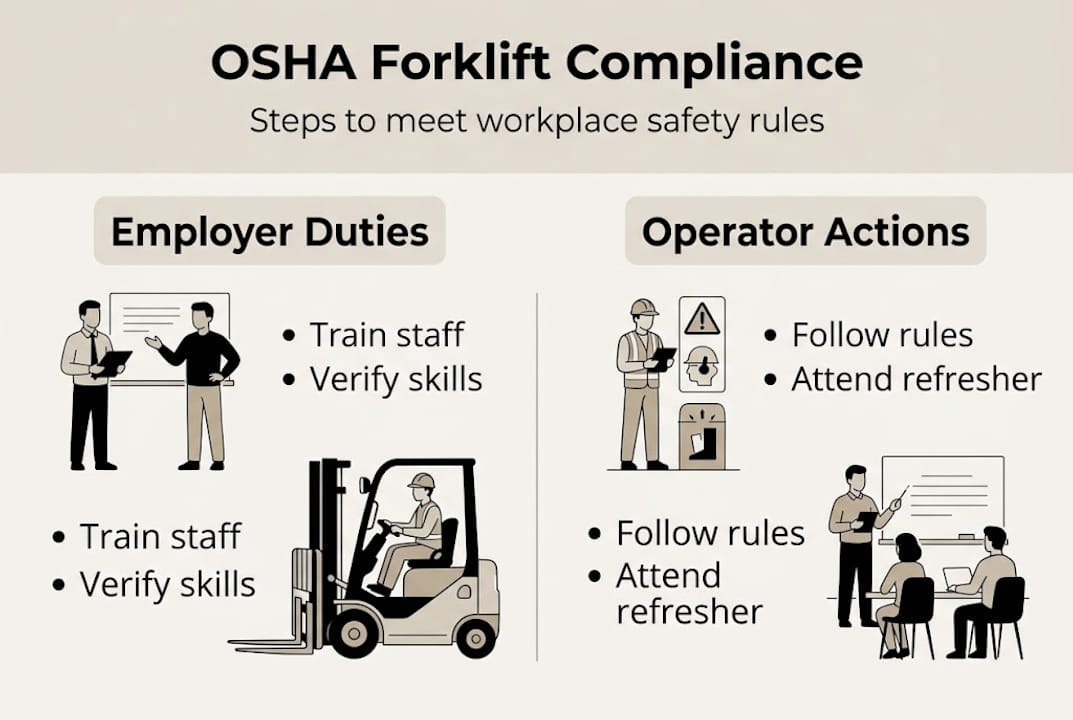
Another common misconception is that operators need an official government-issued forklift license. That doesn’t exist. Certification under OSHA is an employer-issued document that includes the operator name, training and evaluation dates, and the identity of the trainer. You create and maintain it internally.
Before building your program, get clear on four key terms:
- Training: The formal instruction and hands-on practice operators receive before operating independently.
- Evaluation: A practical assessment where a qualified person observes the operator performing tasks.
- Certification: The employer-issued record confirming the operator has completed training and evaluation.
- Refresher training: Additional instruction triggered by specific events or at scheduled intervals.
Here’s a quick overview of who the standard applies to:
| Workplace type | Covered by 29 CFR 1910.178? |
|---|---|
| General industry warehouses | Yes |
| Construction sites | Separate standard (29 CFR 1926.602) |
| Maritime operations | Separate standard |
| Agriculture | Separate standard |
For most warehouse managers, 29 CFR 1910.178 is your primary reference. Reviewing the OSHA forklift standards in full will help you map your current practices against what’s actually required, and a solid forklift compliance guide can make that comparison faster.
“OSHA’s forklift standard isn’t a suggestion. It’s a minimum baseline. The companies that treat it as a ceiling are the ones that end up in incident reports.”
Forklift operator training: What OSHA requires
Once you understand the framework, the next step is building a training program that actually meets the standard. OSHA mandates three distinct components: formal instruction, practical training, and evaluation by a qualified person with relevant knowledge, training, and experience. All three must happen before an operator works independently.
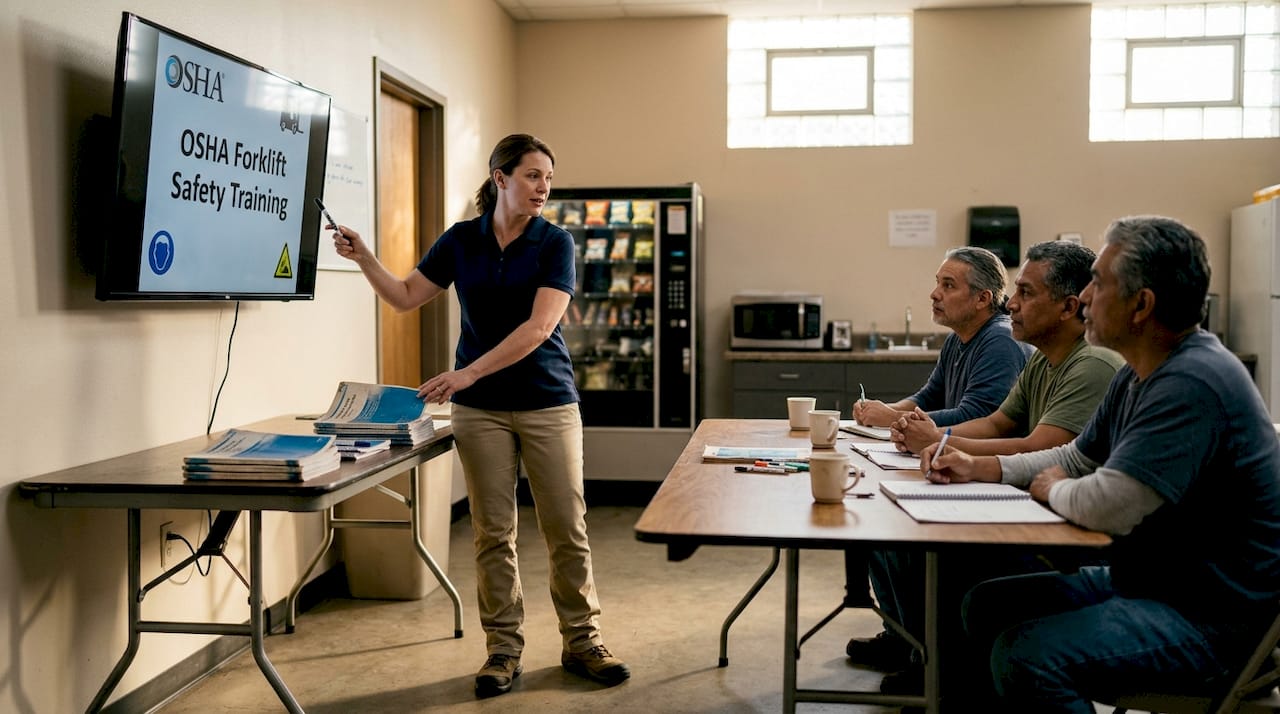
Formal instruction covers classroom-style learning, including lectures, discussions, videos, and written materials. Practical training puts operators on actual equipment in real or simulated work conditions. Evaluation is the final check where a qualified trainer observes performance and confirms competency.
Here’s how the three training components compare:
| Component | Format | Goal |
|---|---|---|
| Formal instruction | Classroom, online, video | Build foundational knowledge |
| Practical training | Hands-on with equipment | Develop operating skill |
| Evaluation | Observed performance | Confirm competency |
OSHA also specifies that training must be type-specific. An operator certified on a sit-down counterbalanced forklift is not automatically certified to operate a reach truck or order picker. Each truck type requires its own training and evaluation cycle. This surprises many managers who assume certification transfers across equipment.
The core training topics OSHA requires fall into three categories:
- Truck-related topics: Operating instructions, warnings, precautions, controls, stability, inspection, and refueling.
- Workplace-related topics: Surface conditions, load handling, ramps, pedestrian areas, hazardous locations, and narrow aisles.
- OSHA requirements: The regulatory content operators need to understand their rights and responsibilities.
Trainers don’t need a third-party certification to qualify. What they do need is demonstrated knowledge and hands-on experience with the specific equipment type. Many facilities use an experienced senior operator or a safety manager as their designated trainer.
Pro Tip: Build site-specific scenarios into your practical training. If your warehouse has a loading dock with uneven surfaces or a cold storage area, those environments should be part of every operator’s hands-on training. Generic training misses the hazards that actually exist in your building. A structured employee forklift training guide can help you customize your program for your specific operation, and resources on how to implement safety training effectively will keep your program consistent over time.
Certification, evaluation, and refresher requirements
Completing training is only half the job. Proper certification and ongoing compliance require deliberate documentation and a clear process for managing refresher cycles.
Here are the four steps to certifying a forklift operator:
- Complete all required formal instruction for the specific truck type.
- Conduct supervised practical training on the actual equipment in the actual work environment.
- Perform a formal evaluation where a qualified trainer observes and assesses the operator.
- Issue and retain a certification record that includes the operator’s name, training and evaluation dates, and trainer identity.
Until that process is complete, trainees can only operate under direct supervision in areas that won’t endanger other employees. No independent operation is allowed for uncertified operators, period.
Here’s a summary of what your certification records should include:
| Record element | Required? |
|---|---|
| Operator name | Yes |
| Training completion date | Yes |
| Evaluation date | Yes |
| Trainer name or identity | Yes |
| Equipment type covered | Strongly recommended |
Refresher training is where many facilities fall short. OSHA requires it in specific situations, not just on a fixed calendar. Refresher training is triggered when an operator is observed behaving unsafely, is involved in an accident or near-miss, is assigned a different truck type, or when workplace conditions change significantly. Beyond those triggers, a performance evaluation must happen at least every three years.
“Refresher training isn’t a punishment. It’s a reset. The best facilities treat it as a routine investment, not a reaction to failure.”
Documentation is the employer’s responsibility from start to finish. A clear certification checklist helps you stay organized, and a business forklift training guide can help you scale these processes across a larger workforce without letting records slip through the cracks.
Common compliance pitfalls and how to avoid them
Even well-intentioned programs develop gaps over time. Here are the most frequent compliance failures warehouse managers encounter, and practical ways to close them.
Top compliance mistakes:
- Incomplete or missing training documentation, especially for long-tenured employees hired before formal programs existed.
- Missed refresher deadlines because no one owns the tracking process.
- Theory-heavy training with insufficient hands-on practice time.
- Operators using equipment types they were never specifically trained and evaluated on.
- Failing to address site-specific hazards in training content.
- Skipping daily pre-use inspections, which are a separate but equally important OSHA requirement.
Daily pre-use inspections, load stability, and pedestrian separation are critical operational requirements where employer responsibility is absolute. Inspections aren’t optional, and their completion should be logged every shift.
The payoff for getting this right is significant. OSHA-compliant training reduces accidents by up to 70%, and since human error causes roughly 87% of forklift incidents, the training investment directly attacks the root cause of most warehouse injuries.
Pro Tip: Appoint a dedicated compliance officer or safety lead who owns the training calendar, tracks refresher deadlines, and audits records quarterly. When no one person owns compliance, it drifts. One person with a clear mandate changes that dynamic immediately.
A well-structured forklift training program guide gives you a repeatable system for onboarding new operators and managing existing certifications. Pairing it with a detailed OSHA compliance checklist keeps your facility audit-ready at all times. For facilities exploring flexible formats, understanding the online certification benefits can help you decide how to structure the formal instruction component of your program efficiently.
Why most warehouse teams still struggle with OSHA forklift compliance
Here’s the uncomfortable truth: most compliance failures aren’t caused by ignorance of the rules. They’re caused by leadership treating training as a checkbox rather than an operational investment.
When managers view forklift certification as something you do once to satisfy an audit, the program stagnates. Refresher deadlines get missed. Documentation gets sloppy. Operators start cutting corners because they sense that safety isn’t actually a priority.
Real compliance is cultural, not procedural. The facilities that maintain clean records and low incident rates aren’t just following the steps. They have supervisors who talk about safety daily, trainers who take evaluation seriously, and operators who understand why the rules exist, not just what they are.
Online modules and classroom instruction are valuable starting points, but they don’t build culture on their own. Practical application, leader involvement, and consistent reinforcement do. When your safety lead is visible on the floor, when supervisors address unsafe behavior immediately, and when refresher training is treated as normal rather than punitive, compliance becomes self-sustaining. Resources on implementing training programs can help you move from procedural compliance to genuine safety leadership.
Achieve OSHA forklift compliance with expert-guided certification
Building and maintaining a fully compliant forklift training program takes time, expertise, and consistent follow-through. For many warehouse operations, the most practical path forward is partnering with a proven provider that handles the complexity for you.
At Forklift Academy, we’ve spent over 20 years helping warehouse teams across the U.S. achieve and maintain OSHA forklift certification without the guesswork. Our programs cover everything from initial operator training to refresher cycles and recordkeeping, available in online, onsite, and train-the-trainer formats. Whether you need to certify one operator or an entire facility, we have a solution designed for your operation. Start navigating forklift certification with confidence today.
Frequently asked questions
Who is responsible for OSHA forklift compliance in a warehouse?
The employer is fully responsible for ensuring all forklift operators are properly trained, evaluated, and certified. Operators cannot be held liable for gaps the employer created.
How often is forklift refresher training required under OSHA rules?
OSHA requires refresher training after unsafe conduct, accidents, equipment or workplace changes, and a performance evaluation every 3 years at minimum, regardless of incident history.
Is an OSHA forklift license issued to operators?
No. There is no government-issued license for forklift operators. Certification is issued by the employer after the operator completes required training and evaluation.
What topics must be covered in OSHA forklift operator training?
OSHA requires instruction on truck-related, workplace-related, and regulatory topics, including operating procedures, inspection, load stability, site-specific hazards, and applicable OSHA requirements.
Recommended
- Forklift Evaluation Guide: Step-by-Step OSHA Compliance – Top Osha Forklift Certification
- Forklift Safety Checklist Guide for OSHA Compliance – Top Osha Forklift Certification
- How to Implement Forklift Safety Training for OSHA Compliance – Top Osha Forklift Certification
- How to Lead Onsite Forklift Training for OSHA Compliance – Top Osha Forklift Certification