
Many warehouse managers believe scissor lifts are low-maintenance equipment that only needs attention when something breaks. This misconception puts workers at risk and leads to costly compliance violations. Regular maintenance isn’t just about fixing problems, it’s about preventing accidents before they happen. In this guide, you’ll learn the essential maintenance tasks that keep scissor lifts safe, compliant with OSHA standards, and operating efficiently. We’ll cover critical components to inspect, practical checklists you can implement today, common challenges with proven solutions, and how proper maintenance connects directly to regulatory compliance and workplace safety.
Table of Contents
- Key takeaways
- Understanding scissor lift components that need maintenance
- Step-by-step routine maintenance checklist for scissor lifts
- Common maintenance challenges and how to overcome them
- Ensuring OSHA compliance through maintenance and training
- Enhance your scissor lift safety with expert training and certification
- Frequently asked questions
Key Takeaways
| Point | Details |
|---|---|
| Regular maintenance prevents accidents | Routine inspections and scheduled servicing reduce hazards and keep equipment compliant with OSHA guidelines. |
| Battery and hydraulics focus | Prioritize checks on battery systems and hydraulic components to prevent power failures and jerky lift movements. |
| Safety features must function | Test emergency lowering, guardrails, and interlocks in each inspection to prevent falls and equipment malfunctions. |
| Document and train for compliance | Maintain thorough records of inspections and provide operator training to support safety and legal adherence. |
Understanding scissor lift components that need maintenance
Every scissor lift contains critical systems that require regular attention to function safely. Knowing which parts to focus on helps you prioritize maintenance efforts and allocate resources effectively.
The battery system powers electric scissor lifts and demands consistent monitoring. Check battery fluid levels weekly, clean terminals monthly, and test charging systems to prevent unexpected power failures. Weak batteries cause lifts to drop unexpectedly, creating serious hazards for operators working at height.
Hydraulic components control lift movement and platform stability. Inspect hydraulic fluid levels before each use and watch for leaks around hoses, cylinders, and connections. Low fluid or contaminated hydraulic systems lead to jerky movements and platform instability. Maintenance should focus on battery, hydraulics, safety systems, and structural components for safe lift operation.
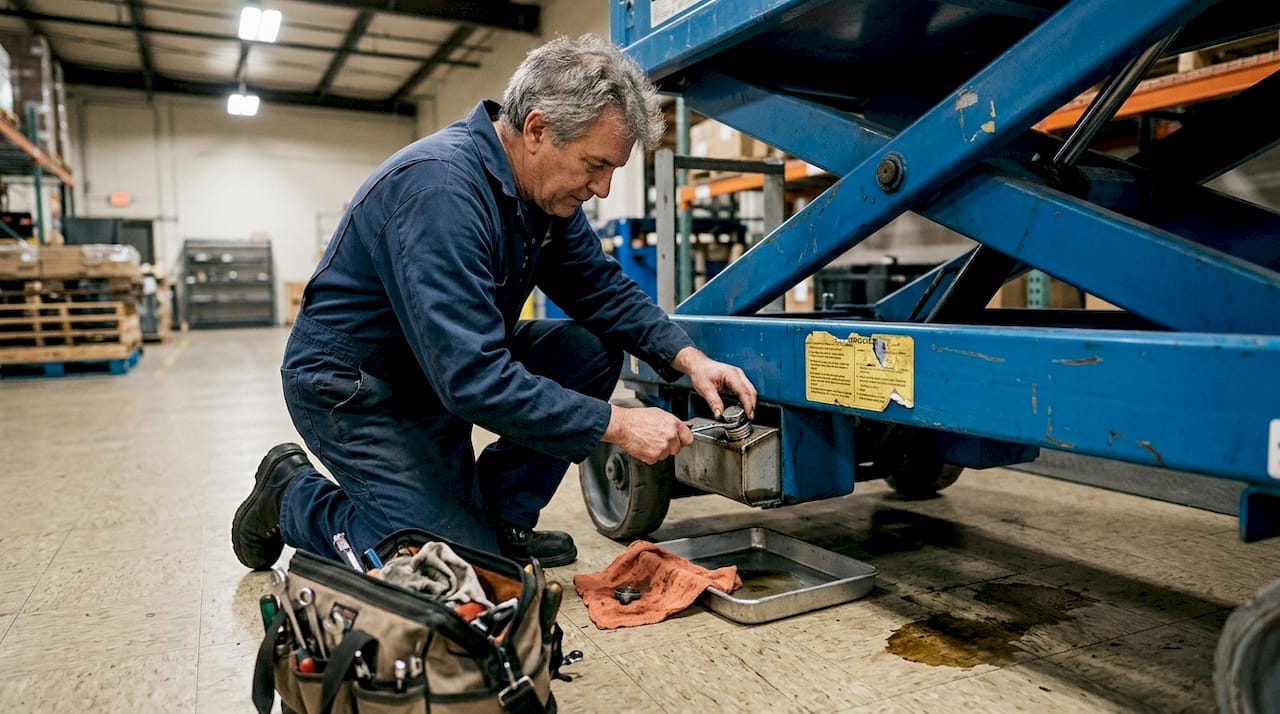
Safety features require special attention because they protect operators from falls and equipment malfunctions. Test emergency lowering systems, guardrails, and safety interlocks during every inspection cycle. These devices must function perfectly every time, as a single failure can result in serious injury or death.
Structural integrity affects the entire lift’s stability and load capacity. Examine the platform for cracks, welds for damage, and scissor arms for wear or deformation. Pay attention to:
- Platform surfaces for rust, cracks, or loose fasteners
- Scissor arm pivot points for excessive wear or play
- Welds and joints for stress fractures or separation
- Wheels and casters for proper rotation and brake function
- Frame alignment to ensure the lift operates level
Regular component inspections catch small problems before they become dangerous failures. Understanding scissor lift operation basics helps maintenance teams recognize what normal operation looks like, making abnormalities easier to spot.
Step-by-step routine maintenance checklist for scissor lifts
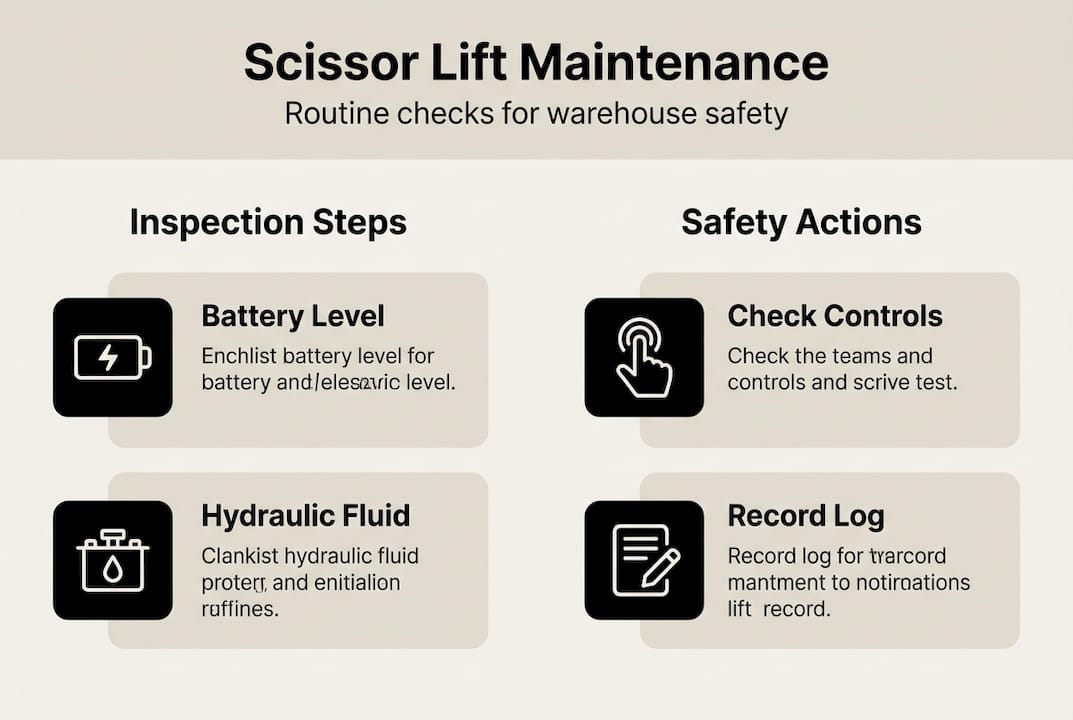
Implementing a structured maintenance schedule keeps scissor lifts safe and reduces unexpected downtime. This practical checklist breaks maintenance into manageable daily, weekly, and monthly tasks.
Daily pre-use inspections take 10 minutes but prevent most accidents. Before operating any scissor lift, complete these essential checks:
- Walk around the lift looking for visible damage, leaks, or loose parts
- Test all controls at ground level to verify proper function
- Check tire pressure and condition on mobile units
- Verify battery charge level shows adequate power
- Inspect the platform surface for debris, oil, or damage
- Test emergency stop and lowering functions
- Confirm all safety decals and warning labels are visible
- Document the inspection with date, time, and operator signature
Weekly maintenance digs deeper into system performance. Consistent daily and monthly inspections reduce mechanical failures and enhance worker safety. Schedule these tasks every seven days:
- Check hydraulic fluid level and condition
- Inspect all hydraulic hoses for wear, cracks, or leaks
- Test battery water levels on flooded lead-acid batteries
- Clean battery terminals and check for corrosion
- Lubricate pivot points and moving parts per manufacturer specs
- Verify all fasteners are tight and secure
- Test safety devices including tilt sensors and overload protection
Monthly comprehensive maintenance addresses long-term wear and system health. Dedicate 30 to 45 minutes for thorough inspections:
- Perform load testing to verify lift capacity and stability
- Inspect structural welds and joints for cracks or damage
- Check all electrical connections for looseness or corrosion
- Test emergency descent system under controlled conditions
- Verify platform leveling functions correctly throughout travel range
- Inspect wheels, bearings, and braking systems
- Review maintenance logs to identify recurring issues
- Update equipment records with all findings and repairs
Pro Tip: Keep a dedicated maintenance log book with each scissor lift. Record every inspection, repair, and part replacement with dates and technician signatures. This documentation proves compliance during OSHA inspections and helps identify patterns that predict future failures.
Consistent adherence to this checklist prevents 80% of maintenance-related incidents. Understanding scissor lift certification steps ensures your team knows proper inspection procedures and can spot problems early.
Common maintenance challenges and how to overcome them
Warehouse managers face predictable obstacles when maintaining scissor lifts. Recognizing these challenges and implementing practical solutions keeps your maintenance program effective.
Insufficient operator training creates the most maintenance problems. Untrained operators miss warning signs, use equipment improperly, and fail to report issues promptly. This leads to minor problems becoming major failures. Solution: Implement mandatory training before anyone operates scissor lifts and provide refresher courses annually. Lack of training and insufficient documentation are leading causes of maintenance-related incidents.
Irregular inspection schedules allow problems to accumulate unnoticed. When maintenance happens sporadically, small issues compound into expensive repairs or safety hazards. Busy warehouse operations make it tempting to skip inspections, but this creates liability and risk. Solution: Assign specific maintenance responsibilities to designated team members and use digital reminders or scheduling software to ensure inspections happen on time.
Documentation lapses leave you vulnerable during audits and investigations. Missing maintenance records make it impossible to prove compliance or track equipment history. When accidents occur, incomplete documentation exposes your company to significant liability. Solution: Create simple, standardized inspection forms that take minimal time to complete. Store records digitally for easy retrieval and analysis.
Budget constraints tempt managers to delay maintenance or use substandard parts. Short-term savings lead to long-term costs through equipment failures, accidents, and regulatory fines. Solution: Calculate the true cost of maintenance failures including downtime, repairs, and potential injuries. Present this data to leadership showing that preventive maintenance saves money.
Key strategies for overcoming maintenance challenges include:
- Establishing clear accountability with assigned maintenance personnel
- Creating visual inspection aids posted near equipment storage
- Scheduling maintenance during slow operational periods
- Building relationships with qualified service providers
- Investing in quality replacement parts that meet manufacturer specifications
Pro Tip: Take photos of properly maintained equipment and post them in maintenance areas. Visual references help technicians quickly identify when something looks wrong or needs attention.
Proper maintenance isn’t an expense, it’s an investment in worker safety and operational efficiency. Every dollar spent on preventive maintenance saves an average of four dollars in emergency repairs and lost productivity.
Addressing these challenges systematically transforms maintenance from a burden into a competitive advantage. Following scissor lift safety tips every manager must know helps create a culture where maintenance is valued and prioritized.
Ensuring OSHA compliance through maintenance and training
OSHA regulations directly connect scissor lift maintenance to workplace safety and legal compliance. Understanding these requirements protects workers and shields your company from violations.
OSHA mandates regular maintenance and operator training to prevent workplace accidents and fulfill compliance obligations. The agency requires employers to ensure scissor lifts are maintained in safe operating condition through regular inspections and prompt repairs. Failure to maintain equipment properly results in citations, fines, and potential criminal liability if injuries occur.
OSHA maintenance requirements include:
- Daily pre-use inspections by qualified operators
- Immediate removal of defective equipment from service
- Repairs performed only by authorized personnel
- Maintenance following manufacturer specifications
- Written records of all inspections and repairs
- Annual comprehensive inspections by qualified technicians
Training mandates work hand in hand with maintenance requirements. OSHA requires employers to certify that operators have received proper training and evaluation. This training must cover equipment inspection procedures, recognizing maintenance needs, and reporting defects immediately.
The following table outlines OSHA maintenance frequency and documentation expectations:
| Maintenance Activity | Frequency | Documentation Required | Retention Period |
|---|---|---|---|
| Pre-use Inspection | Before each use | Operator checklist | 3 months minimum |
| Routine Maintenance | Weekly/Monthly per manufacturer | Service log with dates and findings | Duration of equipment ownership |
| Comprehensive Inspection | Annually | Detailed report by qualified person | Duration of equipment ownership |
| Defect Repairs | Immediately upon discovery | Work order with parts and labor | Duration of equipment ownership |
| Operator Training | Initial and every 3 years | Certificate with evaluation results | Duration of employment plus 3 years |
Compliance goes beyond checking boxes. It requires building systems that ensure maintenance happens consistently and documentation proves it. Create a compliance program that includes:
- Written maintenance procedures specific to your equipment
- Designated qualified persons responsible for inspections
- Clear processes for removing defective equipment from service
- Vendor relationships for repairs requiring specialized expertise
- Regular audits to verify procedures are followed
Operator certification connects directly to maintenance effectiveness. Trained operators recognize problems early, perform daily inspections correctly, and understand why maintenance matters for their safety. Understanding OSHA compliance forklift certification requirements helps managers build comprehensive safety programs.
Maintenance and training create a safety culture where everyone takes responsibility for equipment condition. When operators know their lives depend on proper maintenance, they become partners in keeping lifts safe rather than passive equipment users.
Enhance your scissor lift safety with expert training and certification
Mastering scissor lift maintenance basics is just the beginning of creating a truly safe workplace. Professional training transforms maintenance knowledge into practical skills that protect workers and ensure compliance.
Forklift Academy offers specialized scissor lift certification programs designed specifically for warehouse operations. Our courses combine maintenance fundamentals with hands-on operator training, giving your team the complete skill set needed for safe, compliant operations. With over 20 years of experience delivering OSHA-compliant training, we understand the real-world challenges warehouse managers face.
Our step by step scissor lift certification program covers everything from daily inspections to emergency procedures. Choose convenient online training or schedule onsite sessions at your facility. We also offer train the trainer programs that empower your team to deliver ongoing training internally. Understanding OSHA compliance forklift certification requirements ensures your training meets all regulatory standards. Invest in professional certification and build a safety culture that protects your most valuable asset: your people.
Frequently asked questions
What is the recommended frequency for routine scissor lift maintenance?
Routine checks should happen daily before each use, with operators completing pre-use inspection checklists. More detailed maintenance occurs weekly for fluid levels and monthly for comprehensive system checks. Follow your equipment manufacturer’s specific maintenance schedule and OSHA guidelines, as requirements vary by lift type and usage intensity.
What are the most common causes of scissor lift maintenance issues?
Battery failures top the list, followed by hydraulic leaks, worn safety devices, and structural wear from heavy use. Environmental factors like extreme temperatures and corrosive materials accelerate component degradation. Proper preventive maintenance and thorough operator training significantly reduce these issues by catching problems early.
How does operator training impact scissor lift maintenance and safety?
Operator training directly improves maintenance effectiveness by teaching workers to identify problems during daily inspections. Trained operators report fewer maintenance issues and accidents because they understand equipment limitations and proper operating procedures. Well-trained staff also perform more thorough pre-use checks and communicate problems promptly, preventing minor issues from becoming dangerous failures.
What documentation must be kept for scissor lift maintenance compliance?
Maintain records of all daily inspections, routine maintenance, repairs, and annual comprehensive inspections for the duration of equipment ownership. OSHA requires operator training certificates be kept for the employment period plus three years. Documentation must include dates, findings, corrective actions taken, and signatures of qualified persons performing the work. Digital or paper records are acceptable if they’re readily accessible during inspections.
Can warehouse staff perform scissor lift maintenance or must we hire outside contractors?
Your staff can perform routine maintenance tasks like daily inspections, fluid checks, and basic cleaning if they receive proper training. However, complex repairs involving hydraulic systems, electrical components, or structural welding require qualified technicians with specialized expertise. Many warehouses handle routine maintenance internally while contracting annual comprehensive inspections and major repairs to certified service providers.
Recommended
- Scissor lift operation basics: Cut accidents by 60% – Top Osha Forklift Certification
- 10 Scissor Lift Safety Rules Every Worker Should Know – Top Osha Forklift Certification
- Essential Scissor Lift Training Steps for Safe Operations – Top Osha Forklift Certification
- Beginner Scissor Lift Training Steps for Safe Operation – Top Osha Forklift Certification