
Forklift accidents account for thousands of serious injuries in North American warehouses each year, yet most are preventable through proper safety protocols. Warehouse managers and business owners face constant pressure to maintain productivity while protecting workers from potentially fatal equipment failures. A comprehensive OSHA compliance checklist transforms this challenge into a manageable daily routine. This guide delivers the exact criteria, inspection elements, and documentation practices you need to meet regulatory standards while creating a safer workplace.
Table of Contents
- Key takeaways
- Key criteria for an effective OSHA forklift compliance checklist
- Additional Canadian forklift compliance requirements and standards
- Common forklift safety violations and how a compliance checklist prevents them
- Comparing top forklift checklist elements: a practical comparison table
- Ensure OSHA compliance with expert forklift training and certification
- FAQ
Key Takeaways
| Point | Details |
|---|---|
| Daily inspections required | OSHA requires inspecting every forklift before the start of each shift as a legal requirement that protects workers and employers. |
| Visual and functional checks | The checklist should cover visual inspections of tires, brakes, steering, forks, mast, fluids, and safety devices plus functional tests of lift, tilt, horn, lights, and backup alarm. |
| Documentation and tagging | Every inspection must be recorded with what was checked who performed it defects found and corrective actions, and any unit failing inspection must be tagged out of service. |
| Canadian standards alignment | Canadian operations follow provincial health and safety laws and the CSA B335 15 standard. |
Key criteria for an effective OSHA forklift compliance checklist
An effective compliance checklist starts with understanding exactly what OSHA requires. Federal regulations demand that warehouse operators inspect every forklift before the start of each shift. This isn’t a suggestion or best practice, it’s a legal requirement that protects both workers and employers from preventable incidents.
The OSHA compliance checklist must cover specific equipment components. Operators need to examine tires for wear and proper inflation, check all fluid levels including hydraulic oil and coolant, test brakes for responsiveness, verify steering operates smoothly, inspect forks for cracks or bends, examine the mast for damage, and confirm all safety devices function properly. These visual inspections take only minutes but catch problems before they escalate.
Functional testing forms the second critical layer. Simply looking at equipment isn’t enough. Operators must test the lift mechanism under load, verify the tilt function responds correctly, check that the horn produces adequate sound, confirm all lights illuminate properly, and ensure the backup alarm activates. Each test confirms the forklift can perform its job safely.
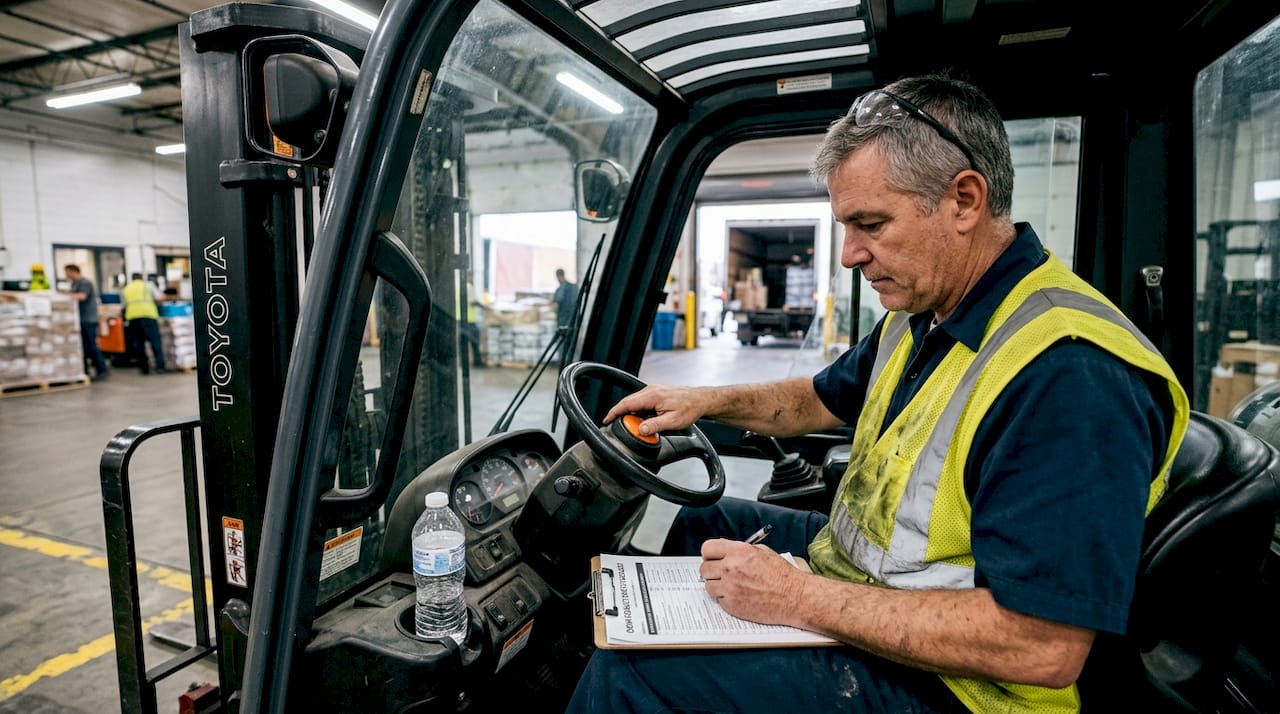
Documentation separates compliant operations from liability nightmares. Every inspection requires written records showing what was checked, who performed the inspection, what defects were found, and what corrective actions were taken. When equipment fails inspection, it must be tagged out of service immediately. The forklift safety checklist guide provides templates that streamline this documentation process.
Defect reporting creates accountability. Operators who discover problems during inspections must report them to supervisors immediately. Management then faces a clear choice: repair the equipment or keep it out of service. There’s no middle ground. Operating a forklift with known defects violates OSHA standards and exposes the company to severe penalties.
The most effective checklists organize inspection points logically. Start with a walkaround visual inspection, move to the operator compartment for controls and safety devices, then conduct functional tests. This sequence ensures nothing gets missed during busy morning shift changes. A well-designed USA OSHA forklift daily safety inspection checklist follows this natural flow.
Additional Canadian forklift compliance requirements and standards
Canadian warehouse operations follow parallel but distinct regulations. While OSHA sets the standard for U.S. facilities, Canadian operations must comply with provincial Occupational Health and Safety laws plus the CSA B335-15 standard. These requirements create similar inspection obligations with some important additions.
Provincial regulations vary across Canada but share common elements. Ontario’s OHSA Regulation 851 mandates that only trained and competent operators can use powered mobile equipment. British Columbia requires written operating procedures for each type of forklift. Alberta demands specific load capacity documentation displayed on every unit. Quebec adds language requirements for all safety documentation and training materials.
The Canadian Centre for Occupational Health and Safety operator guidelines establish that forklift safety follows provincial OHS laws and CSA B335-15 standard, requiring trained operators, daily inspections, and load limits. This standard specifically addresses operator training, equipment maintenance, and workplace procedures. It requires employers to develop site-specific safe operating procedures that account for unique facility hazards.
Trainer qualifications receive more scrutiny in Canadian jurisdictions. Individuals providing forklift training must demonstrate both operational expertise and instructional ability. Many provinces require trainers to hold specific credentials or complete train-the-trainer programs. This ensures consistent quality across training providers and better prepares operators for real-world conditions.
Refresher training cycles differ from U.S. practices. Canadian standards recommend recertification every three years, though some provinces mandate it more frequently after incidents or near misses. The forklift certification checklist helps track when operators need updated training.
Load capacity rules get extra emphasis under Canadian standards. Every forklift must display its maximum load rating clearly visible to the operator. Exceeding this capacity, even temporarily, constitutes a serious violation. The load center distance matters too, since loads positioned further from the mast reduce effective capacity significantly.
Pro Tip: Companies operating in both countries should adopt the stricter requirements from both regulatory frameworks. This creates a single, comprehensive safety program that meets all obligations regardless of facility location.
Provincial audits add another compliance layer. Inspectors can visit facilities unannounced to review training records, inspect equipment, and interview operators. Facilities must maintain organized documentation systems that can withstand this scrutiny. The OSHA forklift standards provide a foundation that Canadian operations can build upon.
Common forklift safety violations and how a compliance checklist prevents them
Certain violations appear repeatedly in workplace safety citations. Understanding these patterns helps warehouse managers focus their prevention efforts where they matter most. A systematic checklist approach catches these issues before inspectors or accidents bring them to light.
The five most common violations reveal predictable failure points:
- Operating forklifts with worn or damaged tires that reduce stability and traction
- Ignoring fluid leaks that create slip hazards and indicate mechanical problems
- Missing or non-functional backup alarms that fail to warn pedestrians
- Damaged or bent forks that compromise load security
- Inadequate operator training or expired certifications
These common violations like worn tires, fluid leaks, and missing safety alarms occur when daily inspections become rushed or skipped entirely. Compliance greatly reduces incidents by catching problems during routine checks rather than emergency situations.
Daily checklists transform these vulnerabilities into manageable inspection points. When operators examine tires each morning, they spot wear patterns before tread separates. Checking for fluid leaks reveals seal failures while they’re still minor repairs rather than major breakdowns. Testing the backup alarm takes seconds but ensures pedestrians receive critical warnings.
Load handling violations stem from inadequate training rather than equipment defects. Operators who don’t understand load center principles or stability triangles make dangerous decisions. They travel with loads raised too high, reducing visibility and increasing tip-over risk. They take corners too fast, creating lateral forces that destabilize the machine. They exceed rated capacity, stressing components beyond design limits.
A comprehensive checklist addresses these operator behaviors through built-in reminders. Including items like “load positioned at proper height for travel” and “travel speed appropriate for conditions” reinforces safe practices. These behavioral checkpoints work best when supervisors randomly verify compliance rather than relying solely on operator self-reporting.
Documentation protects employers from liability claims. When accidents occur, investigators examine whether the company maintained proper safety protocols. Complete inspection records demonstrate due diligence. They show management took reasonable steps to identify and correct hazards. This documentation often determines whether citations include willful violations with dramatically higher penalties.
“Facilities that implement systematic daily inspections and maintain comprehensive training records reduce forklift-related injuries by up to 70% compared to operations with inconsistent safety practices.”
Pro Tip: Photograph any defects discovered during inspections. Visual documentation supports written records and helps maintenance teams understand problems before they arrive at the equipment. These photos also create powerful training materials for showing operators what to look for.
The OSHA forklift inspection process guide walks through proper documentation methods that satisfy regulatory requirements. Meanwhile, the forklift inspection procedures detail exactly how to conduct each checkpoint systematically.
Comparing top forklift checklist elements: a practical comparison table
Not all checklists deliver equal value. Some provide exhaustive detail that slows down operations, while others offer so little structure that critical items get missed. The right balance depends on your facility’s specific needs, operator experience levels, and equipment complexity.
| Checklist Type | Best For | Strengths | Limitations |
|---|---|---|---|
| Detailed comprehensive | Large facilities, multiple forklift types, new operators | Covers every component, excellent training tool, thorough documentation | Takes 10-15 minutes per inspection, can overwhelm experienced operators |
| Streamlined essentials | Small operations, experienced crews, single forklift type | Quick 3-5 minute completion, focuses on critical safety items | May miss subtle problems, requires operator judgment |
| Digital/mobile app | Multi-shift operations, centralized record keeping | Automatic timestamps, photo integration, instant defect alerts | Requires devices and connectivity, initial setup investment |
| Visual diagram based | Diverse workforce, language barriers, high turnover | Clear graphics reduce confusion, minimal text, universal understanding | Less detail on functional tests, harder to customize |
The forklift evaluation checklist demonstrates how official OSHA checklist criteria focus on structural integrity, operational tests, and safety devices while allowing flexibility in format and presentation.
Comprehensive checklists work best during operator training and for facilities with diverse equipment fleets. When you operate electric forklifts, propane units, and reach trucks, each requires slightly different inspection points. A detailed checklist ensures operators remember to check battery connections on electric units and propane tank security on fuel-powered machines.
Streamlined checklists suit experienced operators in stable environments. Veterans who’ve inspected the same equipment for years develop pattern recognition. They spot abnormalities quickly without methodically checking every item. A focused checklist reminds them to document their findings without slowing their workflow.
Digital solutions offer advantages for operations running multiple shifts. When day, evening, and night crews all use the same equipment, digital records prevent gaps in coverage. The system flags when a forklift hasn’t been inspected before a shift starts. Management can review all inspections from a central dashboard, identifying patterns that suggest emerging problems.
Visual checklists overcome language barriers in diverse workforces. Diagrams showing tire wear patterns, fork damage, and fluid leak locations communicate clearly regardless of the operator’s primary language. These work especially well in facilities with high turnover where new operators need quick orientation to inspection requirements.
Your facility might benefit from hybrid approaches. Use detailed checklists for training and monthly comprehensive inspections, while daily checks follow a streamlined format. The forklift evaluation guide helps determine which elements deserve daily attention versus periodic review.
Ensure OSHA compliance with expert forklift training and certification
Implementing an effective compliance checklist requires more than just paperwork. Your operators need proper training to understand what they’re inspecting and why each checkpoint matters. Forkliftacademy.com delivers comprehensive OSHA-compliant certification programs that prepare your team to conduct thorough, meaningful inspections.
Our forklift train the trainer online program equips your supervisors to deliver consistent, high-quality training internally. This approach reduces per-operator costs while ensuring your team learns from instructors who understand your specific facility challenges. You maintain control over training schedules and can provide immediate refresher sessions when needed.
The complete range of training programs covers every forklift type and operational scenario. From basic operator certification to advanced load handling techniques, these courses build the knowledge base that makes daily inspections effective. Operators who understand how equipment functions can better identify when something isn’t working correctly.
Businesses benefit from our forklift certification business solutions that streamline compliance across multiple locations. Centralized record keeping, standardized curricula, and consistent evaluation criteria ensure every facility meets the same high standards.
FAQ
What does OSHA require for daily forklift inspections?
OSHA mandates inspecting tires, brakes, fluids, steering, forks, mast, and safety devices before each forklift shift. Operators must test functional systems like lift mechanisms, tilt controls, horns, and lights. Defects must be documented immediately and equipment taken out of service until repairs are completed. Written records of each inspection must be maintained for regulatory review.
How often should forklift operators be trained or certified in Canada?
Operators should complete initial training and certification before operating equipment independently. Refresher training is recommended every three years to reinforce safe practices and update operators on any regulation changes. Additional training becomes mandatory after accidents, near misses, or when operators will use different equipment types. Trainer qualifications and provincial audits ensure ongoing compliance with CSA B335-15 standards.
What are the top causes of forklift accidents and how can a checklist help?
Common causes include worn tires reducing stability, fluid leaks creating slip hazards, missing backup alarms, improper load handling, and operator errors from inadequate training. Daily checklists identify these issues during routine inspections rather than during operations when they cause accidents. Documented inspections reduce injuries by up to 70% by ensuring problems get fixed immediately. This documentation also protects employers from liability by demonstrating consistent safety protocols.
How long should inspection records be kept?
Maintain forklift inspection records for at least the duration of equipment use plus three years after disposal. Many jurisdictions require longer retention periods, so check your specific provincial or state requirements. Digital storage systems make long-term record keeping manageable while ensuring documents remain accessible during audits. These records prove compliance history and help identify recurring problems that need permanent solutions.
Can operators skip inspections if the forklift wasn’t used the previous day?
No, OSHA requires pre-operation inspections before each shift regardless of how recently the equipment was used. Problems can develop even when forklifts sit idle, including flat tires, dead batteries, or fluid leaks. The inspection requirement protects against assuming equipment remains safe without verification. This consistent approach prevents gaps in safety protocols that lead to accidents.
Recommended
- OSHA forklift compliance checklist 2026: Warehouse safety – Top Osha Forklift Certification
- Forklift Safety Checklist Guide for OSHA Compliance – Top Osha Forklift Certification
- Forklift safety checklist 2026: ensure OSHA compliance – Top Osha Forklift Certification
- OSHA Forklift Compliance Guide for Safe Operations – Top Osha Forklift Certification