
TL;DR:
- Workplace safety compliance is a legal requirement for employers to uphold OSHA standards and address all recognized hazards actively.
- Effective programs involve hazard assessments, written procedures, documented training, and regular audits, supported by management commitment.
Workplace safety compliance is the legal obligation of employers to provide a hazard-free work environment by adhering to OSHA standards and the General Duty Clause of the Occupational Safety and Health Act. Congress enacted the OSH Act in 1970, creating OSHA to establish and enforce standards that protect workers across every industry in the United States. For businesses, compliance is not optional. It is a binding legal duty backed by federal enforcement authority, civil penalties, and in serious cases, criminal prosecution. Organizations that treat safety compliance as a management priority rather than a regulatory checkbox protect their employees, reduce liability, and build the kind of operational culture that sustains long-term performance.
What is workplace safety compliance under OSHA?
Workplace safety compliance is defined as an employer’s active fulfillment of all legally binding obligations under the OSH Act, primarily through adherence to OSHA standards and the General Duty Clause. The term “occupational safety requirements” is the recognized industry framing for this body of obligations, and it covers everything from physical hazard controls to employee training and incident documentation.

OSHA standards are the primary rulebook. They cover specific industries and hazards, from construction fall protection to chemical exposure limits in manufacturing. When a recognized hazard exists but no specific OSHA standard addresses it, the General Duty Clause fills the gap. It requires employers to address any condition that causes or is likely to cause serious physical harm or death, even if OSHA has not yet written a rule for it. That scope is broader than most safety managers initially expect.
Employer obligations under this framework include four core duties:
- Hazard identification and mitigation: Recognize, evaluate, and control workplace hazards before injuries occur.
- Employee training: Provide workers with the knowledge and skills to perform their jobs safely, in a language they understand.
- Recordkeeping: Maintain OSHA-required injury and illness logs, incident reports, and training documentation.
- Incident reporting: Report severe injuries, including hospitalizations and fatalities, to OSHA within required timeframes.
OSHA enforces these obligations through inspections, citations, and fines. Inspections can be triggered by employee complaints, referrals, or programmed targeting of high-hazard industries. Penalties for willful violations reach into the hundreds of thousands of dollars per citation. The enforcement structure involves the Secretary of Labor, OSHA itself, and an independent Occupational Safety and Health Review Commission that adjudicates disputes, creating a three-part oversight system with real teeth.
Pro Tip: Document every safety training session with dates, attendee signatures, and the topics covered. This single habit resolves a significant portion of OSHA citation disputes before they escalate.
How do federal OSHA rules interact with state OSHA plans?
Federal OSHA sets a nationwide compliance floor, but it does not operate alone. Currently, 29 states operate their own OSHA programs, and each state plan must be at least as effective as federal standards. OSHA monitors these state programs to verify they meet that threshold, but states retain authority to set stricter rules, different enforcement procedures, and their own penalty structures.
The practical implication for businesses is significant. A company with facilities in California, Washington, and Texas operates under three different regulatory environments. California’s Cal/OSHA and Washington’s WISHA both exceed federal OSHA requirements in several areas, including heat illness prevention and personal protective equipment standards. Texas, which has no state plan, falls directly under federal OSHA jurisdiction.
| Feature | Federal OSHA | State OSHA plans |
|---|---|---|
| Coverage | All states without a state plan | 29 states and territories |
| Minimum standard | Sets the national baseline | Must be at least as effective as federal |
| Penalty structure | Federal civil and criminal penalties | Varies by state; some states have lower average penalties |
| Enforcement authority | OSHA regional offices | State-run agencies with OSHA oversight |
| Scope flexibility | Fixed federal rules | Can add stricter requirements |
Penalties vary between federal OSHA and state plans, and some states carry lower average fines, which can reduce deterrence. Organizations operating across multiple states must build compliance programs that separate the federal baseline from supplemental state requirements. A single uniform policy written to federal standards will leave gaps in states with stricter rules.
What practical steps should organizations take to ensure ongoing safety compliance?
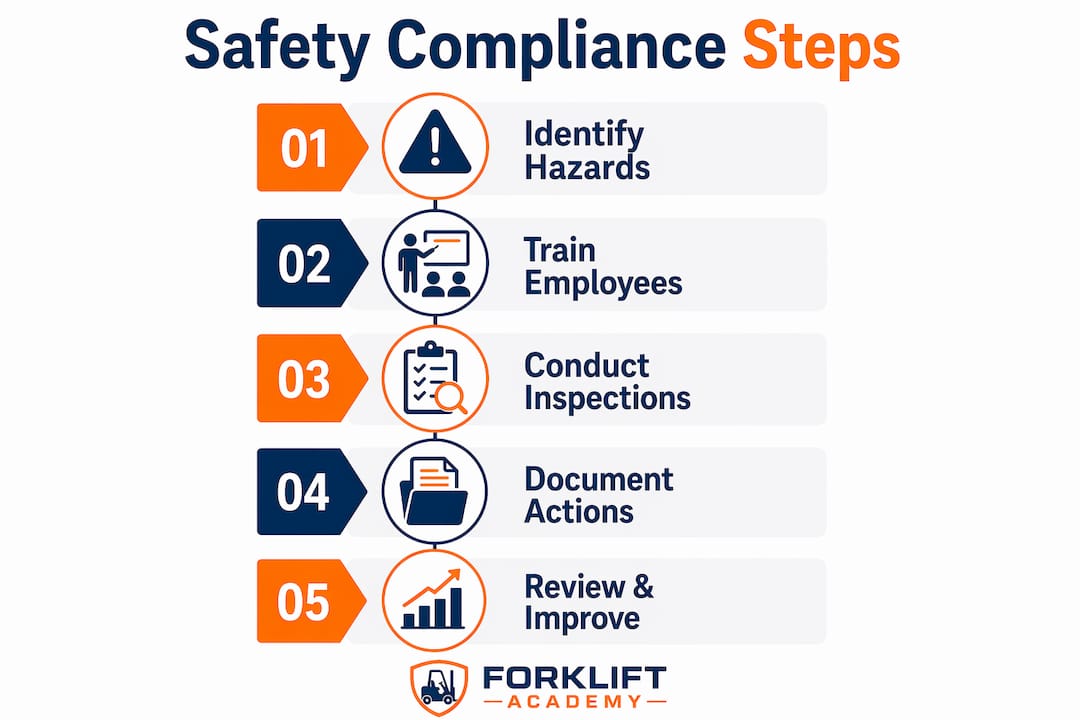
Effective workplace health standards do not emerge from a single policy document. They result from a repeatable management process that runs continuously. The following steps translate legal obligations into operational practice:
- Conduct a baseline hazard assessment. Walk every work area with a trained safety professional and document physical, chemical, biological, and ergonomic hazards. Use OSHA’s industry-specific standards as a starting checklist, then extend the review to cover recognized hazards that may not have a dedicated standard. This is where the General Duty Clause becomes practically relevant.
- Design written safety programs. Every major hazard category should have a written control procedure. Lockout/tagout, fall protection, forklift operation, and chemical handling each require documented protocols that workers can reference and supervisors can enforce. Review the OSHA forklift compliance checklist as a model for equipment-specific program design.
- Deliver and document training. Employers must implement hazard identification, maintain records, provide employee training, and establish incident reporting to comply with OSHA regulations. Training must be job-specific, delivered before workers face the hazard, and repeated when conditions change or incidents occur.
- Establish incident reporting systems. Workers need a clear, accessible process for reporting near-misses, injuries, and unsafe conditions without fear of retaliation. OSHA’s anti-retaliation provisions under Section 11© of the OSH Act make suppressing incident reports a separate legal violation.
- Audit and update regularly. Schedule internal audits at least annually and after any significant incident. Track regulatory updates from OSHA’s Federal Register notices and your state plan agency. Assign a specific person or team to monitor changes and update programs accordingly.
Pro Tip: Treat your safety compliance program like a living document. Set a calendar reminder every quarter to review at least one program element. Small, consistent updates prevent the large compliance gaps that attract OSHA attention.
The benefits of safety compliance extend beyond avoiding fines. Organizations with mature safety programs report lower workers’ compensation costs, reduced absenteeism, and stronger employee retention. A proactive safety culture signals to workers that leadership takes their wellbeing seriously, which directly affects morale and productivity.
What are common challenges and misconceptions about safety compliance?
The most persistent misconception in workplace safety is that compliance equals paperwork. OSHA expects active hazard control and real safety management, not just documentation. A binder full of safety policies sitting on a shelf does not satisfy the General Duty Clause if workers are still exposed to recognized hazards. OSHA inspectors look for evidence that controls are actually implemented and effective.
Several other misconceptions create compliance failures for otherwise well-intentioned organizations:
- “If OSHA hasn’t written a standard for it, we’re covered.” The General Duty Clause applies to any recognized hazard that causes or could cause serious harm, regardless of whether a specific standard exists. Industry knowledge and employer awareness both factor into what counts as “recognized.” Ignoring a known hazard because no rule explicitly names it is a documented path to citation.
- “OSHA only inspects after accidents.” Programmed inspections target high-hazard industries on a scheduled basis, independent of any incident. Warehousing, construction, and manufacturing face regular OSHA attention without any triggering event.
- “Our state plan is less strict, so we have more flexibility.” Organizations operating across multiple states must manage compliance to meet both federal OSHA requirements and varying state plan rules. A facility in a state with lower penalties still faces federal OSHA standards as a floor, and some state plans impose stricter rules in specific areas.
- “One compliance program covers all our locations.” Multi-state operations require location-specific compliance layers. The federal baseline applies everywhere, but state-specific additions must be mapped to each facility separately.
Safety compliance programs should incorporate hazard recognition beyond explicit OSHA standards to include all recognized serious hazards based on industry and employer knowledge. The safest approach is to assume OSHA’s reach is broader than the written standards suggest, because in practice, it is.
Key takeaways
Workplace safety compliance requires active hazard control, documented training, and jurisdiction-specific program design to satisfy both OSHA standards and the General Duty Clause.
| Point | Details |
|---|---|
| Core legal obligation | Compliance means meeting OSHA standards and the General Duty Clause, not just filing paperwork. |
| General Duty Clause scope | Employers must address all recognized serious hazards, even those without a specific OSHA standard. |
| Federal vs. state rules | 29 states run their own OSHA plans; multi-state businesses need location-specific compliance layers. |
| Practical program design | Hazard assessments, written procedures, documented training, and regular audits form the compliance backbone. |
| Misconception risk | Treating compliance as documentation rather than active hazard control is the most common and costly mistake. |
Why management commitment is the real compliance variable
After working with organizations across warehousing, manufacturing, and logistics, the pattern is consistent: the companies that pass OSHA inspections without scrambling are the ones where senior leadership treats safety as an operational metric, not a legal formality. The safety manager at a mid-sized distribution center does not create a compliant workplace alone. The general manager who asks about incident rates in every operations meeting does.
I’ve seen well-funded safety programs fail because the written procedures never translated into floor-level behavior. The policies existed. The training records existed. But supervisors were not held accountable for enforcement, and workers learned quickly that cutting corners had no consequences. OSHA’s inspection process is designed to surface exactly this gap, and it does.
The emerging compliance challenge I find most underestimated is the General Duty Clause’s expanding application to new hazard categories. Workplace violence, extreme heat, and ergonomic stress are all areas where OSHA has cited employers under the General Duty Clause without a specific standard in place. Organizations that only track published OSHA rules will be caught off guard. The smarter approach is to treat the General Duty Clause as a standing mandate to assess any condition that your industry recognizes as dangerous, whether or not OSHA has formalized a rule for it yet.
Building safety into daily operations means connecting it to the metrics that managers already track. Tie near-miss reporting rates to performance reviews. Include safety audit scores in quarterly business reviews. When safety data sits in a separate compliance report that leadership reads once a year, it loses the organizational weight it needs to drive real behavior change.
— Juiced
How Forkliftacademy supports your OSHA compliance program
Forklift operation is one of the most OSHA-cited hazard categories in warehousing and manufacturing, and operator certification is a direct occupational safety requirement under OSHA 29 CFR 1910.178. Forkliftacademy has delivered OSHA-compliant forklift and scissor lift certification programs for over 20 years, with online and onsite formats built for businesses that need to certify operators efficiently and document compliance accurately. The Train the Trainer online program gives your internal safety staff the authority to certify operators directly, reducing ongoing certification costs while keeping your program current with OSHA standards. For organizations building or auditing their full compliance program, the business solutions page covers onsite training, training kits, and certification products designed for multi-operator environments.
FAQ
What is workplace safety compliance?
Workplace safety compliance is an employer’s legal obligation to meet OSHA standards and the General Duty Clause of the OSH Act, which requires providing a workplace free from recognized hazards that cause or could cause serious harm. It covers hazard identification, employee training, recordkeeping, and incident reporting.
What does the General Duty Clause require from employers?
The General Duty Clause requires employers to address any recognized hazard that causes or is likely to cause serious physical harm, even when no specific OSHA standard covers that hazard. It functions as a catch-all obligation that extends compliance beyond the written rulebook.
How does OSHA enforce workplace safety regulations?
OSHA enforces compliance through scheduled and complaint-driven inspections, issuing citations and civil or criminal penalties for violations. Willful violations carry the highest fines, and severe injuries must be reported to OSHA within strict timeframes.
Do state OSHA plans replace federal OSHA requirements?
State OSHA plans operate independently but must be at least as effective as federal standards, and OSHA monitors them for compliance with that threshold. Businesses in states with their own plans must follow state rules, which can be stricter than federal requirements in specific areas.
What should a basic safety compliance checklist include?
A safety compliance checklist should cover hazard identification and risk assessment, written safety procedures for each major hazard, documented employee training records, incident reporting protocols, and a schedule for internal audits. Equipment-specific requirements, such as the forklift inspection standards outlined by OSHA, should be included for any relevant operations.
Recommended
- Workplace forklift safety: OSHA compliance explained – Top Osha Forklift Certification
- Why warehouse safety matters: Reduce risks and stay compliant – Top Osha Forklift Certification
- OSHA pallet jack compliance: what every manager must know – Top Osha Forklift Certification
- Understanding the Importance of Workplace Safety – Top Osha Forklift Certification