


TL;DR:
- OSHA compliance for trucking businesses requires meeting safety standards for off-road activities, including docks, terminals, and maintenance shops.
- Most citations stem from forklift training deficiencies, hazard communication failures, and walking surface hazards.
OSHA compliance for trucking businesses is defined as meeting federal workplace safety standards that apply whenever employees work off public roadways, including loading docks, maintenance shops, and freight terminals. The Occupational Safety and Health Administration governs these off-road activities, while the Federal Motor Carrier Safety Administration (FMCSA) covers highway driving. Many logistics managers assume DOT regulations cover all trucking safety. That assumption creates a costly compliance gap. Serious OSHA violations carry base penalties starting at $16,131 per occurrence as of 2026. A single unaddressed hazard at your terminal can trigger that fine.
OSHA standards touch nearly every non-driving task your employees perform. The five areas that generate the most citations in trucking operations are forklift safety, hazard communication, walking and working surfaces, personal protective equipment, and recordkeeping.

Forklift operator training under 29 CFR 1910.178 is the most cited standard at trucking terminals. Operators must complete formal instruction, a practical skills evaluation, and refresher training every three years. OSHA also requires retraining after any accident, near-miss, or observed unsafe behavior. Failure to document that retraining is one of the most common inspection failures. A signed training record with dates, trainer name, and equipment type is the minimum acceptable documentation.
Hazard Communication (HazCom) under the Global Harmonized System (GHS) requires that Safety Data Sheets be physically accessible to every driver and dock worker who handles chemicals. HazCom violations most often stem from inaccessible SDS binders and containers with missing or damaged labels. Keeping a current SDS binder at each dock station, not just in the main office, closes this gap quickly.
Walking and working surfaces rules under 29 CFR 1910.28 cover slip, trip, and fall prevention at docks and in yard environments. Wet dock plates, uneven pavement, and poor lighting are the most cited physical hazards. PPE hazard assessments must be documented per job role, and training records must show each employee received that assessment.
Recordkeeping applies to any fleet with 11 or more employees. OSHA 300, 300A, and 301 forms must be maintained throughout the year, and the 300A summary must be posted from february 1 through april 30 annually. Late or incomplete entries count as independent violations.
Pro Tip: Set a calendar reminder each january 15 to audit your OSHA 300 log before the february 1 posting deadline. Catching omissions before the posting window opens prevents avoidable citations.
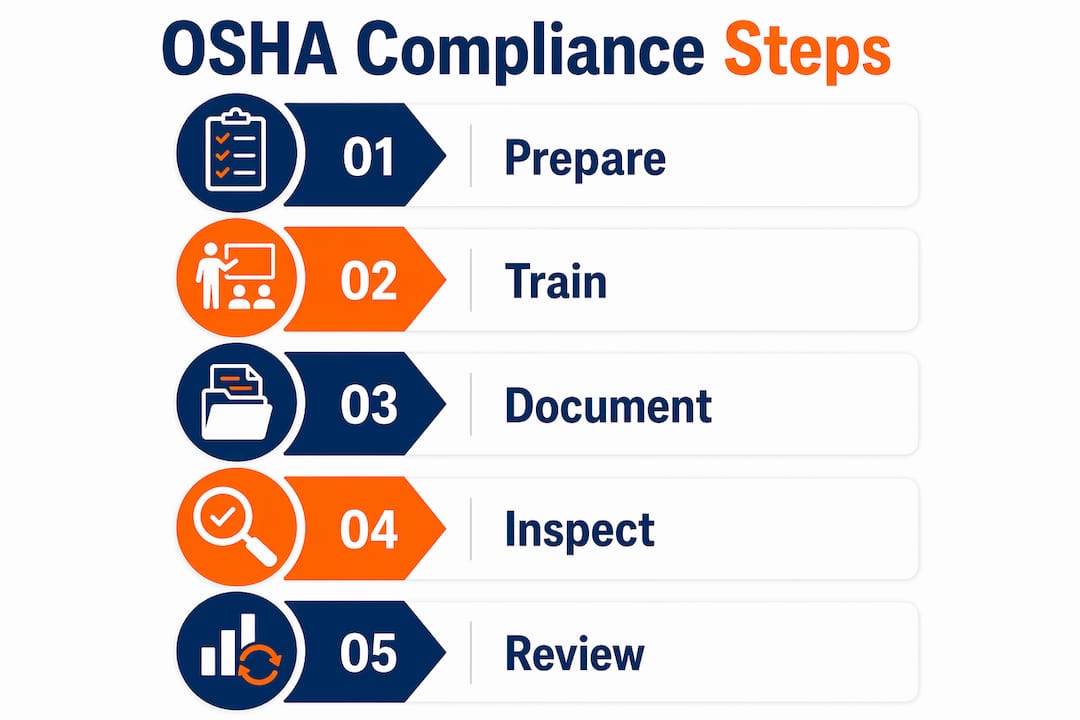
The jurisdictional line between OSHA and FMCSA is cleaner than most managers expect, but the overlap zones are where violations happen.
FMCSA regulates vehicle operation and driver qualifications on public roads. OSHA authority applies the moment an employee steps off the public road and onto company property. That means a driver fueling a truck in your yard, a mechanic performing a brake inspection in your shop, and a dock worker unloading freight are all under OSHA jurisdiction simultaneously.
The reporting rules reflect this split clearly:
“Many fleet managers mistakenly believe DOT regulations cover all trucking safety, creating a compliance gap that OSHA requirements must fill for workplace hazards.” — Gallagher Insurance
The practical fix is to integrate OSHA compliance checks directly into your existing DOT and FMCSA audit calendar. Running them as separate programs creates documentation gaps and missed retraining triggers. A combined safety file for each employee, tracking both OSHA and DOT training and incident records, is the most efficient way to manage both obligations.
OSHA’s National Emphasis Program has increased inspection activity at distribution terminals, and inspectors arrive with a specific checklist. Knowing their focus areas lets you address problems before they become citations.
OSHA inspectors at trucking terminals target powered industrial truck safety, ergonomic hazards, and walking and working surface conditions. Forklift operation and fall protection violations under 29 CFR 1910.178 and 1910.28 are the highest frequency citations at these facilities. That pattern has held steady for several inspection cycles, which means it is a known risk, not a surprise.
The most common pitfalls logistics managers encounter during inspections:
Ergonomic hazards during loading and unloading tasks are an emerging inspection focus. Inspectors now document repetitive motion risks and awkward lifting postures at dock stations. A Job Safety Analysis (JSA) that addresses ergonomic risk for each dock task gives you documented evidence of due diligence.
Building a repeatable compliance system is more effective than reacting to inspection notices. The following framework covers the core requirements for most trucking operations.
| Compliance area | Minimum documentation required |
|---|---|
| Forklift operator training | Signed training record, practical evaluation form, retraining log |
| HazCom / GHS | SDS binder at each work station, container labeling log |
| PPE | Written hazard assessment, signed training acknowledgment per employee |
| Recordkeeping | OSHA 300, 300A, 301 forms; 300A posted february 1 through april 30 |
| Incident investigation | Root cause analysis form, corrective action record, follow-up date |
Pro Tip: Assign one person as your OSHA compliance coordinator, separate from your DOT compliance officer. Splitting the roles prevents both sets of obligations from falling through the cracks during busy seasons.
Effective OSHA compliance in trucking requires integrating workplace safety standards with FMCSA obligations, because neither regulatory framework alone covers all the hazards your employees face.
| Point | Details |
|---|---|
| OSHA covers off-road work | Loading docks, yards, and maintenance shops fall under OSHA, not FMCSA jurisdiction. |
| Forklift training is the top citation | 29 CFR 1910.178 requires documented initial training, practical evaluation, and three-year refresher cycles. |
| Recordkeeping violations are independent | Missing or late OSHA 300 entries generate separate citations beyond the underlying incident. |
| Merge compliance files | A unified employee safety file tracking both OSHA and DOT records prevents documentation gaps. |
| Proactive audits prevent fines | Quarterly internal audits using OSHA 300 logs and JSA records catch issues before inspectors do. |
The single biggest mistake I see logistics managers make is treating OSHA compliance as a secondary concern behind their DOT audit prep. It makes intuitive sense. Your drivers are on the road, your DOT scores are visible, and FMCSA audits feel more immediate. But OSHA violations happen in your own yard, on your own dock, with your own equipment, and they carry penalties that can exceed a DOT fine by a significant margin.
The forklift training gap is the clearest example. A manager will confirm that every driver has a current medical certificate and a clean MVR, then have no idea whether the dock forklift operators have a signed practical evaluation on file. Those are two completely separate regulatory worlds, and conflating them is expensive.
What actually works is treating OSHA compliance as a parallel track to your DOT program, not a subordinate one. When you build your annual safety calendar, OSHA 300 posting deadlines, forklift refresher training schedules, and PPE assessment reviews belong on the same calendar as your DOT drug testing windows and vehicle inspection cycles. The managers who avoid surprise citations are the ones who stopped separating these two programs years ago.
The other misconception worth addressing: OSHA reporting is not just for catastrophic events. A hospitalization from a dock slip triggers an OSHA report within 24 hours. Missing that window is an automatic violation on top of whatever caused the injury. Build the reporting trigger into your incident response checklist so it fires automatically, not as an afterthought.
— Juiced
Trucking terminals that operate forklifts face a specific compliance obligation under 29 CFR 1910.178, and meeting it requires more than a one-time training event.
Forkliftacademy delivers OSHA-aligned forklift certification programs built for businesses that need to train multiple operators efficiently. The Train-the-Trainer online program lets your own staff become certified trainers, so you can run initial certifications, three-year refreshers, and post-incident retraining entirely in-house. With over 20 years of experience and training locations across the U.S., Forkliftacademy provides the documentation tools and certification records your safety files require. Explore the full range of business training programs to find the format that fits your terminal’s schedule and headcount.
OSHA covers all workplace safety activities that occur off public roads, including loading and unloading, forklift operation, maintenance, and yard work. Highway driving and driver qualifications on public roads fall under FMCSA jurisdiction.
Forklift operators must complete refresher training every three years under 29 CFR 1910.178, and must be retrained after any accident, near-miss, or observed unsafe operation.
Trucking fleets with 11 or more employees must maintain OSHA 300, 300A, and 301 injury and illness records. The 300A summary must be posted from february 1 through april 30 each year.
Yes. Any serious injury, hospitalization, or fatality occurring on company property, including yards and terminals, triggers OSHA reporting. The deadline is 8 hours for fatalities and 24 hours for in-patient hospitalizations.
Forklift operation violations under 29 CFR 1910.178 and fall protection violations under 29 CFR 1910.28 are the most frequently cited standards at trucking terminals, followed by HazCom failures related to inaccessible Safety Data Sheets.