
TL;DR:
- Forklift operator skills are essential for safe, efficient warehouse operations and regulatory compliance. Inadequate skills increase the risk of injuries, operational disruptions, and costly OSHA penalties exceeding $16,000 per violation. Ongoing, site-specific training, proper evaluation, and a safety-focused culture are crucial to maintaining operator competence and reducing these risks.
Forklift operator skills are the foundation of safe, efficient, and legally compliant warehouse operations. A single gap in operator competence, whether in load handling, hazard recognition, or equipment control, creates conditions for injury, product loss, and OSHA citations that carry penalties exceeding $16,000 per serious violation. For warehouse managers and logistics professionals, understanding why forklift operator skills matter is not an abstract concern. It is a direct operational and financial responsibility tied to federal standards under 29 CFR 1910.178, the OSHA regulation that governs powered industrial truck operation across the United States.
Why forklift operator skills matter in every warehouse
Forklift operator skills, known in industry compliance circles as powered industrial truck operator competencies, cover three interconnected domains: technical equipment control, safety awareness, and workplace judgment. Each domain directly determines whether your facility runs smoothly or accumulates preventable incidents.
Technical skills include precise load handling, mast control, speed management, and spatial awareness in tight aisles. Safety awareness covers hazard recognition, pedestrian interaction protocols, and the ability to read floor conditions, overhead clearances, and load stability. Workplace judgment includes communication with supervisors and co-workers, reporting near-misses, and adapting to changing site conditions.
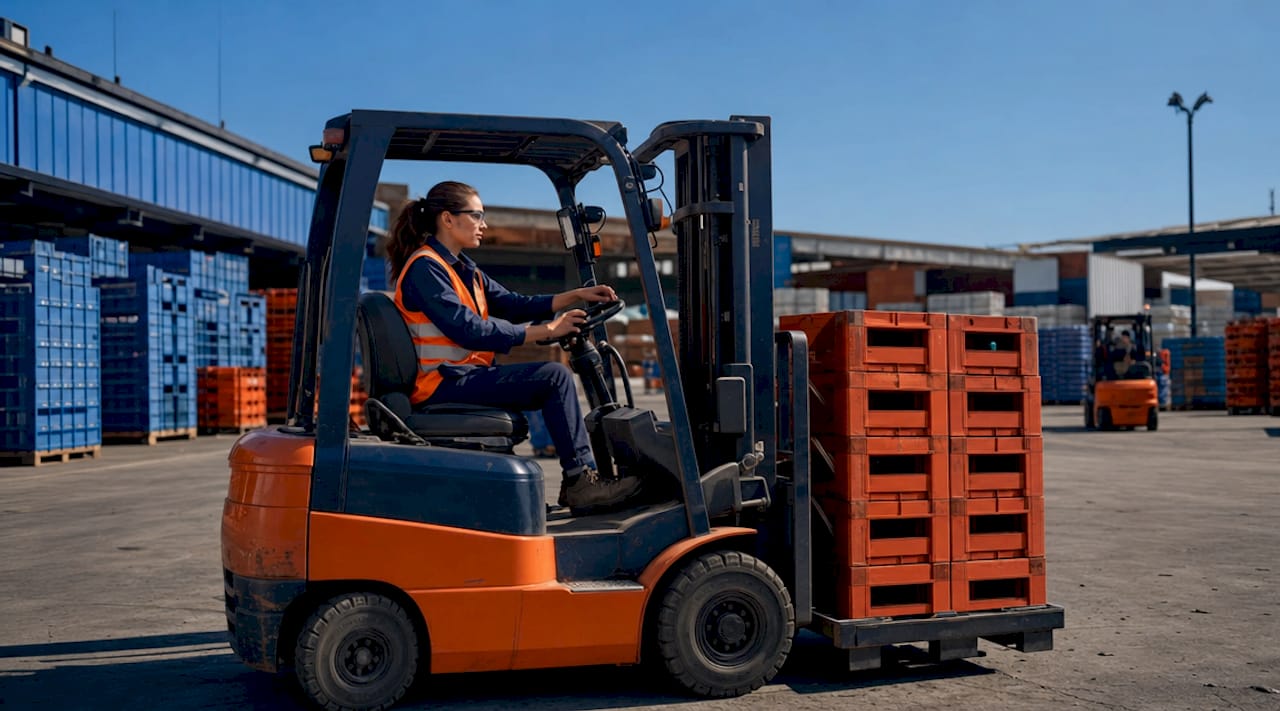
The practical impact of each skill is concrete. An operator who misjudges a load’s center of gravity risks tip-over. An operator who fails to check pedestrian zones before reversing creates a collision risk that a 2026 industry white paper identifies as one of the most persistent contributors to serious forklift incidents. These are not edge cases. They are the predictable results of skill gaps that training programs exist to close.
The benefits of skilled forklift operators extend beyond safety. Operators who understand their equipment reduce product damage, maintain faster cycle times, and require fewer supervisor interventions. For logistics operations running on tight margins, that efficiency difference compounds across thousands of lifts per year.
Pro Tip: When evaluating operator skill gaps, separate technical deficiencies from judgment deficiencies. Technical gaps respond to hands-on practice. Judgment gaps often require scenario-based coaching and near-miss debriefs.
What essential skills forklift operators need
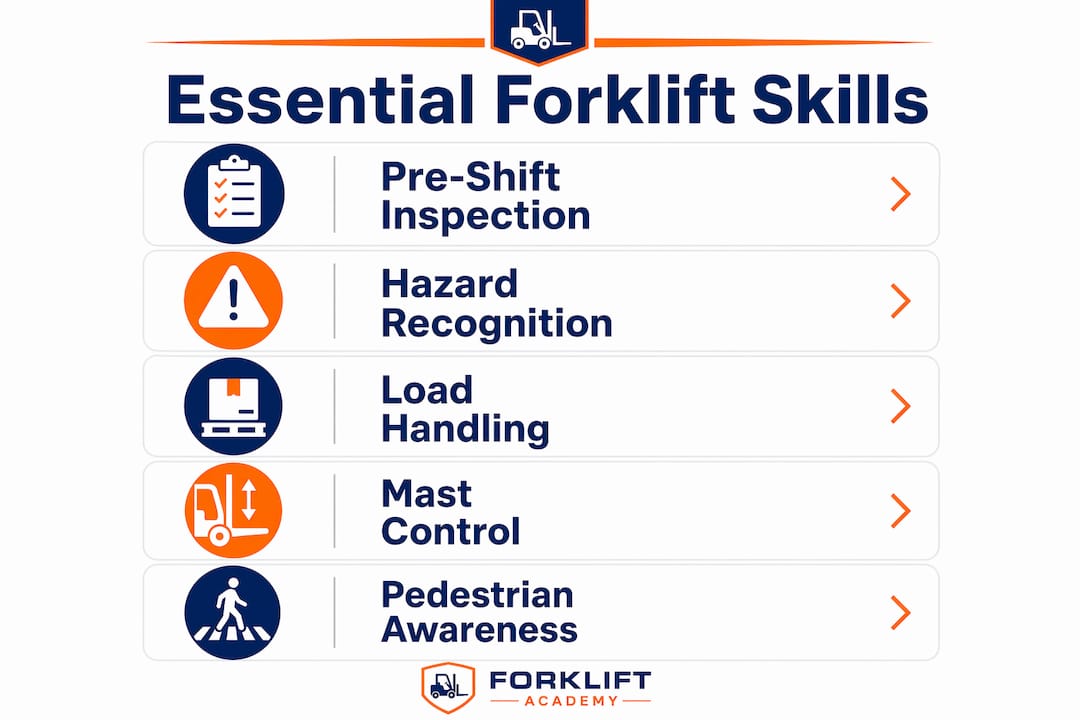
The skills needed for forklift operators fall into three tiers, each building on the last:
- Equipment operation: Pre-shift inspection routines, mast and tilt control, speed regulation in congested areas, and load weight verification against the data plate
- Hazard recognition: Identifying blind spots, reading floor load ratings, recognizing unstable loads, and managing pedestrian traffic in shared zones
- Soft skills: Clear verbal and non-verbal communication with spotters and pedestrians, attention to detail during pre-checks, and the problem-solving ability to stop and report rather than improvise
Each tier has a direct safety payoff. Operators who consistently complete pre-shift inspections catch mechanical issues before they become incidents. Operators who understand blind spots and pedestrian safety risks reduce the most common category of serious forklift injuries. Operators with strong communication habits create a feedback loop that surfaces near-misses before they escalate.
The soft skills tier is the most underestimated. Warehouse managers often invest in technical training and overlook the communication and reporting behaviors that prevent repeat incidents. An operator who notices an unusual load shift but says nothing because the culture discourages it is a liability no certification card addresses.
Pro Tip: Build near-miss reporting into your daily debrief routine. Operators who report small anomalies give you the data to fix systemic issues before a recordable incident forces the conversation.
How OSHA defines and enforces forklift operator requirements
OSHA’s standard under 29 CFR 1910.178(l) establishes a three-part training structure that every forklift operator must complete before operating independently:
- Formal instruction: Classroom or online content covering equipment types, load handling principles, refueling, and workplace-specific hazards
- Practical hands-on training: Supervised operation of the actual truck type in conditions that reflect the real work environment
- Workplace performance evaluation: Direct observation of the operator performing job tasks on the specific equipment at the actual site
The third component is where most compliance failures occur. Managers often treat the first two steps as sufficient and skip or delay the workplace evaluation that confirms real-world competence. OSHA does not accept classroom completion as a substitute for observed performance.
The table below summarizes the key OSHA requirements and their compliance implications:
| Requirement | What it means for your facility |
|---|---|
| Formal instruction | Must cover truck type, load handling, and site-specific hazards |
| Hands-on practice | Must use the actual equipment the operator will drive |
| Performance evaluation | Must be conducted at the actual workplace by a qualified evaluator |
| Refresher training | Triggered by incidents, unsafe behavior, or workplace changes, not a fixed schedule |
| Re-evaluation cycle | Performance evaluation required at minimum every three years |
One compliance detail that catches many facilities off guard: certification on one truck type does not cover another. An operator certified on a sit-down counterbalanced forklift must be separately evaluated before operating a powered pallet truck. Ignoring this creates both safety risks and citation exposure.
Refresher training under OSHA is event-triggered, not calendar-driven. It is required after an accident, after observed unsafe behavior, after a workplace layout change, or when an operator is assigned to a new truck type. The three-year cycle applies to performance evaluations only.
What happens when forklift skills are inadequate
Inadequate forklift operator skills produce three categories of harm: physical injury, operational disruption, and legal liability.
“Blind spots, congestion, and operator distraction remain persistent safety risks in forklift operations, contributing directly to serious incidents in warehouse environments.” — 2026 industry white paper on AI-powered collision avoidance
Physical injuries from forklift incidents range from crush injuries and tip-overs to struck-by incidents involving pedestrians. The pedestrian interaction risks are especially acute in facilities where forklifts and foot traffic share the same aisles without clear separation protocols. Operators who lack the spatial awareness to manage these zones are the direct link between facility design and injury outcomes.
Operational disruptions are less visible but equally costly. Product damage from improper load handling, racking damage from poor maneuvering, and workflow stoppages from near-miss investigations all reduce throughput. A single tip-over can shut down a receiving dock for hours while the incident is documented and equipment is inspected.
Legal and financial exposure is the consequence that gets executive attention. Common OSHA citations include missing certification records, expired refresher training documentation, and absent workplace evaluations. Average penalties exceed $16,000 per serious violation in 2026, and OSHA cites per untrained operator, meaning a facility with five uncertified operators faces five separate penalty calculations.
Best practices for developing and maintaining forklift skills
Building a skills program that holds up under OSHA scrutiny and actually reduces incidents requires more than scheduling a training course once a year. These practices define what effective programs look like in 2026:
Match training to truck type and site conditions. A certification program that integrates site layout, aisle widths, and truck capacity limits into its evaluation criteria produces operators who are prepared for actual conditions, not a generic course environment. Generic training creates generic competence. Site-specific training creates operators who recognize the hazards in your facility.
Treat new hires and temps with the same rigor as new operators. Prior experience does not satisfy OSHA’s evaluation requirement. Temporary or new employees with documented forklift experience must still complete a workplace performance evaluation on your equipment at your site. Their prior training records can inform the process, but they cannot replace it.
Use qualified trainers, not just experienced operators. OSHA requires that trainers have the knowledge, training, and experience to deliver compliant instruction. A qualified trainer understands the regulatory framework, can conduct a valid performance evaluation, and documents outcomes correctly. A skilled driver who has never studied 29 CFR 1910.178(l) does not meet that standard.
Manage refresher training by trigger, not by calendar. The most common skill management error is either over-training on fixed annual schedules or under-training by misreading the three-year evaluation cycle as a refresher mandate. Build a trigger-based system: document every incident, near-miss, and equipment change, then use those events to initiate refresher training when OSHA actually requires it.
Document everything. Certification records, evaluation dates, truck-type specifics, and trainer qualifications must be on file and accessible. In an OSHA inspection, the absence of documentation is treated the same as the absence of training.
Key takeaways
Skilled forklift operators reduce injuries, prevent costly OSHA citations, and sustain warehouse productivity because competence in equipment control, hazard recognition, and workplace judgment is the direct mechanism behind every safe lift.
| Point | Details |
|---|---|
| Skills drive safety outcomes | Gaps in hazard recognition and equipment control are the direct cause of most forklift incidents. |
| OSHA requires three training components | Formal instruction, hands-on practice, and workplace evaluation are all mandatory under 29 CFR 1910.178(l). |
| Certification is truck-type specific | An operator certified on one forklift type must be separately evaluated before operating a different type. |
| Refresher training is event-triggered | OSHA requires retraining after incidents or workplace changes, not on a fixed annual schedule. |
| Documentation is compliance proof | Missing records carry the same penalty exposure as missing training under OSHA enforcement. |
The skill gap nobody talks about
After working with warehouse operations across the country, the pattern I see most often is not operators who lack technical ability. It is operators who were trained once, years ago, on a different truck at a different facility, and whose managers assumed that certification transferred. It does not.
The deeper problem is cultural. Many facilities treat forklift certification as a checkbox rather than an ongoing competency standard. Operators get certified, the card goes in the file, and nobody revisits the question until an incident forces it. By then, the skill decay is real and the liability is documented.
What actually works is treating forklift operator skills the same way aviation treats pilot currency: as something that requires periodic verification against real conditions, not just initial training. The forklift operator evaluation is not a bureaucratic hurdle. It is the mechanism that confirms your operators can still perform safely under current conditions with current equipment.
The facilities I have seen run the cleanest safety records are not the ones with the most training hours. They are the ones where managers actually watch operators work, ask questions after near-misses, and treat the evaluation as a conversation rather than a test. That cultural shift costs nothing and changes everything.
— Juiced
Get your operators certified the right way
Forkliftacademy has delivered OSHA-compliant forklift training and certification for over 20 years, serving warehouses and logistics operations across the United States and Canada. Whether you need online certification for individual operators or a complete business training solution that covers multiple truck types and site-specific evaluations, the programs are built to meet 29 CFR 1910.178(l) requirements from the ground up.
For facilities that want to build internal training capacity, the train-the-trainer program equips your qualified staff to conduct OSHA-compliant evaluations and refresher training on-site, reducing reliance on external providers and keeping your documentation current. Every program includes the certification records and evaluation documentation your facility needs to stay audit-ready in 2026.
FAQ
What are the most critical skills for forklift operators?
The most critical skills are load handling, hazard recognition, and pedestrian awareness. Operators who master these three areas account for the largest reduction in forklift-related incidents in warehouse environments.
Does OSHA require forklift recertification every year?
No. OSHA requires performance evaluations at least every three years and event-triggered refresher training after incidents, unsafe behavior, or workplace changes. Annual recertification is not mandated but may be a company policy.
Can a forklift operator use one certification for all truck types?
No. Truck-type certification is specific to each equipment class. An operator certified on a sit-down counterbalanced forklift must complete a separate evaluation before operating a powered pallet truck or any other class.
What are the penalties for untrained forklift operators?
OSHA penalties for serious violations exceed $16,000 per violation in 2026, and citations are issued per untrained operator. A facility with multiple uncertified operators faces compounding penalty exposure.
Do experienced operators still need a workplace evaluation when changing jobs?
Yes. Prior experience and training documentation can be considered, but a new workplace evaluation is mandatory to confirm competency on the specific equipment and site conditions at the new employer’s facility.