

TL;DR:
- Standardized warehouse equipment terminology ensures clear communication, reduces errors, and maintains OSHA compliance across operations. Knowing specific equipment types, storage methods, and automation terms enables safer, more efficient warehouse workflows. Building a shared vocabulary accelerates training, reduces misidentification, and supports better decision-making on the warehouse floor.
Warehouse equipment terminology is the standardized vocabulary used to describe the tools, machinery, and processes that drive daily warehouse operations. Without a shared language, forklift operators misidentify equipment, logistics professionals misread invoices, and safety incidents multiply. Standardizing warehouse terms eliminates miscommunication and confirmation bias between departments, ensuring consistent operational execution. This article breaks down the most critical terms across equipment, storage, automation, and safety categories so you can communicate with precision, stay OSHA-compliant, and operate more effectively on the floor.
Material Handling Equipment, or MHE, is the umbrella term for every device used to move, store, protect, or control materials inside a facility. The category includes forklifts, pallet jacks, conveyors, and Automated Storage and Retrieval Systems (AS/RS). MHE improves inventory accuracy and reduces manual labor across the supply chain. Knowing the category name alone is not enough. You need to distinguish the specific equipment types within it.
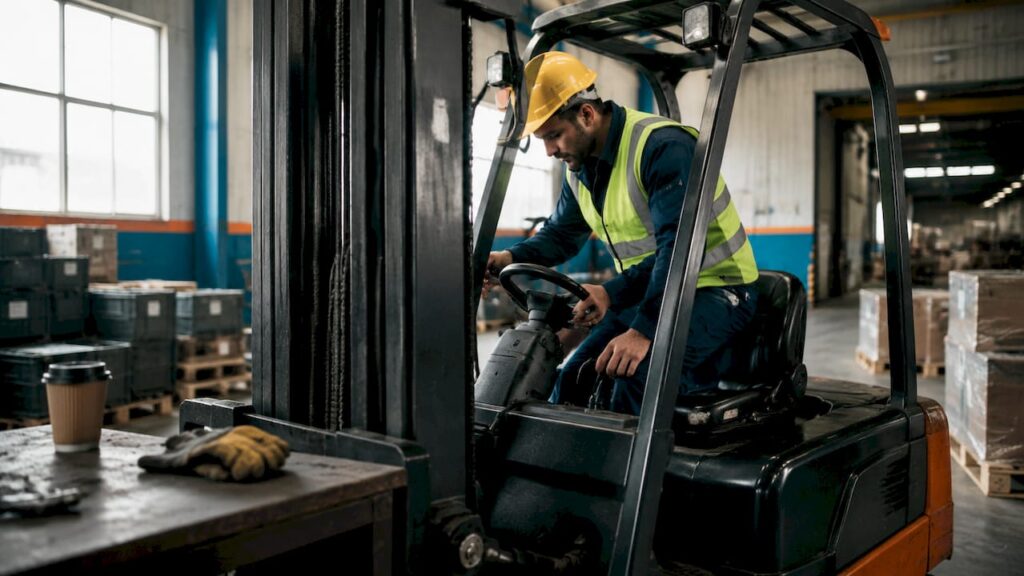
Forklifts are the most recognized piece of MHE, but the term covers several distinct machines. A counterbalance forklift uses a rear counterweight to offset front loads and is built for dock loading and wider aisles. A reach truck, by contrast, extends its forks forward into racking and operates in aisles as narrow as 1.5 to 2.5 meters, enabling far denser storage than a counterbalance unit can achieve. Confusing the two is not just a vocabulary error. It is a safety risk.
Pallet jacks come in two forms: manual and electric. A manual pallet jack, sometimes called a pump truck, uses hydraulic pressure activated by hand to lift pallets a few inches off the ground for short-distance moves. An electric pallet jack, also called a walkie or rider pallet truck, uses a battery-powered motor and is suited for longer runs or heavier loads. Both are distinct from forklifts because they cannot elevate loads to racking height.
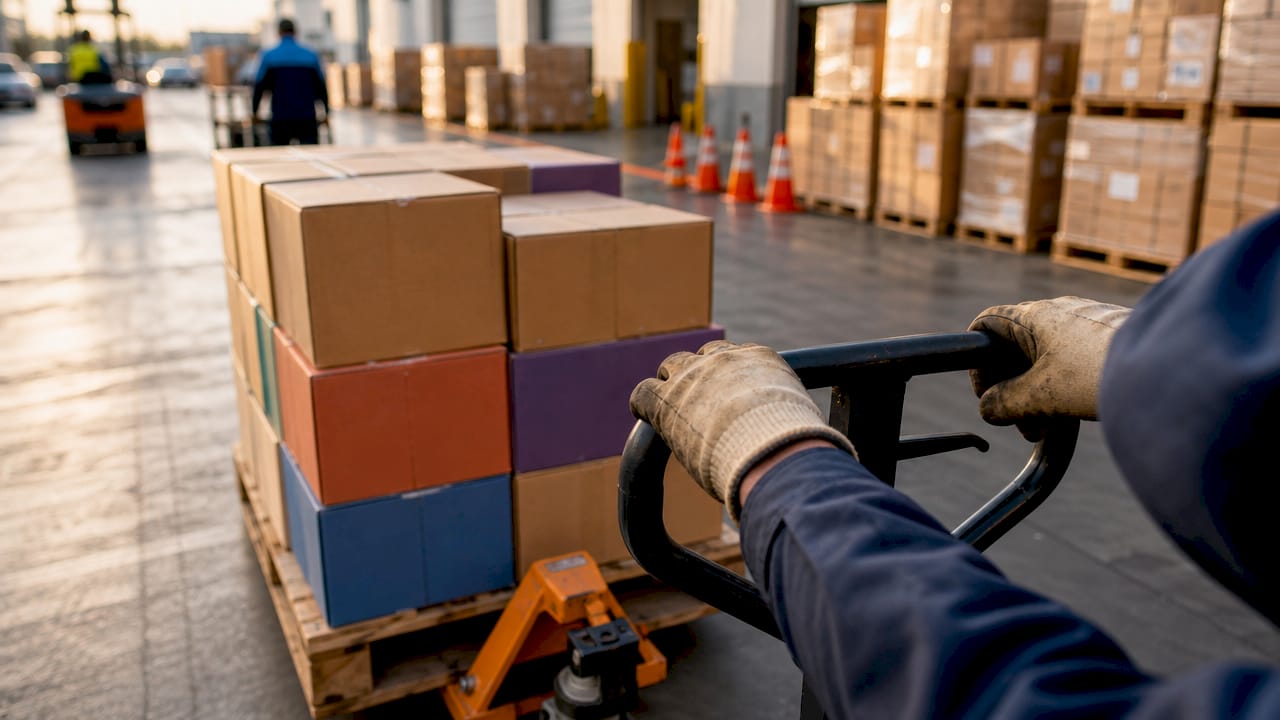
Conveyors are fixed or semi-fixed systems that move goods along a set path, typically in receiving, sorting, or shipping areas. Stretch wrap machines apply plastic film around palletized loads to stabilize them before shipment. AS/RS refers to computer-controlled systems that automatically place and retrieve loads from storage locations, often in very high-density environments where human access is limited.
Pro Tip: When you hear “forklift” on the floor, always confirm whether the speaker means a counterbalance unit or a reach truck. The two require different operator certifications, different aisle widths, and different load-handling techniques. Treating them as interchangeable is one of the most common and costly mistakes in warehouse operations.
Storage terminology directly determines how a warehouse is designed and how efficiently pickers move through it. The four primary racking types every operator should recognize are selective racking, drive-in racking, push-back racking, and pallet flow racking. Each system involves a different trade-off between storage density and pallet accessibility.
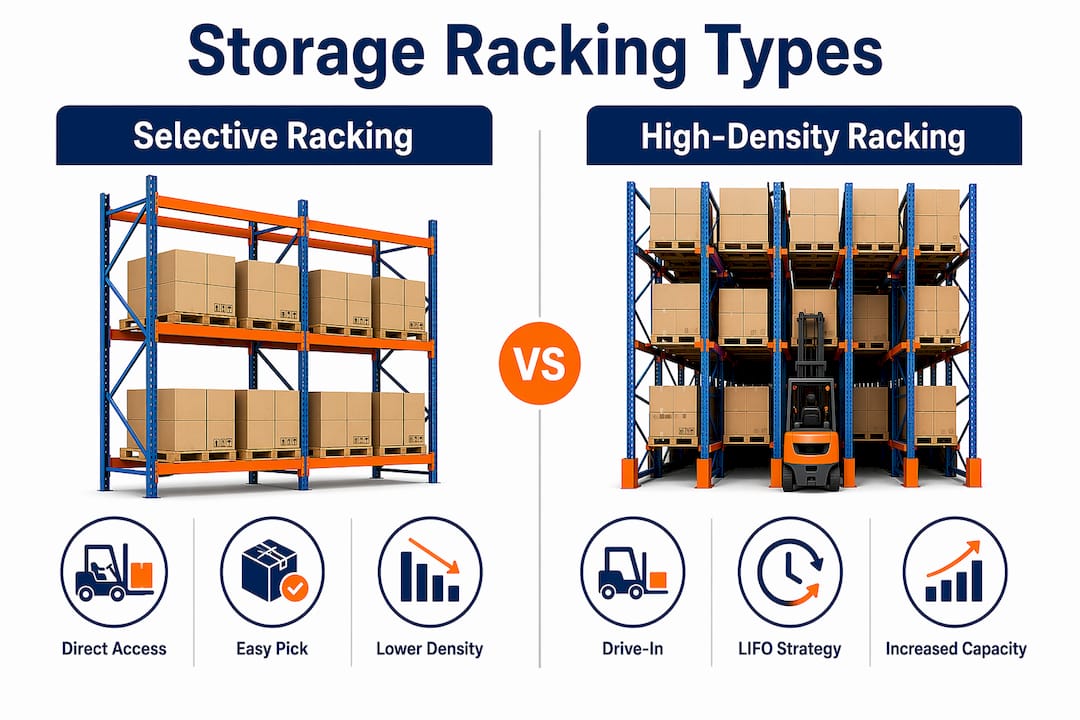
| Rack type | Key characteristic | Best use case |
|---|---|---|
| Selective racking | Direct access to every pallet | High SKU variety, FIFO operations |
| Drive-in racking | High density, last-in/first-out | Low SKU variety, bulk storage |
| Push-back racking | Gravity-fed, multiple deep lanes | Medium variety, FIFO or LIFO |
| Pallet flow racking | Roller-conveyor lanes, FIFO | High-volume, date-sensitive goods |
High-density racking like drive-in increases pallet density but requires a LIFO (last-in, first-out) strategy, which limits accessibility and affects picking plans. FIFO (first-in, first-out) is the opposite approach, where the oldest stock ships first. FIFO is mandatory for perishables and pharmaceuticals and is supported by selective or pallet flow racking.
Aisle width is a term that connects directly to equipment choice. Standard aisles for counterbalance forklifts require roughly 3.5 to 4.5 meters of clear space. Narrow-aisle configurations for reach trucks can drop to 2.5 meters, and very narrow-aisle (VNA) systems using turret trucks can operate in aisles under 1.8 meters. Choosing the wrong equipment for your aisle configuration creates both safety hazards and throughput bottlenecks.
Putaway refers to the process of moving received goods to their designated storage location. Picking is the reverse: retrieving goods from storage to fulfill an order. Zone picking assigns pickers to fixed areas of the warehouse. Wave picking releases multiple orders simultaneously to maximize picker efficiency. Understanding these terms lets you read a warehouse management report, follow a supervisor’s instruction, or design a more efficient pick path without confusion.
Automation vocabulary is no longer optional for logistics professionals. Warehouses across the United States are integrating robotics and software platforms at a rapid pace, and misunderstanding the terminology leads directly to poor purchasing decisions and failed integrations.
Three robotics terms you need to separate clearly:
The software side of warehouse automation has its own distinct vocabulary. Confusing WMS, WES, and WCS leads to integration failures that cost facilities months of productivity loss. Here is the breakdown:
RFID (Radio Frequency Identification) uses electromagnetic fields to automatically identify and track tags attached to pallets, cartons, or individual items. Unlike barcodes, RFID does not require line-of-sight scanning, which speeds up receiving and inventory audits significantly.
Pro Tip: If you are building a career in logistics, learn the WMS, WES, and WCS distinction now. Hiring managers at distribution centers increasingly expect supervisors and coordinators to speak fluently about these systems during interviews. Knowing the difference signals operational maturity that separates candidates.
OSHA compliance in warehousing is built on precise language. When an inspector, trainer, or supervisor uses a term incorrectly, the downstream consequences range from failed audits to preventable injuries. The forklift safety terminology used in OSHA standards is specific and non-negotiable.
Key safety terms every warehouse employee and forklift operator must know:
OSHA forklift standards require operators to be trained and evaluated on the specific type of truck they will operate. That means a certification on a counterbalance forklift does not automatically qualify an operator to use a reach truck. Knowing the terminology is the first step to knowing your legal obligations.
Precise vocabulary reduces errors at every stage of the warehouse workflow. When a receiving clerk calls a shipment “cross-docked” instead of “put away,” the WMS routes it differently, the pick team looks in the wrong location, and an order ships late. One wrong term, one missed delivery.
The operational areas where terminology clarity delivers the most measurable gains:
“The warehouse floor does not forgive vague language. Every term has a physical consequence.”
Pro Tip: Build a one-page warehouse equipment glossary specific to your facility and post it in break rooms, near dock doors, and inside training binders. Include photos next to each term. New hires absorb terminology 40 percent faster when definitions are paired with visual references.
Mastering warehouse equipment terminology is the single most direct path to safer operations, fewer errors, and stronger OSHA compliance across every role on the floor.
| Point | Details |
|---|---|
| MHE is the foundation | Every warehouse tool falls under Material Handling Equipment; knowing subcategories prevents misidentification. |
| Forklift types are not interchangeable | Counterbalance and reach trucks require separate certifications and serve different aisle configurations. |
| Software terms prevent costly failures | Distinguishing WMS, WES, and WCS stops integration errors before they disrupt operations. |
| Safety terms carry legal weight | Terms like rated capacity and load center appear in OSHA standards and affect compliance outcomes. |
| Shared vocabulary reduces errors | Standardized terminology across departments cuts miscommunication and improves order accuracy. |
After two decades of watching warehouse operations across dozens of facilities, the terminology gaps that cause the most damage are rarely the obvious ones. Nobody confuses a conveyor with a forklift. The costly mistakes happen in the middle ground: operators who call every forklift a “forklift” regardless of type, supervisors who use “WMS” when they mean “WCS,” and receiving teams who treat “putaway” and “cross-docking” as synonyms.
The reach truck versus counterbalance confusion is the one I see most often. An operator certified on a counterbalance unit gets asked to move a pallet in a narrow-aisle rack. They assume a forklift is a forklift. The aisle is too tight, the turning radius is wrong, and the rack takes a hit. That incident was a terminology failure before it was an equipment failure.
The automation vocabulary gap is growing fast. Facilities are deploying AMRs and WES platforms while floor staff and even some managers still think in terms of basic WMS functions. When the team cannot describe what a system does, they cannot use it correctly, flag problems accurately, or train others effectively. Knowing the difference between AGVs and AMRs is not just academic. It determines whether you spec the right robot for your environment.
My honest recommendation: treat your warehouse equipment glossary the same way you treat your safety checklist. Review it regularly, update it when new equipment arrives, and make it part of every onboarding session. The operators who invest in vocabulary are the ones who advance into supervisory and logistics coordination roles. The floor rewards precision.
— Juiced
Understanding warehouse equipment terminology is the foundation. Certification is what makes that knowledge count with OSHA and your employer. Forkliftacademy has delivered OSHA-compliant forklift training across the United States and Canada for over 20 years, with online and onsite formats built for busy warehouse teams. Whether you are an individual operator seeking your first credential or a safety manager ready to build an in-house training program, the Train the Trainer certification gives your team the tools to certify operators internally and stay compliant long-term. For operators ready to get certified now, the OSHA forklift certification course covers every equipment type with the terminology and practical knowledge OSHA requires.
Warehouse equipment terminology is the standardized set of definitions for the tools, machinery, systems, and processes used in warehouse and logistics operations. It covers everything from MHE categories and forklift types to WMS software and OSHA safety terms.
A counterbalance forklift carries loads on front forks balanced by a rear counterweight and is designed for wider aisles and dock loading. A reach truck extends its forks into racking and operates in aisles as narrow as 1.5 meters, making it the standard choice for high-density storage environments.
WMS stands for Warehouse Management System, a software platform that handles inventory tracking, order management, and labor planning at a strategic level. It is distinct from a WCS, which controls automation hardware, and a WES, which coordinates real-time workflows between human workers and automated systems.
OSHA 29 CFR 1910.178 requires that operators be trained and evaluated on the specific type of powered industrial truck they will operate. Terms like rated capacity, load center, and counterbalance appear directly in OSHA standards, and misunderstanding them is a compliance violation that can result in fines and increased incident risk.
Cycle counting is a method of auditing inventory by counting a subset of stock on a rotating schedule rather than shutting down operations for a full physical count. It maintains ongoing warehouse operations while keeping inventory records accurate, making it the preferred method in high-volume distribution centers.