
TL;DR:
- Hazard identification in forklift training involves teaching operators to recognize risks linked to equipment and specific work environments, requiring documented evaluations. Effective programs map site-specific hazards and integrate operation-cycle-based assessment methods to enhance safety and OSHA compliance. Generic training often fails because it neglects real-world behaviors and accurate record-keeping essential for workplace safety and audit success.
Hazard identification in forklift training is the structured process of teaching operators to recognize, evaluate, and respond to operational risks tied to both their equipment and their specific work environment. Under OSHA 29 CFR 1910.178(l), this process requires formal instruction, hands-on practice, and documented workplace evaluations conducted on actual equipment under real conditions. The industry term for this systematic approach is hazard analysis, and it covers two distinct categories: truck-related hazards such as load capacity limits and brake condition, and workplace-related hazards such as pedestrian traffic, ramp grades, and floor surfaces. When a forklift training program skips site-specific hazard analysis, it produces operators who can pass a written test but freeze or misjudge in the field.
What workplace-specific hazards must forklift training address?
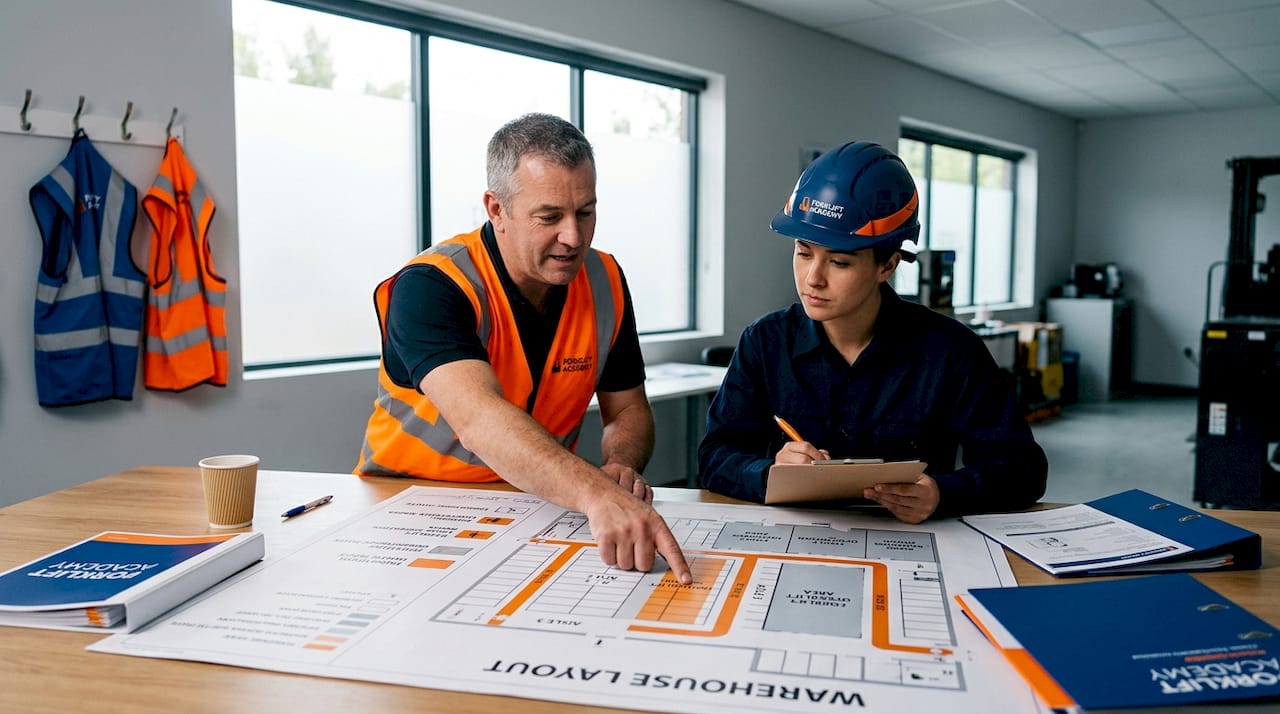
Effective hazard identification training separates truck-related from workplace-related hazards, and the workplace category is where most real-world incidents originate. Generic training scenarios rarely reflect the actual conditions operators face on a given shift. A defensible forklift training program maps the specific hazards present in the operator’s actual facility, not a hypothetical warehouse.
The core workplace hazards every forklift hazard assessment must address include:
- Aisle widths and turning radii: Narrow aisles force operators to make sharper turns at reduced speeds, increasing tip-over risk with any off-center load.
- Ramps and slopes: Grade changes affect braking distance and load stability. Operators must know the rated slope limits for their specific truck class.
- Pedestrian traffic patterns: Approximately 20% of forklift fatalities involve pedestrian strikes. Training must cover the 10-foot clearance rule, horn use at blind corners, and designated crossing zones.
- Floor and surface conditions: Wet concrete, dock plates, expansion joints, and debris all affect tire traction and load stability.
- Load types and characteristics: Oversized, unstable, or hazardous loads require specific handling protocols that vary by product category.
- Lighting and visibility zones: Low-light areas, blind corners, and racking configurations create predictable collision points that operators must learn to anticipate.
Pro Tip: Map your facility’s pedestrian traffic patterns before designing any training scenario. Operators who train on the actual routes they will travel every day retain hazard recognition behaviors far longer than those trained on generic floor plans.
Site-specific hazard assessment is not optional under OSHA. Training must reflect actual operator environments, which means a trainer working across multiple facilities needs a distinct hazard profile for each location. This is the single most common gap Forkliftacademy sees in otherwise well-intentioned programs.
How does hazard identification integrate with the forklift operation cycle?
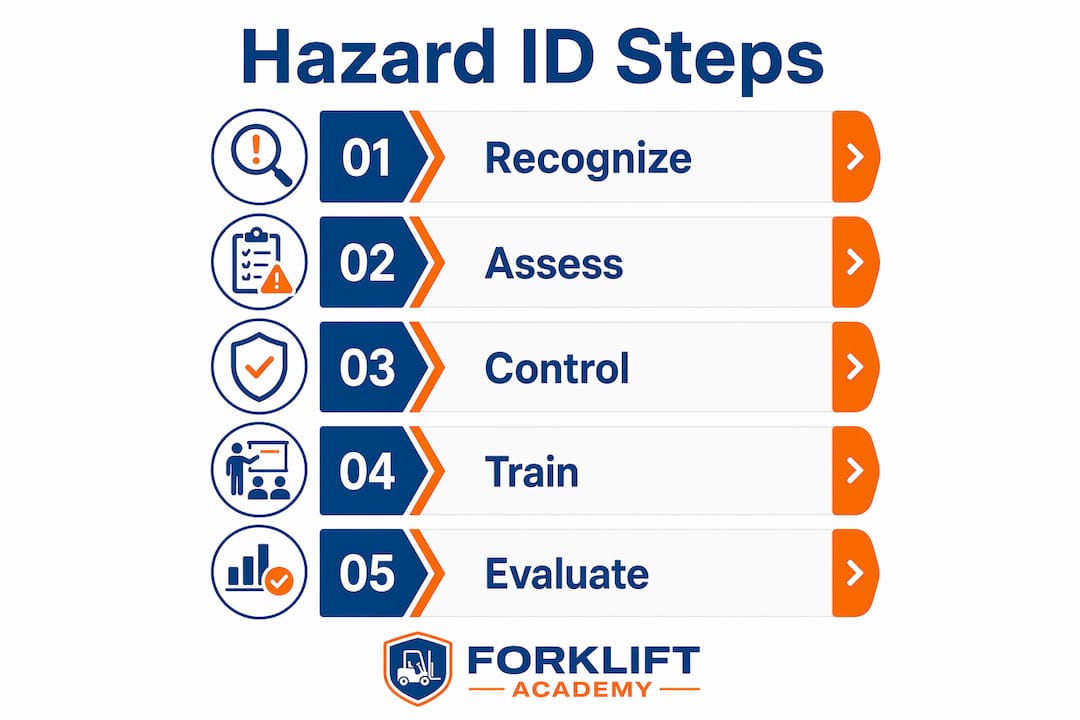
A stepwise hazard identification approach tied to the operation cycle gives trainers a measurable framework for evaluating operator competence at each task stage. Job safety analysis (JSA) methodology structures this process by breaking forklift work into discrete steps and assigning specific hazards to each one.
The five-stage operation cycle and its corresponding hazard focus points are:
- Pre-use inspection: Operators check fluid levels, tire condition, forks, mast, and brakes. Hazards at this stage include undetected brake fade, hydraulic leaks, and damaged forks that compromise load stability before the truck moves.
- Loading: The operator must verify load weight against the capacity plate, center the load on the forks, and confirm stack height does not block forward visibility. Overloading and off-center loads are the leading causes of tip-overs during travel.
- Travel: Hazard recognition during travel includes speed management in pedestrian zones, horn use at intersections, and maintaining safe following distances. Visibility through or around the load is a constant variable.
- Unloading: Placing loads at height introduces mast extension risks, overhead obstruction hazards, and the need to confirm rack capacity before depositing a load.
- Shutdown: Operators must park on level ground, lower forks to floor level, neutralize controls, and apply the parking brake. Improper shutdown creates secondary hazards for the next operator and for pedestrians in the area.
“Memorizing a list of hazards is not competence. Competence is demonstrated when an operator slows before a blind corner without being told, checks the capacity plate before picking an unfamiliar load, and parks correctly at the end of every shift.” — OSHA performance evaluation standard, as interpreted in forklift JSA practice
Hazard identification training that builds real behaviors under operational pressure produces measurably safer operators. The JSA framework gives trainers a direct line between each operation stage and the evaluation criteria used to confirm competence.
What are the OSHA documentation requirements for hazard training?
OSHA’s three-component training requirement under 29 CFR 1910.178(l) covers formal instruction, hands-on training, and workplace evaluation. Each component must be documented, and the documentation must survive an audit. Documentation gaps on evaluation dates or missing refresher trigger records are among the most frequent causes of OSHA citations in warehouse environments.
A compliant training record must include the operator’s full name, the date of training, the date of evaluation, the name and signature of the evaluator, the equipment type covered, and the specific workplace hazards addressed. Vague entries like “forklift safety training completed” do not satisfy the specificity OSHA expects during an inspection.
| Documentation Element | Compliance Requirement |
|---|---|
| Operator name and ID | Required on every training and evaluation record |
| Training and evaluation dates | Must align with the three-year evaluation cycle |
| Evaluator name and signature | Confirms a qualified person conducted the assessment |
| Equipment type covered | Must match the actual truck class operated |
| Refresher trigger documentation | Required when retraining is event-driven, not just calendar-based |
The three-year evaluation cycle is widely misunderstood. Refresher training is event-triggered, not calendar-based. The five triggers that require immediate refresher training are: observed unsafe operation, an accident or near-miss, a failed evaluation, assignment to a different truck type, and a change in workplace conditions. The three-year rule applies only to the periodic evaluation, not to the refresher training obligation.
Pro Tip: Create a simple trigger log alongside your training records. Every time one of the five OSHA refresher triggers occurs, document it with a date and description. This single habit eliminates the most common audit vulnerability in forklift safety programs.
Maintaining complete, accurate records with consistent certification and evaluation dates aligned to OSHA timelines is the difference between a program that passes an inspection and one that generates citations.
How should trainers customize hazard training for different fleets and operators?
Prior training is insufficient unless it has been evaluated and supplemented with workplace-specific hazard recognition. This applies directly to temporary workers, new hires with claimed experience, and operators transferring between facilities. OSHA requires employers to assess whether prior training covers the specific truck class and workplace conditions the operator will actually encounter.
Customizing a safety training program for forklift operators across a diverse fleet requires attention to several variables:
- Truck class and attachments: A Class IV cushion-tire sit-down counterbalanced forklift presents different hazards than a Class II narrow-aisle reach truck. Operators certified on one class are not automatically qualified on another. Attachments such as side-shifters, clamps, and rotators change load center calculations and require specific instruction.
- Operator experience level: New operators need foundational hazard recognition built from scratch. Experienced operators transferring from another site need a gap assessment focused on the new facility’s specific hazard profile, not a repeat of basic instruction.
- Temporary and contract workers: Organizations with rotating operators face the highest compliance risk. Assuming a temp agency has provided adequate hazard training is not a defensible position under OSHA. The host employer bears responsibility for workplace-specific evaluation.
- Facility-specific scenario development: Build training scenarios around the actual routes, loads, and pedestrian zones in your facility. Video walkthroughs of your specific aisles, dock areas, and high-traffic zones are more effective than stock footage of a generic warehouse.
- Practical evaluation on real routes: Practical evaluation on facility-specific routes identifies the hazards operators actually miss in your environment, which then drives the content of any refresher training. This closes the loop between assessment and instruction.
The goal is not to train operators on every possible forklift hazard in existence. The goal is to train them on the hazards they will face on Tuesday morning in your building, with your equipment, moving your loads.
Key takeaways
Effective hazard identification in forklift training requires site-specific hazard analysis, operation-cycle-aligned instruction, and documented OSHA-compliant evaluations to produce operators who recognize and respond to real risks.
| Point | Details |
|---|---|
| Site-specific hazard mapping | Train operators on the actual routes, loads, and pedestrian zones in your facility, not generic scenarios. |
| Operation cycle integration | Assign specific hazards to each stage from pre-inspection through shutdown to create measurable evaluation criteria. |
| OSHA documentation accuracy | Record operator name, dates, evaluator signature, equipment type, and any refresher trigger events on every training record. |
| Refresher triggers vs. evaluations | The three-year rule governs periodic evaluations; refresher training is required immediately after any of five specific trigger events. |
| Prior experience is not a substitute | Evaluate all operators, including temps and transfers, against your specific workplace hazard profile before allowing unsupervised operation. |
Why generic hazard training keeps failing warehouses
After working in forklift safety education for years, the pattern I see most often is this: a warehouse manager runs a solid-looking training program, operators pass the written assessment, certifications get filed, and then an incident happens at the exact blind corner that was never included in the training scenario. The program looked compliant on paper. It just was not built around the actual facility.
The behavioral dimension of hazard identification is what most programs underinvest in. Operators do not fail because they cannot recite the pedestrian clearance rule. They fail because operational pressure, habit, and distraction override what they learned in a classroom. Training that develops real operator behaviors under realistic conditions is the only kind that holds up when a shift gets busy and shortcuts become tempting.
The documentation piece is equally underestimated. I have seen programs that trained operators correctly but could not survive an OSHA audit because the records were incomplete or the refresher trigger log did not exist. Compliance is not just about what you teach. It is about what you can prove you taught, when you taught it, and why you taught it again.
My recommendation: treat your facility’s hazard map as a living document. Every time a workplace condition changes, a new product line arrives, or a near-miss occurs, update the hazard profile and document the training response. That habit alone puts you ahead of the majority of operations I have seen.
— Juiced
How Forkliftacademy supports your hazard identification program
Forkliftacademy has delivered OSHA-compliant forklift training across the United States and Canada for over 20 years, with programs built specifically around the hazard identification and evaluation requirements that warehouse managers and safety trainers need most.
The Train the Trainer online course equips your in-house trainers to conduct site-specific hazard assessments, build facility-tailored training scenarios, and document evaluations that satisfy OSHA’s three-component requirement. For operators who need direct certification, the OSHA forklift certification programs cover all major truck classes with hands-on evaluation components. Whether you manage a single facility or a multi-site fleet, Forkliftacademy provides the tools to build a forklift hazard assessment program that holds up in the field and in an audit.
FAQ
What is hazard identification in forklift training?
Hazard identification in forklift training is the structured process of teaching operators to recognize truck-related and workplace-related risks specific to their equipment and facility. It is a required component of OSHA 29 CFR 1910.178(l) and must be validated through documented workplace performance evaluations.
What are the most common forklift hazards operators must recognize?
The most common forklift hazards include pedestrian strike risk, load instability, tip-overs on ramps, blind corners, and surface conditions such as wet floors or dock plates. Pedestrian strikes account for roughly 20% of forklift-related fatalities, making pedestrian safety a top training priority.
How often does OSHA require forklift hazard training to be repeated?
OSHA requires a performance evaluation at least every three years, but refresher training is event-triggered and must occur after unsafe operation, an accident, a failed evaluation, a truck reassignment, or a change in workplace conditions.
Does prior forklift experience satisfy OSHA training requirements?
No. Prior training is considered insufficient unless the employer evaluates the operator on the specific truck class and workplace hazards present in the current facility. This applies to temporary workers and experienced transfers alike.
What must forklift training documentation include to be OSHA-compliant?
Compliant documentation must include the operator’s name, training and evaluation dates, the evaluator’s name and signature, the equipment type covered, and records of any event-triggered refresher training. Missing evaluation dates or absent refresher trigger records are a leading cause of OSHA citations during inspections.
Recommended
- Examples of Forklift Safety Hazards Operators Must Know – Top Osha Forklift Certification
- Forklift Hazard Awareness Explained: Reducing Warehouse Risks – Top Osha Forklift Certification
- Forklift Hazards Explained: Reducing Warehouse Risks – Top Osha Forklift Certification
- Forklift compliance guide: Keep your warehouse safe in 2026 – Top Osha Forklift Certification