
TL;DR:
- Hands-on forklift training improves safety, reduces accidents, and builds operator confidence.
- OSHA mandates practical evaluation to demonstrate operator competency, lowering liability risks.
- Real equipment practice boosts productivity, adaptability, and employee retention in logistics operations.
Relying solely on online modules or classroom lectures to certify forklift operators is a gamble most logistics and warehouse employers cannot afford. Forklift-related incidents cost U.S. businesses billions in lost productivity, medical expenses, and regulatory fines every year. The difference between a compliant, high-performing operation and a costly liability often comes down to one factor: whether your operators actually practiced on real equipment before they hit the floor. This article breaks down six concrete advantages hands-on forklift training delivers for employers, from measurable safety gains to long-term workforce adaptability.
Table of Contents
- Boosting workplace safety and reducing accidents
- Ensuring OSHA compliance and reducing liability
- Increasing operational efficiency and productivity
- Enhancing employee engagement and retention
- Supporting business growth and adaptability
- Why most employers underestimate the ROI of hands-on forklift training
- Ready to unlock the benefits of hands-on forklift training?
- Frequently asked questions
Key Takeaways
| Point | Details |
|---|---|
| Greater workplace safety | Hands-on forklift training leads to fewer incidents and a safer warehouse environment. |
| Stronger OSHA compliance | Practical instruction helps you meet rigorous regulatory requirements and avoid fines. |
| Tangible efficiency gains | Employees trained hands-on learn faster, make fewer errors, and boost operations. |
| Improved retention | Staff feel more engaged and stay longer when supported with job-relevant, hands-on training. |
| Business adaptability | Hands-on training ensures your team quickly adapts to changing equipment and demands. |
Boosting workplace safety and reducing accidents
Forklift accidents are not random. They follow predictable patterns, and most are preventable. Tip-overs, pedestrian strikes, and load drops happen when operators lack the muscle memory and situational awareness that only come from real equipment practice. No video module teaches a worker how to feel an unstable load or judge a blind corner at speed.
Hands-on training lowers accident rates compared to classroom-only or online approaches, a finding consistent with OSHA’s own emphasis on practical instruction. The OSHA forklift regulations under 29 CFR 1910.178 explicitly require operators to demonstrate competency through practical exercises, not just pass a written test.
Here is what hands-on training addresses that theory alone cannot:
- Hazard recognition in real time: Operators learn to spot unstable surfaces, overhead obstructions, and pedestrian zones through repeated, supervised practice.
- Corrective action under pressure: Scenario drills teach workers what to do when something goes wrong, not just what the manual says.
- Equipment-specific handling: Different lift trucks behave differently. Hands-on sessions cover counterbalance forklifts, reach trucks, and order pickers with the actual machine in hand.
- Load management: Proper stacking, weight distribution, and travel speed are skills built through repetition, not reading.
For employers improving safety with forklift training, the payoff shows up in incident logs, insurance premiums, and OSHA audit results. Companies that document a structured hands-on program consistently outperform those that rely on digital-only certification.
Pro Tip: Even experienced hires should complete in-person practice exercises when joining your team. OSHA rule updates and site-specific hazards require a fresh practical review, regardless of prior certification history.
For a broader look at business forklift OSHA compliance, building your safety program around practical demonstration is the single most defensible position an employer can take.
Ensuring OSHA compliance and reducing liability
OSHA compliance is not optional, and the penalties for getting it wrong are steep. Fines for serious violations can reach $16,550 per incident, with willful violations climbing to $165,514. Beyond fines, a single documented non-compliance event can expose your company to civil litigation, workers’ compensation claims, and reputational damage that outlasts any fine.
OSHA requires practical evaluation for forklift operators, not just theoretical instruction. The agency’s own language is clear:
“The employer shall ensure that each powered industrial truck operator is competent to operate a powered industrial truck safely, as demonstrated by the successful completion of the training and evaluation specified in this paragraph.”
That word, demonstrated, carries legal weight. It means your records must show that an evaluator watched your operator perform tasks on actual equipment and signed off on competency. The OSHA training eTool outlines exactly what that evaluation must cover.
To stay audit-ready, follow these steps:
- Document every training session with date, trainer name, equipment type, and operator performance notes.
- Retain evaluation records for the duration of employment plus three years minimum.
- Schedule re-evaluation every three years or after any incident, near-miss, or equipment change.
- Use standardized checklists that mirror OSHA’s required competency areas so nothing is missed.
- Store records in a centralized system accessible to safety managers and HR during audits.
Meeting OSHA training requirements through documented hands-on evaluation is your strongest legal shield. If an incident occurs and you can show a complete, practical training record, your liability exposure drops significantly.
Increasing operational efficiency and productivity
Safety and compliance matter most, but hands-on training also delivers a direct productivity return that shows up on your bottom line. Operators who trained on real equipment make fewer errors, handle loads faster, and require less supervision during their first months on the job.
Practical skills training reduces downtime and error rates, which translates to measurable throughput gains. The OSHA injury prevention guide reinforces that well-trained operators are central to efficient warehouse operations.
| Metric | Before hands-on training | After hands-on training |
|---|---|---|
| Average onboarding time | 3 to 4 weeks | 1 to 2 weeks |
| Equipment damage incidents per quarter | 6 to 8 | 1 to 2 |
| Load error rate | 12% | 3% |
| Operator-reported confidence level | Low to moderate | High |
Scenario-based exercises are particularly effective. When operators practice navigating tight aisles, managing ramp grades, or handling oversized pallets in a controlled setting, they build the confidence to execute those tasks correctly under real production pressure.
Efficiency gains you can track today:
- Fewer product damage incidents reduce replacement costs and customer complaints.
- Faster loading and unloading cycles improve dock-to-shelf speed.
- Reduced equipment wear from proper operation extends machine life.
- Shorter onboarding timelines free up supervisors for higher-value tasks.
For employers looking to implement effective forklift safety training, the productivity case is just as strong as the safety case. Both point to the same solution: put operators on real equipment before they run your operation.
Enhancing employee engagement and retention
Here is a number worth paying attention to: replacing a single warehouse employee costs an average of 16 to 20 percent of that worker’s annual salary when you factor in recruiting, onboarding, and lost productivity. Hands-on training is one of the most underrated tools for keeping people around.
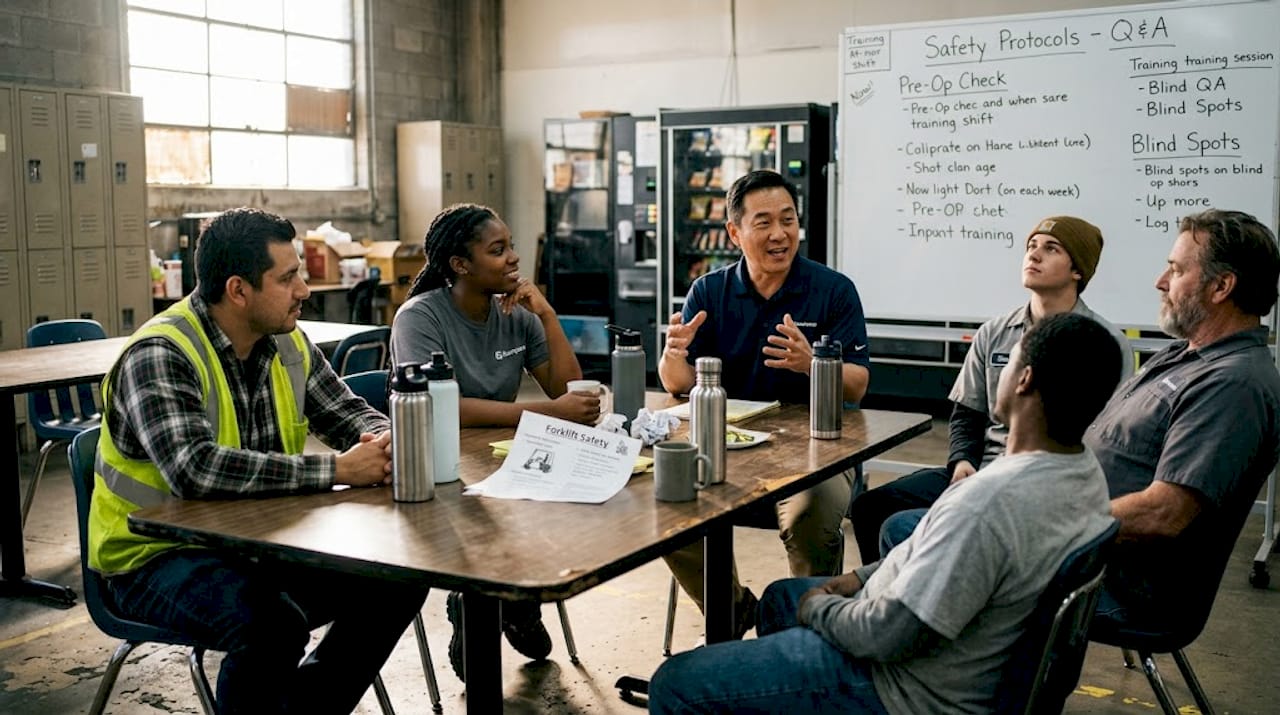
Employees report higher job satisfaction and lower turnover intentions after receiving practical, job-relevant training. This is not surprising. Workers who feel genuinely prepared for their role are more confident, less stressed, and more likely to see a future with your company. Labor turnover data consistently shows that perceived investment in employee development is a top driver of retention in physically demanding industries.
Top retention drivers in warehouse environments:
- Feeling competent and safe on the job from day one.
- Clear career progression tied to certified skill development.
- Visible employer investment in worker wellbeing and training quality.
- Peer recognition from demonstrating mastery in practical settings.
- Reduced workplace injuries that create fear and disengagement.
Hands-on training also builds a stronger safety culture. When workers see that leadership invests in real equipment time and not just a checkbox course, they internalize safety as a shared value rather than a compliance burden. That cultural shift reduces near-misses and encourages workers to speak up about hazards.
Pro Tip: Make hands-on sessions participatory. Encourage operators to ask questions during drills, run scenario exercises where they identify hazards themselves, and debrief as a group. This turns training into a team experience, not a solo test.
For employee-focused hands-on training that sticks, the format matters as much as the content.
Supporting business growth and adaptability
Warehousing and logistics operations rarely stay static. New equipment arrives, workflows change, seasonal surges hit, and business growth demands a workforce that can flex without breaking. Hands-on training is what makes that flexibility possible.
Regular practical training prepares operators for technological changes and equipment upgrades, which matters more as automation and new lift truck models enter the market. An operator who trained hands-on adapts faster to a new machine because they understand how equipment behaves, not just how it looks on a diagram.
| Training type | Adaptability to new equipment | Speed of cross-training | Confidence under pressure |
|---|---|---|---|
| Hands-on training | High | Fast (days to a week) | High |
| Online/lecture only | Low | Slow (weeks) | Low to moderate |
Steps to integrate hands-on training into ongoing workforce development:
- Build a training calendar that schedules hands-on refreshers every six to twelve months, not just at onboarding.
- Cross-train operators on multiple equipment types so you have coverage during absences or surge periods.
- Assign floaters who are certified on all lift truck classes in your facility to cover peak demand without scrambling.
- Tie training milestones to pay grades or advancement opportunities to incentivize participation.
- Partner with a training provider who offers organizing onsite hands-on training at your facility to minimize downtime.
Well-trained floaters are particularly valuable during Q4 surges or contract expansions. Instead of rushing new hires through a compliance checkbox, you have a bench of operators ready to step in safely and productively.
Why most employers underestimate the ROI of hands-on forklift training
Most employers frame hands-on training as a cost center. They see the invoice, the scheduling disruption, and the time pulled from production, and they look for the cheapest compliant option. That framing misses the compounding value entirely.
The biggest return from OSHA-compliant training ROI is not just fewer fines. It is lower insurance premiums over time, a reputation that attracts better hires, reduced equipment repair bills, and a workforce that does not need constant supervision. These savings are real but they accumulate quietly, which is why they get ignored in budget conversations.
We have seen operations where a single avoided forklift incident paid for three years of training costs. The math is not complicated, but it requires thinking past the next quarter. Skimping on hands-on training also erodes internal trust. Workers notice when safety investment is performative. That cynicism spreads, and it shows up in turnover, near-miss underreporting, and a culture where shortcuts feel normal.
The flywheel effect is real: each year of consistent hands-on training builds a more skilled, more confident, and more loyal workforce. That compounds. Employers who treat training as a strategic investment rather than a compliance tax are the ones who scale without incident.
Ready to unlock the benefits of hands-on forklift training?
Hands-on forklift training is not just about checking an OSHA box. It is how you build a safer floor, a more productive team, and a business that can grow without adding risk.
At Forklift Academy, we offer OSHA-compliant forklift training programs designed specifically for logistics and warehouse operations. Whether you need onsite instruction at your facility or a scalable solution for your entire team, our business forklift training certification packages are built to fit your workflow. Explore our full range of forklift certification solutions and put your operators on the path to genuine competency, not just a certificate.
Frequently asked questions
How does hands-on forklift training differ from online-only courses?
Hands-on forklift training includes real equipment practice and direct evaluation by a qualified trainer, while online-only courses cover rules and theory but cannot replicate the physical experience OSHA requires. OSHA-mandated training includes hands-on evaluation components that digital-only programs cannot fulfill on their own.
Is hands-on forklift training required by OSHA?
Yes. OSHA requires practical evaluation for all lift truck operators, meaning employers must document that each worker demonstrated competency on actual equipment, not just completed a written test.
What business risks are reduced by hands-on forklift training?
Practical training lowers accident rates, reduces equipment damage, and protects employers from OSHA fines and civil liability. Documented hands-on training also strengthens your position during audits and post-incident investigations.
Can hands-on training help with new equipment or workflow changes?
Absolutely. Practical training builds readiness for equipment and process changes by giving operators the physical intuition to adapt quickly rather than starting from scratch with every new machine or layout shift.
Recommended
- Hands-On Forklift Training: Real Impact on Safety – Top Osha Forklift Certification
- 7 Key Benefits of OSHA Forklift Training for Warehouses – Top Osha Forklift Certification
- Complete Guide to the Role of Hands-On Forklift Training – Top Osha Forklift Certification
- 7 Advantages of Online Forklift Courses for Managers – Top Osha Forklift Certification