

TL;DR:
- Pallet jack safety involves proper operation, inspection, and maintenance to prevent injuries and ensure OSHA compliance.
- Effective training and organizational protocols are essential for reducing accident risks and maintaining a safe warehouse environment.
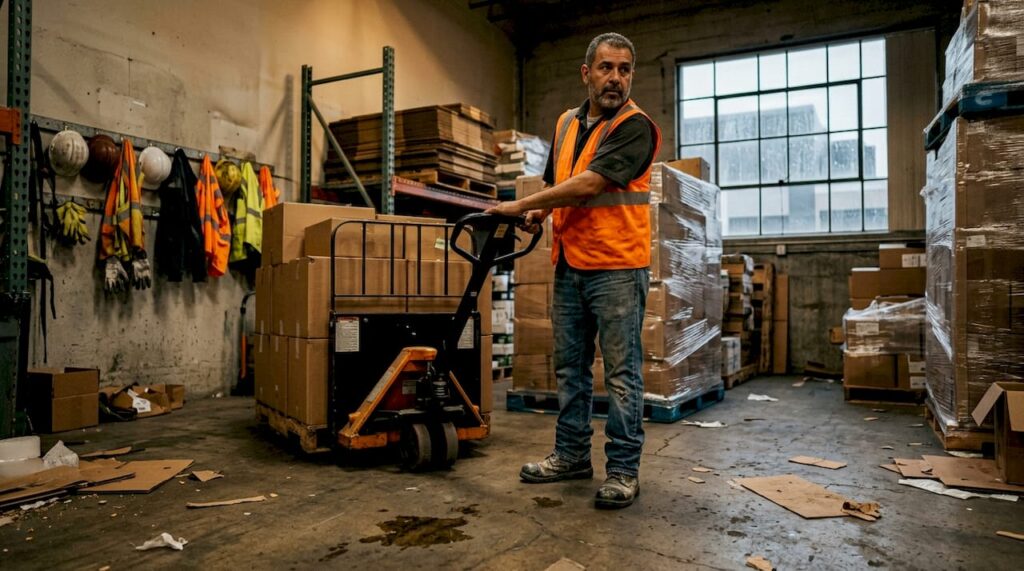
Pallet jack safety is the practice of operating, inspecting, and maintaining pallet jacks to prevent workplace injuries, protect goods, and meet OSHA standards. Understanding why pallet jack safety matters is not optional for warehouse and logistics personnel. Overloading, poor maintenance, and skipping pre-use checks are leading causes of tip-overs and dropped loads that injure workers and damage products. OSHA requires employers to train operators on powered industrial trucks, which includes electric pallet jacks, and violations carry real financial and legal consequences. Safe pallet jack operation is a complete system, not a single rule.
Pallet jack incidents cause injuries that range from crushed toes to severe back damage and, in the worst cases, fatalities. The equipment looks simple, but the physics behind a loaded jack moving across a warehouse floor are not. Overloading and improper load placement are among the most common root causes of tip-overs and dropped loads, both of which injure operators and bystanders.
The financial cost compounds the human cost. Product damage, workers’ compensation claims, OSHA fines, and lost productivity all follow a single preventable incident. Warehouses that treat pallet jack safety as a checkbox exercise pay for that attitude in ways that show up on the balance sheet for years.
Compliance is the third layer. OSHA’s powered industrial truck standard applies to electric pallet jacks, and OSHA pallet jack compliance requires documented training, operator evaluations, and equipment inspections. Ignoring those requirements does not reduce risk. It adds regulatory exposure on top of physical danger.
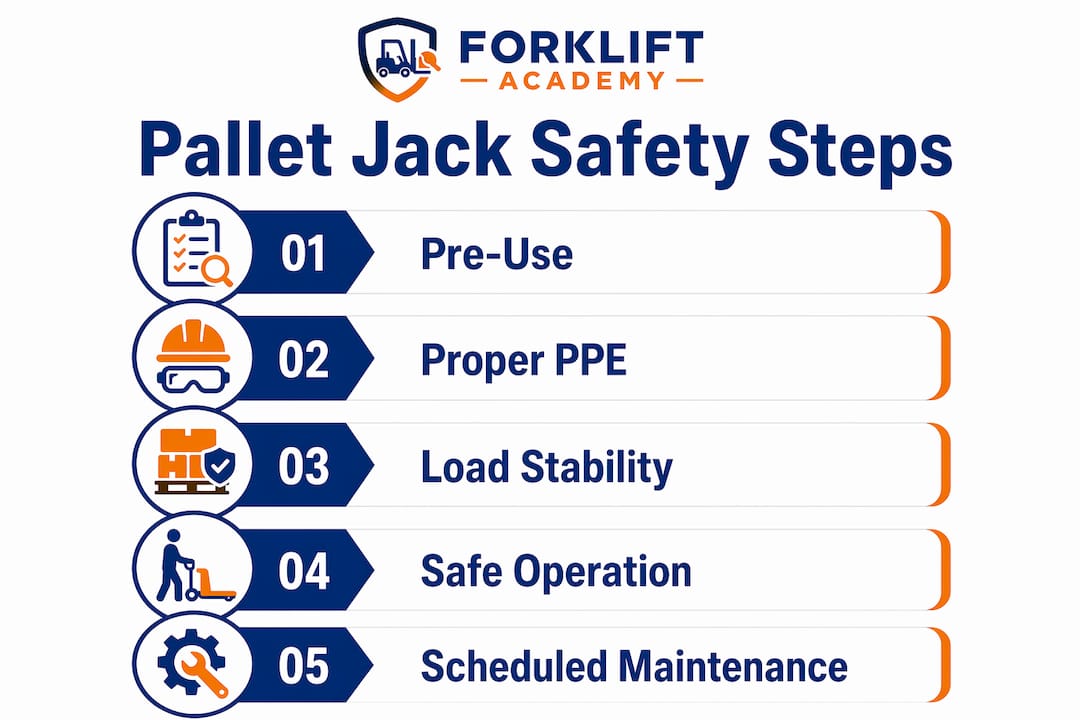
Pallet jack hazards fall into three categories: operator behavior, load management, and equipment condition. Each one can cause a serious incident on its own. When two or three combine, the outcome is almost always worse.
Operator behavior hazards:
Load management hazards:
Equipment condition hazards:
Electric pallet jacks add a specific layer of risk. Battery mismanagement can cause acid leaks, fire hazards, and sudden power loss during operation. Manual jacks carry their own risks, particularly to the back and hands during repeated pumping cycles.
Pro Tip: Wear safety shoes with steel toes, cut-resistant gloves, and high-visibility clothing every shift. Personal protective equipment significantly reduces injury severity when something does go wrong.
Proper technique is the fastest way to cut incident rates without spending a dollar on new equipment. The following steps represent industry best practice for every operator, regardless of experience level.
Always push, never pull. Pulling a pallet jack forces you to walk backward, blocks your line of sight, and puts your back in a mechanically weak position. Pushing keeps you in front of the load, improves visibility, and uses stronger muscle groups. This single habit change reduces back injury risk substantially.
Keep forks low during travel. Forks should stay 1–2 inches off the ground while moving. Traveling with raised forks shifts the load’s center of gravity upward, making the jack far more likely to tip on uneven surfaces or during turns.
Make wide, controlled turns. Sharp turns under load are a primary cause of tip-overs. Slow down before any turn, swing wide, and complete the turn before accelerating again.
Stay within rated capacity. Every pallet jack has a load rating printed on it. Exceeding that rating does not just risk a tip-over. It stresses the frame, degrades the hydraulic system, and shortens the equipment’s service life.
Never ride the jack. Standing on the forks or the chassis during travel is prohibited under OSHA guidelines. If you need to move quickly, walk. The jack is not a vehicle for the operator.
Yield to pedestrians. Pedestrian right-of-way is not a courtesy. It is a safety procedure. Sound the horn at intersections and blind corners, and make eye contact before proceeding.
Pro Tip: Before moving any load, check that it is centered on both forks and stable. An off-center load can shift during travel and tip the jack without warning. Review safe load handling techniques if you are unsure.
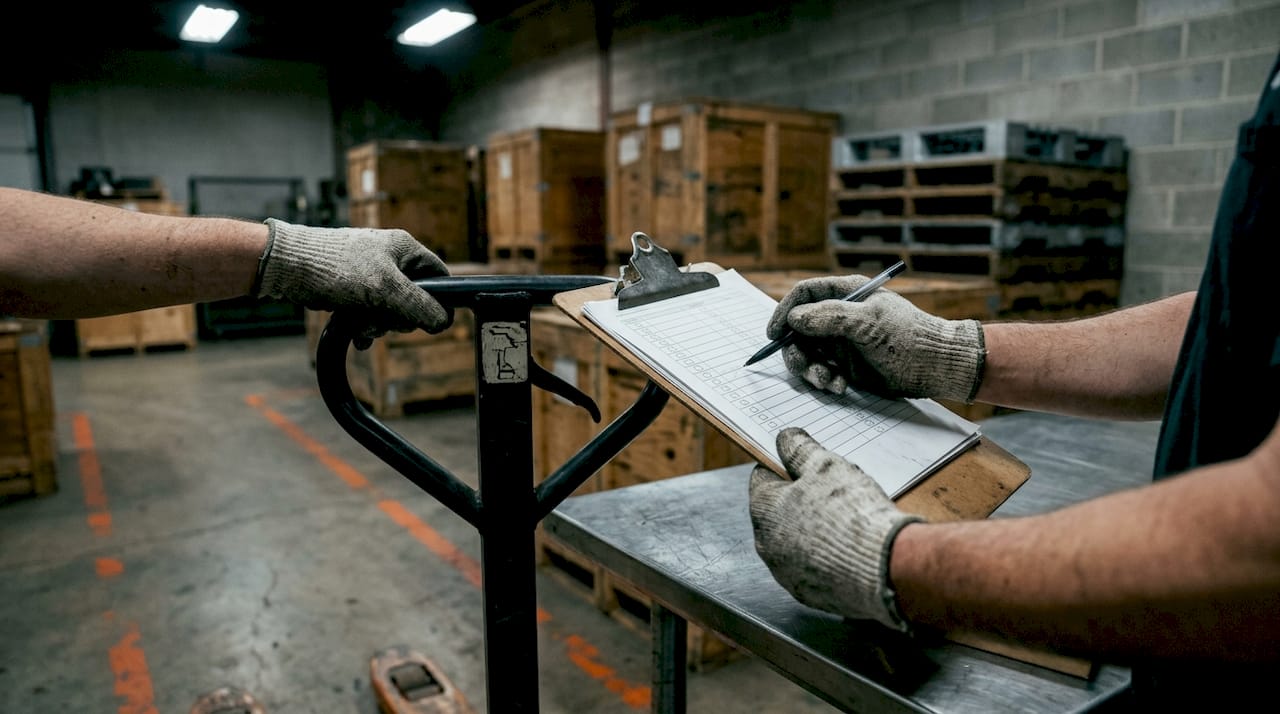
Equipment failure during operation is predictable when inspections are skipped. Pre-use checklists standardize the inspection process at the start of every shift, catching damage or faults before they cause an incident. A cracked fork or a sticky brake discovered at the start of a shift is a maintenance ticket. The same defect discovered mid-operation is an accident.
Daily checks catch visible problems. Scheduled maintenance catches the ones you cannot see. Proper maintenance schedules keep braking and steering reliable over time, reducing the push and pull forces required to operate the jack safely. Hydraulic seals degrade, wheel bearings wear, and brake pads thin out. None of those failures announce themselves before they happen.
| Maintenance task | Frequency | Why it matters |
|---|---|---|
| Visual inspection and controls check | Before every shift | Catches visible damage and control faults |
| Wheel and caster inspection | Weekly | Prevents steering loss and uneven travel |
| Hydraulic fluid check and top-off | Monthly | Maintains lift capacity and smooth operation |
| Full brake system inspection | Quarterly | Prevents brake failure on slopes or under load |
| Battery inspection (electric jacks) | Before every shift | Prevents acid leaks, fire risk, and power loss |
Use the Forkliftacademy pallet jack inspection checklist to standardize this process across your facility. A written record of every inspection also satisfies OSHA documentation requirements.
Individual technique and equipment condition matter, but neither holds up without organizational support. Workplace protocols create the structure that keeps safety consistent across shifts, supervisors, and seasons.
Formal pallet jack safety training ties the entire safety system together. Training programs focused on hazard recognition, load management, and pedestrian safety reduce incidents and improve compliance across the board. Operators who understand why a rule exists follow it more consistently than those who only know what the rule says.
Effective workplace protocols include:
Near-miss reporting deserves special attention. Most warehouses track injuries. Far fewer track near-misses, which are statistically the best predictor of future injuries. A near-miss report is free information about a hazard that has not yet caused harm. Treating it as a learning opportunity rather than a paperwork burden changes the safety culture of a facility.
Audit programs reinforce protocols. A monthly walk-through that checks for proper PPE use, correct load heights during travel, and current inspection records gives supervisors real data. That data drives targeted retraining rather than blanket refresher courses that waste time for experienced operators.
Pallet jack safety requires correct operation technique, disciplined pre-use inspections, and organizational training to prevent injuries and maintain OSHA compliance.
| Point | Details |
|---|---|
| Push, never pull | Pushing keeps your line of sight clear and protects your back from injury. |
| Inspect before every shift | Use a standardized checklist to catch forks, brake, and hydraulic faults before they cause accidents. |
| Stay within rated capacity | Overloading is a leading cause of tip-overs and accelerated equipment wear. |
| Train and retrain operators | Formal training improves hazard recognition and builds consistent safe habits across your team. |
| Report near-misses | Near-miss data identifies hazards before they become injuries, making it the most cost-effective safety tool available. |
Pallet jack safety is treated as a list of rules in most facilities. Post the capacity. Wear the boots. Don’t ride the jack. Those rules are correct, but they miss the point. Safety on a loaded pallet jack is a physics problem first and a compliance problem second.
The center of gravity on a loaded jack changes with every different pallet. A tall, narrow load on a standard jack behaves completely differently than a wide, flat load at the same weight. Operators who understand load geometry make better decisions in real time. Operators who only memorize rules freeze when the situation does not match the rule they were taught.
Maintenance is the part that gets cut first when a facility is busy. I have seen warehouses where the inspection checklist exists on paper but nobody checks whether it is actually completed. The result is predictable. Brakes degrade quietly, wheels flatten, and hydraulic seals weep fluid until one shift the jack does not stop where it should. That is not bad luck. That is deferred maintenance presenting its invoice.
Training elevates judgment, but only when the organization backs it up. An operator who completes a certified course and returns to a facility with no travel routes, no near-miss reporting, and no enforcement of load limits will revert to the surrounding culture within weeks. The training investment pays off only when the workplace protocols match what the training taught.
The facilities with the best safety records treat pallet jack safety as a system. Operator skill, equipment condition, and organizational structure all have to work together. Pull any one of them out and the other two are not enough.
— Juiced
Your team’s safety depends on more than good intentions. It depends on verified, documented training that meets OSHA requirements and builds real operator competence.
Forkliftacademy delivers OSHA-compliant training programs for pallet jack and forklift operators across the United States and Canada, with over 20 years of industry experience behind every course. Options include online certification, onsite training at your facility, and a train-the-trainer program that lets your own staff certify new operators going forward. Whether you need to certify one operator or build a facility-wide compliance program, Forkliftacademy has a format that fits your operation. Get your team certified and keep your workplace on the right side of OSHA.
Pallet jack safety is the practice of operating, inspecting, and maintaining pallet jacks to prevent injuries, protect loads, and comply with OSHA standards. It covers correct technique, pre-use checks, load management, and operator training.
Always push a pallet jack. Pulling forces you to walk backward, blocks your view, and significantly increases the risk of back injury and being run over by the load.
A pallet jack should be inspected before every shift using a standardized checklist. Scheduled maintenance checks for brakes, hydraulics, and wheels should occur weekly, monthly, or quarterly depending on the component.
OSHA’s powered industrial truck standard requires documented training and operator evaluation for electric pallet jacks. Employers must certify operators and keep training records on file.
Operators should wear steel-toed safety shoes, cut-resistant gloves, and high-visibility clothing. This PPE reduces injury severity during tip-overs, dropped loads, and foot-contact incidents.